Within Triangulation
Odd on screen is not odd in the sky
A strange-looking 2D camera track may become ordinary once distance, altitude, and speed are measured.
On this page
- What image plane motion can and cannot prove
- Why distance changes apparent speed
- How triangulation turns outliers into testable tracks
Page outline Jump by section
Introduction
Automated instrumented UFO or UAP detectors are designed to find unusual observations, not to assume that every unusual observation represents an unusual object. A track that looks exceptional in a single camera can become entirely ordinary once its distance is measured. This is because a lone optical station records only where an object appears on the image plane, not how far away it is. Without range, estimates of speed, altitude, size and acceleration are largely inferred rather than measured. Multi-site triangulation exists precisely to resolve this ambiguity by converting two-dimensional image tracks into three-dimensional positions with quantified uncertainty. NASA’s independent UAP study highlighted the need for calibrated, multi-sensor observations because isolated sightings often lack the information needed to place reliable physical constraints on an event.[arXiv]arxiv.orgThe Scientific Investigation of Unidentified Aerial Phenomena (UAP) Using Multimodal Ground-Based ObservatoriesMay 29, 2023…

What image-plane motion can and cannot prove
A camera converts the three-dimensional sky into a flat image. Every detection is reduced to a changing pixel position or an angular direction. Even with excellent tracking software, a single station cannot determine where along that viewing direction the object actually is.
This limitation creates an important distinction between an observational outlier and a physical outlier. A detection may look unusual because:
- it crosses the field of view rapidly;
- it appears to reverse direction;
- it follows an unexpected curve;
- it brightens or dims abruptly.
None of these observations alone determines whether the object itself performed an extraordinary manoeuvre. The same image-plane behaviour can arise from widely different physical situations, including a nearby insect passing close to the lens, a bird changing direction, a drone at moderate range, an aircraft at cruising altitude, or a satellite hundreds of kilometres away. Without distance, the camera records only angular motion rather than true motion through space.[arXiv+2Geodetic Systems]arxiv.orgThe Scientific Investigation of Unidentified Aerial Phenomena (UAP) Using Multimodal Ground-Based ObservatoriesMay 29, 2023…
For automated detection systems this distinction is crucial. Algorithms are intentionally tuned to identify statistical outliers so that nothing potentially interesting is missed. Being flagged as an outlier therefore means “different from the background population”, not “physically anomalous”.
Why distance changes apparent speed
The same angular movement corresponds to vastly different physical velocities depending on range.
Imagine two objects each moving across one degree of sky in one second. If one object is only 100 metres away while the other is 10 kilometres distant, their true sideways speeds differ by roughly two orders of magnitude despite producing nearly identical camera tracks.
The opposite effect also occurs. A nearby object can sweep rapidly across a camera’s field of view while moving quite slowly in reality. Small insects close to wide-angle lenses are a familiar example. Conversely, satellites move at orbital velocities approaching several kilometres per second yet often appear to drift smoothly because they are extremely distant.
This relationship means that every estimate of:
- velocity,
- acceleration,
- object size,
- turning radius, or
- energy requirements
depends directly on knowing the object’s range first. If the assumed distance is wrong by a factor of ten, many derived quantities become wrong by similar or even larger factors. This is one reason that apparent “impossible acceleration” claims based solely on a single optical recording require careful scrutiny before being interpreted as evidence of unusual flight behaviour.[Geodetic Systems+2Wikipedia]geodetic.comGeodetic SystemsBasics of PhotogrammetryThe fundamental principle used by photogrammetry is triangulation. By taking photographs from at…
How triangulation turns outliers into testable tracks
Adding a second synchronised observing station changes the problem fundamentally.
Instead of one line of sight extending indefinitely into space, two calibrated cameras provide two independent viewing rays. Their geometry constrains where the object can actually be located. Rather than inferring distance from appearance, analysts estimate it directly from intersecting sightlines while accounting for measurement uncertainty.
Once successive positions are reconstructed in three dimensions, the system can calculate:
- altitude;
- ground track;
- true velocity;
- climb or descent rate;
- acceleration; and
- uncertainty for every measurement.[isprs.org]isprs.orgdelay systems can achieve relatively low measurement uncertainty fact…
At this point an apparent anomaly becomes a quantitative hypothesis that can be compared with known aircraft performance, balloon drift, satellite ephemerides, meteor trajectories or atmospheric effects. Many detections that initially looked exceptional in two dimensions become compatible with ordinary aerial traffic once their real geometry is established. Conversely, if a track remains unusual after distance has been independently measured, it becomes substantially more worthy of further investigation because its kinematics no longer depend on guesswork.[arXiv+2conference.sdo.esoc.esa.int]arxiv.orgThe Scientific Investigation of Unidentified Aerial Phenomena (UAP) Using Multimodal Ground-Based ObservatoriesMay 29, 2023…
Distance measurement introduces its own quality checks
Triangulation is not simply “using two cameras”. Reliable reconstruction requires the observing network itself to pass several consistency tests.
If the cameras are accurately calibrated and time-synchronised, reconstructed positions from multiple frames should form a physically plausible trajectory. Large inconsistencies often indicate more ordinary problems such as:
- mismatched targets between stations;
- timing errors;
- inaccurate camera pointing;
- lens calibration errors;
- insufficient baseline between observing sites.
Modern photogrammetry and computer vision therefore treat triangulation together with uncertainty estimation rather than assuming every pair of viewing rays intersects perfectly. Real systems estimate the most probable position while propagating calibration and measurement errors through the solution. This makes the resulting three-dimensional track scientifically testable instead of visually persuasive.[arXiv+2mrcal.secretsauce.net]arxiv.orgarXiv Optimal Triangulation Method is Not Really OptimalOptimal Triangulation Method is Not Really OptimalJuly 9, 2021 — by SM Nasiri · 2021 · Cited by 11 — Abstract Triangulation refers t…

Why automated UFO detectors should treat 2D outliers as the beginning, not the end
An automated observatory benefits from flagging unusual image tracks early because unusual observations deserve additional measurements. However, the classification pipeline should separate “visually unexpected” from “physically unexplained”.
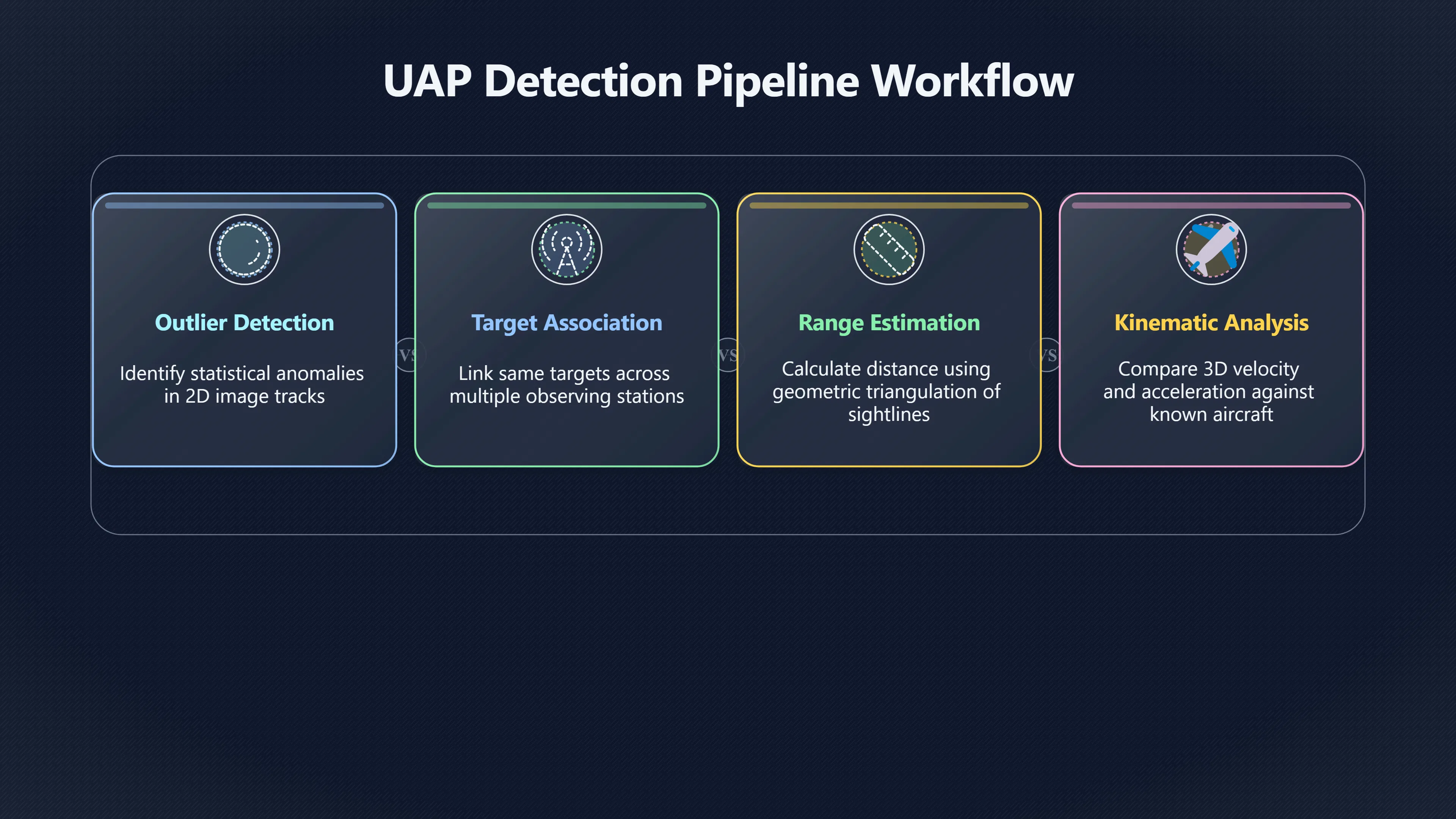
A robust workflow therefore follows a progression:
- Detect statistical outliers in image-space behaviour.
- Attempt multi-station association of the same target.
- Estimate range through triangulation.
- Reconstruct the three-dimensional trajectory.
- Compare measured kinematics against known classes of objects.
This sequence reduces false positives while preserving genuinely unusual cases for closer examination. Rather than dismissing odd-looking tracks or accepting them as extraordinary, the system asks the more scientific question: what happens to this outlier once its distance is known?
Within automated instrumented UAP detection, that distinction is essential. A strange-looking path on a screen is evidence that merits measurement—not evidence, by itself, that the object in the sky behaved in an extraordinary way.
Amazon book picks
Further Reading
Books and field guides related to Odd on screen is not odd in the sky. Use these as the next step if you want deeper reading beyond the article.

UFOs : Generals, Pilots, and Government Officials Go on the R...
Context for evidence standards in UAP research.


eBay marketplace picks
Marketplace Samples
Example marketplace items related to this page. Use the search link to explore similar finds on eBay.



Endnotes
1.
Source: arxiv.org
Link:https://arxiv.org/abs/2305.18566
Source snippet
The Scientific Investigation of Unidentified Aerial Phenomena (UAP) Using Multimodal Ground-Based ObservatoriesMay 29, 2023...
Published: May 29, 2023
2.
Source: conference.sdo.esoc.esa.int
Link:https://conference.sdo.esoc.esa.int/proceedings/sdc9/paper/335
Source snippet
Triangulation of Space-based Optical Measurements for...While this methodology is well assessed in the literature for ground-based senso...
3.
Source: geodetic.com
Link:https://www.geodetic.com/basics-of-photogrammetry/
Source snippet
Geodetic SystemsBasics of PhotogrammetryThe fundamental principle used by photogrammetry is triangulation. By taking photographs from at...
4.
Source: Wikipedia
Title: Triangulation (computer vision)
Link:https://en.wikipedia.org/wiki/Triangulation_%28computer_vision%29
5.
Source: Wikipedia
Link:https://en.wikipedia.org/wiki/Triangulation
6.
Source: arxiv.org
Title: arXiv Absolute Triangulation Algorithms for Space Exploration
Link:https://arxiv.org/abs/2205.12197
7.
Source: mrcal.secretsauce.net
Title: Triangulation methods and uncertainty
Link:https://mrcal.secretsauce.net/triangulation.html
Source snippet
methods and uncertainty - mrcalEach triangulation operation takes as input Two camera models. Intrinsics (lens behavior) and extrinsics (...
8.
Source: arxiv.org
Title: arXiv Optimal Triangulation Method is Not Really Optimal
Link:https://arxiv.org/pdf/2107.04618
Source snippet
Optimal Triangulation Method is Not Really OptimalJuly 9, 2021 — by SM Nasiri · 2021 · Cited by 11 — Abstract Triangulation refers t...
Published: July 9, 2021
9.
Source: arxiv.org
Link:https://arxiv.org/pdf/2306.04516
Source snippet
Scientific Perspectivesby R Dodson · 2023 · Cited by 3 — This development would bring order of magnitude improvements of sensitivity and...
10.
Source: isprs.org
Link:https://isprs.org/proceedings/XXXV/congress/comm5/papers/188.pdf
Source snippet
delay systems can achieve relatively low measurement uncertainty fact...
Additional References
11.
Source: cris.fbk.eu
Link:https://cris.fbk.eu/retrieve/ddb241a5-6766-ba8a-e053-3a05fe0afd55/Towardsreal-timelargescaleunderwaterphotogrammetryforsubseametrologyapplications_PID5934751.pdf
Source snippet
real-time underwater photogrammetry for subsea...by C SA · Cited by 33 — This solution guarantees that 3D points are triangulated with a...
12.
Source: amsdottorato.unibo.it
Link:https://amsdottorato.unibo.it/id/eprint/9489/1/Chiara%20Francolini_PhD%20Thesis_XXXIII_AMS.pdf
Source snippet
Francolini_PhD Thesis_XXXIII_AMSThey are the fundamental of the photogrammetry and are used for example in the spatial intersection, spac...
13.
Source: ccatobservatory.org
Link:https://www.ccatobservatory.org/papers/
14.
Source: youtube.com
Link:http://www.youtube.com/watch?v=mvsU4p0Gsas
Source snippet
FULL Senate Hearing | Dr. Jon T. Kosloski Testifies UAPs Armed Services Subcommittee (Nov. 19, 2024)...
15.
Source: youtube.com
Title: Replay! NASA’s Release of the Unidentified Anomalous Phenomena Report
Link:http://www.youtube.com/watch?v=nuBMnluJfs0
Source snippet
NASA UAP independent study meeting Public Meeting on Unidentified Anomalous Phenomena (Official NASA Broadcast)...
16.
Source: bartol.udel.edu
Title: 3 Triangulation and Parallax
Link:https://www.bartol.udel.edu/~owocki/phys133/3%20-%20Triangulation%20and%20Parallax.pdf
Source snippet
udel.eduPHYS133 – Lab 3 Triangulation and ParallaxThis lab consists of two parts, a practical use of triangulation on land to measure the...
17.
Source: youtube.com
Title: Public Meeting on Unidentified Anomalous Phenomena (Official NASA Broadcast)
Link:http://www.youtube.com/watch?v=bQo08JRY0iM
Source snippet
Breaking Down UAP Footage with the Head of The Pentagon’s UAP Taskforce, Dr. Jon Kosloski...
18.
Source: ietresearch.onlinelibrary.wiley.com
Link:https://ietresearch.onlinelibrary.wiley.com/doi/10.1049/ipr2.12831
Source snippet
optimal triangulation method is not really optimal22 May 2023 — The results show that the optimal triangulation method is actually not th...
Published: May 2023
19.
Source: ui.adsabs.harvard.edu
Link:https://ui.adsabs.harvard.edu/abs/2025jwst.prop.8007T/abstract
Source snippet
A Tielens · 2025 — JavaScript is disabled. In order to continue, we need to verify that you're not a robot. This requires JavaScript. Ena...
20.
Source: youtube.com
Link:http://www.youtube.com/watch?v=rMnvrmZf2Mc
Source snippet
Sky360 UAP Tracking Project v1promo...
Topic Tree