Within Hessdalen
Why Ordinary Lights Had to Be Hidden
Masking roads and houses showed how local geography can keep ordinary lights from overwhelming an automated UFO detector.
On this page
- Roads houses and local light pollution
- How image masks reduced bad triggers
- What local knowledge adds to automation
Page outline Jump by section
Introduction
One of the most practical lessons from the Hessdalen Automatic Measurement Station was not about mysterious lights at all. It was about preventing ordinary lights from being mistaken for unusual phenomena. As the station operated night after night, researchers discovered that roads, houses, vehicles, and other local light sources could repeatedly trigger alarms if they remained inside the camera’s analysis area. The solution was simple but important: parts of the camera image were deliberately hidden from the detection software. By masking known sources of interference, the system could focus on the sky and valley areas where genuinely unusual events were more likely to appear. This experience became an early example of a principle now central to automated UFO and UAP monitoring: a detector is only as good as its ability to reject false alarms.[Project Hessdalen]hessdalen.orgProject HessdalenAMSThis page is updated whenever a new alarm picture comes from the station. Most of these pictures are false alarms, wh…

Roads, Houses and Local Light Pollution
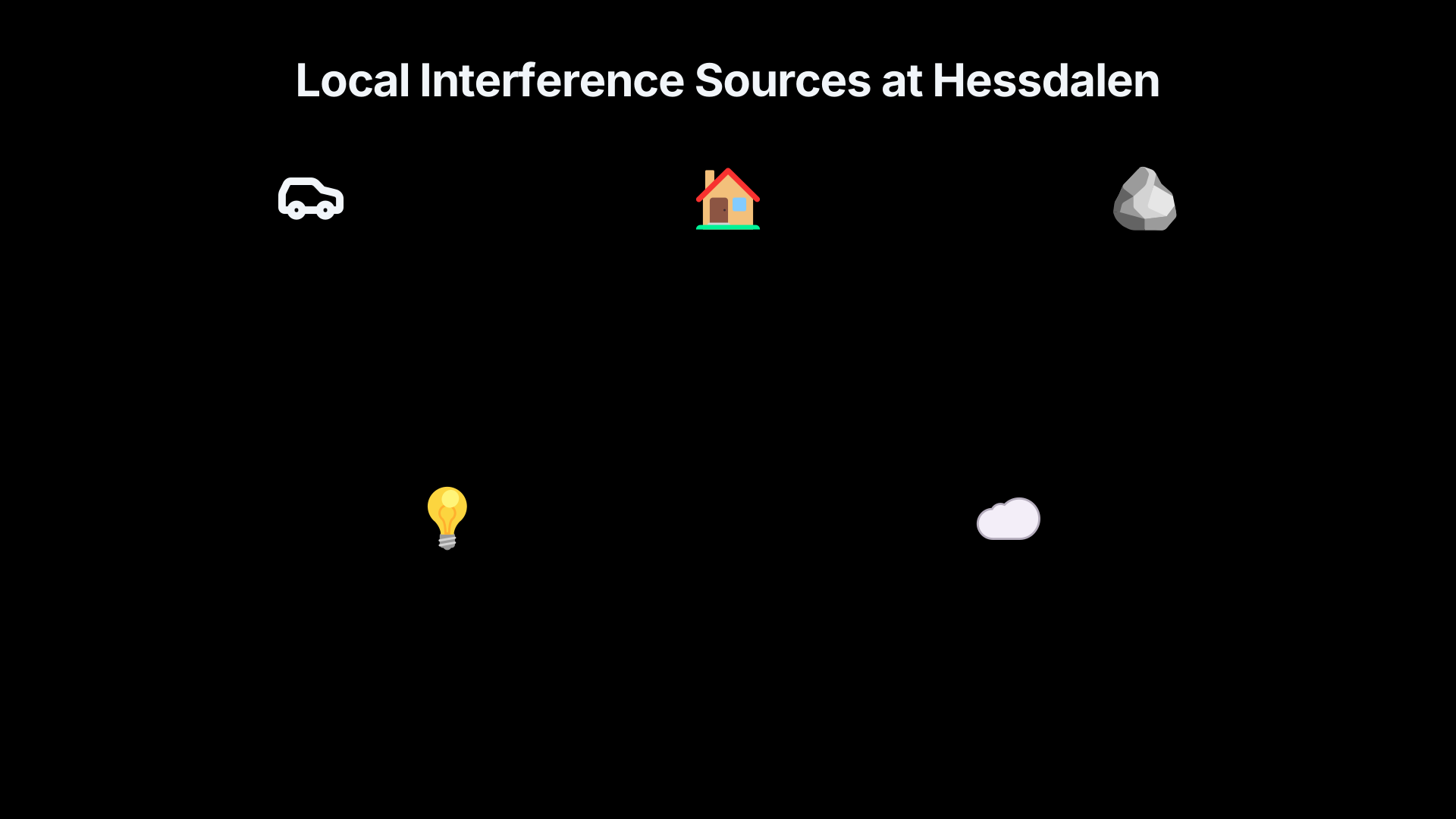
The Hessdalen monitoring station was designed to watch a valley where reports of luminous phenomena had often been made near mountain slopes, above the valley floor, and sometimes even close to houses. That geography created a challenge. The same landscape that produced reports also contained ordinary human activity: illuminated buildings, vehicle headlights, distant traffic, and changing lighting conditions.[Hessdalen Project]old.hessdalen.orgHessdal article2000.shtmlHessdalen ProjectProject Hessdalen18 Mar 1983 — Yellow or yellow-white lights. These lights have very often been seen in the valley, just…
Researchers quickly learned that an automated system cannot rely on the common sense that a human observer uses. A person familiar with the valley might instantly recognise a car climbing a road or a light from a farmhouse. A computer analysing brightness changes in a video frame may simply register “new light detected”.
The station therefore incorporated image masks. A published AMS alarm page shows that the computer did not analyse the entire camera image. Areas marked in red on the mask were excluded from automatic processing. These excluded regions corresponded to locations known to generate nuisance detections or irrelevant activity.[Project Hessdalen]hessdalen.orgProject HessdalenAMSThis page is updated whenever a new alarm picture comes from the station. Most of these pictures are false alarms, wh…
The significance of this design choice is easy to overlook. The mask was not intended to help discover anomalies. It was intended to stop known, ordinary lights from overwhelming the system.
How Image Masks Reduced Bad Triggers
The Hessdalen alarm archive explicitly notes that most alarm pictures turned out to be false alarms for which an immediate explanation could be found. Only a smaller subset required further investigation.[Project Hessdalen]hessdalen.orgProject HessdalenAMSThis page is updated whenever a new alarm picture comes from the station. Most of these pictures are false alarms, wh…
Image masking helped manage this problem through several mechanisms:
- Removal of fixed light sources. Buildings, outdoor lamps and other predictable lights could be excluded from analysis.
- Reduction of vehicle-related triggers. Roads often generate moving light patterns from headlights, reflections and changing viewing angles. Masking road corridors prevented these routine events from repeatedly activating the system.
- Protection against environmental clutter. Nearby terrain features can produce reflections, shadows and contrast changes that are visually dramatic but uninteresting from a detection standpoint.
- Lower processing burden. By analysing only selected regions, the software could devote attention to areas of genuine interest rather than continuously evaluating known noise sources.
In effect, the mask function acted as a geographical filter. Instead of asking whether every bright object was unusual, the system first asked whether the object appeared in a region where ordinary explanations were already expected.
This approach resembles modern machine-vision practice. Contemporary surveillance systems, wildlife cameras and astronomical observatories routinely define exclusion zones before detection algorithms are allowed to operate. Hessdalen adopted a similar principle decades earlier for a specialised sky-monitoring task.[Project Hessdalen]hessdalen.orgProject HessdalenAMSThis page is updated whenever a new alarm picture comes from the station. Most of these pictures are false alarms, wh…
Why the Solution Was Deliberately Local
An important feature of the Hessdalen masks is that they were tied to a specific observing site.
The excluded areas were not based on a universal rule about what a UFO or UAP should look like. They were based on detailed knowledge of the local landscape. Researchers knew where roads were located, where houses stood, and which parts of the valley routinely produced misleading signals. That local knowledge was translated directly into software behaviour.[Project Hessdalen]hessdalen.orgProject HessdalenAMSThis page is updated whenever a new alarm picture comes from the station. Most of these pictures are false alarms, wh…
This reveals a broader truth about automated anomaly detection. False alarms are often highly location-dependent. A detector placed in a desert, on a coastline, near an airport or in a populated valley will encounter different sources of confusion. Effective filtering therefore requires site-specific understanding rather than generic assumptions.
What Local Knowledge Adds to Automation
The Hessdalen experience demonstrates that automation does not eliminate the need for human expertise. Instead, expertise is often embedded into the system before it begins operating.
Without local knowledge, an automated detector may generate impressive numbers of alerts while providing little useful information. Every vehicle, lamp, aircraft reflection or environmental artefact becomes another event requiring review. With local knowledge incorporated into masks and exclusion zones, the detector becomes more selective and its alarms become more meaningful.[Project Hessdalen]hessdalen.orgProject HessdalenAMSThis page is updated whenever a new alarm picture comes from the station. Most of these pictures are false alarms, wh…
For automated UFO and UAP observatories, this lesson remains highly relevant. The challenge is not merely detecting unusual lights. It is distinguishing them from the countless ordinary lights that appear unusual when viewed through a camera at night. Hessdalen showed that one of the most effective ways to improve data quality is often the least glamorous: carefully mapping the local environment and teaching the software what to ignore.
The Lasting Lesson for Automated UFO Detectors
The masks used at Hessdalen illustrate a fundamental engineering principle. A successful detector is not defined solely by what it can see; it is also defined by what it intentionally refuses to see.
By hiding roads, houses and other predictable sources of illumination from automated analysis, the Hessdalen station reduced unnecessary triggers and improved the value of the events that remained. The result was not a perfect system—false alarms still occurred—but it was a more disciplined one.[Project Hessdalen]hessdalen.orgProject HessdalenAMSThis page is updated whenever a new alarm picture comes from the station. Most of these pictures are false alarms, wh…
For modern instrumented UFO detection projects, the lesson is straightforward. Before sophisticated algorithms, artificial intelligence or multi-sensor fusion can be useful, the observing system must first understand its own surroundings. Hessdalen’s image masks turned local geographical knowledge into a practical filtering tool, showing that the path to better anomaly detection often begins with carefully excluding the ordinary.[Project Hessdalen]hessdalen.orgProject HessdalenAMSThis page is updated whenever a new alarm picture comes from the station. Most of these pictures are false alarms, wh…
Amazon book picks
Further Reading
Books and field guides related to Why Ordinary Lights Had to Be Hidden. Use these as the next step if you want deeper reading beyond the article.
The Hynek UFO Report
Explores how reports are classified, investigated, and filtered, paralleling the problem of eliminating false detections.

UFOs : Generals, Pilots, and Government Officials Go on the R...
Covers the challenge of investigating unusual aerial reports using evidence rather than assumptions, aligning with discussions of false a...
Passport to Magonia
Provides broader context for interpreting unusual reports and understanding how observations can be influenced by environment and percept...
The UFO Enigma
Focuses on evaluating observational evidence and distinguishing genuine anomalies from ordinary explanations.
eBay marketplace picks
Marketplace Samples
Example marketplace items related to this page. Use the search link to explore similar finds on eBay.

Endnotes
1.
Source: hessdalen.org
Link:https://hessdalen.org/station/alarm.shtml
Source snippet
Project HessdalenAMSThis page is updated whenever a new alarm picture comes from the station. Most of these pictures are false alarms, wh...
2.
Source: old.hessdalen.org
Title: Hessdal article2000.shtml
Link:https://old.hessdalen.org/reports/Hessdal-article2000.shtml
Source snippet
Hessdalen ProjectProject Hessdalen18 Mar 1983 — Yellow or yellow-white lights. These lights have very often been seen in the valley, just...
Additional References
3.
Source: Wikipedia
Link:https://en.wikipedia.org/wiki/Hessdalen_lights
Source snippet
Hessdalen lightsThe Hessdalen lights are unidentified lights which have been observed in a 12-kilometre-long (7.5 mi) stretch of the H...
4.
Source: medium.com
Link:https://medium.com/%40krindiri/six-minds-one-valley-one-big-mistery-remote-viewing-the-famous-hessdalen-lights-bca46c64c9a8
Source snippet
Remote Viewing the famous Hessdalen LightsProject Hessdalen operates an automated measurement station in the valley. The lights have been...
5.
Source: facebook.com
Title: the hessdalen lights have stumped scientists for 40 yearsin a remote valley in n
Link:https://www.facebook.com/61583174895936/videos/the-hessdalen-lights-have-stumped-scientists-for-40-yearsin-a-remote-valley-in-n/1607905727171889/
Source snippet
The Hessdalen Lights Have Stumped Scientists for 40 Years...May 2025, something moved through their camera field so fast it appeared in...
Published: May 2025
6.
Source: discoveryuk.com
Title: hessdalen lights natural phenomenon or extraterrestrial signals
Link:https://www.discoveryuk.com/mysteries/hessdalen-lights-natural-phenomenon-or-extraterrestrial-signals/
Source snippet
Hessdalen Lights: Natural Phenomenon or Extraterrestrial...18 Sept 2023 — The Hessdalen lights are a series of illuminations that are sa...
7.
Source: researchgate.net
Link:https://www.researchgate.net/publication/303885782_Benefit_of_large_field-of-view_cameras_for_visual_odometry
Source snippet
The experiments point out that it is advantageous to use a large FoV camera (e.g....Read more...
8.
Source: naturphilosophie.co.uk
Title: The Hessdalen Light Phenomenon, Norway
Link:https://naturphilosophie.co.uk/2023/05/07/identifying-the-unidentified-the-hessdalen-light-phenomenon-norway/
Source snippet
7 May 2023 — The Hessdalen light phenomenon started in late 1981, when local people reported seeing lights down the valle...
Published: May 2023
9.
Source: blogs.egu.eu
Link:https://blogs.egu.eu/geolog/2014/05/19/imaggeo-on-mondays-light-fantastic-flashing-phenomena-in-norways-night-sky/
Source snippet
fantastic – flashing phenomena in Norway's night sky19 May 2014 — Towards the north, the night sky over Hessdalen Valley in Norway is col...
Published: May 2014
10.
Source: facebook.com
Link:https://www.facebook.com/upsocltheenigma/posts/who-left-the-light-on-in-the-hessdalen-valley-in-norway-an-inexplicable-light-wa/1372382794929365/
Source snippet
In the Hessdalen valley in Norway...... automated measurement station as well, that included an impressive amount of technical gear. Th...
11.
Source: youtube.com
Link:https://www.youtube.com/watch?v=D3NSbpG1G9k
Source snippet
Norway. Scientists have studied them with cameras, [radar]({{ 'radar/' | relative_url }}), and...
12.
Source: discovery.ucl.ac.uk
Title: manuscript low res
Link:https://discovery.ucl.ac.uk/id/eprint/10162239/1/manuscript_low_res.pdf
Source snippet
Primal-Dual Networks for Lensless Camerasby O Kingshott · 2022 · Cited by 33 — We propose to replace classical lensless reconstruction me...
Topic Tree