Within Provenance
Why the raw file matters most
Processed UAP clips can help reviewers see an event quickly, but raw files are what let later analysts test what really changed.
On this page
- What cropping and compression can hide
- How raw, processed and interpreted layers differ
- When a shareable clip stops being evidence
Page outline Jump by section
Introduction
Automated instrumented UAP detectors often produce two versions of the same event: an original sensor recording and a processed clip designed for rapid human review. The processed version may be easier to watch, but it should never replace the original. Once cropping, compression, stabilisation, contrast enhancement or object tracking have been applied, some of the information needed for later scientific or forensic analysis may be permanently lost.
 For systems intended to generate credible evidence rather than merely interesting footage, the raw recording is the primary record. Processed clips are useful derivative products that help people locate and understand an event, but they should always remain traceable back to an unchanged original with documented processing steps. This distinction reflects standard practice in digital forensics and aligns with broader recommendations that UAP investigations depend on well-calibrated sensors, complete metadata and reproducible analysis rather than visually persuasive video alone.[NASA Science+2arXiv]science.nasa.govScience Independent Study Team ReportNASA ScienceIndependent Study Team ReportSeptember 13, 2023 — At present, analysis of UAP data is hampered by poor sensor calibration, th…
What cropping and compression can hide
Most image processing is intended to improve visibility for human viewers, not preserve measurement quality. A reviewer may legitimately crop a frame around an apparent object or increase contrast to make a faint target easier to see. Those edits, however, can remove information that later proves essential.
Cropping changes the observational context. It may eliminate landmarks needed to reconstruct viewing geometry, remove stars required for astrometric calibration, or hide aircraft lights, clouds or other reference objects that would help identify the event. A tightly cropped object can appear to move dramatically when the wider scene would reveal that the apparent motion was caused by camera movement.
Compression introduces a different problem. Modern codecs discard image information to reduce file size. Fine detail, sensor noise patterns, subtle gradients and compression artefacts become mixed together, making later analysis more difficult. A feature that appears significant in a compressed clip may be created or exaggerated by the encoding process itself, while genuine weak signals may disappear altogether. Video forensic research has shown that metadata and encoding characteristics can also reveal whether a file has been edited or re-exported, but repeated processing reduces the value of those forensic indicators.[arXiv]arxiv.orgarXiv Forensic Analysis of Video Files Using MetadataarXiv Forensic Analysis of Video Files Using Metadata
Other common processing steps can also alter evidential value:
- Image stabilisation changes pixel positions relative to the original sensor output.
- Frame interpolation inserts synthetic frames that never existed at capture time.
- Noise reduction may erase faint stars or distant objects.
- Sharpening can create artificial edges.
- False-colour rendering changes the relationship between pixel values and measured sensor intensity.
None of these techniques is inherently improper, provided they are documented and never overwrite the original recording.
How raw, processed and interpreted layers differ
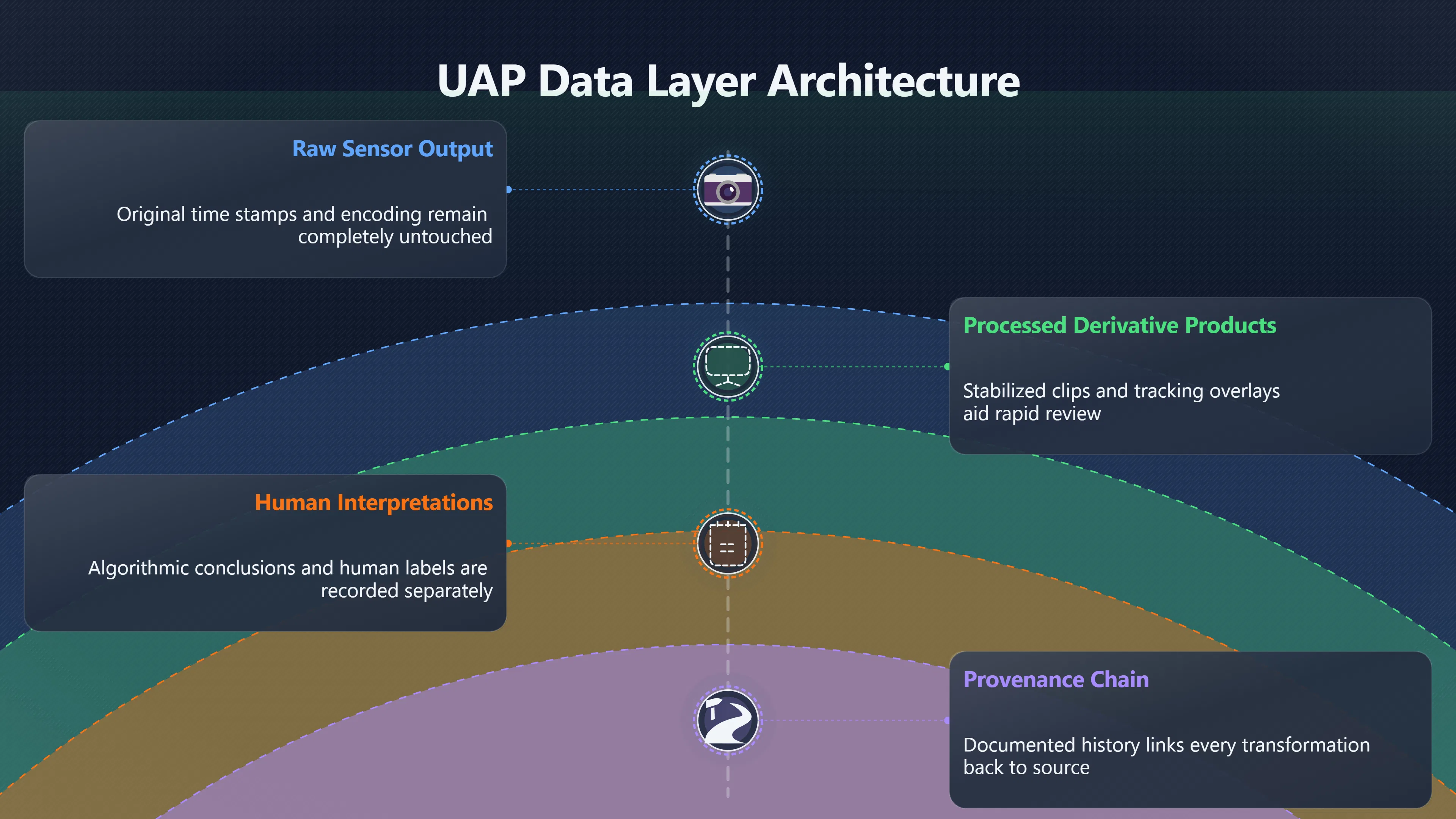
A robust automated UAP detection system should treat every event as three distinct but connected layers rather than a single video file.
Raw layer. This is the direct sensor output with its original timestamps, metadata and encoding. It represents what the instrument actually recorded and should be preserved without modification.
Processed layer. This contains derivative products created to improve usability. Examples include cropped review clips, stabilised videos, annotated images, brightness-adjusted frames or machine-generated tracking overlays. These products are valuable because they allow analysts to examine many events quickly, but every transformation should be reproducible from the raw source.
Interpreted layer. This records human or algorithmic conclusions, such as “likely aircraft”, “possible satellite”, “bird”, “meteor” or “unresolved”. Interpretations may change as new information becomes available, whereas the raw record should remain fixed.
Keeping these layers separate prevents an important logical error: confusing interpretation with observation. If an automated classifier later proves incorrect, investigators can revisit the unchanged sensor data without being constrained by earlier assumptions. This separation also supports independent review, allowing different researchers to test alternative explanations from the same underlying evidence. The importance of preserving provenance and documenting every transformation is increasingly recognised in digital provenance standards and forensic practice.[TrueScreen - Trust as a Service]truescreen.ioTrue ScreenDefinition and StandardsMarch 17, 2026 — 1 Jun 2026 — Digital provenance is the verifiable record of a digital file's origin, modificatio…

When a shareable clip stops being evidence
Short, highly compressed clips are excellent for communication. They allow operators to flag unusual events quickly, share incidents across networks and support rapid triage.
Their evidential value declines, however, once they become detached from the original dataset.
A stand-alone social media clip often lacks:
- precise acquisition time;
- original frame rate;
- sensor calibration information;[science.nasa.gov]science.nasa.govScience Independent Study Team ReportNASA ScienceIndependent Study Team ReportSeptember 13, 2023 — At present, analysis of UAP data is hampered by poor sensor calibration, th…
- exposure and gain settings;
- geographic location;
- camera orientation;
- complete frame sequence;
- cryptographic integrity checks;
- processing history.
Without those elements, later investigators cannot reliably determine whether unusual motion results from the object itself, camera movement, rolling shutter effects, atmospheric distortion or post-processing. NASA’s independent UAP study repeatedly emphasised that poor calibration, incomplete metadata and insufficient baseline information severely limit meaningful analysis of anomalous observations.[NASA Science]science.nasa.govScience Independent Study Team ReportNASA ScienceIndependent Study Team ReportSeptember 13, 2023 — At present, analysis of UAP data is hampered by poor sensor calibration, th…
A useful comparison is laboratory science. Researchers routinely publish processed graphs because they communicate results efficiently, yet the underlying measurements remain available for validation. Automated UAP systems benefit from the same philosophy: the processed clip is the illustration, while the raw recording is the evidence.
Why preserving the original protects future analysis
Many historical UAP cases remain controversial because only edited imagery survives. Investigators cannot determine exactly what was captured, which processing occurred or whether important contextual information was removed before publication.
Preserving raw files avoids this problem by allowing future analysts to apply techniques that did not exist when the event was first recorded. Improved image registration, more accurate star catalogues, better atmospheric models or stronger machine-learning classifiers may all produce better explanations years later, but only if the original measurements still exist.
Raw preservation also enables independent replication. Multiple research groups can begin from the same unchanged data, apply different processing pipelines and compare results. Agreement reached through independent analysis is considerably stronger than conclusions based solely on a single processed export.
For automated instrumented UAP detectors, the practical principle is simple: generate as many review products as needed, but never replace or overwrite the original sensor record. Every derived clip should point back to a preserved raw file through a documented chain of provenance so that the observation remains testable long after the first viewing.[NASA Science+2arXiv]science.nasa.govScience Independent Study Team ReportNASA ScienceIndependent Study Team ReportSeptember 13, 2023 — At present, analysis of UAP data is hampered by poor sensor calibration, th…
Amazon book picks
Further Reading
Books and field guides related to Why the raw file matters most. Use these as the next step if you want deeper reading beyond the article.
Windows Forensics And Incident Recovery Covers Windows Server...
Explains preserving original data and documenting changes.
Digital Evidence and Computer Crime
Directly addresses integrity of original digital files.

eBay marketplace picks
Marketplace Samples
Live-tested eBay searches with available results related to this page.

Endnotes
1.
Source: science.nasa.gov
Title: Science Independent Study Team Report
Link:https://science.nasa.gov/wp-content/uploads/2023/09/uap-independent-study-team-final-report.pdf
Source snippet
NASA ScienceIndependent Study Team ReportSeptember 13, 2023 — At present, analysis of UAP data is hampered by poor sensor calibration, th...
Published: September 13, 2023
2.
Source: arxiv.org
Title: arXiv Forensic Analysis of Video Files Using Metadata
Link:https://arxiv.org/abs/2105.06361
3.
Source: arxiv.org
Link:https://arxiv.org/abs/1807.10359
4.
Source: truescreen.io
Title: True Screen
Link:https://truescreen.io/articles/digital-provenance/
Source snippet
Definition and StandardsMarch 17, 2026 — 1 Jun 2026 — Digital provenance is the verifiable record of a digital file's origin, modificatio...
Published: March 17, 2026
5.
Source: science.nasa.gov
Link:https://science.nasa.gov/uap/
Source snippet
NASA ScienceUAP9 Jun 2022 — The UAP Independent Study shall report on the following questions: What types of scientific data currently co...
6.
Source: pwkinternational.com
Title: uap unidentified anomaly or demand signal
Link:https://pwkinternational.com/2025/11/11/uap-unidentified-anomaly-or-demand-signal/
Source snippet
UAP | An [Uncertainty]({{ 'uncertainty/' | relative_url }}) Tax & Demand Signal |11 Nov 2025 — Vendors who can show provenance, chain-of-custody, and metadata-rich ingestion wi...
Additional References
7.
Source: instagram.com
Link:https://www.instagram.com/reel/CxL-UQHxSzQ/?hl=en
Source snippet
NASA UAP (UFO) report released today offers a few answers...A resurfaced set of documents allegedly connected to Pentagon UFO and UAP in...
8.
Source: nps.edu
Link:https://nps.edu/documents/110773463/165192597/CTX-EAG-Special-Issue-2026.pdf
Source snippet
untainted, as scientific evidence depends on establishing a clear chain of custody and preserving data...
9.
Source: nevadacurrent.com
Title: nasa report finds no evidence that ufos are extraterrestrial
Link:https://nevadacurrent.com/2023/09/18/nasa-report-finds-no-evidence-that-ufos-are-extraterrestrial/
Source snippet
18 Sept 2023 — Analysis of this data is “hampered by poor sensor calibration, the lack of multiple measurements, the lack of sensor metad...
10.
Source: space.com
Title: nasa ufo uap study team first results revealed
Link:https://www.space.com/nasa-ufo-uap-study-team-first-results-revealed
Source snippet
NASA UFO report finds no evidence of 'extraterrestrial...14 Sept 2023 — NASA's UFO study team released its long-awaited first report tod...
11.
Source: youtube.com
Title: [Open Source]({{ ‘open-source/’ | relative_url }}) Astronomy
Link:https://www.youtube.com/watch?v=rf1cyFFtYLs
Source snippet
Unidentified Anomalous Phenomena Independent Study Report - YouTube Unidentified Anomalous Phenomena Independent Study Report - YouTube...
12.
Source: youtube.com
Title: Replay! NASA’s Release of the Unidentified Anomalous Phenomena Report
Link:https://www.youtube.com/watch?v=nuBMnluJfs0
Source snippet
SOMETHING IS HAPPENING — We Are Detecting Anomalous Objects...
13.
Source: youtube.com
Title: SOMETHING IS HAPPENING — We Are Detecting Anomalous Objects
Link:https://www.youtube.com/watch?v=op_wCAep23o
Source snippet
The [Galileo]({{ 'galileo/' | relative_url }}) Project's First Data on Half a Million Objects with Avi Loeb...
14.
Source: youtube.com
Title: Unidentified Anomalous Phenomena Independent Study Report
Link:https://www.youtube.com/watch?v=TQcqOW39ksk
Source snippet
Replay! NASA's Release of the Unidentified Anomalous Phenomena Report...
15.
Source: youtube.com
Title: The Galileo Project’s First Data on Half a Million Objects with Avi Loeb
Link:https://www.youtube.com/watch?v=uJtER5ahdPY
Source snippet
Open Source Astronomy - Sky360...
Topic Tree