Within Buy or Build
Can Your Detector Save the Evidence?
A detector is more useful when it saves enough original imagery, logs and sensor context for later independent review.
On this page
- Why clips alone are often weak
- What near raw records should preserve
- Storage choices for continuous sky monitoring
Page outline Jump by section
Introduction
For an automated instrumented UFO detector, the most important buying question is often not how well it detects objects but how well it preserves evidence after a trigger. A detector that only saves a short, heavily compressed clip may be adequate for alerts, yet provide too little information for independent analysis. By contrast, a system that retains original imagery, timing information, sensor readings and environmental context allows later investigators to test alternative explanations, reproduce measurements and assess whether an event was unusual or simply misidentified.
 This is where commercial and DIY systems often diverge. Commercial products sometimes prioritise convenience, storage efficiency and easy review, while open-source systems frequently allow much greater control over what is retained. The better choice depends on whether the detector functions primarily as an alarm or as a scientific instrument. NASA’s independent UAP study repeatedly emphasised that future progress depends less on collecting more reports than on collecting higher-quality, well-documented observational data.[NASA Science]science.nasa.govScience Independent Study Team ReportNASA ScienceIndependent Study Team ReportSeptember 13, 2023 — The study of Unidentified Anomalous Phenomena (UAP) presents a unique scien…
Why clips alone are often weak
A short event clip can show that something crossed the camera’s field of view, but it often fails to answer the questions that matter most during later analysis.
Investigators typically need to know what happened immediately before the trigger, whether similar objects appeared minutes earlier, whether the exposure changed automatically, whether clouds or insects entered the scene, and whether the tracking software reacted correctly. If recording begins only after detection, the first part of the event may already have been lost.
Heavy video compression creates another limitation. Modern codecs deliberately discard visual information that appears redundant to reduce file size. While this is excellent for streaming, it introduces compression artefacts that can obscure faint details, distort object edges and complicate forensic examination. Video forensic research consistently shows that compression history, re-encoding and metadata preservation become important when assessing authenticity or extracting measurements from footage.[Amped Blog+2DFRWS]blog.ampedsoftware.comAmped Blog Behind the Screen: Video Codecs and Formats UnveiledAmped BlogBehind the Screen: Video Codecs and Formats UnveiledNovember 8, 2024 — 8 Nov 2024 — Impact of Compression on Forensic Analysis…
Equally important is context. A single cropped clip rarely preserves:
- the camera’s full field of view
- calibration information
- exact trigger timing
- weather conditions
- aircraft or satellite context
- sensor status before the event
Without those records, later reviewers may be unable to distinguish an unexpected observation from a camera artefact or a known object.
What near-raw records should preserve
The scientific value of a detector increases dramatically when it stores information that can be re-analysed years later using improved software.
Rather than treating the recorded video as the complete observation, it is better to think of the detector as producing an evidence package.
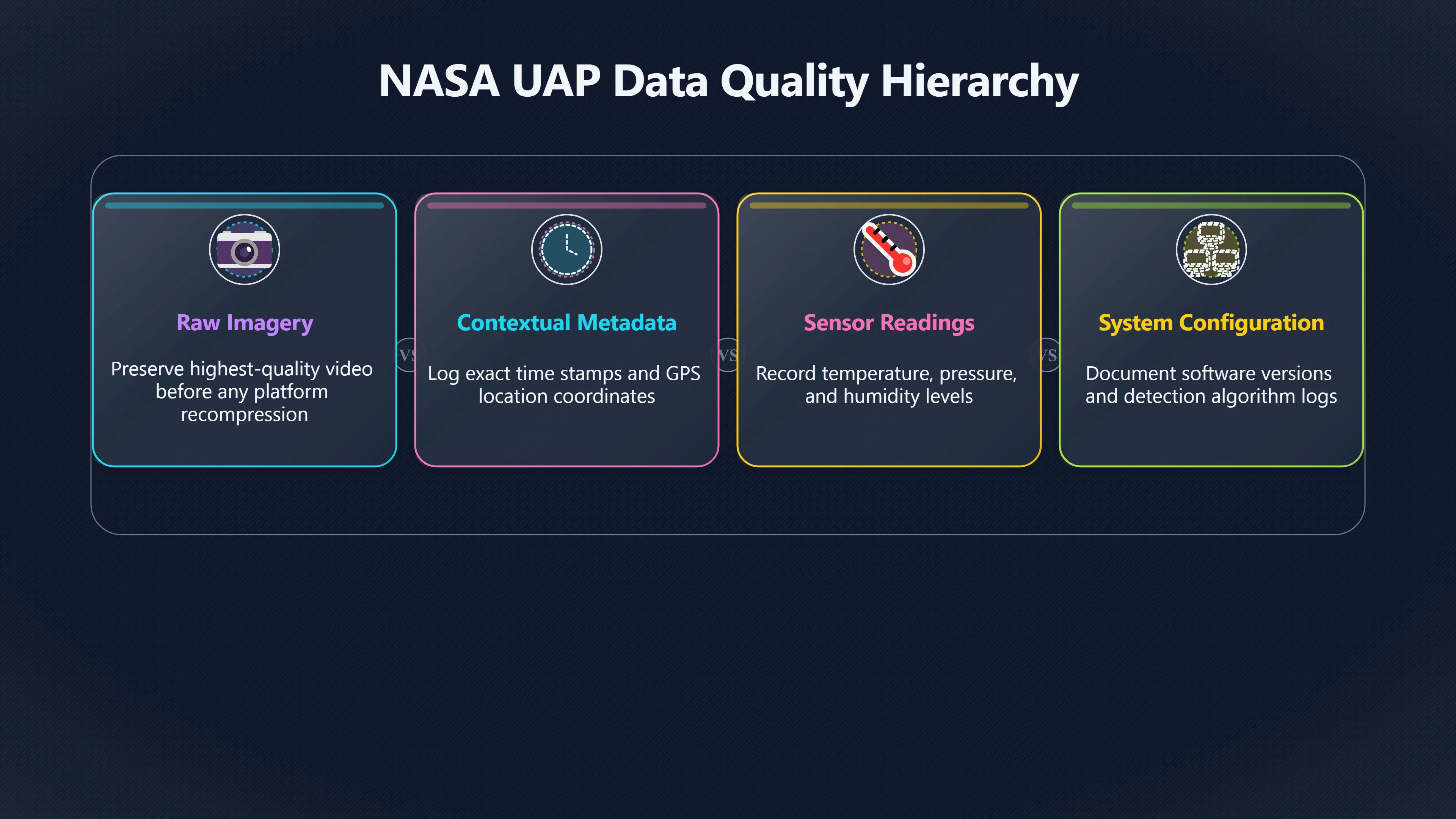
A strong evidence package typically includes:
- the highest-quality original video available before platform recompression
- several seconds or minutes of pre-trigger footage from a rolling buffer
- continued recording after the event disappears
- exact timestamps synchronised to GPS or another reliable time source
- camera settings such as exposure, gain, frame rate and focal length
- full-resolution frames rather than only scaled preview images
- pointing direction and camera orientation
- GPS location
- environmental measurements such as temperature, pressure and humidity
- motion or orientation sensor data where available
- trigger confidence and detection logs
- software version and configuration used during acquisition
The objective is not simply to collect more files but to preserve enough information for an independent analyst to reproduce the circumstances of the observation.
This principle appears across successful automated observing networks outside the UAP field. Meteor camera networks such as the Global Meteor Network rely on calibrated cameras, precise timing and retained observational data because trajectory reconstruction and cross-station verification depend upon the original measurements rather than edited highlight clips.[OUP Academic+2Global Meteor Network]academic.oup.comOUP AcademicThe Global Meteor Network – Methodology and first resultsby D Vida · 2021 · Cited by 126 — The Global Meteor Network (GMN) ut…
Storage choices for continuous sky monitoring
Continuous recording presents a practical engineering problem. High-quality video rapidly consumes storage, especially when multiple cameras operate throughout the night or around the clock.
Most systems therefore balance evidence quality against storage capacity using one of several approaches.
Continuous ring buffers
A ring buffer continuously records while automatically overwriting the oldest material. When an event occurs, the system permanently saves the surrounding time window. This approach preserves valuable pre-trigger information without requiring unlimited storage.
Triggered archive plus background recording
Some stations retain low-bitrate continuous video while saving high-quality recordings whenever detection occurs. The background recording provides context while the higher-quality archive captures detailed evidence.
Near-lossless or lightly compressed recording
Instead of maximising compression, some builders accept larger files in exchange for preserving more image detail. Storage costs have fallen substantially over the past decade, making this increasingly practical for fixed observatories.
Selective retention
Some open-source systems retain every detection for a limited period while automatically deleting ordinary recordings after review. Only unusual or scientifically valuable events are archived permanently.
These strategies illustrate why storage design is part of the scientific design rather than merely an IT consideration.
Why DIY systems often provide greater evidence control
Raw data retention is one of the strongest arguments in favour of open-source builds.
A builder can usually decide:
- which video format to store
- how much pre-trigger history to retain
- whether to archive every frame
- which metadata fields to log
- how environmental sensors are synchronised
- whether intermediate processing files are preserved
- how long original recordings remain available before deletion
This flexibility allows the station to evolve as analysis methods improve. If researchers later discover a better tracking algorithm or calibration technique, archived original imagery can often be processed again.
Commercial systems may also provide extensive recording options, but buyers should verify exactly what is retained rather than assuming “recorded event” means “original evidence”. Some products focus on efficient review and detection rather than preserving every stage of acquisition. Storage policies, export formats and access to original files therefore become important purchase criteria.

The buy-or-build test
Viewed purely as detection devices, many commercial and DIY systems appear broadly comparable. Viewed as evidence collectors, meaningful differences emerge.
When comparing systems, useful questions include:
- Can the original video be exported without additional recompression?
- Is there a configurable pre-trigger recording buffer?
- Are timestamps independently synchronised?
- Are camera settings recorded alongside the footage?
- Can sensor logs be matched precisely to individual frames?
- Is the detection algorithm’s decision process logged?
- Can archived data be reprocessed with different software in future?
- Does storage automatically overwrite potentially valuable observations before review?
NASA’s UAP study argued that progress depends on calibrated observations with sufficient metadata and rigorous data acquisition rather than isolated anecdotes. That recommendation applies directly to detector design. A station that preserves rich, near-raw observational records offers investigators far more opportunity to verify, challenge or explain an unusual event than one that saves only a short compressed clip after the trigger has already fired.[NASA Science+2NASA Science]science.nasa.govScience Independent Study Team ReportNASA ScienceIndependent Study Team ReportSeptember 13, 2023 — The study of Unidentified Anomalous Phenomena (UAP) presents a unique scien…
Amazon book picks
Further Reading
Books and field guides related to Can Your Detector Save the Evidence?. Use these as the next step if you want deeper reading beyond the article.

UFOs : Generals, Pilots, and Government Officials Go on the R...
Highlights the value of strong evidence.


Digital Image Processing, Global Edition
First published 2018. Subjects: Image processing, digital techniques.
eBay marketplace picks
Marketplace Samples
Example marketplace items related to this page. Use the search link to explore similar finds on eBay.




Endnotes
1.
Source: science.nasa.gov
Title: Science Independent Study Team Report
Link:https://science.nasa.gov/wp-content/uploads/2023/09/uap-independent-study-team-final-report.pdf
Source snippet
NASA ScienceIndependent Study Team ReportSeptember 13, 2023 — The study of Unidentified Anomalous Phenomena (UAP) presents a unique scien...
Published: September 13, 2023
2.
Source: science.nasa.gov
Link:https://science.nasa.gov/uap/
Source snippet
NASA ScienceUAP9 Jun 2022 — A study team to examine unidentified anomalous phenomena (UAPs) – that is, observations of events in the sky...
3.
Source: dfrws.org
Title: 2014 EU paper forensic analysis of video file formats
Link:https://dfrws.org/wp-content/uploads/2019/06/2014_EU_paper-forensic_analysis_of_video_file_formats.pdf
Source snippet
Canon Ixus IIs, Canon PowerShot...Read more...
4.
Source: academic.oup.com
Link:https://academic.oup.com/mnras/article/506/4/5046/6347233
Source snippet
OUP AcademicThe Global Meteor Network – Methodology and first resultsby D Vida · 2021 · Cited by 126 — The Global Meteor Network (GMN) ut...
5.
Source: science.nasa.gov
Link:https://science.nasa.gov/uap/faqs/
Source snippet
8 May 2026 — The study team then recommended a roadmap for potential future NASA unidentified anomalous data analyses. The study took nin...
Published: May 2026
6.
Source: community.ring.com
Title: video compression
Link:https://community.ring.com/t/video-compression/141761
Source snippet
Compression26 Jun 2022 — When it comes to the video quality of your Ring Doorbell or Camera, the best place to start with troubleshooting...
7.
Source: blog.ampedsoftware.com
Title: Amped Blog Behind the Screen: Video Codecs and Formats Unveiled
Link:https://blog.ampedsoftware.com/2024/11/08/video-codecs-and-formats
Source snippet
Amped BlogBehind the Screen: Video Codecs and Formats UnveiledNovember 8, 2024 — 8 Nov 2024 — Impact of Compression on Forensic Analysis...
Published: November 8, 2024
8.
Source: globalmeteornetwork.org
Link:https://globalmeteornetwork.org/wiki/
Source snippet
the Global Meteor Network wiki page!10 Mar 2026 — The goal is to observe the night sky using low-light video cameras and produce meteor t...
9.
Source: globalmeteornetwork.groups.io
Title: io Allsky Project on github
Link:https://globalmeteornetwork.groups.io/g/main/topic/allsky_project_on_github/34864046
Source snippet
Brightness, flares and fragmentation of meteorite...Read more...
Additional References
10.
Source: github.com
Link:https://github.com/CroatianMeteorNetwork/RMS
Source snippet
CroatianMeteorNetwork/RMS: RPi Meteor StationRMS is the core open-source software library powering the Global Meteor Network (GMN). The G...
11.
Source: youtube.com
Link:https://www.youtube.com/watch?v=zxrlDpDUyJQ
Source snippet
Investing In A RAW Video Workflow Part 1: Cameras...RAWVideo #tutorial #videography 00:00 - Introduction 01:42 - RAW Overview 03:55 - Co...
12.
Source: youtube.com
Link:https://www.youtube.com/watch?v=HkPDHmc7XcQ
Source snippet
REPLAY! NASA Announces Unidentified Aerial Phenomena...NASA is commissioning on unidentified aerial phenomena. These are the observation...
13.
Source: youtube.com
Link:https://www.youtube.com/watch?v=TQcqOW39ksk
Source snippet
Unidentified Anomalous Phenomena Independent Study ReportNASA commissioned an independent study team to examine unidentified anomalous ph...
14.
Source: arxiv.org
Link:https://arxiv.org/pdf/2402.06669
Source snippet
Compression Effects and Scene Details on the Source...by RR López · 2024 · Cited by 21 — In an open scenario, the forensic analyst does...
15.
Source: researchgate.net
Title: 363364796 The Global Meteor Network Methodology and first results
Link:https://www.researchgate.net/publication/363364796The_Global_Meteor_Network-_Methodology_and_first_results
Source snippet
The Global Meteor Network – Methodology and first results3 May 2026 — The Global Meteor Network (GMN) utilizes highly sensitive low-cost...
Published: May 2026
16.
Source: researchgate.net
Link:https://www.researchgate.net/publication/371679147_The_Significance_of_Metadata_and_Video_Compression_for_Investigating_Video_Files_on_Social_Media_Forensic
Source snippet
The Significance of Metadata and Video Compression for...11 Jun 2026 — In this review study, we made a novel attempt by reviewing the media...
17.
Source: leonarddavid.com
Title: nasa report released unidentified anomalous phenomena uap
Link:https://www.leonarddavid.com/nasa-report-released-unidentified-anomalous-phenomena-uap/
Source snippet
Unidentified Anomalous Phenomena (UAP) – UPDATED14 Sept 2023 — The study will focus on identifying available data, how best to collect fu...
18.
Source: youtube.com
Title: The [Galileo]({{ ‘galileo/’ | relative_url }}) Project’s First Data on Half a Million Objects with Avi Loeb
Link:https://www.youtube.com/watch?v=uJtER5ahdPY
19.
Source: space.com
Title: nasa ufo uap study team first results revealed
Link:https://www.space.com/nasa-ufo-uap-study-team-first-results-revealed
Source snippet
NASA UFO report finds no evidence of 'extraterrestrial...14 Sept 2023 — NASA's UFO study team released its long-awaited first report tod...
Topic Tree