Within Infrared
How Weather Turns Infrared Into Guesswork
Fog, rain, humidity, dust and dirty optics can make infrared systems miss aircraft or misread ordinary sky clutter.
On this page
- Fog, rain and humidity effects
- Lens contamination and treeline clutter
- Weather metadata every event needs
Page outline Jump by section
Introduction
Infrared all-sky cameras are often described as tools that can “see in the dark”, but darkness is only one part of the problem. For automated instrumented UFO detectors, the atmosphere between the camera and the sky is just as important as the sensor itself. Fog, rain, high humidity, airborne dust, dirty optics and even nearby trees can quietly reduce detection range, alter apparent target brightness or create misleading artefacts. The result is not usually dramatic image failure. Instead, weather gradually pushes the system towards missed detections, uncertain classifications and inconsistent tracking—precisely the opposite of what an automated scientific instrument requires. Recent commissioning work on the Galileo Project’s all-sky infrared array has highlighted that environmental conditions measurably change aircraft detection performance, reinforcing that weather must be treated as recorded measurement data rather than background scenery.[MDPI]mdpi.comCommissioning an All-Sky Infrared Camera Array for…by L Domine · 2025 · Cited by 11 — One of the key instruments is an all-sky inf…

Fog, rain and humidity reduce infrared performance in different ways
A common misconception is that thermal cameras simply “see through” bad weather. In reality, long-wave infrared (LWIR) cameras operate within an atmospheric transmission window rather than outside the atmosphere. Water vapour, liquid droplets and suspended particles still absorb and scatter infrared radiation, reducing the contrast between a distant object and the sky behind it.[FLIR]flir.comcan thermal imaging see through fog and rainCan Thermal Imaging See Through Fog and Rain?30 Dec 2020 — Thermal imaging cameras see in total darkness, producing clear, crisp imag…
The effect depends on the weather:
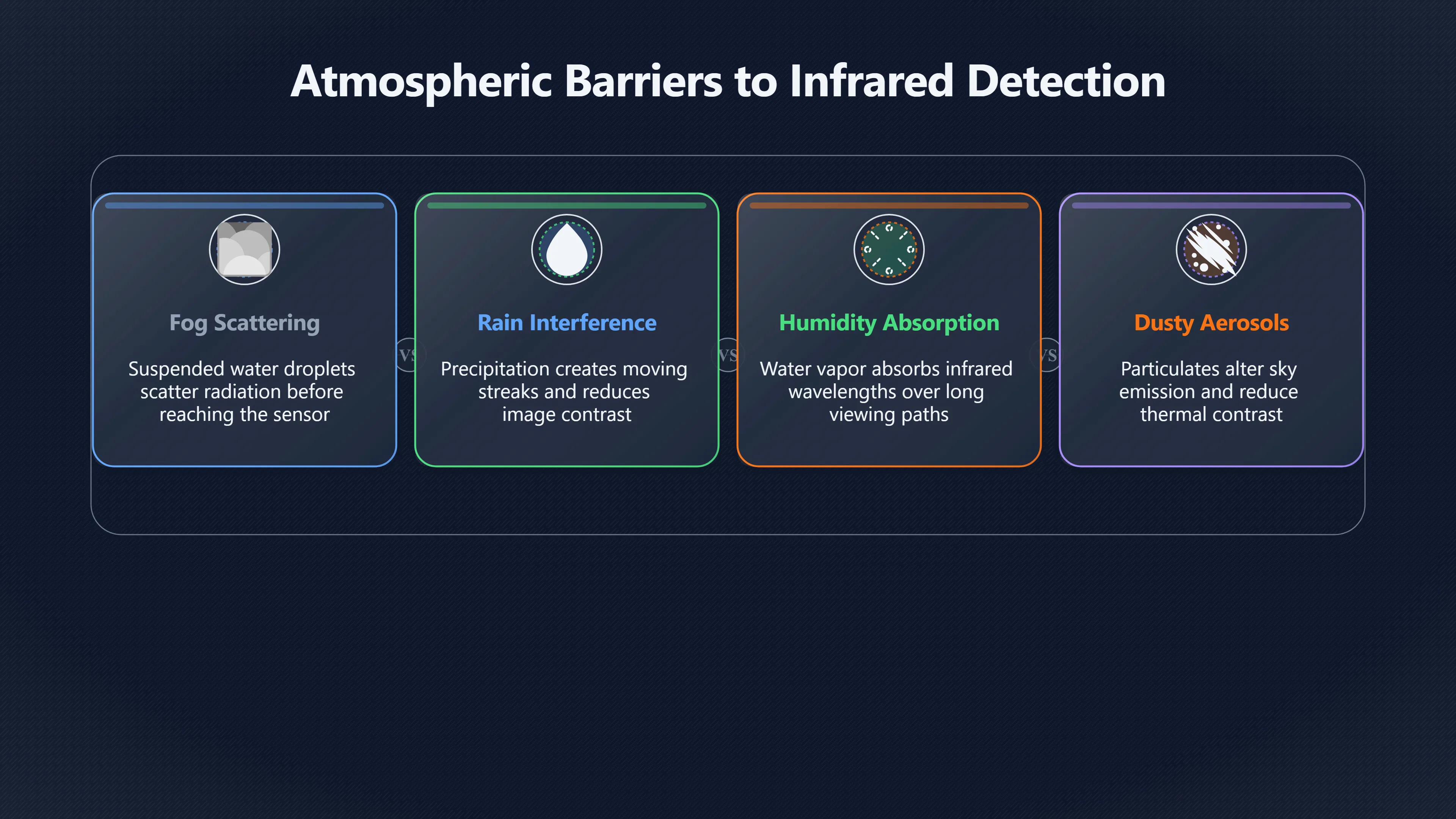
- Fog is often the most damaging because countless suspended water droplets scatter thermal radiation before it reaches the sensor. Detection range can fall sharply even though nearby objects remain visible.[KTH]aphys.kth.seFog and precipitation are the principle obstacles in flying scenarios, might be able to detect…
- Rain attenuates infrared signals while also introducing moving streaks and droplets that complicate automated motion detection. Heavy rain reduces both image contrast and effective detection distance.[FLIR]flir.comcan thermal imaging see through fog and rainCan Thermal Imaging See Through Fog and Rain?30 Dec 2020 — Thermal imaging cameras see in total darkness, producing clear, crisp imag…
- High humidity increases atmospheric absorption over long viewing paths. A target that is detectable on a dry winter night may become marginal during a warm, humid evening even without visible fog.[FLIR]flir.comcan thermal imaging see through fog and rainCan Thermal Imaging See Through Fog and Rain?30 Dec 2020 — Thermal imaging cameras see in total darkness, producing clear, crisp imag…
These changes rarely produce a simple “working” versus “not working” threshold. Instead, signal quality declines progressively with increasing atmospheric attenuation. For automated detection software, that gradual degradation matters because classification algorithms often depend on small differences in brightness, apparent size and motion.
Why missed detections matter more than false confidence
Weather does not merely make images look worse. It changes what an automated detector believes exists.
The Galileo Project’s commissioning study evaluated aircraft detection under real operating conditions using synchronised ADS-B aircraft positions as ground truth. Detection efficiency decreased during precipitation, poor visibility and periods of high relative humidity. Dust, raindrops on the camera housing and interference from nearby terrain also affected performance. Rather than assuming constant sensitivity, the researchers characterised detection probability as a function of weather and observing conditions.[MDPI]mdpi.comCommissioning an All-Sky Infrared Camera Array for…by L Domine · 2025 · Cited by 11 — One of the key instruments is an all-sky inf…
This distinction is important for UAP studies. A night with few detections may not indicate an unusually quiet sky. It may simply reflect reduced atmospheric transmission or degraded optics. Without accounting for those effects, comparisons between observing nights become misleading.
Lens contamination and treeline clutter
Some of the largest performance losses originate close to the camera rather than high in the atmosphere.
Raindrops on the protective window or lens scatter incoming infrared radiation, producing blurred regions, distorted hotspots or transient bright features as droplets move or evaporate. Dust accumulation can lower image contrast gradually over weeks, making the degradation difficult to notice without calibration checks. Similar problems are well documented in other automated imaging systems, where contamination reduces downstream detection accuracy even if the camera itself remains functional.[MDPI]mdpi.comCommissioning an All-Sky Infrared Camera Array for…by L Domine · 2025 · Cited by 11 — One of the key instruments is an all-sky inf…
Nearby terrain creates another subtle problem. Trees, buildings and hills often remain warmer than the open sky after sunset, generating strong thermal backgrounds near the horizon. Moving branches, heat released from vegetation and changing wind conditions can all trigger motion-detection algorithms or partially obscure genuine aerial targets.
The Galileo commissioning campaign identified treeline interference as one of several environmental factors that affected practical detection performance. This illustrates that site selection matters alongside camera specifications. A theoretically capable infrared sensor can perform poorly if its lowest viewing angles are dominated by thermally active foreground objects.[MDPI]mdpi.comCommissioning an All-Sky Infrared Camera Array for…by L Domine · 2025 · Cited by 11 — One of the key instruments is an all-sky inf…
Dust, aerosols and changing sky temperature
Clear skies are not always thermally stable. Airborne dust and aerosols alter how the atmosphere emits and absorbs infrared radiation, changing the apparent temperature of the sky itself.
Studies of infrared sky measurements have shown that dusty atmospheric conditions can substantially increase measured infrared sky temperatures by altering atmospheric emission. That reduces thermal contrast between targets and background, particularly for distant objects whose signals have already been weakened during propagation.[AGU Publications]agupubs.onlinelibrary.wiley.comAGU PublicationsModification of the IR sky temperature under different…by AH Maghrabi · 2012 · Cited by 13 — The study showed that dus…
For an automated detector, this means the background is not constant. Detection thresholds that work well after a cold front may perform poorly during dusty or humid conditions unless the software adapts to changing sky radiance.

Weather metadata every event needs
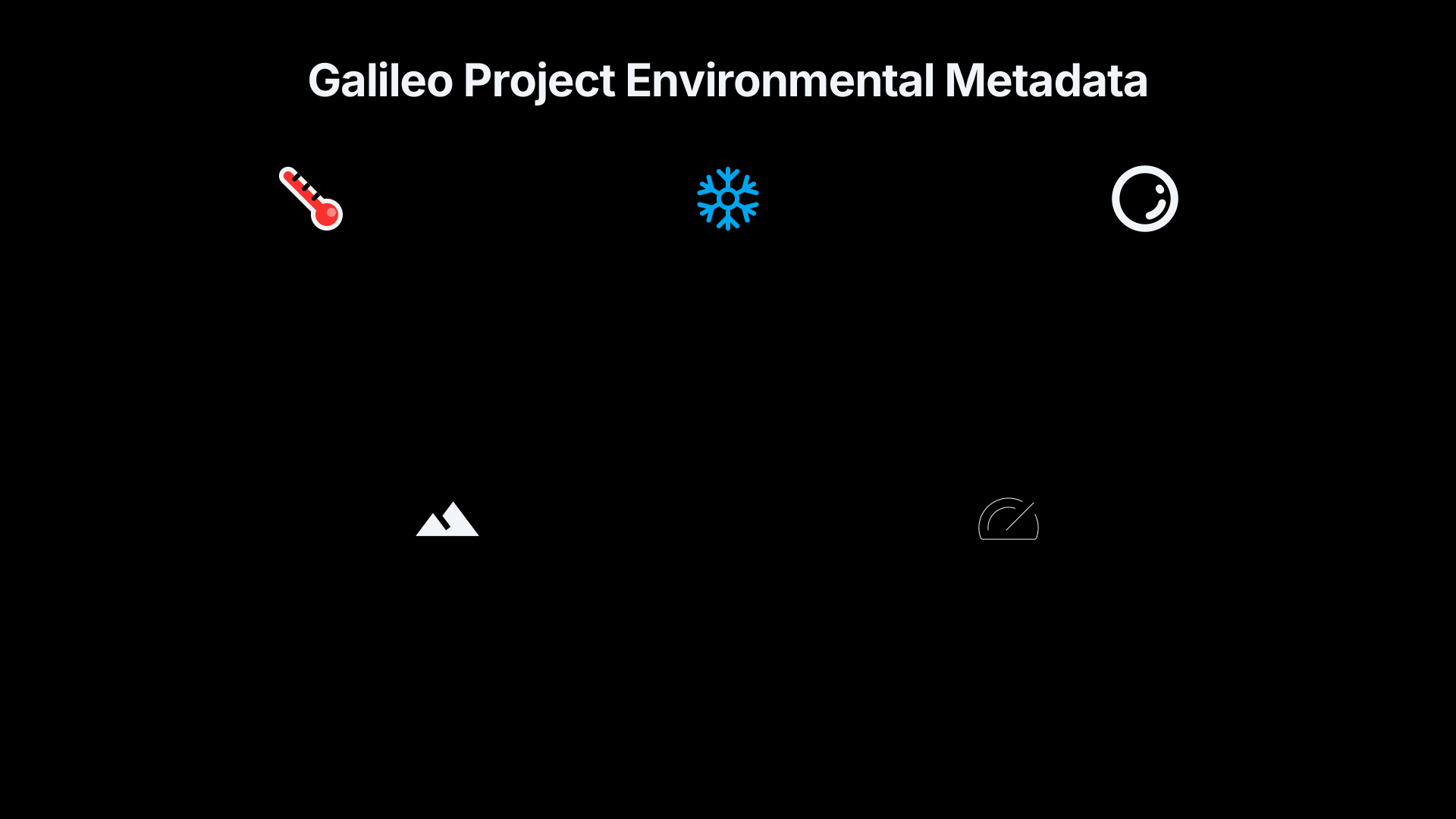
An infrared recording is far more valuable when accompanied by environmental measurements. A scientifically useful event record should preserve enough context to explain why an object was—or was not—detected.
Useful metadata include:
- air temperature and relative humidity;
- precipitation type and intensity;
- visibility or cloud-base measurements where available;
- wind speed and direction;
- lens status, including contamination or maintenance history;
- camera temperature and calibration state;
- observing geometry, including horizon obstructions.
These measurements allow later investigators to separate genuine anomalies from changes in sensor performance. They also make it possible to estimate whether detection probability was unusually low during a particular observation period. The Galileo Project explicitly combines environmental monitoring with calibration against known aircraft to quantify these effects rather than treating them as uncontrolled background noise.[MDPI]mdpi.comCommissioning an All-Sky Infrared Camera Array for…by L Domine · 2025 · Cited by 11 — One of the key instruments is an all-sky inf…
Weather is part of the instrument
The practical lesson for automated night-time UAP detection is that weather is not an external inconvenience but an integral component of the measurement system. Infrared cameras remain valuable because they provide continuous night-time observations that visible-light cameras often cannot, yet their effectiveness depends on atmospheric transmission, local surroundings and optical cleanliness.
A reliable all-sky infrared observatory therefore needs more than a sensitive detector. It requires continuous environmental monitoring, routine optical maintenance and performance calibration under changing conditions. Only then can reductions in detection rate be interpreted as changes in the sky rather than changes in the instrument’s ability to observe it.[MDPI]mdpi.comCommissioning an All-Sky Infrared Camera Array for…by L Domine · 2025 · Cited by 11 — One of the key instruments is an all-sky inf…
Amazon book picks
Further Reading
Books and field guides related to How Weather Turns Infrared Into Guesswork. Use these as the next step if you want deeper reading beyond the article.

Introduction to infrared and electro-optical systems
Explains infrared system performance, atmospheric effects, sensors and imaging limitations relevant to weather impacts.

Building electro-optical systems
Focuses on practical electro-optical system integration, calibration and real-world measurement challenges.

Field guide to infrared systems, detectors, and FPAs
First published 2010. Subjects: Optical detectors, Infrared technology, Focal planes, Handbooks, manuals.
Alien Worlds
This intriguing collection of essays presents reflections upon the birth, proliferation, enduring appeal, and future of extraterrestrial...
eBay marketplace picks
Marketplace Samples
Example marketplace items related to this page. Use the search link to explore similar finds on eBay.
Endnotes
1.
Source: mdpi.com
Link:https://www.mdpi.com/1424-8220/25/3/783
Source snippet
Commissioning an All-Sky Infrared Camera Array for...by L Domine · 2025 · Cited by 11 — One of the key instruments is an all-sky inf...
2.
Source: flir.com
Title: can thermal imaging see through fog and rain
Link:https://www.flir.com/en-gb/discover/rd-science/can-thermal-imaging-see-through-fog-and-rain/
Source snippet
Can Thermal Imaging See Through Fog and Rain?30 Dec 2020 — Thermal imaging cameras see in total darkness, producing clear, crisp imag...
3.
Source: aphys.kth.se
Link:https://www.aphys.kth.se/polopoly_fs/1.934189.1600690015%21/Thesis_Josefine_Ulrika.pdf
Source snippet
Fog and precipitation are the principle obstacles in flying scenarios, might be able to detect...
4.
Source: mdpi.com
Link:https://www.mdpi.com/2072-4292/13/9/1852
Source snippet
Day and Night Clouds Detection Using a Thermal-Infrared...by Y Wang · 2021 · Cited by 27 — This work proposes a day and night clouds det...
5.
Source: agupubs.onlinelibrary.wiley.com
Link:https://agupubs.onlinelibrary.wiley.com/doi/full/10.1029/2012JD017881
Source snippet
AGU PublicationsModification of the IR sky temperature under different...by AH Maghrabi · 2012 · Cited by 13 — The study showed that dus...
Additional References
6.
Source: pmc.ncbi.nlm.nih.gov
Title: PMCImpact of Rainfall on the Detection Performance of Non
Link:https://pmc.ncbi.nlm.nih.gov/articles/PMC11085814/
Source snippet
by Y Sumi · 2024 · Cited by 4 — This study comprehensively investigates how rain and drizzle affect the object-detection performance o...
7.
Source: researchgate.net
Link:https://www.researchgate.net/publication/387717669_The_Impact_of_Rain_on_Image_Quality_From_Sensors_on_Connected_and_Autonomous_Vehicles
Source snippet
The results show a 45% reduction in SNR at 40 m and 38 mm/h, 42% increase in color error...
8.
Source: phys.org
Title: 2025 04 sky infrared camera dalek alien
Link:https://phys.org/news/2025-04-sky-infrared-camera-dalek-alien.html
Source snippet
An all-sky infrared camera named Dalek continues the...9 Apr 2025 — Galileo Project proposes an All-Sky Infrared Camera (Dalek) to searc...
9.
Source: pixfra.com
Title: how does weather affect thermal imaging
Link:https://www.pixfra.com/how-does-weather-affect-thermal-imaging
Source snippet
?18 Jul 2025 — Atmospheric attenuation increases with humidity as water vapor absorbs certain infrared wavelengths. This effect reduces s...
10.
Source: up42.com
Link:https://up42.com/blog/introduction-to-thermal-infrared
Source snippet
An introduction to thermal infrared21 Dec 2023 — Dive into the fascinating world of thermal infrared imagery. From wildfire monitoring to...
11.
Source: journals.ametsoc.org
Link:https://journals.ametsoc.org/view/journals/bams/106/8/BAMS-D-24-0259.1.xml
Source snippet
Use and Potential of Far-Infrared Remote Sensing in...by Y Du · 2025 — This study demonstrates that adding FIR data greatly enhances lon...
12.
Source: amt.copernicus.org
Link:https://amt.copernicus.org/articles/16/707/2023/amt-16-707-2023.pdf
Source snippet
of raindrop size distribution and rain rate with...by J Lee · 2023 · Cited by 19 — This study estimated raindrop size distribution (DSD)...
13.
Source: scholar.google.com
Link:https://scholar.google.com/citations?citation_for_view=DNuiPHwAAAAJ%3AZXPVDZvx_usC&hl=en&user=DNuiPHwAAAAJ&view_op=view_citation
Source snippet
google.com[https://scholar.google.com/citations?view_op=view_...No](https://scholar.google.com/citations?view_op=view_...No) information is available for this page...
14.
Source: arxiv.org
Link:https://arxiv.org/abs/2411.07956
Source snippet
Commissioning An All-Sky Infrared Camera Array for...by L Dominé · 2024 · Cited by 11 — The Galileo Project is designing, building, and...
15.
Source: youtube.com
Title: Basics of Thermal Imaging (How Conditions Affect Thermal Performance)
Link:https://www.youtube.com/watch?v=4SxCQkdNK4o
Source snippet
Can a FLIR Boson Thermal Camera See Through Fog?...
Topic Tree