Within Galileo
Why Galileo Does Not Take UFO Photos
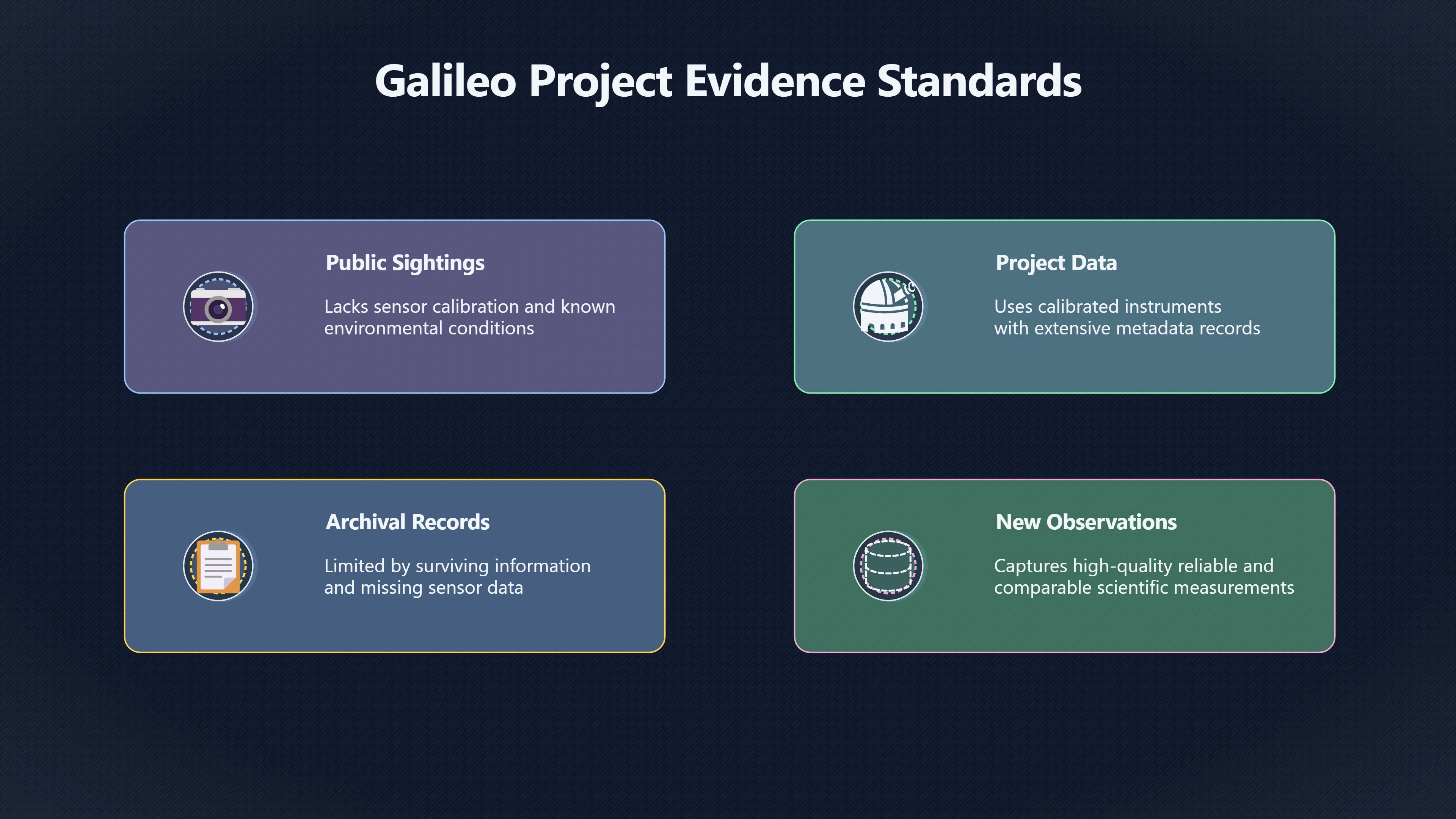
Galileo does not take public UFO photos because its evidence standard depends on calibrated sensors, known settings and comparable metadata.
On this page
- What outside photos usually lack
- Why calibration and metadata matter
- How Galileo creates its own evidence stream
Page outline Jump by section
Introduction
The Galileo Project does not accept public UFO photographs or videos as research evidence because its scientific strategy depends on data collected by calibrated instruments operating under known conditions. In the project’s view, even a striking image is of limited scientific value if researchers do not know exactly how it was captured, what the sensor was doing at the time, whether the image has been processed, or what other instruments recorded simultaneously. Rather than sorting through existing sightings after the fact, the project seeks to build its own stream of observations using dedicated observatories that continuously monitor the sky and record extensive metadata alongside the imagery. This policy is not a judgement on the sincerity of witnesses. It is an evidence standard designed to produce measurements that can be independently checked, compared and reproduced.[The Galileo Project+2Medium]galileo.hsites.harvard.eduThe Galileo ProjectFrequently Asked Questions | The Galileo Project26 Jan 2022 — The Galileo Project will apply the scientific method to…
What Outside Photos Usually Lack
Most UFO photographs arrive with substantial unknowns. Researchers often do not know the exact camera settings, lens characteristics, compression history, environmental conditions or chain of custody of the file. In many cases, they also lack crucial context such as radar data, distance measurements, atmospheric conditions and simultaneous observations from independent sensors.
For the Galileo Project, these missing elements make it difficult to determine whether an image shows an unusual object, a conventional aircraft, an optical artefact, a nearby insect, a balloon, sensor noise or a processing error. A single photograph may capture something unexpected, but it rarely provides enough information to reconstruct the object’s true size, speed, distance or physical nature. The project’s stated goal is therefore not to collect more ambiguous images but to acquire data capable of ruling out ordinary explanations.[The Galileo Project+2arXiv]galileo.hsites.harvard.eduThe Galileo ProjectFrequently Asked Questions | The Galileo Project26 Jan 2022 — The Galileo Project will apply the scientific method to…
The project’s FAQ explicitly states that it is not accepting outside photos or videos because it seeks information that is “high-quality, reliable, consistent, calibrated and comparable.” It similarly distinguishes its research programme from the collection of anecdotes and public sightings.[The Galileo Project]galileo.hsites.harvard.eduThe Galileo ProjectFrequently Asked Questions | The Galileo Project26 Jan 2022 — The Galileo Project will apply the scientific method to…
Why Calibration and Metadata Matter
The central issue is not whether a photograph looks convincing. The issue is whether the observation can be measured.
Calibration means that researchers understand precisely how an instrument responds to the world. They know its sensitivity, field of view, distortions, timing accuracy and operating state. Metadata records the circumstances of the observation, including timestamps, location, instrument settings and environmental conditions.
Without calibration and metadata, many basic scientific questions become difficult or impossible to answer:
- Was the object large and distant or small and nearby?
- Was apparent motion caused by the object or by camera movement?
- Was the image altered by compression, sharpening or digital processing?
- Did other sensors observe the same event?
- Can another team independently verify the result?
The Galileo Project’s observatory architecture was designed specifically to address these questions. Its technical papers repeatedly identify poor data quality, missing metadata and uncalibrated observations as major obstacles in UAP research. The project’s computing and data-management systems are built around preserving provenance information and maintaining a documented chain from observation to analysis.[arXiv]arxiv.orgarXiv Galileo Project Observatory Class System ArchitecturearXiv Galileo Project Observatory Class System Architecture
This emphasis reflects a broader trend in official and scientific UAP studies. Galileo founder Avi Loeb has argued that claims of extraordinary phenomena require exceptionally well-characterised measurements and that archival reports from unknown or poorly documented sensors rarely meet that standard.[Medium]avi-loeb.medium.comNASA, AARO and the Galileo Project Agree on the Need for a…NASA, AARO and the Galileo Project Agree on the Need for a Scientific…
Why Galileo Prefers New Observations to Archival Sightings
A common assumption is that a scientific UFO project would begin by examining the vast collection of existing photos and videos. Galileo largely rejects that approach.
The project’s philosophy is that retrospective analysis is constrained by whatever information happens to survive. If an important measurement was never recorded, no amount of later investigation can recover it. A photograph taken years ago cannot be re-observed under controlled conditions. Missing sensor data remain missing.
Because of this limitation, the Galileo Project was conceived as a forward-looking observatory effort. Its public descriptions emphasise collecting new open scientific data with purpose-built instruments rather than relying on historical reports, classified material or anecdotal evidence. The goal is to generate observations whose quality is known from the moment they are captured.[Medium+2The Harvard Crimson]drbriankeating.medium.comThe Galileo Project: Systematically Searching for Evidence of…The Galileo Project aims to identify the nature of UAP and 'Oumuam…
This approach also avoids endless debates over authenticity. Instead of asking whether an old image is genuine, researchers can examine a freshly recorded event whose instrumentation, calibration records and processing history are already documented.
How Galileo Creates Its Own Evidence Stream
The rejection of outside photos is paired with an alternative: continuous, instrumented observation.
Galileo’s observatories are designed to collect multimodal data rather than isolated images. The system combines optical and infrared cameras with additional sensors and software intended to classify ordinary objects and identify anomalies. Its observatory architecture places heavy emphasis on synchronised measurements, sensor characterisation and long-term monitoring.[arXiv]arxiv.orgOpen source on arxiv.org.
A key advantage of this approach is cross-validation. If an unusual object appears, researchers can compare multiple simultaneous data sources instead of relying on a single frame from a single camera. Observatory systems can also be recalibrated, tested against known targets and evaluated against large baseline datasets of aircraft, satellites, birds, weather phenomena and other routine sky traffic.[arXiv]arxiv.orgCommissioning An All-Sky Infrared Camera Array for Detection Of Airborne ObjectsNovember 12, 2024…
The project’s first observatory generated data on hundreds of thousands of detected aerial objects, providing a reference catalogue of normal sky activity. From Galileo’s perspective, this background census is essential because anomalies can only be identified reliably when researchers understand what ordinary observations look like.[Medium]avi-loeb.medium.comCommissioning Data on Half a Million Objects in the Sky fromCommissioning Data on Half a Million Objects in the Sky from…November 12, 2024 — Commissioning Data on Half a Million Objects in…
The Policy Behind the Photo Policy
Galileo’s refusal to accept public UFO photos is fundamentally a governance choice about evidence quality. The project is attempting to move UAP research away from witness-centred investigation and towards observatory-based measurement.
Under this framework, an image is not valuable because it is dramatic or unexplained. It becomes valuable when it is accompanied by enough calibrated information to support rigorous analysis. The project therefore prioritises controlled data acquisition over crowd-sourced submissions, believing that scientific progress is more likely to come from systematically collected measurements than from attempting to interpret isolated photographs whose observational context is largely unknown.[The Galileo Project+2Medium]galileo.hsites.harvard.eduThe Galileo ProjectFrequently Asked Questions | The Galileo Project26 Jan 2022 — The Galileo Project will apply the scientific method to…
Amazon book picks
Further Reading
Books and field guides related to Why Galileo Does Not Take UFO Photos. Use these as the next step if you want deeper reading beyond the article.
UFOs : Generals, Pilots, and Government Officials Go on the R...
Provides context for serious UFO investigation and the challenge of obtaining reliable evidence.
Extraterrestrial: The First Sign of Intelligent Life Beyond E...
Closely connected to the Galileo Project's scientific approach to investigating unusual objects.
Astrophysics for People in a Hurry
Rating: 4.5/5 from 7 Google Books ratings
Provides accessible background on astronomical observation and the scientific mindset underlying projects like Galileo.
The Demon-Haunted World: Science as a Candle in the Dark
Directly supports the article's emphasis on evidence quality, measurement standards, and skepticism toward unsupported visual claims.
eBay marketplace picks
Marketplace Samples
Example marketplace items related to this page. Use the search link to explore similar finds on eBay.
Endnotes
1.
Source: galileo.hsites.harvard.edu
Link:https://galileo.hsites.harvard.edu/FAQ
Source snippet
The Galileo ProjectFrequently Asked Questions | The Galileo Project26 Jan 2022 — The Galileo Project will apply the scientific method to...
2.
Source: drbriankeating.medium.com
Link:https://drbriankeating.medium.com/the-galileo-project-systematically-searching-for-evidence-of-extraterrestrial-technological-cb4535c6f351
Source snippet
The Galileo Project: Systematically Searching for Evidence of...The Galileo Project aims to identify the nature of UAP and 'Oumuam...
3.
Source: arxiv.org
Link:https://arxiv.org/abs/2305.18566
4.
Source: arxiv.org
Title: arXiv Galileo Project Observatory Class System Architecture
Link:https://arxiv.org/abs/2506.00125
5.
Source: avi-loeb.medium.com
Link:https://avi-loeb.medium.com/nasa-aaro-and-the-galileo-project-agree-on-the-need-for-a-scientific-study-of-uap-58b39c005b57
Source snippet
NASA, AARO and the Galileo Project Agree on the Need for a...NASA, AARO and the Galileo Project Agree on the Need for a Scientific...
6.
Source: avi-loeb.medium.com
Link:https://avi-loeb.medium.com/ideas-are-not-good-enough-without-good-data-72ff67822a1f
Source snippet
Are Not Good Enough Without Good Data | by Avi LoebI lead the experimental search for objects of extraterrestrial technological origin wi...
7.
Source: arxiv.org
Link:https://arxiv.org/abs/2411.07956
Source snippet
Commissioning An All-Sky Infrared Camera Array for Detection Of Airborne ObjectsNovember 12, 2024...
Published: November 12, 2024
8.
Source: avi-loeb.medium.com
Title: Commissioning Data on Half a Million Objects in the Sky from
Link:https://avi-loeb.medium.com/commissioning-data-on-half-a-million-objects-in-the-sky-from-the-galileo-project-observatory-are-a23bd084233a
Source snippet
Commissioning Data on Half a Million Objects in the Sky from...November 12, 2024 — Commissioning Data on Half a Million Objects in...
Published: November 12, 2024
9.
Source: avi-loeb.medium.com
Title: fellows of the galileo project 67e48a078c28
Link:https://avi-loeb.medium.com/fellows-of-the-galileo-project-67e48a078c28
Source snippet
of the Galileo Project - Avi Loeb... scientific knowledge on UAP will be advanced by well-calibrated instruments under the control of bri...
10.
Source: galileo.hsites.harvard.edu
Link:https://galileo.hsites.harvard.edu/public-announcement
Source snippet
Announcement | The Galileo Project - Harvard UniversityThe Galileo Project officially kicked off with the public announcement and virtual...
11.
Source: galileo.hsites.harvard.edu
Link:https://galileo.hsites.harvard.edu/search
Source snippet
The Galileo ProjectThe Galileo Project is the first systematic scientific research program in the search for potential astro-archaeolog...
12.
Source: arxiv.org
Link:https://arxiv.org/html/2411.02401v1
Source snippet
A Civilian Astronomer's Guide to UAP Research5 Nov 2024 — Instruments are well calibrated, allowing homogenous data collection. After the...
13.
Source: docs.galileo.ai
Title: ai FA Q
Link:https://docs.galileo.ai/references/faqs/faqs
Source snippet
Galileo AIQ: what is Galileo? Galileo is an end-to-end platform for evaluating and improving the performance of generative AI models. It...
14.
Source: skepticalinquirer.org
Link:https://skepticalinquirer.org/2021/10/the-galileo-project/
15.
Source: thecrimson.com
Title: The Harvard Crimson Harvard Prof
Link:https://www.thecrimson.com/article/2021/8/11/galileo-project/
Source snippet
Loeb Launches 'Galileo Project,' Systematic...11 Aug 2021 — The Galileo Project, per the release, aims to identify UAP “using the standa...
16.
Source: youtube.com
Link:https://www.youtube.com/watch?v=uJtER5ahdPY
Source snippet
t Harvard, which is dedicated to advancing the scientific study of...
17.
Source: youtube.com
Link:https://www.youtube.com/watch?v=Q3NqRak2tjc
18.
Source: science.nasa.gov
Link:https://science.nasa.gov/mission/galileo/
Source snippet
nasa.govGalileoNASA's Galileo spacecraft orbited Jupiter for almost eight years, and made close passes by its major moons.Read more...
19.
Source: Wikipedia
Title: The Galileo Project
Link:https://en.wikipedia.org/wiki/The_Galileo_Project
Source snippet
The Galileo ProjectThe Galileo Project is an international scientific research project to search for extraterrestrial intelligence or...
Additional References
20.
Source: reddit.com
Link:https://www.reddit.com/r/UFOs/comments/ou0onn/questions_for_the_galileo_project/
Source snippet
Questions for the Galileo Project: r/UFOsThere has been a lot of excitement with the recent announcement of the Galileo Project by Profe...
21.
Source: gsc-europa.eu
Title: FA Q | European GNSS Service Centre (GSC)Galileo High Accuracy Service FAQs
Link:https://www.gsc-europa.eu/galileo/faq
Source snippet
What do I need to use the Galileo HAS? You need a compatible Galileo-enabled receiver capable of receiving, decoding and...Read more...
22.
Source: reddit.com
Link:https://www.reddit.com/r/space/comments/qrubd9/opinion_and_discussion_on_the_galileo_project/
Source snippet
ze existing images or radar data, or speculate on prior UAP...Read more...
23.
Source: youtube.com
Link:https://www.youtube.com/watch?v=zHn69IQSIcg
Source snippet
Avi Loeb on the Pentagon's UFO file release: What the data really shows...
24.
Source: facebook.com
Link:https://www.facebook.com/NewsNationNow/videos/the-search-for-alien-civilization-with-avi-loeb-hot-take-with-jesse-weber/970968949276699/
Source snippet
e Galileo Project lead by Harvard astrophysicist Avi Loeb...
25.
Source: facebook.com
Link:https://www.facebook.com/realAnnaPaulina/posts/while-i-was-at-harvard-today-i-also-got-a-tour-of-the-observatory-and-a-briefing/1495283351961723/
Source snippet
Thank you for all you do...Read more...
26.
Source: youtube.com
Title: The Unknown Physics of UFO/UAP With Avi Loeb
Link:https://www.youtube.com/watch?v=W6RiI-VQtHg
Source snippet
Interview with Avi Loeb: Extraterrestrial Intelligence, UAP, and the Galileo Project...
27.
Source: youtube.com
Link:https://www.youtube.com/watch?v=MzjyjEpDW90
Source snippet
2022-10-23 | The Ins and Outs of PHD2 Calibration: Bruce...Calibrating PHD2 is an important step to having a successful night with good...
Published: October 23, 2022
28.
Source: youtube.com
Title: Avi Loeb on the Pentagon’s UFO file release: What the data really shows
Link:https://www.youtube.com/watch?v=rS0hcpLOmME
Source snippet
The Truth About Aliens - Avi Loeb...
29.
Source: youtube.com
Title: The Truth About Aliens
Link:https://www.youtube.com/watch?v=ZgeqGCdr7rU
Source snippet
The Unknown Physics of UFO/UAP With Avi Loeb...
Topic Tree