Within Parallax
The Data Missing From Most UAP Videos
NASA's UAP work emphasized that calibrated sensors, metadata, and baseline data matter more than collecting dramatic clips alone.
On this page
- Why video alone is not a measurement system
- Which metadata makes later reconstruction possible
- How baseline sky data reduces false surprise
Page outline Jump by section
Introduction
NASA’s 2023 independent study of unidentified anomalous phenomena (UAP) reached a conclusion that is directly relevant to automated instrumented UFO detectors: the biggest obstacle is usually not a lack of dramatic videos, but a lack of scientifically useful data. The study found that many reported UAP cannot be reconstructed because recordings are missing calibrated sensor information, accurate timestamps, observer location, camera settings, environmental context, and independent measurements. Without that information, analysts often cannot determine range, altitude, speed, or even whether an apparent anomaly originated from the object or the sensor itself.[NASA Science]science.nasa.govNASA ScienceIndependent Study Team ReportThe panel notes that, at present, gathering data on UAP is hampered by sensor calibration challe…
 Within the broader problem of parallax, distance errors, and impossible-speed claims, NASA’s message is straightforward: a video clip is only one component of a measurement. What transforms footage into scientific evidence is the accompanying metadata that allows later investigators to reconstruct exactly what happened.
Why video alone is not a measurement system
A conventional video records how light reached a sensor. It does not automatically record the physical properties of the observed object.
NASA’s study emphasised that current UAP investigations are limited by four recurring deficiencies:
- poor sensor calibration;[en.wikisource.org]en.wikisource.orgwikisource.orgPage:UAP Independent Study Team - Final Report.pdf/512 Nov 2023 — At present, analysis of UAP data is hampered by poor sens…
- missing or incomplete sensor metadata;
- too few independent measurements;[nasa.gov]nasa.govupdate nasa shares uap independent study report names directorUPDATE: NASA Shares UAP Independent Study Report14 Sept 2023 — We found that NASA can help the whole-of-government UAP effort through sys…
- insufficient baseline observations of normal conditions.[NASA Science]science.nasa.govNASA ScienceIndependent Study Team ReportThe panel notes that, at present, gathering data on UAP is hampered by sensor calibration challe…
These shortcomings are closely connected. Even an apparently high-quality image cannot reliably establish an object’s distance, velocity or acceleration if investigators do not know precisely how the camera was operating when the recording was made.
This is particularly important for claims of extraordinary motion. A bright point moving rapidly across a frame may represent a nearby insect, a distant aircraft, a balloon carried by wind, a satellite, or a genuinely unusual event. Without the contextual information surrounding the recording, these possibilities cannot be distinguished with confidence.
NASA therefore reframed UAP investigation as a data-quality problem rather than primarily an image-analysis problem. The agency argued that scientific progress depends on producing observations that can be independently reconstructed instead of relying on isolated visual impressions.[NASA Science]science.nasa.govNASA ScienceIndependent Study Team ReportThe panel notes that, at present, gathering data on UAP is hampered by sensor calibration challe…
Which metadata makes later reconstruction possible
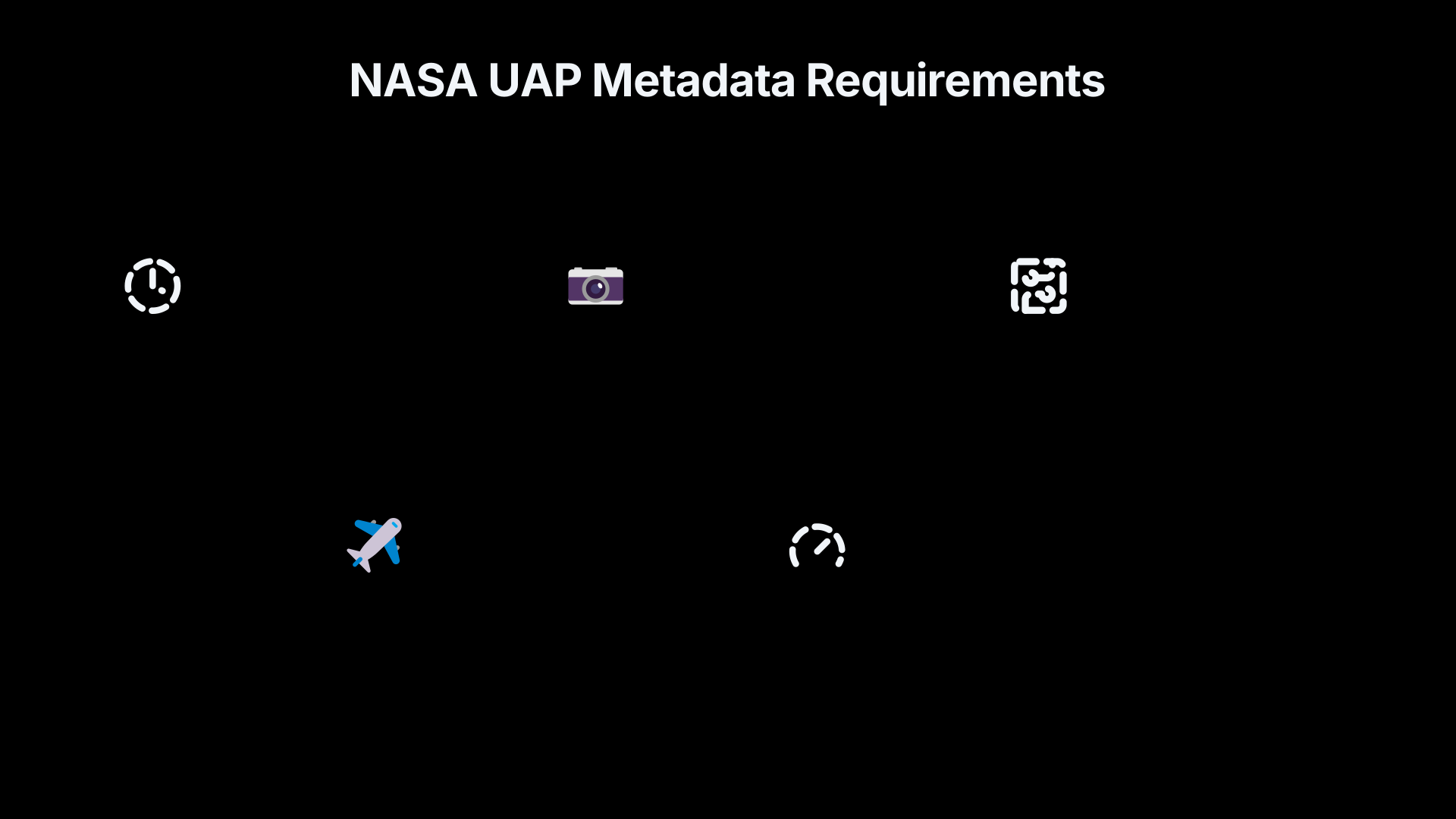
NASA did not publish a rigid reporting template, but its recommendations consistently identify the categories of metadata needed to transform an observation into an analysable measurement.
Time and location
Every observation requires an accurate timestamp together with the precise position of the observing platform.
These data allow investigators to:
- compare observations from multiple sensors;
- calculate astronomical positions;
- reconstruct aircraft or vehicle motion;
- identify known satellites and aircraft;
- compare weather conditions with the observation.
Even small timing errors can significantly alter triangulation and speed estimates when objects are moving quickly or are observed from moving platforms.
Sensor configuration
The camera itself is part of the measurement.
Useful metadata includes information such as:
- focal length or zoom level;
- field of view;
- frame rate;
- exposure time;
- gain or ISO settings;
- stabilisation mode;
- infrared or visible-light operating mode;
- compression method.
NASA specifically noted that sensor operating modes are essential contextual information because the same object may appear very differently under different imaging settings.[NASA Science]science.nasa.govNASA ScienceIndependent Study Team ReportThe panel notes that, at present, gathering data on UAP is hampered by sensor calibration challe…
Sensor identity and calibration
Knowing the sensor model is only the beginning.
Investigators also benefit from records showing:
- calibration history;
- optical distortion characteristics;
- detector noise;
- spectral sensitivity;
- known artefacts;
- manufacturer specifications.
NASA highlighted that metadata describing the sensor itself—including manufacturer information and noise characteristics—is necessary because apparent anomalies have repeatedly proved to be sensor artefacts once calibration and metadata were examined carefully.[Wikisource]en.wikisource.orgPage:UAP Independent Study TeamPage:UAP Independent Study Team - Final Report.pdf/1512 Nov 2023 — Indeed, several apparent UAP have been demonstrated to be se…
Observer and platform motion
For airborne observations, the movement of the observing platform can dominate the apparent movement of the target.
Useful metadata therefore includes:
- aircraft position;
- heading;
- pitch;
- roll;
- velocity;
- altitude;
- sensor pointing direction.
These values are indispensable when correcting for parallax and reconstructing the true geometry of the observation.
Environmental conditions
Weather and atmospheric conditions influence both the object and the measurement.
Relevant contextual data include:
- cloud cover;
- visibility;
- wind profiles;
- atmospheric turbulence;
- precipitation;
- temperature;
- solar position;
- moon phase where relevant.
These data help determine whether optical effects, atmospheric refraction or known meteorological phenomena offer conventional explanations.
Why calibration matters as much as the image
Calibration determines how faithfully a sensor records reality.
NASA’s report argues that calibrated measurements are essential because investigators must separate characteristics of the observed object from characteristics introduced by the instrument. Without calibration, apparent motion, brightness, size or shape may reflect properties of the camera rather than the target.[NASA Science]science.nasa.govNASA ScienceIndependent Study Team ReportThe panel notes that, at present, gathering data on UAP is hampered by sensor calibration challe…
For automated UAP detector networks, this has practical consequences.
A scientifically useful station should record not only images but also:
- calibration files;
- lens models;
- clock accuracy;
- software version;
- sensor health information;
- synchronisation status.
If software changes the image through sharpening, denoising, interpolation or compression, those processing steps should also be documented so later analysts understand exactly how the final image was produced.
How baseline sky data reduces false surprise
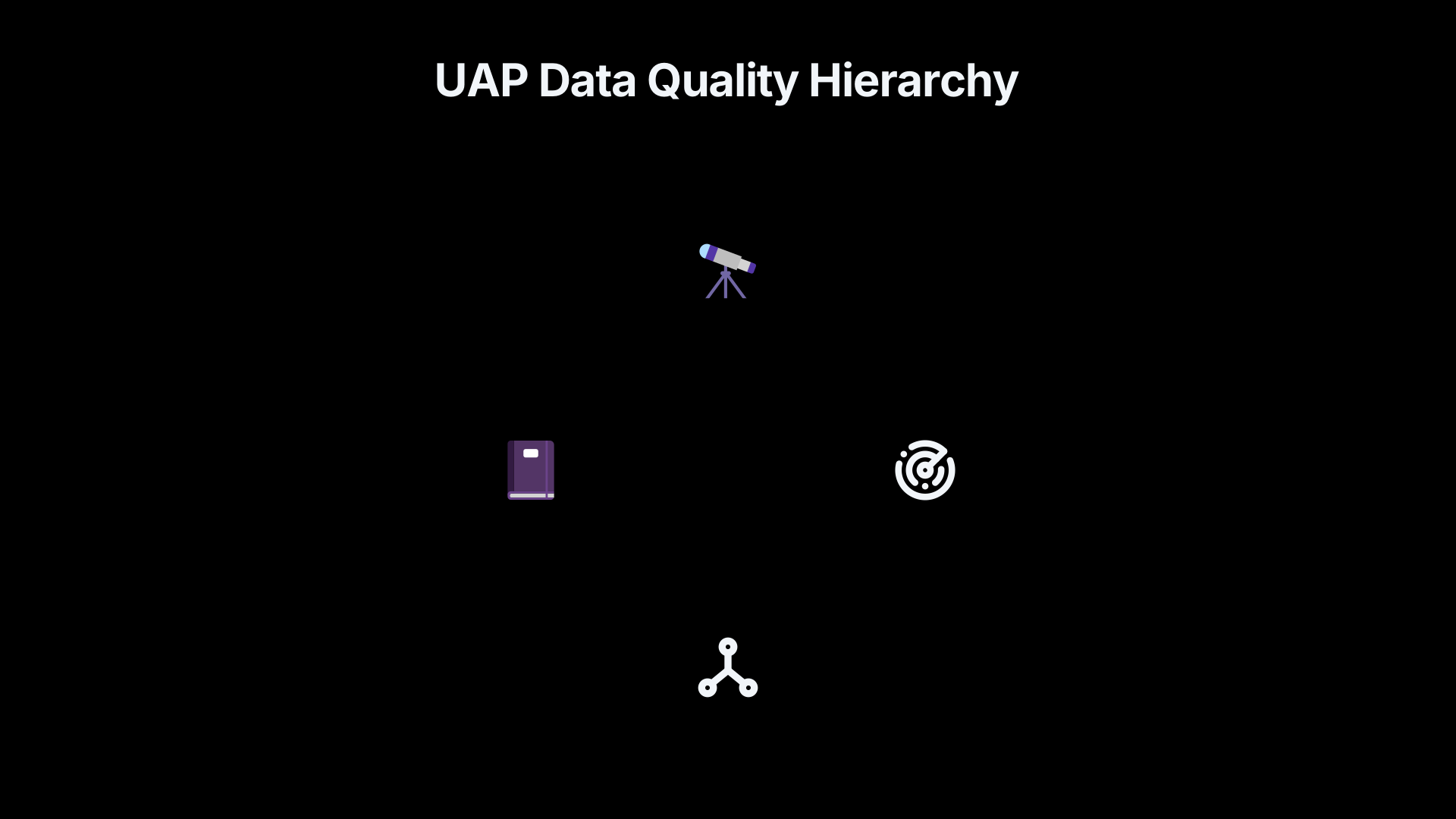
NASA repeatedly stressed the importance of baseline data—records of what the sky normally looks like under ordinary conditions.[NASA Science]science.nasa.govNASA ScienceIndependent Study Team ReportThe panel notes that, at present, gathering data on UAP is hampered by sensor calibration challe…
Baseline observations serve several purposes.
First, they establish how stars, planets, aircraft, balloons, birds, insects and satellites typically appear to a specific sensor under different lighting and weather conditions.
Second, they allow machine-learning systems to distinguish common events from genuinely unusual observations using the characteristics of the local environment rather than generic assumptions.
Third, they make rare events statistically meaningful. A detector that continuously records normal sky traffic provides a reference against which an unusual observation can be compared quantitatively instead of subjectively.
This represents an important shift in philosophy. Rather than asking whether an isolated video “looks strange,” NASA’s approach asks whether an event measurably differs from the thousands of ordinary observations collected by the same calibrated instrument.
Multiple sensors are more valuable than higher-resolution video
NASA also emphasised the importance of multiple independent measurements.[NASA Science]science.nasa.govNASA ScienceIndependent Study Team ReportThe panel notes that, at present, gathering data on UAP is hampered by sensor calibration challe…
For the problem of distance estimation, this is crucial.
A single camera usually provides only a direction to the target. Adding independent measurements—such as radar, infrared imaging, another synchronised optical camera, or observations from a second location—can provide the additional information needed to estimate range and reconstruct three-dimensional motion.
This directly addresses the parent problem of impossible-speed claims. Many dramatic velocity estimates arise because analysts unknowingly assume an incorrect distance. Independent sensors reduce that uncertainty by constraining the geometry rather than relying on visual appearance alone.
Implications for automated instrumented UFO detectors
NASA’s recommendations point towards a detector architecture that records far more than images.
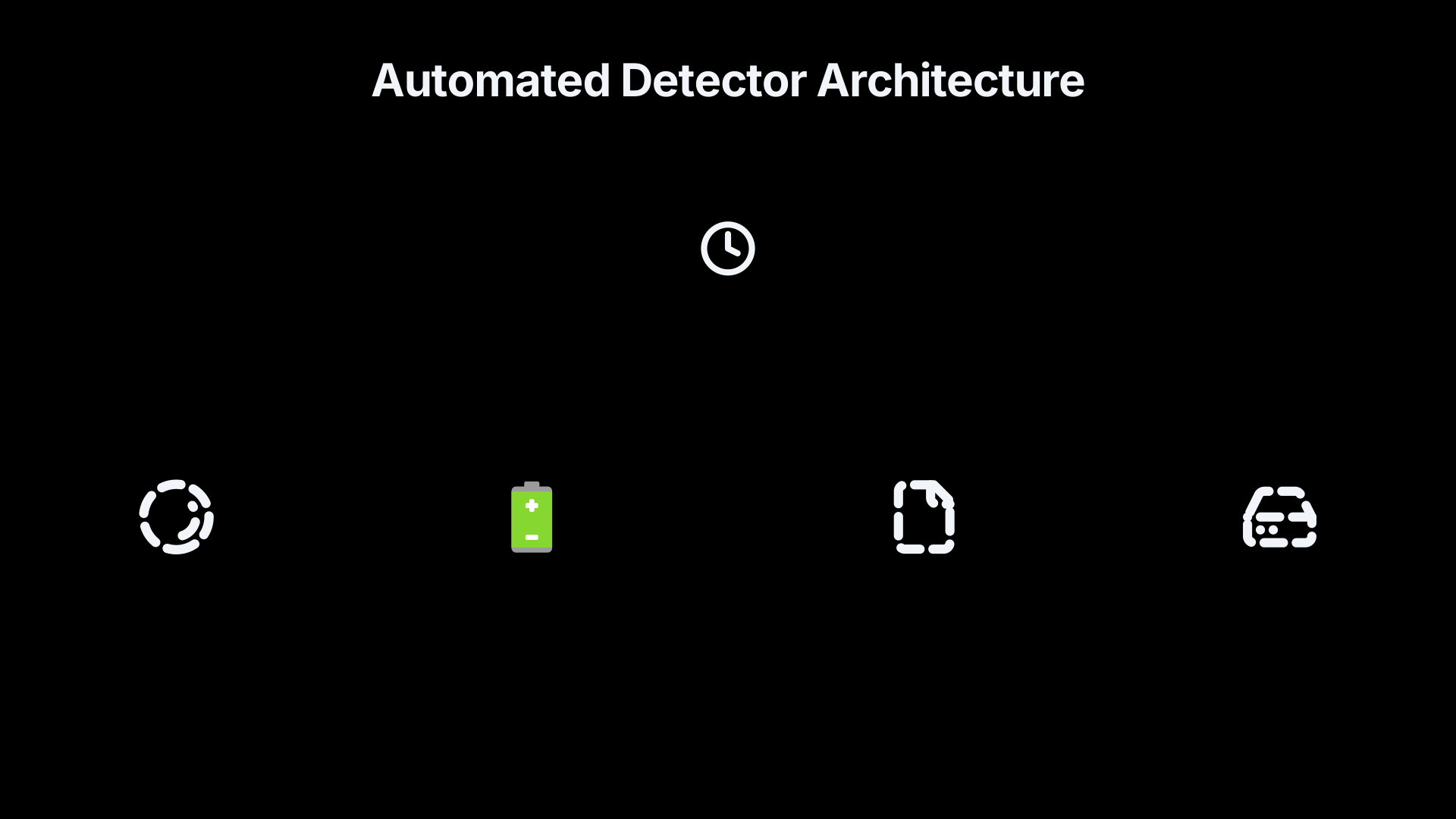
A scientifically robust automated observing station would ideally preserve:
- precise UTC timestamps;
- GPS position and orientation;
- calibrated optical characteristics;
- complete camera operating parameters;
- environmental sensor readings;
- platform motion where applicable;
- raw or minimally processed image data;
- synchronised observations from multiple instruments whenever available.
The objective is not simply to detect unusual objects, but to preserve enough contextual information that independent researchers can reproduce the analysis years later.
This emphasis on metadata represents one of NASA’s most important contributions to UAP research. Rather than proposing a specialised “UFO camera,” the study advocates applying standard scientific practice: calibrated instruments, documented measurements, reproducible observations and comprehensive metadata. Within the context of parallax and distance estimation, those records are what make it possible to distinguish genuine high-performance behaviour from ordinary objects viewed under misleading geometric conditions.[NASA Science+2NASA]science.nasa.govNASA ScienceIndependent Study Team ReportThe panel notes that, at present, gathering data on UAP is hampered by sensor calibration challe…
Amazon book picks
Further Reading
Books and field guides related to The Data Missing From Most UAP Videos. Use these as the next step if you want deeper reading beyond the article.

Multiple view geometry in computer vision
Shows how calibration and metadata enable reliable reconstruction.

Fundamentals of Astrodynamics and Applications
Useful background on trajectory determination from sensor observations.

An introduction to error analysis
Directly supports understanding of uncertainty and data quality.

eBay marketplace picks
Marketplace Samples
Live-tested eBay searches with available results related to this page.

Endnotes
1.
Source: science.nasa.gov
Link:https://science.nasa.gov/wp-content/uploads/2023/09/uap-independent-study-team-final-report.pdf
Source snippet
NASA ScienceIndependent Study Team ReportThe panel notes that, at present, gathering data on UAP is hampered by sensor calibration challe...
2.
Source: nasa.gov
Title: update nasa shares uap independent study report names director
Link:https://www.nasa.gov/news-release/update-nasa-shares-uap-independent-study-report-names-director/
Source snippet
UPDATE: NASA Shares UAP Independent Study Report14 Sept 2023 — We found that NASA can help the whole-of-government UAP effort through sys...
3.
Source: en.wikisource.org
Link:https://en.wikisource.org/wiki/NASA_Unidentified_Anomalous_Phenomena%3A_Independent_Study_Team_Report/Responses_to_Statement_of_Task
Source snippet
NASA Unidentified Anomalous Phenomena: Independent...14 Oct 2023 — The panel notes that, at present, gathering data on UAP is...
4.
Source: en.wikisource.org
Title: Page:UAP Independent Study Team
Link:https://en.wikisource.org/wiki/Page%3AUAP_Independent_Study_Team_-_Final_Report.pdf/15
Source snippet
Page:UAP Independent Study Team - Final Report.pdf/1512 Nov 2023 — Indeed, several apparent UAP have been demonstrated to be se...
5.
Source: nasa.gov
Link:https://www.nasa.gov/
Source snippet
National Aeronautics and Space Administration. NASA explores the unknown in air and space, innovates for the benefit of humanity, and...
6.
Source: science.nasa.gov
Link:https://science.nasa.gov/uap/
Source snippet
nasa.govUAP9 Jun 2022 — On September 14, 2023, the NASA Unidentified Anomalous Phenomena Independent Study Team published its final repor...
Published: September 14, 2023
7.
Source: en.wikisource.org
Link:https://en.wikisource.org/wiki/Page%3AUAP_Independent_Study_Team_-_Final_Report.pdf/5
Source snippet
wikisource.orgPage:UAP Independent Study Team - Final Report.pdf/512 Nov 2023 — At present, analysis of UAP data is hampered by poor sens...
8.
Source: zenodo.org
Link:https://zenodo.org/records/20137882
Source snippet
Unlocking the Pentagon's Declassified UFO Secrets12 May 2026 — NASA: Provided scientific validation, effectively weaponizing the scientif...
Published: May 2026
Additional References
9.
Source: war.gov
Title: dr jon kosloski director aaro media roundtable on the fy24 consolidated annual
Link:https://www.war.gov/News/Transcripts/Transcript/Article/3965734/dr-jon-kosloski-director-aaro-media-roundtable-on-the-fy24-consolidated-annual/
Source snippet
Jon Kosloski, Director, AARO, Media Roundtable on the...14 Nov 2024 — AARO has taken meaningful steps to improve data collection and ret...
10.
Source: aaro.mil
Link:https://www.aaro.mil/FAQ/
Source snippet
AARO FAQAARO will announce when a reporting mechanism is available to the public. What are the leading explanations to account for UAP re...
11.
Source: aui.edu
Link:https://aui.edu/aaro-releases-report-on-unidentified-anomalous-phenomena-uap/
Source snippet
AARO Releases Report on Unidentified Anomalous...Key findings of the report relate to overcoming such barriers, effective use of UAP dat...
12.
Source: aaro.mil
Link:https://www.aaro.mil/Portals/136/PDFs/Information_for_UAP_Analysis-20240125.pdf
Source snippet
About the PhenomenonAbout the Observer. ▫ Observer's date, time, location, and travel path for first and last observation of the UAP, wit...
13.
Source: reddit.com
Link:https://www.reddit.com/r/nasa/comments/16ij1ym/nasa_has_released_the_unidentified_anomalous/
Source snippet
Recommendations from NASA's UAP study teamNASA has released the Unidentified Anomalous Phenomena independent study team's report with rec...
14.
Source: thedebrief.org
Link:https://thedebrief.org/all-domain-anomaly-resolution-office-hosts-private-workshop-with-civilian-researchers-universities-and-government-agencies/
Source snippet
All-domain Anomaly Resolution Office Hosts Private...26 Feb 2026 — A recent AARO report outlines new standards for data collection, AI u...
15.
Source: reddit.com
Link:https://www.reddit.com/r/UFOs/comments/16ik6x5/summary_of_nasa_unidentified_anomalous_phenomena/
Source snippet
SUMMARY OF NASA UNIDENTIFIED ANOMALOUS...NASA's Unidentified Anomalous Phenomena (UAP) Independent Study Team underlines the importance...
16.
Source: linkedin.com
Link:https://www.linkedin.com/posts/nontapat-pratheeptintong-30b66a30a_uap-aerospaceengineering-opticalphysics-activity-7458756360390860800-Sk0F
Source snippet
UAP Analysis: Sensor Artifacts, Optics, and Data InsufficiencyA team at Nanjing University of Aeronautics and Astronautics has published...
17.
Source: defensescoop.com
Link:https://defensescoop.com/2023/10/18/dods-all-domain-anomaly-resolution-office-is-now-investigating-more-than-800-uap-cases/
Source snippet
DOD's All-domain Anomaly Resolution Office confirms...18 Oct 2023 — A new Pentagon report confirms that AARO has received a total of 801...
18.
Source: rev.com
Title: unidentified anomalous phenomena independent study report from nasa transcript
Link:https://www.rev.com/transcripts/unidentified-anomalous-phenomena-independent-study-report-from-nasa-transcript
Source snippet
UAP Independent Study Report from NASA18 Sept 2023 — In June of last year, NASA commissioned an independent study team to examine unident...
Topic Tree