Within Baselines
Why Repeating Satellite Tracks Matter
Satellite passes can look strange in single clips, but repeated local records help show which tracks return predictably.
On this page
- How predictable passes enter the local baseline
- Why satellites can remain unmatched in camera only data
- What repeated tracks reveal about normal sky traffic
Page outline Jump by section
Introduction
Recurring satellite passes are one of the most important ingredients in a reliable baseline for automated instrumented UFO or UAP detection. A single camera recording of a bright moving light may appear unusual, especially if it lacks supporting radar, timing or positional data. However, when the same detector observes similar tracks repeatedly at predictable times, directions and speeds over weeks or months, those events become part of the site’s normal pattern of sky activity rather than unexplained anomalies. This is why modern pattern-of-life collection emphasises long-term observation instead of isolated sightings. A detector that repeatedly sees satellites passing through known parts of the sky becomes better at recognising ordinary orbital traffic and less likely to flag it as something exceptional. NASA’s independent UAP study likewise stressed that robust baseline data and calibrated measurements are essential before identifying genuine anomalies.[NASA Science]science.nasa.govScience Independent Study Team ReportNASA ScienceIndependent Study Team ReportSeptember 13, 2023 — The study of Unidentified Anomalous Phenomena (UAP) presents a unique scien…

How predictable satellite passes become part of the local baseline
Unlike aircraft, satellites usually produce no navigation lights, engine noise or publicly broadcast identity that can be received directly by ordinary cameras. Yet they are among the most predictable moving objects in the night sky because their orbits are governed by well-understood mechanics and are tracked continuously through publicly available orbital data.
For a fixed observing station, this predictability gradually becomes measurable rather than theoretical. After weeks of operation, an automated system begins accumulating repeated observations showing that:
- certain sky corridors consistently contain satellite traffic shortly after sunset or before sunrise;
- similar angular speeds recur from the same directions;
- many tracks repeat on successive nights with only small timing shifts caused by orbital motion;
- seasonal changes alter visibility, but not the underlying orbital behaviour.
These repeated detections become part of the detector’s local statistical model. Instead of treating every bright moving point as a fresh mystery, the system learns that similar events occur frequently under similar conditions. This transforms recurring satellite observations from apparent anomalies into expected background activity.[NASA Science+2Breaking Defense]science.nasa.govScience Independent Study Team ReportNASA ScienceIndependent Study Team ReportSeptember 13, 2023 — The study of Unidentified Anomalous Phenomena (UAP) presents a unique scien…
For automated UAP sensors, this is analogous to learning local aircraft routes. The value lies not in identifying every satellite individually, but in understanding that recurring orbital traffic has consistent spatial and temporal patterns.
Why satellites can remain unmatched in camera-only data
Even though satellite orbits are predictable in principle, camera-only observations often cannot identify individual spacecraft with certainty.
Several practical limitations contribute to this problem:
- consumer and scientific cameras rarely measure range directly;
- wide-angle systems may record only a short segment of a pass;
- clouds, haze and atmospheric scattering alter apparent brightness;
- timing errors of even a few seconds can complicate orbital matching;
- publicly available orbital elements are updated periodically rather than continuously.
Consequently, a detector may record a genuine satellite that cannot immediately be matched to a specific catalogue entry. That lack of an instant identification does not necessarily indicate an unknown object.
Brightness is another source of confusion. Satellite reflections vary dramatically depending on the positions of the Sun, spacecraft orientation and observer. Some passes remain extremely faint, while others suddenly brighten by several magnitudes before fading within seconds. These changes can look surprising in isolated video clips despite being entirely consistent with reflected sunlight.[AARO+2A&A]aaro.milCorrelations of Starlink Satellite Flaring with UAPCorrelations of Starlink Satellite Flaring with UAP…April 22, 2025 — by A An · 2024 — Many in the astronomy community are concerne…
The historical example of Iridium flares demonstrated how spectacular satellite reflections could be mistaken for unusual aerial phenomena until their geometry became well understood. Modern satellite constellations produce different reflection patterns, but the underlying lesson remains the same: repeated observations reveal regularity that single observations conceal.[A&A]aanda.orgaa37501 20A&AImpact of satellite constellations on astronomical…by OR Hainaut · 2020 · Cited by 183 — Flares of −5 mag in brightness occurred th…
What repeated observations reveal about normal sky traffic
Long-duration monitoring produces information unavailable from isolated sightings.
Repeated observations show that satellite activity is not randomly distributed. Instead, detectors often discover persistent characteristics such as:
- preferred elevation ranges where satellites become visible after leaving Earth’s shadow;
- regular concentrations near twilight, when sunlight still illuminates spacecraft while the ground is dark;
- recurring orbital inclinations that generate familiar paths across the camera’s field of view;
- systematic changes associated with seasons and solar geometry.
These recurring patterns allow software to estimate the normal probability of satellite appearance in different parts of the sky. Rather than asking, “Is this object unusual?”, the detector begins asking, “How unusual is this event compared with thousands of previous nights?”
That shift from binary classification to probability estimation is one of the central advantages of pattern-of-life collection.
Large satellite constellations make this even more important. Thousands of low-Earth-orbit spacecraft now contribute to increasingly busy skies, meaning that repeated observations become richer but also more complex. Baseline datasets therefore require continual updating as the orbital population changes.[Space+2CelesTrak]space.comStarlink satellites: Facts, tracking and impact on astronomyStarlink satellites: Facts, tracking and impact on astronomyApril 14, 2022 — 1 Jun 2026 — As of June 1, 2026, there are currently 10…

Satellite flares show why repetition matters
One of the clearest demonstrations of the value of recurring observations comes from satellite flares and glints.
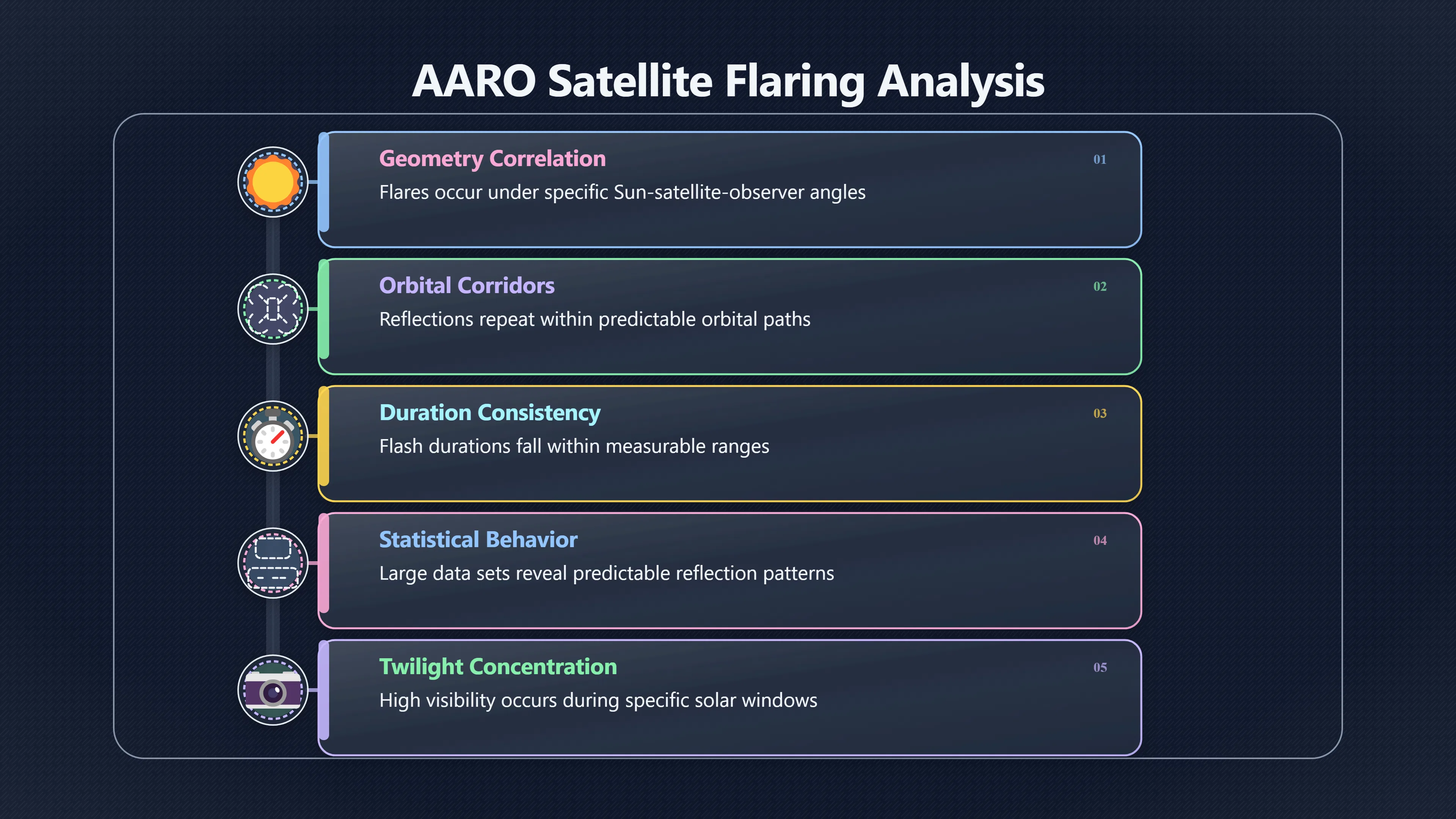
Reflections from satellite surfaces can create brief flashes that appear to accelerate, brighten or vanish suddenly. Viewed once, these events may appear extraordinary. Recorded repeatedly from the same site, however, they exhibit measurable regularities:
- they occur under similar Sun-satellite-observer geometry;
- they repeat in characteristic orbital corridors;
- their durations fall within consistent ranges;
- many coincide with predicted satellite passages.[aaro.mil]aaro.milCorrelations of Starlink Satellite Flaring with UAPCorrelations of Starlink Satellite Flaring with UAP…April 22, 2025 — by A An · 2024 — Many in the astronomy community are concerne…
Recent analysis by the U.S. All-domain Anomaly Resolution Office (AARO) examined correlations between Starlink flaring and reported UAP observations, highlighting how repeated optical reflections from satellite constellations can contribute to misidentifications if observational context is incomplete.[AARO]aaro.milCorrelations of Starlink Satellite Flaring with UAPCorrelations of Starlink Satellite Flaring with UAP…April 22, 2025 — by A An · 2024 — Many in the astronomy community are concerne…
Studies of Starlink brightness have likewise shown that although individual flares may appear unpredictable to casual observers, their statistical behaviour becomes increasingly predictable across large observational datasets.[arXiv]arxiv.orgOpen source on arxiv.org.
Why automated detectors benefit from historical comparison
A mature automated detector rarely evaluates a new observation in isolation. Instead, it compares incoming measurements against its accumulated history.
For recurring satellites, this historical comparison can identify:
- similar tracks recorded on previous nights;
- recurring transit directions;
- expected angular velocities;
- normal brightness distributions for comparable viewing geometry;
- known seasonal frequencies.
This comparison does not require perfect identification of every spacecraft. Instead, it recognises that the observation belongs to a repeatedly observed class of ordinary orbital behaviour.
AARO’s description of GREMLIN sensor deployments explicitly refers to collecting a 90-day “pattern of life” before attempting operational anomaly detection, illustrating how sustained observation is becoming a deliberate design choice rather than a secondary feature.[Breaking Defense]breakingdefense.comBreaking DefenseGREMLIN, but no aliens: Pentagon UAP office plans first…14 Nov 2024 — GREMLIN “successfully collected data” for a 90-d…
Why recurring satellites reduce false anomalies
Recurring satellites demonstrate a broader principle behind baseline sky data: repetition is evidence.
A single unexplained recording often lacks enough context for confident interpretation. Hundreds of similar recordings collected by the same calibrated instruments, under known observing conditions, reveal whether the behaviour is genuinely exceptional or simply part of the local sky’s normal rhythm.
As satellite numbers continue to increase, this historical perspective becomes increasingly valuable. Rather than eliminating satellite detections, an effective automated UAP detector incorporates them into its evolving model of ordinary sky traffic. The richer that baseline becomes, the more confidently the system can distinguish common orbital activity from events that genuinely depart from established patterns.[NASA Science+2Space]science.nasa.govScience Independent Study Team ReportNASA ScienceIndependent Study Team ReportSeptember 13, 2023 — The study of Unidentified Anomalous Phenomena (UAP) presents a unique scien…
Amazon book picks
Further Reading
Books and field guides related to Why Repeating Satellite Tracks Matter. Use these as the next step if you want deeper reading beyond the article.
NightWatch
Covers practical recognition of common night-sky objects, including predictable sky motion.
The Backyard Astronomer's Guide
Relevant to cameras, observing conditions, sky traffic, and systematic amateur observation.
The Demon-Haunted World
Reinforces careful explanation-seeking before treating repeated lights as anomalous.
Turn Left at Orion
Helps readers build observational context for repeated tracks and normal celestial motion.
eBay marketplace picks
Marketplace Samples
Example marketplace items related to this page. Use the search link to explore similar finds on eBay.
Endnotes
1.
Source: science.nasa.gov
Title: Science Independent Study Team Report
Link:https://science.nasa.gov/wp-content/uploads/2023/09/uap-independent-study-team-final-report.pdf
Source snippet
NASA ScienceIndependent Study Team ReportSeptember 13, 2023 — The study of Unidentified Anomalous Phenomena (UAP) presents a unique scien...
Published: September 13, 2023
2.
Source: space.com
Title: pentagon ufo uap office aaro sensors anomalies orbit
Link:https://www.space.com/pentagon-ufo-uap-office-aaro-sensors-anomalies-orbit
Source snippet
Pentagon UFO office developing 'Gremlin' sensors to help...9 Mar 2024 — The Pentagon's UFO office is developing sensor kits to help it c...
3.
Source: celestrak.org
Link:https://celestrak.org/publications/ICSSA/2020/
Source snippet
SSA Degradation From Large Constellations1 Jul 2022 — We explore the potential impacts to, and degradations of, Space Situational Awarene...
4.
Source: aaro.mil
Title: Correlations of [Starlink Satellite]({{ ‘starlink/’ | relative_url }}) Flaring with UAP
Link:https://www.aaro.mil/Portals/136/PDFs/Information%20Papers/AARO_Satellite_Flaring_Paper_508_FINAL_04222025.pdf
Source snippet
Correlations of Starlink Satellite Flaring with UAP...April 22, 2025 — by A An · 2024 — Many in the astronomy community are concerne...
Published: April 22, 2025
5.
Source: aanda.org
Title: aa37501 20
Link:https://www.aanda.org/articles/aa/full_html/2020/04/aa37501-20/aa37501-20.html
Source snippet
A&AImpact of satellite constellations on astronomical...by OR Hainaut · 2020 · Cited by 183 — Flares of −5 mag in brightness occurred th...
6.
Source: arxiv.org
Link:https://arxiv.org/abs/2111.09735
7.
Source: space.com
Title: Starlink satellites: Facts, tracking and impact on astronomy
Link:https://www.space.com/spacex-starlink-satellites.html
Source snippet
Starlink satellites: Facts, tracking and impact on astronomyApril 14, 2022 — 1 Jun 2026 — As of June 1, 2026, there are currently 10...
Published: April 14, 2022
8.
Source: aaro.mil
Link:https://www.aaro.mil/
Source snippet
AARO HomeWelcome to the website for the All-domain Anomaly Resolution Office (AARO). Our team of experts leads the U.S. government's effo...
9.
Source: arxiv.org
Link:https://arxiv.org/abs/2412.10814
Source snippet
more...
10.
Source: breakingdefense.com
Link:https://breakingdefense.com/2024/11/gremlin-but-no-aliens-pentagon-uap-office-plans-first-deployment-of-new-sensor-suite/
Source snippet
Breaking DefenseGREMLIN, but no aliens: Pentagon UAP office plans first...14 Nov 2024 — GREMLIN “successfully collected data” for a 90-d...
Additional References
11.
Source: facebook.com
Link:https://www.facebook.com/groups/2365809903441367/posts/25942210465374646/
Source snippet
How to predict Starlink satellite flares?New research reveals that under certain conditions, SpaceX's Starlink satellites can produce “ex...
12.
Source: blog.neuraspace.com
Title: patterns of life in orbit how neuraspace is making sense of satellite behaviour
Link:https://blog.neuraspace.com/patterns-of-life-in-orbit-how-neuraspace-is-making-sense-of-satellite-behaviour
Source snippet
of Life in Orbit: How Neuraspace Is Making Sense...3 Jul 2025 — Using publicly available orbital data, we developed a deep learning mode...
13.
Source: youtube.com
Link:https://www.youtube.com/watch?v=HkPDHmc7XcQ
Source snippet
REPLAY! NASA Announces Unidentified Aerial Phenomena...NASA is commissioning on unidentified aerial phenomena. These are the observation...
14.
Source: avi-loeb.medium.com
Title: a new calculation on the fly to the nasa uap study 2dacaf860cac
Link:https://avi-loeb.medium.com/a-new-calculation-on-the-fly-to-the-nasa-uap-study-2dacaf860cac
Source snippet
New Calculation on the Fly to the NASA UAP Study - Avi LoebThe NASA Study will examine unclassified data on UAP in an attempt to separate...
15.
Source: nextgov.com
Title: nasa teams plan decode ufo sightings hinges better data
Link:https://www.nextgov.com/digital-government/2023/05/nasa-teams-plan-decode-ufo-sightings-hinges-better-data/386954/
Source snippet
NASA team's plan to decode UFO sightings hinges on...31 May 2023 — The space agency is convening an independent panel to publish a repor...
Published: May 2023
16.
Source: instagram.com
Link:https://www.instagram.com/reel/CxL-UQHxSzQ/?hl=en
Source snippet
These videos capture objects moving at high speeds with no visible propulsion systems...
17.
Source: skyandtelescope.org
Title: starlink flares can fool anyone even airline pilots
Link:https://skyandtelescope.org/astronomy-news/starlink-flares-can-fool-anyone-even-airline-pilots/
Source snippet
Starlink Flares Can Fool Anyone — Even Airline Pilots10 Jun 2024 — The flare from numerous Starlink satellites, launched by SpaceX to pro...
18.
Source: splid-devkit.readthedocs.io
Link:https://splid-devkit.readthedocs.io/en/latest/dataset.html
Source snippet
The astrometric data consists of the osculating orbital elements...Read more...
19.
Source: defensescoop.com
Link:https://defensescoop.com/2024/03/08/embargo-10a-friday-dod-developing-gremlin-capability-to-help-personnel-collect-real-time-uap-data/
Source snippet
AARO's acting director Tim Phillips gave his first off-camera...Read more...
20.
Source: earthsky.org
Title: another uap study this one will be from nasa
Link:https://earthsky.org/human-world/another-uap-study-this-one-will-be-from-nasa/
Source snippet
New UAP study: This one is from NASA10 Jun 2022 — NASA is commissioning a new UAP study to examine unidentified aerial phenomena (UAPs, a...
Topic Tree