Within Sky Detectors
What Fools UFO Detectors Most Often?
Most sky alarms are ordinary things, so detector pages need to explain the common impostors before the rare events.
On this page
- Biological false alarms
- Aircraft, satellites, and Starlink flares
- Lens, focus, parallax, and exposure artefacts
Page outline Jump by section
Introduction
Automated UFO or UAP detectors do not fail mainly because the sky is empty; they fail because the sky is crowded. Birds, insects, aircraft, balloons, satellites, stars and camera artefacts can all produce “interesting” motion, flashes, blobs or streaks in an automated system before any unusual event is even considered. That is why a useful detector page has to start with false positives. NASA’s UAP study put the core problem plainly: analysis is weakened by poor calibration, missing metadata, lack of multiple measurements and lack of baseline data. Without those basics, a detector cannot reliably tell the difference between an anomaly and ordinary sky clutter recorded under awkward conditions.[NASA Science]science.nasa.govScience Independent Study Team ReportNASA ScienceIndependent Study Team ReportSeptember 13, 2023 — At present, analysis of UAP data is hampered by poor sensor calibration, th…
The practical lesson is not that all UFO reports are birds or satellites. It is that most automated alarms should be expected to be ordinary until the system proves otherwise. The best instrumented projects now treat detection as a filtering problem: build a long-term census of normal aerial activity, classify the common impostors, and reserve attention for tracks that survive checks against biology, aircraft data, satellite predictions, weather, optical behaviour and sensor metadata. The Galileo Project describes this as a multi-modal census of natural and human-made aerial phenomena, not a simple “UFO camera”.[arXiv]arxiv.orgThe Scientific Investigation of Unidentified Aerial Phenomena (UAP) Using Multimodal Ground-Based ObservatoriesMay 29, 2023…
Why False Positives Are the Main Work
A sky detector is usually watching a scene where the overwhelming majority of moving objects are mundane. The All-domain Anomaly Resolution Office, or AARO, lists airborne clutter such as debris, balloons and birds among the common causes reported as UAP, and a 2024 Department of Defense update said AARO had resolved hundreds of cases as commonplace objects including balloons, birds, drones, satellites and aircraft.[AARO]aaro.milAARO HomeCommon objects/causes frequently reported as UAP include: Airborne clutter: Includes windborne debris like plastic bags and…[U.S. Department of War]war.govdod examining unidentified anomalous phenomenaDepartment of WarDOD Examining Unidentified Anomalous Phenomena14 Nov 2024 — "AARO has successfully resolved hundreds of cases in its hol…
That matters because automated systems can be seduced by exactly the same things that confuse people. A small nearby insect may look like a large distant object. A bird crossing an infrared frame may appear as a bright object with no obvious wings. A satellite flare may brighten, vanish and reappear in a way that feels controlled. A star near the edge of focus may become a glowing disc. The problem is not simply “misidentification”; it is missing scale. A camera sees angle, brightness and time. Distance, size and speed have to be inferred, and bad inference is where false positives thrive.
For automated instrumented UFO detectors, the risk is amplified by software. A human might ignore a moth near a lens; a motion detector may flag it as a fast, high-contrast object. A neural network trained on too few local examples may learn a station’s quirks rather than the sky. A trigger threshold set too sensitively may produce thousands of clips of leaves, insects, birds and aircraft. A threshold set too conservatively may miss the very event the system was built to capture.
The serious systems therefore do not merely ask, “Did something move?” They ask a chain of harder questions:
- Does the track match known aircraft using ADS-B or other aviation data?
- Does the time and direction match a satellite, meteor shower, planet, star, rocket launch or re-entry?
- Is the object in focus, or could it be close to the lens?
- Is the apparent acceleration caused by camera motion, parallax, zoom, stabilisation or exposure?
- Does another sensor see the same event at the same time?
- Does a second camera at another location triangulate a physical object at a plausible distance?
This is why NASA’s emphasis on calibration, metadata, multiple measurements and baseline data is not bureaucratic housekeeping. It is the difference between a database of interesting videos and a measurement system.[NASA Science]science.nasa.govScience Independent Study Team ReportNASA ScienceIndependent Study Team ReportSeptember 13, 2023 — At present, analysis of UAP data is hampered by poor sensor calibration, th…
Biological False Alarms
Birds and insects are awkward because they are physical objects, not sensor glitches. They can appear on optical cameras, infrared cameras and sometimes radar-like systems. They may move erratically, change direction abruptly, disappear behind clutter, and vary in brightness as they flap, bank or pass through focus. In a single-camera clip, that can look more exotic than it is.
AARO’s public imagery catalogue includes a case resolved as migratory birds from Africa, based on infrared footage submitted by United States Africa Command. The same page lists several other cases resolved as balloons and one closed as not anomalous, showing how official UAP review often turns on ordinary airborne objects rather than extraordinary vehicles.[AARO]aaro.milOpen source on aaro.mil.
Birds are especially troublesome for automatic detectors because their apparent behaviour depends heavily on distance. A nearby bird crossing the field of view can cover many degrees per second, giving the impression of extreme speed. A distant flock may appear as several points that brighten and fade in formation. In thermal imagery, a bird can be a compact bright target, and wing motion may be blurred or invisible depending on frame rate, range and exposure.
Insects are worse near the lens. A moth, beetle, fly or spider thread close to the camera can be so out of focus that it becomes a soft orb, streak or translucent shape. If it is illuminated by infrared LEDs, moonlight, a porch light or the detector’s own equipment, it may appear bright against a dark sky. Because it is close, even slow movement can sweep rapidly across the frame. A detector that estimates speed from angular motion alone may treat a centimetre-scale insect as a large object moving implausibly fast.
The Galileo Project’s early public descriptions of its software emphasise exactly this clutter problem: the system is meant to identify outliers among familiar objects such as insects, birds, leaves, clouds, balloons, drones, aircraft and satellites. That framing is important. The detector is not useful because it avoids ordinary objects; it is useful only if it learns ordinary objects well enough to reject them.[The Debrief]thedebrief.orgOpen source on thedebrief.org.
A robust biological-false-positive filter usually needs more than a shape classifier. It needs behaviour. Birds often have sinuous or flapping tracks rather than smooth inertial motion. Insects often change apparent size and blur because they are close to the optics. Leaves drift with wind and tumble. Bats and birds may cluster around twilight. Local ecology matters too: a station near water, trees, fields or street lighting will have a different false-positive profile from a dry rooftop observatory.
The criticism for detector designers is straightforward: “anomalous motion” is not enough. The first question should be whether the motion is anomalous for a distant craft, or merely normal for a nearby living thing.
Aircraft, Satellites and Starlink Flares
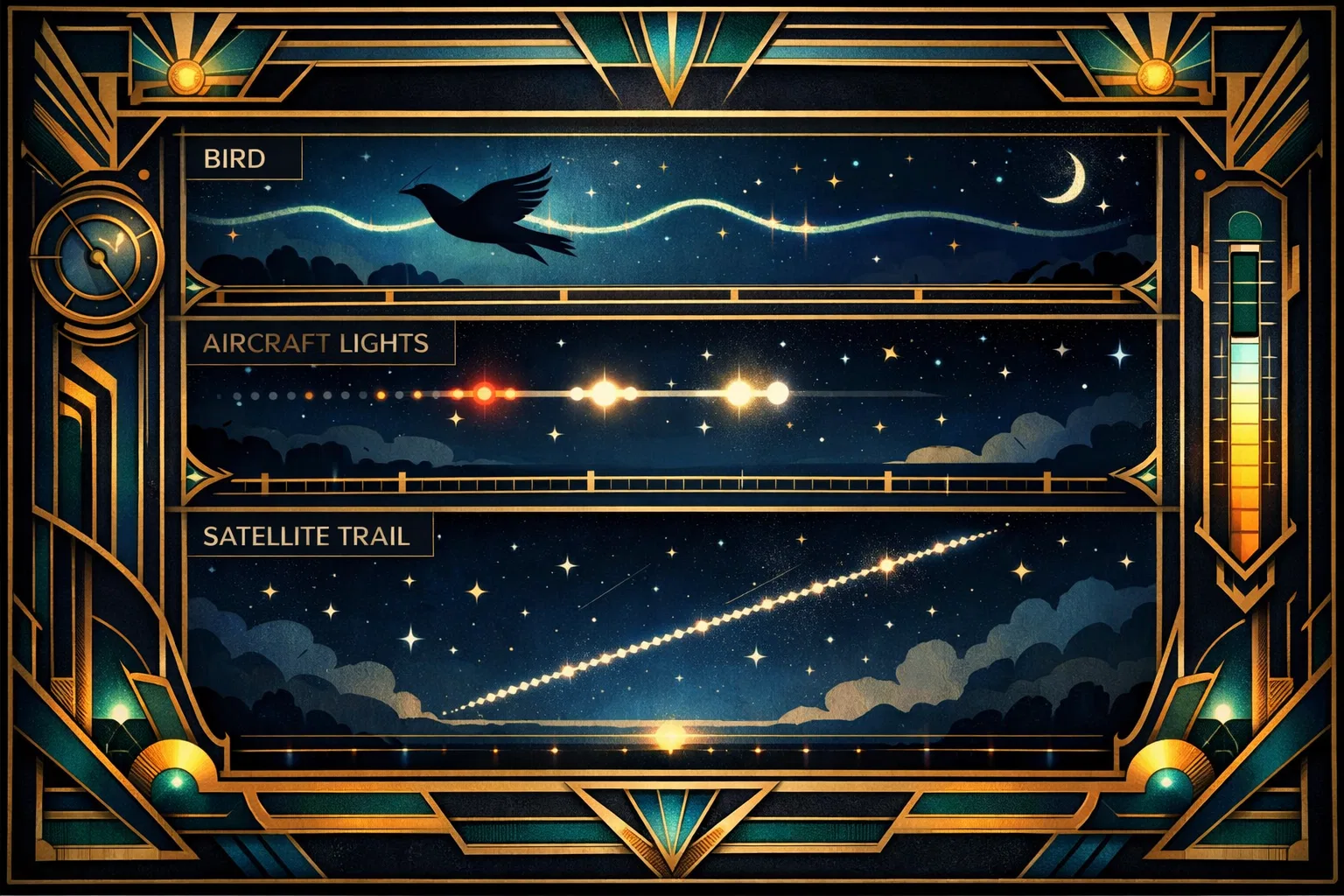
Aircraft are the obvious false positive, but satellites have become the more surprising one. A conventional aircraft can often be filtered with ADS-B, flight schedules, navigation lights, sound, radar, or repeated local routes. Satellites are quieter, higher, sometimes intermittent, and increasingly numerous. They can appear as steady moving points, bright streaks, trains of lights, sudden flares or objects that seem to vanish.
Starlink is the standout example because it has changed the visual texture of the night sky. AARO’s 2024 satellite flaring paper explains that satellite flares are not new, but Starlink trains are relatively new because SpaceX deploys many satellites from a single launch. For several days after launch, they can form a distinctive line of bright objects before spreading out and fading as they move towards operational orbit. The same AARO paper notes that Starlink satellite components can produce diffuse and specular reflections, including flares much brighter than surrounding stars.[AARO]aaro.milCorrelations of Starlink Satellite Flaring with UAPCorrelations of Starlink Satellite Flaring with UAP
This is not just a public-observer problem. A 2024 case study reconstructed an incident on 10 August 2022 in which five pilots on two commercial flights over the Pacific reported a UAP. The researchers used Starlink orbital data and aircraft ADS-B data to show that a recently launched Starlink train could account for the observations, including the unusual viewing geometry from the cockpit.[arXiv]arxiv.orgOpen source on arxiv.org.
For automated UFO detectors, that case is a warning. Multiple witnesses, photographs and video do not automatically mean an object is exotic. Several observers can be fooled by the same satellite geometry if they are looking from similar locations at similar times. Likewise, several cameras in one area may record the same flare, giving a false sense of triangulated mystery unless the system checks satellite ephemerides and illumination conditions.
Starlink and other low-Earth-orbit satellites create several detector-specific traps:[facebook.com]facebook.comSource details in endnotes.
- Straight streaks in long exposure: astronomy surveys treat satellite trails as a serious image-contamination problem. Automated satellite-trail detection methods now use deep learning and computer-vision tools to find and mask trails in ground-based images.[arXiv]arxiv.orgOpen source on arxiv.org.
- Bright flares: specular reflections can brighten suddenly, then fade, creating the impression of appearance and disappearance rather than simple orbital motion.[arXiv]arxiv.orgarXiv Extreme Flaring of Starlink SatellitesarXiv Extreme Flaring of Starlink Satellites
- Trains and clusters: recently launched satellites can appear as a line or group of objects moving together, unlike the single moving point many people expect a satellite to be.[AARO]aaro.milCorrelations of Starlink Satellite Flaring with UAPCorrelations of Starlink Satellite Flaring with UAP
- Pilot and camera geometry: an object that looks strange from an aircraft cockpit or fixed ground station may be predictable once the observer’s location, time and line of sight are reconstructed.[arXiv]arxiv.orgOpen source on arxiv.org.
The solution is not to dismiss all lights as satellites. It is to make satellite rejection automatic. A serious detector should log precise time, location, pointing direction, field of view and exposure; compare events against satellite catalogues and two-line element data where available; and model whether the object would be sunlit from the detector’s position. Without that, satellite clutter will keep producing “interesting” clips.
Stars and planets sit in a different category. They do not usually move quickly across the frame, but they can trigger false alarms through focus drift, mount vibration, clouds, atmospheric scintillation or camera processing. A bright planet near the horizon can shimmer, change colour and appear to move when framed against trees or clouds. A fixed star can become a moving object if the camera, tripod, tracking mount or digital stabilisation shifts. A detector trained only on clean star fields may overreact to thin cloud, haze, aircraft passing near bright stars, or lens reflections around bright celestial objects.
Lens, Focus, Parallax and Exposure Artefacts
Many of the most persuasive-looking false positives are not objects behaving strangely. They are ordinary objects plus optics behaving normally. NASA’s UAP report noted that several apparent UAP have been shown to be sensor artefacts after proper calibration and metadata scrutiny. That is the key distinction: the footage can be real while the apparent behaviour is not.[Wikisource]en.wikisource.orgResponses to Statement of TaskResponses to Statement of Task
Out-of-focus light is a common trap. A point source such as a star, aircraft light, satellite glint or reflection can become a soft disc when focus is wrong. The shape of that disc is governed by the optics, aperture, sensor and processing, not by the object itself. This is why “orb” videos are weak evidence unless the system can show focus state, range, point-spread behaviour and whether the object was resolved.
Parallax is another major source of false motion. A nearby object crossing in front of a distant background appears to move quickly even if it is slow. A camera on a moving aircraft, ship, vehicle or rotating mount can make distant objects appear to accelerate or reverse direction. Zoom changes can exaggerate this. Digital stabilisation can keep the background steady while making a foreground object look as if it is sliding unnaturally.
Exposure can produce its own illusions. Long exposures turn moving objects into streaks. Short exposures may hide wing motion or navigation-light flashes. Rolling shutter can distort fast motion. Compression can smear small objects into blocks. Infrared cameras can lose contrast when a target and background have similar apparent temperatures, creating disappearance or “transmedium” impressions. A 2024 public discussion of AARO cases described one Puerto Rico infrared video in which a supposed transition into water was assessed as an infrared contrast effect rather than an object entering the sea.[News.com.au]news.com.auBlack object': Pentagon's wild UFO revelationBlack object': Pentagon's wild UFO revelation
Automated systems need to preserve the boring details that later make these artefacts testable: lens model, focus setting, aperture, gain, exposure time, frame rate, compression level, sensor temperature, weather, camera motion, mount state and processing steps. A detector that saves only a cropped, compressed clip may throw away the evidence needed to explain its own alarm.
This is one reason astronomical transient surveys are useful analogues for UAP detectors. Modern sky surveys already fight “real versus bogus” problems at industrial scale. Zwicky Transient Facility work, for example, uses machine-learning classifiers to separate real astrophysical events from false detections, while moving-object pipelines use shape, photometry and repeated observations to reduce false positives. Those methods do not translate perfectly to low-altitude UAP detection, but the lesson does: every automated sky survey must invest heavily in rejecting artefacts before claiming rare events.[arXiv]arxiv.orgOpen source on arxiv.org.[arXiv]arxiv.orgOpen source on arxiv.org.
What a Good Detector Should Do Before It Says “Unusual”
The strongest false-positive defence is layered. No single filter is enough, because each impostor can mimic one feature of an anomaly. A bird can be physical and hot. A satellite can be bright and silent. A lens reflection can move with the camera. A star can shimmer and change colour. A balloon can drift in a way that looks deliberate when viewed without wind data.
A useful automated instrumented UFO detector should therefore apply several tests before escalating an event:
- Local sky baseline: the station should know its normal rates of birds, insects, aircraft, satellites, cloud edges, reflections and weather-triggered motion.
- Aircraft correlation: ADS-B and other aviation data should be checked, while recognising that not all aircraft broadcast complete public data.
- Satellite correlation: satellite predictions should include not only path but illumination, flare geometry and recent launch trains.
- Optical sanity checks: focus, exposure, point-spread shape, compression and lens reflections should be logged and reviewed.
- Multi-sensor confirmation: optical, infrared, acoustic, radio, radar-like and environmental channels should be compared when available.
- Multi-site geometry: two or more separated stations can turn angular motion into range and altitude, which is the fastest way to distinguish nearby bugs from distant objects.
- Human review of edge cases: automation should triage, not replace, expert interpretation when the event survives ordinary filters.
The Galileo Project’s instrument concept points in this direction by combining wide-field and narrow-field cameras, infrared instruments, passive radar-style receivers, radio-spectrum monitoring, acoustic sensors, environmental sensors and other measurements. The design logic is simple: a single camera can be fooled by too many things; independent channels make false explanations easier to test.[arXiv]arxiv.orgThe Scientific Investigation of Unidentified Aerial Phenomena (UAP) Using Multimodal Ground-Based ObservatoriesMay 29, 2023…
UFODAP and similar detector projects also show the same ambition: track and record anomalous objects while collecting data from multiple sensors. The risk is that hardware can look scientific while software, metadata and verification remain weak. A UAPx field-expedition paper, for example, criticised UFODAP software reliability for object tracking and identification in that deployment and noted missing ancillary data such as GPS location and ADS-B exchange. That kind of criticism is valuable because it identifies the gap between “a detector recorded something” and “a detector produced analysable evidence”.[UFODAP]ufodap.comOpen source on ufodap.com.[arXiv]arxiv.orgOpen source on arxiv.org.
The Real Test Is Not Detection but Rejection
The most important capability of an automated UFO detector is not spotting motion. Cheap cameras can do that. The hard capability is disciplined rejection: the ability to say, with stored evidence, “this was probably a bird”, “this matches a satellite flare”, “this is a focus artefact”, or “this event remains unusual after ordinary explanations were tested”.
That changes how detector results should be read. A station that posts many dramatic clips but rarely explains rejected alarms is not necessarily doing better science than a station that reports fewer events. It may simply have poorer filtering. Conversely, a detector that quietly rejects thousands of birds, bugs, aircraft, satellites and stars is building the baseline needed for a rare surviving case to matter.
The credibility of automated instrumented UFO detection will depend less on spectacular captures than on transparent false-positive handling. The systems that deserve attention will be the ones that publish not only their anomalies, but also their mistakes: the moths, geese, Starlink trains, lens flares, focus failures and misleading stars that taught the detector what the ordinary sky looks like.
Amazon book picks
Further Reading
Books and field guides related to What Fools UFO Detectors Most Often?. Use these as the next step if you want deeper reading beyond the article.
The UFO Experience
Focuses on classification, investigation, and separating unusual reports from ordinary explanations.
Astrophotography
Explains imaging artefacts, exposure effects, tracking issues, and optical misinterpretations.
Turn Left at Orion
Helps readers recognize common celestial objects often mistaken for unusual aerial phenomena.

The handbook of astronomical image processing
Provides background on image analysis, calibration, noise, and false detections.
eBay marketplace picks
Marketplace Samples
Live-tested eBay searches with available results related to this page.


Endnotes
1.
Source: science.nasa.gov
Title: Science Independent Study Team Report
Link:https://science.nasa.gov/wp-content/uploads/2023/09/uap-independent-study-team-final-report.pdf
Source snippet
NASA ScienceIndependent Study Team ReportSeptember 13, 2023 — At present, analysis of UAP data is hampered by poor sensor calibration, th...
Published: September 13, 2023
2.
Source: arxiv.org
Link:https://arxiv.org/abs/2305.18566
Source snippet
The Scientific Investigation of Unidentified Aerial Phenomena (UAP) Using Multimodal Ground-Based ObservatoriesMay 29, 2023...
Published: May 29, 2023
3.
Source: aaro.mil
Link:https://www.aaro.mil/
Source snippet
AARO HomeCommon objects/causes frequently reported as UAP include: Airborne clutter: Includes windborne debris like plastic bags and...
4.
Source: war.gov
Title: dod examining unidentified anomalous phenomena
Link:https://www.war.gov/News/News-Stories/Article/Article/3965403/dod-examining-unidentified-anomalous-phenomena/
Source snippet
Department of WarDOD Examining Unidentified Anomalous Phenomena14 Nov 2024 — "AARO has successfully resolved hundreds of cases in its hol...
5.
Source: aaro.mil
Link:https://www.aaro.mil/UAP-Cases/Official-UAP-Imagery/
6.
Source: aaro.mil
Title: Correlations of Starlink Satellite Flaring with UAP
Link:https://www.aaro.mil/Portals/136/PDFs/Information%20Papers/AARO_Satellite_Flaring_Paper.pdf
7.
Source: arxiv.org
Link:https://arxiv.org/abs/2403.08155
8.
Source: arxiv.org
Link:https://arxiv.org/html/2407.19461v1
9.
Source: arxiv.org
Title: arXiv Extreme Flaring of Starlink Satellites
Link:https://arxiv.org/abs/2405.13091
10.
Source: en.wikisource.org
Title: Responses to Statement of Task
Link:https://en.wikisource.org/wiki/NASA_Unidentified_Anomalous_Phenomena%3A_Independent_Study_Team_Report/Responses_to_Statement_of_Task
11.
Source: news.com.au
Title: ‘Black object’: Pentagon’s wild UFO revelation
Link:https://www.news.com.au/technology/science/space/very-anomalous-objects-pentagon-reveals-bizarre-ufo-sightings-under-investigation/news-story/a41d822643c8faf3a4ebce168b1d1f92
12.
Source: arxiv.org
Link:https://arxiv.org/abs/1907.11259
13.
Source: arxiv.org
Link:https://arxiv.org/abs/1904.05920
14.
Source: ufodap.com
Link:https://ufodap.com/
15.
Source: arxiv.org
Link:https://arxiv.org/html/2312.00558v4
16.
Source: aaro.mil
Title: AARO Historical Record Report Vol 1 2024
Link:https://www.aaro.mil/Portals/136/PDFs/AARO_Historical_Record_Report_Vol_1_2024.pdf
17.
Source: arxiv.org
Link:https://arxiv.org/html/2402.00497v1
18.
Source: media.defense.gov
Title: DOPSR 2024 0263 AARO HISTORICAL RECORD REPORT VOLUME 1 2024
Link:https://media.defense.gov/2024/Mar/08/2003409233/-1/-1/0/DOPSR-2024-0263-AARO-HISTORICAL-RECORD-REPORT-VOLUME-1-2024.PDF
19.
Source: thedebrief.org
Link:https://thedebrief.org/galileo-project-releases-commissioning-data-on-half-a-million-aerial-objects-are-any-of-them-uap/
20.
Source: Wikipedia
Title: The Galileo Project
Link:https://en.wikipedia.org/wiki/The_Galileo_Project
21.
Source: space.com
Title: starlink satellite train how to see and track it
Link:https://www.space.com/starlink-satellite-train-how-to-see-and-track-it
Additional References
22.
Source: youtube.com
Title: NASA discusses findings from UFO study | full video
Link:https://www.youtube.com/watch?v=PDcI_N2aH4Q
Source snippet
UAP FILES - PR-016: Resolved as Birds over Europe in 2023 - YouTube UAP FILES - PR-016: Resolved as Birds over Europe in 2023 - YouTube...
23.
Source: youtube.com
Title: Unidentified Anomalous Phenomena Independent Study Report
Link:https://www.youtube.com/watch?v=TQcqOW39ksk
Source snippet
NASA discusses findings from UFO study | full video...
24.
Source: researchgate.net
Link:https://www.researchgate.net/publication/382636106_Automated_Detection_of_Satellite_Trails_in_Ground-Based_Observations_Using_U-Net_and_Hough_Transform
25.
Source: facebook.com
Link:https://www.facebook.com/groups/2365809903441367/posts/8253812701307695/
26.
Source: facebook.com
Link:https://www.facebook.com/groups/altairastro/posts/5610639582374350/
27.
Source: facebook.com
Link:https://www.facebook.com/groups/2365809903441367/posts/8741330459222581/
28.
Source: reddit.com
Link:https://www.reddit.com/r/UFOs/comments/nqj4o4/birds_satellites_plane_and_ufo_that_changes/
29.
Source: facebook.com
Link:https://www.facebook.com/StarTalk/videos/is-motion-parallax-the-reason-many-believe-this-to-be-a-uap-turns-out-we-can-cal/1000173309370538/
30.
Source: facebook.com
Link:https://www.facebook.com/NewsNationNow/posts/its-impossible-to-draw-firm-scientific-conclusions-about-uaps-according-to-nasa-/326808863059471/
31.
Source: skepticalinquirer.org
Link:https://skepticalinquirer.org/2021/10/the-galileo-project/
Topic Tree