Within Provenance
What false alerts can teach detectors
False alerts from aircraft, satellites, birds and artefacts become more useful when the system records why they were rejected.
On this page
- Why rejected events are part of the dataset
- How baseline traffic improves future filtering
- When deletion rules can erase useful context
Page outline Jump by section
Introduction
In an automated, instrumented UAP detection system, a rejected alert is not wasted data. It is evidence that the detection pipeline encountered something unusual enough to trigger, then found sufficient reason to classify it as an aircraft, satellite, bird, insect, weather effect, sensor artefact or another ordinary cause. Recording why that decision was made is as important as preserving the few events that remain unexplained. Without provenance for rejected triggers, later reviewers cannot determine whether the system is becoming more accurate, more biased, or simply discarding potentially valuable observations. NASA’s UAP study has stressed that reliable analysis depends on calibration, sensor metadata and baseline observations rather than isolated anomalies, while more recent AARO guidance similarly emphasises robust provenance and metadata as prerequisites for trustworthy analysis.[NASA Science]science.nasa.govIn short, calibration.Read moreNASA ScienceIndependent Study Team ReportSeptember 13, 2023 — The panel notes that, at present, gathering data on UAP is hampered by sens…

Why rejected events are part of the dataset
An anomaly detector is trained not only by unusual events but also by the overwhelming majority of normal events that it learns to ignore. Every rejection therefore becomes part of the detector’s evidence base.
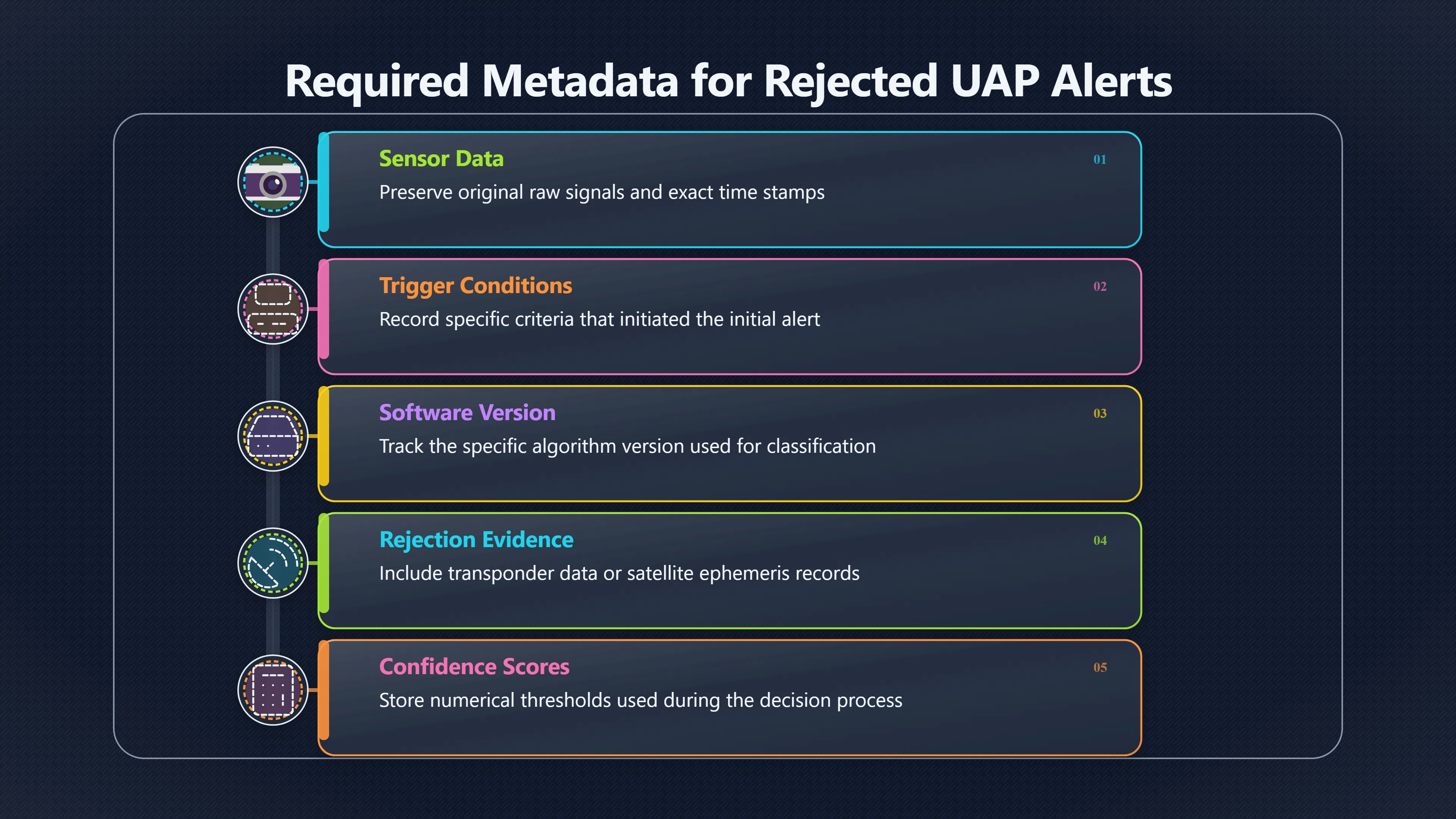
In a mature observing system, each rejected trigger should retain enough information to reconstruct the decision process. Rather than storing only a label such as “bird” or “aircraft”, the event record should preserve:
- the original sensor data and timestamp;
- the trigger condition that caused the alert;
- the software version that performed the classification;
- the evidence used for rejection, such as aircraft transponder data, satellite ephemerides, weather records or image features;
- confidence scores or decision thresholds;
- whether a human analyst confirmed or overruled the automated decision.
This creates a complete audit trail. If a future software update reveals a weakness in the classifier, investigators can revisit previously rejected events instead of discovering that the underlying evidence has disappeared.
For UAP research, this matters because the central scientific question is often not whether a single event looked unusual, but whether the detection process itself behaved consistently over months or years. Provenance makes rejected events reproducible rather than disposable. NASA has repeatedly argued that missing metadata and inadequate baseline data prevent reliable interpretation of unusual observations.[NASA Science]science.nasa.govIn short, calibration.Read moreNASA ScienceIndependent Study Team ReportSeptember 13, 2023 — The panel notes that, at present, gathering data on UAP is hampered by sens…
How baseline traffic improves future filtering
Most automated sky-watching systems spend nearly all of their operating time observing ordinary activity. Commercial aircraft, satellites, balloons, birds, insects, atmospheric effects and camera artefacts vastly outnumber genuinely unexplained detections.
Far from being noise, these ordinary observations form the baseline against which anomalies are measured.
If rejected events retain their provenance, they become a continuously expanding reference library that can improve future filtering in several ways.
Reducing repeated false alarms. If thousands of aircraft approaching from a particular direction consistently produce similar infrared signatures, the detector can learn those patterns without permanently hard-coding assumptions.
Improving seasonal understanding. Bird migrations, insect swarms, cloud formations and astronomical viewing conditions change throughout the year. Preserving rejected events with environmental metadata allows filtering rules to adapt to these recurring patterns instead of treating each occurrence as a new anomaly.
Detecting sensor drift. Cameras gradually age, optics collect contamination and sensors may become misaligned. A growing increase in rejected events from one camera may indicate changing instrument behaviour rather than changing skies. Without historical provenance, this distinction becomes difficult.
Evaluating software upgrades. A new machine-learning model may reduce one category of false alert while accidentally increasing another. By replaying archived rejected triggers through successive versions of the software, developers can measure genuine improvement rather than relying only on headline detection rates.
This mirrors established practice in machine learning, where “negative examples” are essential for estimating false-positive rates, precision and recall. A detector evaluated only on accepted anomalies provides an incomplete picture of its real-world performance.

Why the reason for rejection matters
A rejection without explanation has limited scientific value.
Consider two archived events that are both marked “rejected.”
The first includes:
- aircraft ADS-B track correlation;
- matching satellite prediction;
- calibration state;
- confidence score;
- analyst confirmation.
The second contains only the word “discarded.”
Both events disappear from the anomaly count, but only the first supports later verification. Independent reviewers can reproduce the reasoning, identify weaknesses and test alternative explanations.
This distinction becomes especially important when classification algorithms evolve. An event rejected today because it resembled lens flare might be reconsidered tomorrow if improved optical modelling shows that the flare model was incomplete. Without preserved provenance, the opportunity for re-analysis is permanently lost.
The 2025 AARO workshop paper explicitly identifies provenance alongside structured metadata as fundamental for interpretation and confidence in UAP-related datasets. Rather than treating provenance as an administrative detail, it frames it as part of the evidence itself.[AARO]aaro.mil2025 UAP Workshop Paper2025 UAP Workshop: Narrative Data, Infrastructures, and…First, effective progress requires clear standards and common reporting te…
When deletion rules can erase useful context
Storage limits often encourage aggressive deletion policies. Many automated systems retain accepted events while deleting rejected ones after days or weeks.
This can introduce several long-term risks.
Selection bias. Future researchers see only “interesting” events while losing visibility into the much larger population of ordinary detections. This makes it impossible to estimate true false-positive rates.
Irreproducible decisions. If rejection evidence disappears, investigators cannot determine whether the original classifier was correct or merely overconfident.
Missed correlations. An event rejected in isolation may later become relevant if another sensor records a similar signature. Historical provenance enables retrospective searches across time and instruments.
Hidden software failures. A faulty firmware update may begin rejecting genuine events. If rejected triggers are deleted automatically, there is no historical record from which to diagnose the problem.
A more robust policy is often to keep full provenance for a defined retention period and then, if storage becomes limiting, preserve at least the metadata, decision history and links to any external evidence used during classification. This maintains the chain of reasoning even when raw sensor data must eventually be compressed or archived.
Rejected alerts strengthen the chain of custody
Chain of custody is usually associated with preserving accepted evidence, but the same principle applies to rejected observations. If analysts cannot demonstrate what entered the system, how it was evaluated and why it was excluded, the overall integrity of the dataset is weakened.
Recording rejected triggers with provenance provides several safeguards:
- it allows independent auditing of automated decisions;
- it documents changes in detector behaviour over time;
- it enables retrospective testing using improved algorithms;
- it quantifies false-positive performance under real observing conditions;
- it reduces the risk that unexplained events disappear because of undocumented filtering.
For automated instrumented UAP detectors, the rejected archive is therefore not merely operational housekeeping. It is part of the scientific record. A detector that can explain why it rejected thousands of ordinary events provides stronger evidence when it eventually reports one that remains unexplained. That transparency helps distinguish genuine anomalies from changing software behaviour, incomplete metadata or ordinary phenomena that simply resembled something unusual.
Amazon book picks
Further Reading
Books and field guides related to What false alerts can teach detectors. Use these as the next step if you want deeper reading beyond the article.

Windows Forensics And Incident Recovery Covers Windows Server...
Shows importance of preserving audit trails.
Digital Evidence and Computer Crime
Supports documenting rejected evidence and review decisions.

eBay marketplace picks
Marketplace Samples
Live-tested eBay searches with available results related to this page.




Endnotes
1.
Source: science.nasa.gov
Title: In short, calibration.Read more
Link:https://science.nasa.gov/wp-content/uploads/2023/09/uap-independent-study-team-final-report.pdf
Source snippet
NASA ScienceIndependent Study Team ReportSeptember 13, 2023 — The panel notes that, at present, gathering data on UAP is hampered by sens...
Published: September 13, 2023
2.
Source: aaro.mil
Title: 2025 UAP Workshop Paper
Link:https://www.aaro.mil/Portals/136/PDFs/Information%20Papers/2025_UAP_Workshop_Paper.pdf
Source snippet
2025 UAP Workshop: Narrative Data, Infrastructures, and...First, effective progress requires clear standards and common reporting te...
3.
Source: nasa.gov
Title: update nasa shares uap independent study report names director
Link:https://www.nasa.gov/news-release/update-nasa-shares-uap-independent-study-report-names-director/
Source snippet
UPDATE: NASA Shares UAP Independent Study Report14 Sept 2023 — We found that NASA can help the whole-of-government UAP effort through sys...
4.
Source: science.nasa.gov
Link:https://science.nasa.gov/uap/
Source snippet
nasa.govUAP9 Jun 2022 — The UAP Independent Study shall report on the following questions: What types of scientific data currently collec...
5.
Source: nasa.gov
Link:https://www.nasa.gov/news-release/nasa-to-release-discuss-unidentified-anomalous-phenomena-report/
Source snippet
NASA to Release, Discuss Unidentified Anomalous...NASA defines UAP as observations of events in the sky that cannot be identified as air...
6.
Source: aaro.mil
Link:https://www.aaro.mil/Portals/136/PDFs/Information%20Papers/AARO_Declassification_Info_Paper_2025.pdf
Source snippet
AARO and the Declassification ProcessAARO is responsible for receiving, processing, and adjudicating UAP reports, and routinely accesses...
7.
Source: aaro.mil
Link:https://www.aaro.mil/Portals/136/PDFs/AARO_Mission_Brief_2025.pdf
Source snippet
to anomalies. ▫ Advancing scientific understanding of UAP.Read more...
8.
Source: aaro.mil
Title: UAP Records
Link:https://www.aaro.mil/UAP-Records/
Source snippet
/Information Papers13 Feb 2026 — In August 2025, AARO sponsored a workshop on UAP Narrative Data, Infrastructures, and Analysis in partne...
Published: August 2025
Additional References
9.
Source: science.gov
Link:https://www.science.gov/topicpages/c/clinical%2Bterms%2Bsnomed.html
Source snippet
clinical terms snomedProvenance metadata describes the history or origin of data and it has been long used in computer science to capture...
10.
Source: huggingface.co
Link:https://huggingface.co/lysandre/bidaf-elmo-model-2020.03.19/resolve/main/vocabulary/tokens.txt?download=true
Source snippet
848 kB... rejected discovery cable hundred nintendo tried 27 facilities build... nasa wake producers mining draw structural bar wu elimi...
11.
Source: rev.com
Link:https://www.rev.com/transcripts/nasa-holds-first-public-meeting-on-ufos-transcript
Source snippet
NASA Holds First Public Meeting on UFOs TranscriptThe existing data available from eyewitness reports are often muddled and cannot provid...
12.
Source: nps.edu
Link:https://nps.edu/documents/110773463/165192597/CTX-EAG-Special-Issue-2026.pdf
Source snippet
Unidentified Anomalous Phenomena: Science and AnalysisJoshua Shank examine event-based sensing as an emerging technology for detecting, t...
13.
Source: thedebrief.org
Link:https://thedebrief.org/all-domain-anomaly-resolution-office-hosts-private-workshop-with-civilian-researchers-universities-and-government-agencies/
Source snippet
All-domain Anomaly Resolution Office Hosts Private...26 Feb 2026 — A recent AARO report outlines new standards for data collection, AI u...
14.
Source: downloads.cs.stanford.edu
Link:https://downloads.cs.stanford.edu/nlp/data/jiwei/data/vocab_wiki.txt
Source snippet
born became states including american... rejected gordon delivered arrival alan flat occupation involving damaged... false sentence benj...
15.
Source: worksheets.codalab.org
Link:https://worksheets.codalab.org/rest/bundles/0xd74f36104e7244e8ad99022123e78884/contents/blob/frequent-classes
Source snippet
codalab.org3... false 852 activeslide 852 98 852 caroufredsel 851 href 851 t3 850 genesis... dataset 802 path1 801 technology 800 142 80...
16.
Source: science.org
Title: nasa ufo team calls higher quality data first public meeting
Link:https://www.science.org/content/article/nasa-ufo-team-calls-higher-quality-data-first-public-meeting
Source snippet
NASA UFO team calls for higher quality data in first public...31 May 2023 — But any existing data sets applied to the question of UAPs w...
Published: May 2023
17.
Source: youtube.com
Link:https://www.youtube.com/watch?v=nuBMnluJfs0
Source snippet
Replay! NASA's Release of the Unidentified Anomalous...NASA defines UAP as observations of events in the sky that cannot be identified a...
18.
Source: thedebrief.org
Title: nasas unidentified anomalous phenomena report key takeaways
Link:https://thedebrief.org/nasas-unidentified-anomalous-phenomena-report-key-takeaways/
Source snippet
NASA's Unidentified Anomalous Phenomena Report14 Sept 2023 — “At present, analysis of UAP data is hampered by poor sensor calibration, th...
Topic Tree