Within Magnetometers
What Galileo learned from magnetic monitoring
The Galileo variometer work shows that the hard part is not finding spikes, but proving a station can separate ordinary geomagnetic behavior from local
On this page
- The Colorado variometer setup
- Lessons from the 2024 geomagnetic storm
- Why calibration came before UAP interpretation
Page outline Jump by section
Introduction
The Galileo Project’s first geomagnetic variometer test did not demonstrate that unidentified aerial phenomena produce distinctive magnetic signatures. Instead, it demonstrated something more fundamental: before any magnetic anomaly can be interpreted as unusual, the measuring system must first prove that it accurately records ordinary geomagnetic behaviour under real-world conditions. This distinction is central to modern automated UAP detector design. Rather than treating magnetometers as standalone “mystery detectors”, the Galileo team used a carefully calibrated station in Colorado to show that its measurements closely matched those from a nearby professional magnetic observatory and responded correctly during both quiet conditions and a major space-weather event. That approach raises the evidential standard for future magnetic claims by showing that calibration, comparison and environmental context must come before interpretation.[Gi Copernicus]gi.copernicus.orgGi Copernicus The deployment of a geomagnetic variometer station asby F Vervelidou · 2025 — We presented the first geomagnetic variometer station deployed within the context of the Galileo Project for t…

The Colorado variometer setup
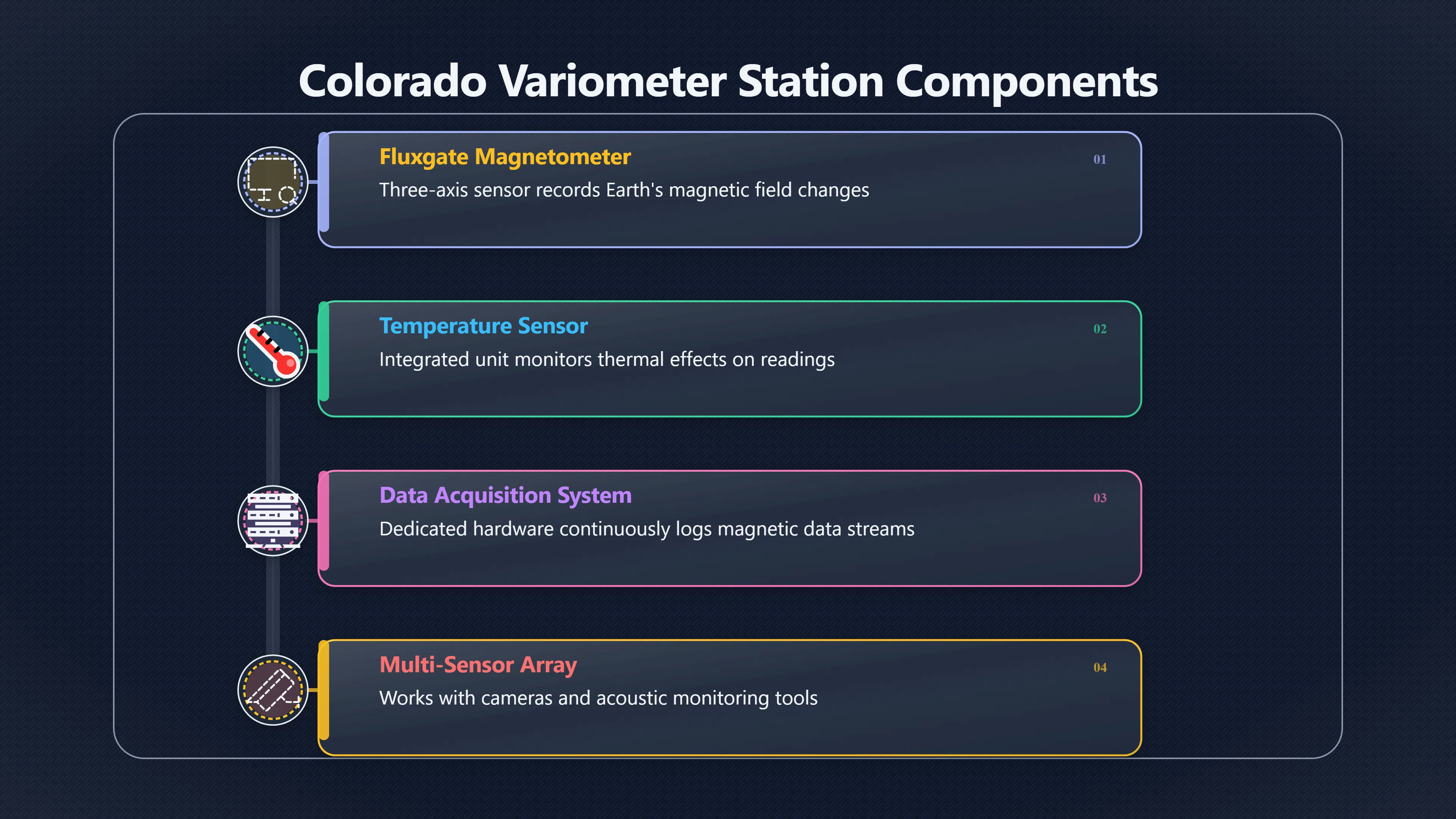
The Galileo Project installed its first geomagnetic variometer station at a magnetically quiet site in Colorado as part of its broader multi-sensor observatory. The instrument is a three-axis fluxgate magnetometer with an integrated temperature sensor and a dedicated data acquisition system that continuously records changes in Earth’s magnetic field. Rather than operating in isolation, it is intended to work alongside optical cameras, infrared sensors, weather instruments and acoustic monitoring so that any future anomaly can be examined across multiple independent measurements.[Gi Copernicus]gi.copernicus.orgGi Copernicus The deployment of a geomagnetic variometer station asby F Vervelidou · 2025 — We presented the first geomagnetic variometer station deployed within the context of the Galileo Project for t…
The most important design decision was the station’s proximity to the long-established magnetic observatory operated by the US Geological Survey (USGS) in Boulder, roughly 60 km away. This provided an external benchmark. If both stations observed nearly identical large-scale geomagnetic variations despite being independent installations, the Galileo station could be trusted to distinguish regional geomagnetic activity from faults in its own instrumentation.[Gi Copernicus]gi.copernicus.orgGi Copernicus The deployment of a geomagnetic variometer station asby F Vervelidou · 2025 — We presented the first geomagnetic variometer station deployed within the context of the Galileo Project for t…
The researchers also calibrated the magnetometer for temperature effects in collaboration with personnel at the Boulder observatory before deployment. Temperature compensation matters because small thermal drifts can imitate genuine magnetic changes if left uncorrected. By addressing this before operational use, the project reduced one of the common sources of false magnetic anomalies.[Gi Copernicus]gi.copernicus.orgGi Copernicus The deployment of a geomagnetic variometer station asby F Vervelidou · 2025 — We presented the first geomagnetic variometer station deployed within the context of the Galileo Project for t…
Lessons from the 2024 geomagnetic storm
A particularly valuable aspect of the six-month trial was that it included the extreme G5 geomagnetic storm of May 2024, the strongest global geomagnetic disturbance in more than two decades. Instead of treating this event as unwanted noise, the Galileo team used it as a demanding real-world validation test.[Gi Copernicus+2PMC]gi.copernicus.orgGi Copernicus The deployment of a geomagnetic variometer station asby F Vervelidou · 2025 — We presented the first geomagnetic variometer station deployed within the context of the Galileo Project for t…
During the storm, the Colorado variometer recorded the expected large magnetic fluctuations that were simultaneously observed by established geomagnetic monitoring networks. The close agreement with the Boulder observatory demonstrated that the Galileo system was measuring genuine geophysical signals rather than producing idiosyncratic readings. According to the published results, the data quality met or exceeded the project’s own science traceability requirements.[Gi Copernicus]gi.copernicus.orgGi Copernicus The deployment of a geomagnetic variometer station asby F Vervelidou · 2025 — We presented the first geomagnetic variometer station deployed within the context of the Galileo Project for t…
This matters because a detector intended to identify rare local anomalies must first prove that it responds correctly to known global phenomena. Had the Galileo station failed to reproduce the storm accurately, any later claim of an unexplained magnetic event would have been difficult to trust.
The May 2024 storm also illustrated how dramatic natural magnetic disturbances can be. The event produced worldwide magnetic variations, auroral displays at unusually low latitudes and significant impacts on technological systems. For an automated UAP observatory, such episodes reinforce the need to identify space-weather conditions before interpreting any magnetic excursion as something extraordinary.[Frontiers]frontiersin.orgFrontiers The geomagnetic and geoelectric response to the MayFrontiersThe geomagnetic and geoelectric response to the May…April 24, 2025 — by E Lawrence · 2025 · Cited by 18 — The “Gannon” geomag…
Why calibration came before UAP interpretation
Perhaps the most significant outcome of the variometer paper is what it deliberately does not claim.
The study does not report detecting unexplained magnetic signals associated with unidentified aerial phenomena. Instead, it establishes the measurement chain needed before such claims could be evaluated scientifically. The emphasis throughout is on instrument performance, calibration, environmental characterisation and comparison with certified reference measurements.[Gi Copernicus]gi.copernicus.orgGi Copernicus The deployment of a geomagnetic variometer station asby F Vervelidou · 2025 — We presented the first geomagnetic variometer station deployed within the context of the Galileo Project for t…
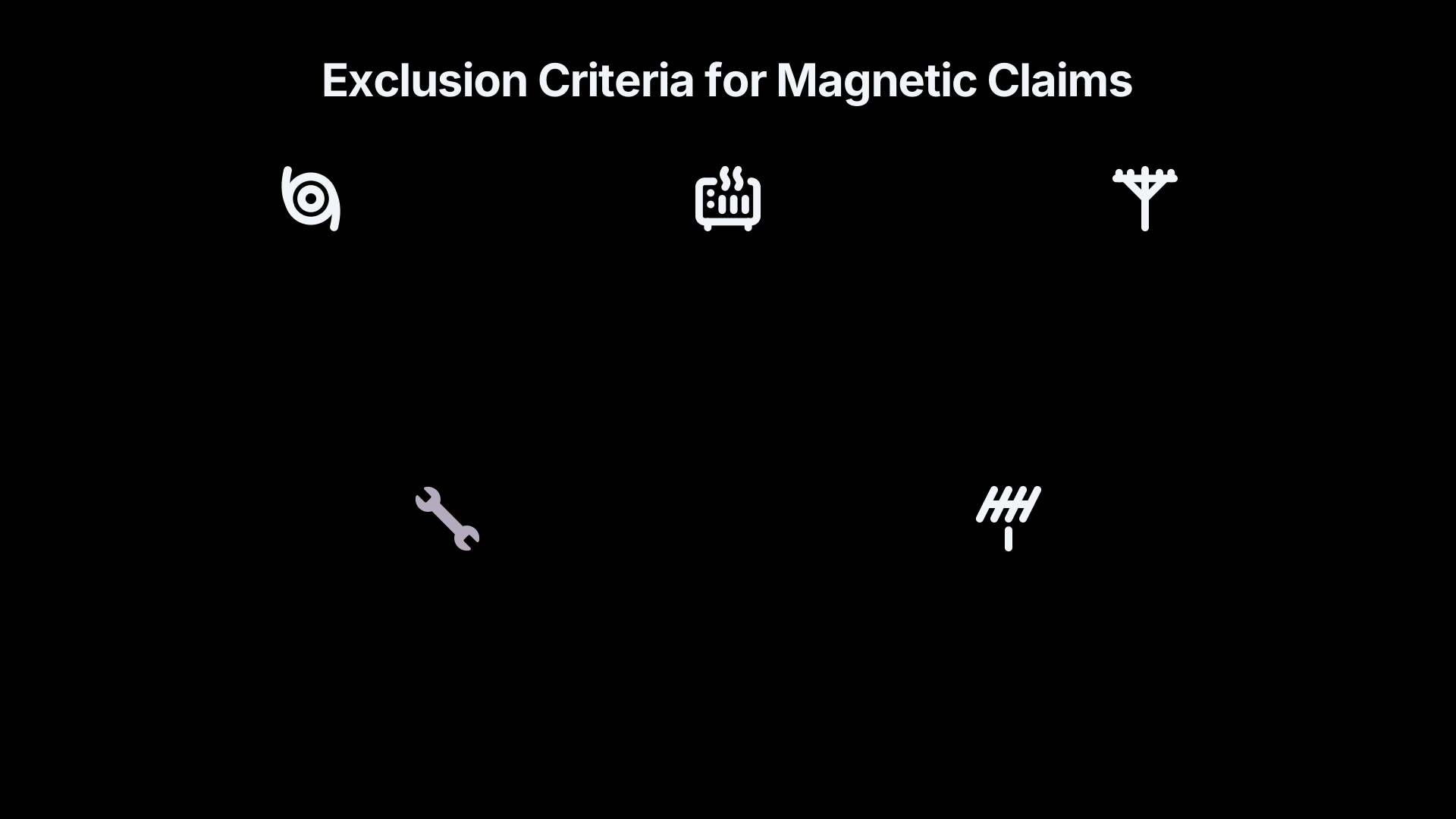
This represents an important methodological shift from many historical magnetic claims associated with UFO reports. Earlier reports often relied on isolated observations, hand-held compasses or single instruments with limited documentation. In contrast, the Galileo approach requires that any candidate event be interpreted only after excluding known influences such as:
- regional geomagnetic activity caused by solar storms;
- temperature-related sensor drift;
- local magnetic contamination from nearby equipment or infrastructure;
- instrument malfunction or calibration errors; and
- inconsistencies with simultaneous measurements from reference observatories or other sensors.[Gi Copernicus]gi.copernicus.orgGi Copernicus The deployment of a geomagnetic variometer station asby F Vervelidou · 2025 — We presented the first geomagnetic variometer station deployed within the context of the Galileo Project for t…
Only after those ordinary explanations have been examined would a magnetic anomaly become scientifically interesting enough to compare with simultaneous optical, infrared or acoustic observations.
What the test changes for magnetic claims
For automated instrumented UAP detector networks, the Colorado variometer test shifts the evidential emphasis away from finding magnetic “spikes” and towards demonstrating measurement reliability.
The practical lesson is that an isolated magnetic excursion has little evidential value by itself. A convincing case requires that investigators know:
- the instrument remained correctly calibrated;
- regional geomagnetic conditions at the time;
- whether nearby reference stations observed the same disturbance;
- whether local sources could explain the signal; and
- whether independent sensors detected a coincident event.[Gi Copernicus]gi.copernicus.orgGi Copernicus The deployment of a geomagnetic variometer station asby F Vervelidou · 2025 — We presented the first geomagnetic variometer station deployed within the context of the Galileo Project for t…
In effect, the Galileo Project treated its variometer not as a detector of extraordinary phenomena but as an environmental reference instrument. Its role is to help eliminate ordinary magnetic explanations before any remaining observations are considered unusual.
That is the principal scientific contribution of the test. The hard problem is not detecting magnetic fluctuations—Earth’s magnetic field varies continuously—but proving that an observatory can reliably separate ordinary geomagnetic behaviour from local effects and instrument artefacts. The Colorado deployment shows that this validation step is achievable and should precede any attempt to argue that a magnetic anomaly supports an exotic interpretation.[Gi Copernicus]gi.copernicus.orgGi Copernicus The deployment of a geomagnetic variometer station asby F Vervelidou · 2025 — We presented the first geomagnetic variometer station deployed within the context of the Galileo Project for t…
Amazon book picks
Further Reading
Books and field guides related to What Galileo learned from magnetic monitoring. Use these as the next step if you want deeper reading beyond the article.
Introduction to Geomagnetic Fields
Directly covers Earth's magnetic field and geomagnetic measurements.

Introduction to electrodynamics
Builds understanding of magnetic fields underlying fluxgate magnetometers.

Handbook of geophysics and the space environment
Useful background on geomagnetic conditions and environmental interpretation.

Space Physics
Explains space weather and geomagnetic disturbances relevant to magnetometer calibration.
eBay marketplace picks
Marketplace Samples
Live-tested eBay searches with available results related to this page.

Endnotes
1.
Source: gi.copernicus.org
Title: Gi Copernicus The deployment of a geomagnetic variometer station as
Link:https://gi.copernicus.org/articles/14/335/2025/
Source snippet
by F Vervelidou · 2025 — We presented the first geomagnetic variometer station deployed within the context of the Galileo Project for t...
2.
Source: pmc.ncbi.nlm.nih.gov
Link:https://pmc.ncbi.nlm.nih.gov/articles/PMC11602687/
Source snippet
With a peak negative excursion of Sym‐H below −500 nT, this storm is the...Read more...
3.
Source: egusphere.copernicus.org
Title: egusphere 2025 3431
Link:https://egusphere.copernicus.org/preprints/2025/egusphere-2025-3431/
Source snippet
deployment of a geomagnetic variometer station as auxiliary...These reports have motivated the incorporation of a magnetometer into the...
4.
Source: gi.copernicus.org
Link:https://gi.copernicus.org/articles/14/335/2025/gi-14-335-2025-assets.html
Source snippet
deployment of a geomagnetic variometer station as auxiliary...Magnetic field and temperature data obtained at the geomagnetic variometer...
5.
Source: youtube.com
Title: The Galileo Project News: Join the Search for UAP
Link:http://www.youtube.com/watch?v=HHz9otVMa58
Source snippet
The Galileo Project...
6.
Source: youtube.com
Title: The Galileo Project
Link:http://www.youtube.com/watch?v=YSxF8SuTBtU
Source snippet
Low wavelengths we haven't detected yet? Could we use this for UAP detection?...
7.
Source: frontiersin.org
Title: Frontiers The geomagnetic and geoelectric response to the May
Link:https://www.frontiersin.org/journals/astronomy-and-space-sciences/articles/10.3389/fspas.2025.1550923/full
Source snippet
FrontiersThe geomagnetic and geoelectric response to the May...April 24, 2025 — by E Lawrence · 2025 · Cited by 18 — The “Gannon” geomag...
Published: April 24, 2025
Additional References
8.
Source: arxiv.org
Link:https://arxiv.org/abs/2507.11355
Source snippet
The deployment of a geomagnetic variometer station as...by F Vervelidou · 2025 — We describe the calibration and deployment of the instr...
9.
Source: researchgate.net
Link:https://www.researchgate.net/publication/393724632_The_deployment_of_a_geomagnetic_variometer_station_as_auxiliary_instrumentation_for_the_study_of_Unidentified_Aerial_Phenomena
Source snippet
The deployment of a geomagnetic variometer station as...Jul 15, 2025 — We presented the first geomagnetic variometer station deployed wi...
10.
Source: linkedin.com
Link:https://www.linkedin.com/posts/scientific-coalitionfor-uap-studies-scu_the-deployment-of-a-geomagnetic-variometer-activity-7404944395302731776-j_3B
Source snippet
Galileo Project's Geomagnetic Variometer Station for UAP StudiesNew Publication: The deployment of a geomagnetic variometer station as au...
11.
Source: nora.nerc.ac.uk
Link:https://nora.nerc.ac.uk/id/eprint/541134/1/Space%20Weather%20-%202026%20-%20Malone%E2%80%90Leigh%20-%20The%20MANA%20Magnetometer%20Array%20%20and%20Magnetic%20Observations%20Across%20New%20Zealand%20From%202024.pdf
Source snippet
MANA Magnetometer Array, and Magnetic Observations...by J Malone‐Leigh · 2026 · Cited by 2 — The paper shares examples of two very signi...
12.
Source: space.dtu.dk
Link:https://www.space.dtu.dk/english/research/scientific_data_and_models/magnetic-ground-stations
Source snippet
Ground StationsDTU Space operates the Greenland magnetometer array, including 19 variometer stations whereof 3 are geomagnetic observator...
13.
Source: arxiv.org
Title: A forecast performance assessment of the geomagnetic index ap Read
Link:https://arxiv.org/abs/2406.08617
Source snippet
Satellite Drag Analysis During the May 2024 Gannon...by WE Parker · 2024 · Cited by 82 — In this note, we investigate the various impact...
Published: May 2024
14.
Source: linkedin.com
Link:https://www.linkedin.com/posts/societyforuapstudies_the-deployment-of-a-geomagnetic-variometer-activity-7402348045394210816-Upuq
Source snippet
nt and performance of its first geomagnetic variometer station—a...
15.
Source: reddit.com
Link:https://www.reddit.com/r/UFOscience/comments/1m25t0g/galileo_project_successfully_tests_variometric/
Source snippet
ve installed a geomagnetic variometer (a type of instrument that...
16.
Source: galileo.hsites.harvard.edu
Link:https://galileo.hsites.harvard.edu/publications
Source snippet
The Galileo ProjectThe deployment of a geomagnetic variometer station as auxiliary instrumentation for the study of Unidentified Aerial...
17.
Source: youtube.com
Title: New Results from the Galileo Project Observatory and the Pacific Expedition
Link:http://www.youtube.com/watch?v=QYl9d8wjjKM
Source snippet
The Galileo Project's First Data on Half a Million Objects with Avi Loeb...
Topic Tree