Within ADS B
Should UAP Stations Trust Flight Trackers?
A local ADS-B receiver can preserve raw nearby traffic that public maps may delay, filter or miss.
On this page
- What local receivers add to public maps
- How filtering and block lists affect review
- When to combine multiple aircraft data sources
Page outline Jump by section
Introduction
For an automated instrumented UAP station, aircraft context is only as trustworthy as the data source supplying it. Public flight-tracking websites are extremely useful for routine review, but they are not designed as scientific evidence logs. They may introduce delays, simplify data, omit some aircraft, or honour privacy and filtering policies that differ between providers. A locally operated ADS-B receiver, by contrast, records the radio transmissions that reach the station itself, preserving a time-aligned record that can be compared directly with sensor data. The most reliable approach is therefore not to choose one over the other, but to use a local receiver as the primary evidence source while cross-checking against one or more public tracking services for broader coverage and historical context.[Flightradar24+2Federal Aviation Administration]flightradar24.comADS-BADS-B (Automatic Dependent Surveillance–Broadcast) enables aircraft to determine their position using GPS and automatic…

What local receivers add to public maps
A local ADS-B receiver listens directly for aircraft broadcasts on frequencies such as 1090 MHz. Unlike a web-based tracker, it records exactly what the antenna could receive at the observation site and when it received it. That distinction is valuable during UAP investigations because the detector is attempting to reconstruct events with precise timing rather than simply identify nearby aircraft.
Several practical advantages follow.
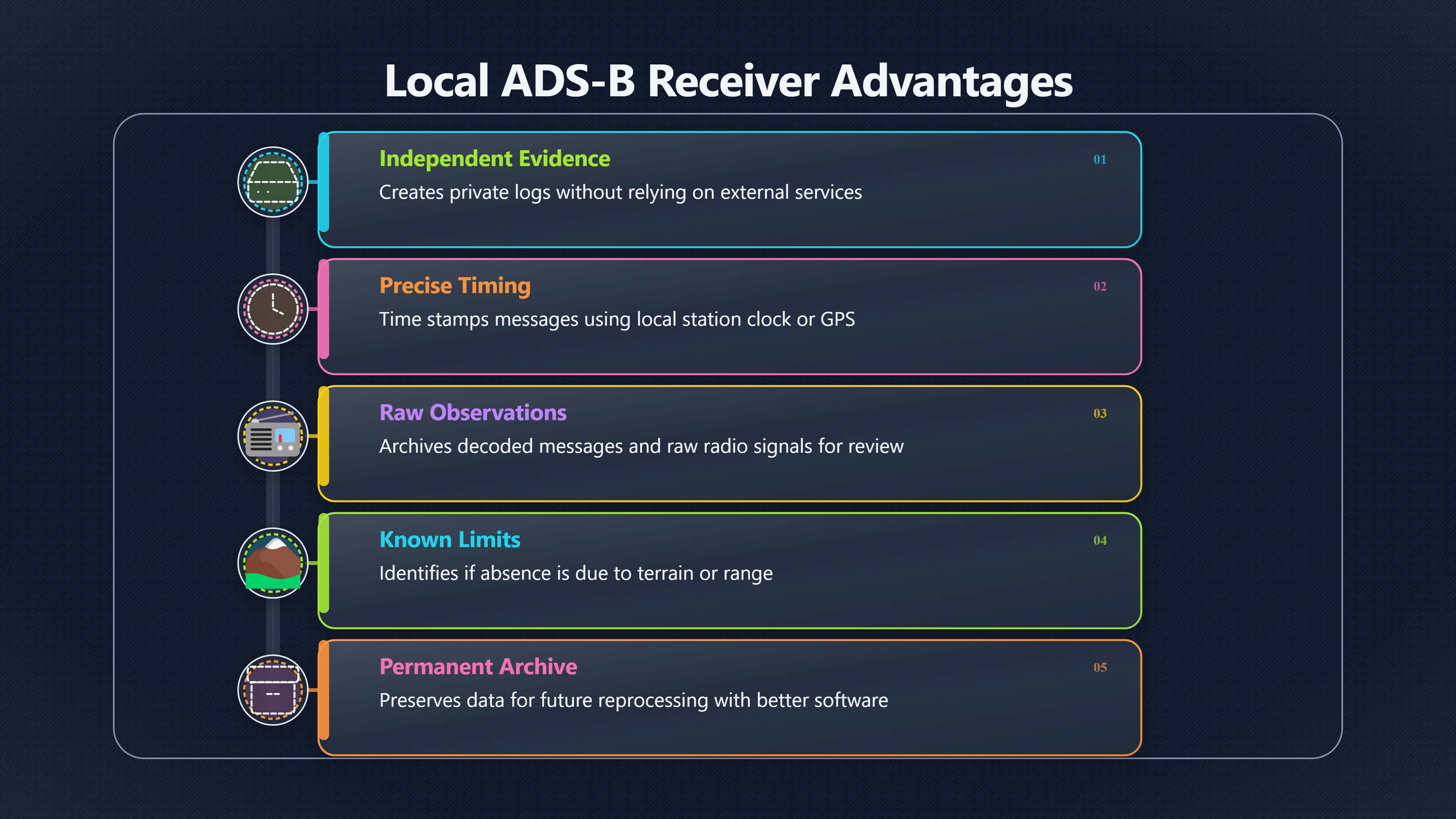
- Independent evidence: The receiver creates its own log instead of relying on an external service that may change policies, remove historical records or suffer outages.
- Precise timing: Received messages can be timestamped using the station’s own clock or GPS time source, making correlation with cameras, infrared sensors and radio equipment much more reliable.
- Raw observations: Many receivers can archive decoded ADS-B or even raw radio messages, allowing investigators to revisit the original data rather than only reconstructed flight paths.
- Known reception limits: If an aircraft was not received locally, the investigator can assess whether terrain, antenna placement or radio range explain the absence instead of assuming the aircraft was not present.
For scientific monitoring, this distinction matters because “no aircraft was received” is a measurable observation, whereas “no aircraft appeared on a website” is only a statement about one service’s displayed data.
Why public flight trackers may not tell the whole story
Most public tracking platforms aggregate data from thousands of volunteer receivers and additional surveillance sources before presenting a simplified map. That aggregation greatly improves geographic coverage but also means the displayed track is a processed product rather than a direct measurement from the observation site.[Flightradar24]flightradar24.comADS-BADS-B (Automatic Dependent Surveillance–Broadcast) enables aircraft to determine their position using GPS and automatic…
For UAP review, several characteristics deserve attention.
Display latency. Many public services prioritise usability over minimum latency. Even when delays are only a few seconds, they complicate precise frame-by-frame comparison with optical recordings.
Interpolation and smoothing. Maps often interpolate between received positions to produce visually continuous flight paths. This is useful for users but means the displayed position may not correspond exactly to an individual transmitted message.
Network dependence. Coverage depends on where volunteer receivers exist. Aircraft flying at low altitude, behind terrain or in sparsely instrumented regions may be seen by a local receiver while remaining incomplete or absent on a public map.
Policy differences. Different services make different decisions about data presentation, historical retention and filtering, so identical events may appear differently across platforms.
None of these characteristics make public trackers unreliable. They simply mean they are optimised for situational awareness rather than forensic reconstruction.
How filtering and block lists affect review
One of the most important differences between local reception and public services is that some publicly displayed aircraft are intentionally filtered or anonymised.
In the United States, the Federal Aviation Administration operates programmes such as the Privacy ICAO Address (PIA) programme that allow eligible operators to reduce public association between an aircraft’s identity and its broadcasts. The purpose is to improve operational privacy rather than hide aircraft from air traffic control.[Federal Aviation Administration]faa.govFederal Aviation AdministrationADS-B Privacy22 Mar 2025 — The FAA acknowledges the desire of some operators to limit the availability of…
Commercial flight-tracking providers may also choose to suppress or limit display of particular aircraft in response to privacy agreements, customer requests or operational policies. Consequently:
- an aircraft may still be broadcasting ADS-B;
- a local receiver may record those transmissions;
- one public tracker may display the aircraft;
- another tracker may omit or anonymise it.
This is particularly relevant when reviewing sightings involving business aviation, government aircraft or other operators that seek greater privacy. The absence of a visible aircraft on one website should therefore never be treated as evidence that no transmitting aircraft was nearby.[Federal Aviation Administration+2aerospace.honeywell.com]faa.govFederal Aviation AdministrationADS-B Privacy22 Mar 2025 — The FAA acknowledges the desire of some operators to limit the availability of…
Conversely, services that explicitly aim to present minimally filtered data may reveal aircraft omitted elsewhere, although they remain subject to the underlying limitations of ADS-B itself, including aircraft that do not transmit compatible signals or are outside reception coverage.[ADS-B Exchange]adsbexchange.comADS-B ExchangeADS-B ExchangeAircraft use ADS-B (Automatic Dependent Surveillance-Broadcast) to transmit their position and flight informa…
When local recordings become decisive
Imagine an automated UAP station detects a bright object crossing the sky for twenty seconds.
A review based only on a public tracking website might conclude that no aircraft were nearby because none appear on the displayed map.
If the station simultaneously recorded local ADS-B traffic, investigators could instead ask:
- Was an aircraft transmission received during the event?
- What exact position was reported at each timestamp?
- Did the transmission strength indicate direct reception?
- Did the reported trajectory intersect the camera’s field of view?
These questions can often distinguish between a genuinely unmatched observation and one that simply failed to appear on a particular online service.
The local recording also provides a permanent archive that can be reprocessed later if improved decoding software or calibration techniques become available.
When to combine multiple aircraft data sources
The strongest implementation is a layered approach rather than dependence on any single feed.
A practical workflow is:
- Use the local ADS-B receiver as the primary aircraft log because it preserves the measurements actually available at the observation site.
- Compare those records with one or more public tracking services to identify broader traffic patterns and detect any aggregation differences.
- Where available, consult open research datasets or community receiver networks for historical reconstruction or independent verification when investigating significant events. Crowdsourced surveillance projects such as the OpenSky Network demonstrate the value of combining observations from many distributed receivers while retaining access to underlying surveillance data for research. Wikipedia
Agreement between independent sources increases confidence that the aircraft context has been reconstructed correctly. Disagreement, by contrast, is informative: it may indicate reception gaps, filtering policies, network outages or timing differences that deserve investigation before drawing conclusions about an apparent anomaly.
Practical policy for automated UAP stations
For an instrumented UAP detection system, public flight trackers should be treated as valuable reference tools rather than authoritative evidence. The station’s own receiver provides reproducible, site-specific measurements that remain available even if external services later change policies or data retention practices.
A robust review policy is therefore to archive local ADS-B data alongside sensor recordings, preserve accurate timestamps, and use multiple external tracking services only as corroborating context. This approach reduces the risk of misclassifying ordinary aircraft as anomalous because of omissions, filtering or presentation choices made by third-party flight-tracking platforms.
Amazon book picks
Further Reading
Books and field guides related to Should UAP Stations Trust Flight Trackers?. Use these as the next step if you want deeper reading beyond the article.

Introduction to Avionics Systems
Explains surveillance data sources including ADS-B and operational limitations.

Fundamentals of Astrodynamics and Applications
Useful for coordinate transformations and precise tracking comparisons.

Understanding GPS/GNSS
Relevant to timing accuracy and positional integrity when comparing local and public data.
eBay marketplace picks
Marketplace Samples
Example marketplace items related to this page. Use the search link to explore similar finds on eBay.




Endnotes
1.
Source: flightradar24.com
Link:https://www.flightradar24.com/how-it-works/ads-b
Source snippet
ADS-BADS-B (Automatic Dependent Surveillance–Broadcast) enables aircraft to determine their position using GPS and automatic...
3.
Source: aerospace.honeywell.com
Title: AD S-B Privacy
Link:https://aerospace.honeywell.com/us/en/about-us/news/2020/11/ads-b-privacy
Source snippet
ADS-B Privacy - What You Need to KnowADS-B Out operates by transmitting the aircraft's unique ICAO address, making identification by any...
4.
Source: faa.gov
Link:https://www.faa.gov/air_traffic/technology/adsb/faq
Source snippet
Federal Aviation AdministrationADS-B FAQ3 Mar 2025 — ADS-B also provides greater coverage since ground stations are so much easier to pla...
5.
Source: faa.gov
Link:https://www.faa.gov/air_traffic/technology/equipadsb/privacy
Source snippet
Federal Aviation AdministrationADS-B Privacy22 Mar 2025 — The FAA acknowledges the desire of some operators to limit the availability of...
6.
Source: adsbexchange.com
Link:https://www.adsbexchange.com/
Source snippet
ADS-B ExchangeADS-B ExchangeAircraft use ADS-B (Automatic Dependent Surveillance-Broadcast) to transmit their position and flight informa...
7.
Source: aviospace.org
Title: real time aircraft tracking network
Link:https://aviospace.org/real-time-aircraft-tracking-network/
Source snippet
ADSBExchange And The Rise Of Unfiltered Aircraft Tracking26 May 2026 — ADSBexchange's policy of showing all aircraft without filtering ha...
Published: May 2026
8.
Source: globe.adsbexchange.com
Link:https://globe.adsbexchange.com/
Source snippet
adsbexchange.comADS-B Exchange - track aircraft liveADS-B Exchange - track aircraft live - aircraft flight history...
9.
Source: adsbexchange.com
Link:https://www.adsbexchange.com/data-products/
Source snippet
Data ProductsAccess ADS-B Exchange data products with live flight APIs and historical datasets, offering high-fidelity, unfiltered aircra...
Additional References
10.
Source: reddit.com
Link:https://www.reddit.com/r/flying/comments/gop52j/adsb_privacy/
Source snippet
ADS-B Privacy: r/flyingWe're being advised that ADS-B exposes us to outside trackers and our privacy could be compromised. FWIW, we've r...
11.
Source: facebook.com
Link:https://www.facebook.com/groups/348704483442978/posts/1218026313177453/
12.
Source: adsbx.discourse.group
Link:https://adsbx.discourse.group/t/featured-content-the-public-value-of-unfiltered-flight-tracking-insights-by-adsbexchange/37
Source snippet
Featured Content: The Public Value of Unfiltered Flight Tracking12 Sept 2023 — The myriad uses of unfiltered ADS-B data underscore the pr...
13.
Source: youtube.com
Link:https://www.youtube.com/watch?v=KahiBjBmgrc
14.
Source: interactive.aviationtoday.com
Title: what is the answer to business aviations ads b privacy concern
Link:https://interactive.aviationtoday.com/what-is-the-answer-to-business-aviations-ads-b-privacy-concern/
Source snippet
is the Answer to Business Aviation's ADS-B Privacy...15 Oct 2018 — Some operators are still seeking solutions that can block their aircr...
15.
Source: instagram.com
Link:https://www.instagram.com/p/DURpQL7iYrd/
Source snippet
ast week after a suspected ADS-B spoofing incident injected...Read more...
16.
Source: jetlaw.com
Title: Who Is Watching You?
Link:https://jetlaw.com/ads-b-raises-aircraft-tracking-issues/
Source snippet
ADS-B raises aircraft tracking...10 Jun 2016 — ADS-B raises aircraft tracking issues (again). There is a growing awareness and concern t...
17.
Source: nationaldefensemagazine.org
Title: [open source]({{ ‘open-source/’ | relative_url }}) flight tracking called threat to military aircraft
Link:https://www.nationaldefensemagazine.org/articles/2023/2/6/open-source-flight-tracking-called-threat-to-military-aircraft
Source snippet
military, a senior Pentagon official recently said.Read more...
18.
Source: researchgate.net
Title: Overview of Open Sky’s architecture
Link:https://www.researchgate.net/figure/Overview-of-OpenSkys-architecture-ADS-B-messages-are-received-by-sensors-deployed-by_fig4_261960161
Source snippet
ADS-B messages are...This paper describes the dataset built for the challenge. It pairs ACARS fuel telemetry, crowdsourced through airfr...
19.
Source: youtube.com
Title: Air Nav [Radar]({{ ‘radar/’ | relative_url }}) Box ADS-B and VHF Air Band Radio Receiver
Link:https://www.youtube.com/watch?v=HxugtkvZqY4
Source snippet
How to Track AirForce-1 AND AirForce-2 in FlightRadar24 (ADSB)...
Topic Tree