Within Provenance
Can the file trail be trusted?
Hashes and audit logs do not prove a UFO is real, but they can prove whether a specific file changed after capture.
On this page
- What hashes can and cannot prove
- How access and export logs reduce disputes
- Why version links matter for public releases
Page outline Jump by section
Introduction
A tamper-evident trail does not prove that a recorded unidentified aerial phenomenon (UAP) is extraordinary. It does something more fundamental: it allows independent reviewers to determine whether the event file is the same one originally produced by the detector or whether it has been altered afterwards. For automated instrumented UFO detection systems, this distinction is critical. An impressive video with no trustworthy history can be challenged indefinitely, whereas a mundane-looking file with a complete, verifiable audit trail can support rigorous scientific analysis.
 Within a broader data provenance and chain-of-custody framework, the audit trail answers a narrow question: can every important change to the event file be reconstructed and independently verified? Modern digital forensics treats this as a combination of cryptographic integrity checks, access logging, timestamps and documented handling procedures rather than relying on trust in individual operators. International digital evidence guidance consistently recommends cryptographic hashing, secure preservation and documented custody as core practices.[NIST Publications+2PMC]nvlpubs.nist.govPublications Digital Evidence PreservationNIST PublicationsDigital Evidence PreservationSeptember 14, 2022 — by B Guttman · 2022 · Cited by 12 — It is best practice to hash digita…
Can the file trail be trusted?
Trust does not come from claiming that a file is “original”. It comes from making every stage of the file’s life visible.
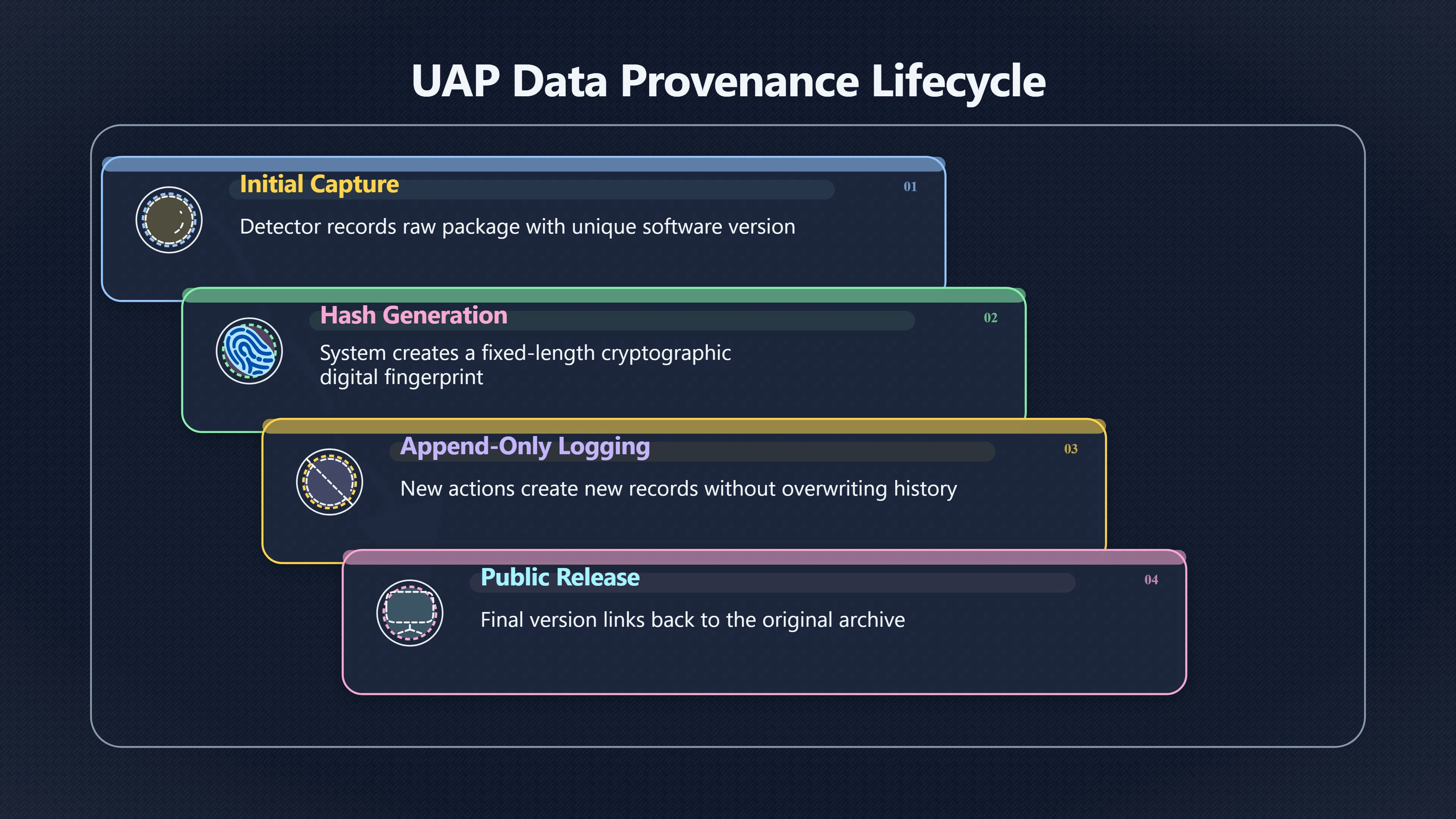
For an automated UAP detector, the audit trail begins the moment an event is captured. The detector should immediately record a cryptographic fingerprint (hash) of the raw event package, preserve associated metadata, and record the exact software version, sensor identity and timestamp responsible for creating it. Every subsequent action—copying, exporting, annotating, compression or public release—should create another recorded event rather than overwriting history.
A well-designed audit trail is therefore append-only. New information is added while earlier records remain intact. This allows reviewers to reconstruct a timeline instead of relying on someone’s memory or handwritten notes. Similar principles underpin modern digital forensic evidence management and are increasingly replacing purely paper-based custody records.[ResearchGate+2NIST Publications]researchgate.netResearchGate(PDF) Digital Evidence Chain of Custody: Navigating New…3 Dec 2024 — This paper explores the critical role of Chain of Cus…
What hashes can and cannot prove
Cryptographic hashes are central to tamper-evident systems because they convert an entire file into a fixed-length digital fingerprint. Even changing a single bit produces a different hash.
For UAP event files, this allows several useful checks:
- confirming that a downloaded copy is identical to the archived original;
- detecting accidental corruption during storage or transmission;
- proving that an exported file matches a previously recorded version;
- identifying precisely which version an analyst examined.
However, hashes have important limits.
A matching hash does not prove that the recorded object was an unknown craft, that the camera was correctly calibrated, or that the timestamp itself was accurate. It merely demonstrates that the current file matches the file from which the hash was generated. If a manipulated video were hashed immediately after manipulation, the hash would faithfully protect the manipulated version.
Likewise, hashes cannot compensate for poor sensor calibration, missing metadata or an incomplete capture process. They preserve integrity, not scientific validity.
Because of these limitations, forensic guidance recommends storing hash values separately from the evidence itself or in an independently controlled evidence management system. Doing so reduces the possibility that both the file and its recorded fingerprint could be altered together.[NIST Publications+2PMC]nvlpubs.nist.govPublications Digital Evidence PreservationNIST PublicationsDigital Evidence PreservationSeptember 14, 2022 — by B Guttman · 2022 · Cited by 12 — It is best practice to hash digita…
How access and export logs reduce disputes
Many arguments over unusual recordings arise long after the event itself. Reviewers may ask:
- Who first accessed the file?
- Was it edited before publication?
- Which analyst created the stabilised version?
- Did someone replace the original export?
Access logs help answer these questions.
Rather than recording only successful edits, a comprehensive audit system records routine interactions as well:
- file creation;
- every authenticated access;
- permission changes;
- transfers between storage systems;
- exports for public release;
- generation of derivative products such as cropped images or enhanced videos.
This produces accountability without requiring every reviewer to trust previous reviewers personally.
For automated detector networks, machine-generated logs are particularly valuable because they eliminate much of the ambiguity associated with handwritten evidence records. If every processing step leaves a timestamped record, disagreements can often be resolved by reconstructing the sequence rather than debating recollections. Current digital evidence literature increasingly favours automated custody logging because it is more consistent and easier to audit than manual documentation alone.[ResearchGate+2PMC]researchgate.netResearchGate(PDF) Digital Evidence Chain of Custody: Navigating New…3 Dec 2024 — This paper explores the critical role of Chain of Cus…

Why version links matter for public releases
Public UAP discussions often involve files that have been resized, stabilised, colour-adjusted or compressed for easier viewing. These processed versions may be useful for communication, but they should never replace the preserved original.
Instead, each derived product should maintain an explicit relationship with its source.
A practical version chain might look like this:
- Raw event package captured by the detector.
- Archived preservation copy.
- Analyst working copy.
- Stabilised analysis version.
- Annotated research version.
- Public release version.
Each version receives its own identifier and hash while recording which earlier version it was derived from. Anyone examining the public video can therefore trace it back to the archived acquisition without guessing which edits occurred along the way.
This approach also avoids a common misunderstanding: enhancement is not inherently suspicious. If every processing step is documented and reproducible, reviewers can distinguish between transparent image processing and undisclosed alteration.
Beyond simple hashes: strengthening the audit trail
Larger detector networks often benefit from additional integrity mechanisms beyond recording individual file hashes.
Examples include:
- Digital signatures, which authenticate which trusted system or organisation produced a record rather than merely confirming file integrity.
- Hash chains, where each audit entry incorporates the previous entry’s hash so that altering one record breaks every subsequent link.
- Merkle trees, which efficiently verify large collections of files while allowing independent verification of individual records.
- Independent timestamping, allowing organisations outside the detector network to confirm when particular evidence existed.
These techniques are widely used in secure logging systems because they provide tamper evidence without requiring every observer to trust a single database administrator. While blockchain-based custody systems have been proposed for digital forensics, reviews generally treat blockchain as one possible implementation rather than a universal requirement. Well-designed append-only logs with strong cryptographic protection can achieve the primary goal of detecting unauthorised modification without introducing unnecessary complexity.[ResearchGate+3Emergent Mind+3arXiv]emergentmind.comimmutable audit logEmergent MindImmutable Audit Log Architecture28 Nov 2025 — They use multi-layered hashing, Merkle trees, and consensus protocols to link…

The practical governance goal
The purpose of a tamper-evident trail is modest but essential. It cannot authenticate an extraordinary aerial event, validate witness interpretations or eliminate alternative explanations. Those questions depend on sensor quality, calibration, metadata and scientific analysis.
What it can do is establish confidence that the evidence being examined today is the same evidence captured by the automated detector, or clearly identify where changes occurred. In UAP investigations—where claims often become controversial long after collection—that distinction can substantially reduce avoidable disputes and allow discussion to focus on the recorded observations rather than uncertainty about the file’s history.
Amazon book picks
Further Reading
Books and field guides related to Can the file trail be trusted?. Use these as the next step if you want deeper reading beyond the article.
Digital Evidence and Computer Crime
Strong coverage of audit trails and evidential reliability.

File system forensic analysis
Explains integrity, metadata and forensic examination of digital files.
LabConnection Guide for Nelson/Phillips/Steuart's Guide to Co...
First published 2015. Subjects: Security, Professional, career & trade -> computer science -> networking.
eBay marketplace picks
Marketplace Samples
Live-tested eBay searches with available results related to this page.



Endnotes
1.
Source: nvlpubs.nist.gov
Title: Publications Digital Evidence Preservation
Link:https://nvlpubs.nist.gov/nistpubs/ir/2022/NIST.IR.8387.pdf
Source snippet
NIST PublicationsDigital Evidence PreservationSeptember 14, 2022 — by B Guttman · 2022 · Cited by 12 — It is best practice to hash digita...
Published: September 14, 2022
2.
Source: pmc.ncbi.nlm.nih.gov
Title: PMCThe Chain of Custody in the Era of Modern Forensics
Link:https://pmc.ncbi.nlm.nih.gov/articles/PMC10000967/
Source snippet
Chain of Custody in the Era of Modern Forensics - PMCby T D’Anna · 2023 · Cited by 71 — The purpose of this work is to renew the interest...
3.
Source: researchgate.net
Link:https://www.researchgate.net/publication/386361522_Digital_Evidence_Chain_of_Custody_Navigating_New_Realities_of_Digital_Forensics
Source snippet
ResearchGate(PDF) Digital Evidence Chain of Custody: Navigating New...3 Dec 2024 — This paper explores the critical role of Chain of Cus...
4.
Source: arxiv.org
Link:https://arxiv.org/abs/1807.10359
5.
Source: arxiv.org
Link:https://arxiv.org/abs/2605.00065
6.
Source: nist.gov
Link:https://www.nist.gov/
Source snippet
National Institute of Standards and TechnologyNIST promotes U.S. innovation and industrial competitiveness by advancing measurement scien...
7.
Source: emergentmind.com
Title: immutable audit log
Link:https://www.emergentmind.com/topics/immutable-audit-log
Source snippet
Emergent MindImmutable Audit Log Architecture28 Nov 2025 — They use multi-layered hashing, Merkle trees, and consensus protocols to link...
Additional References
8.
Source: dev.to
Link:https://dev.to/veritaschain/building-tamper-evident-audit-trails-for-algorithmic-trading-a-deep-dive-into-hash-chains-and-3lh6
Source snippet
Hash chains link events cryptographically—any modification is detectable; Ed25519 signatures prove who created each event; Merkle trees...
9.
Source: dev.to
Link:https://dev.to/veritaschain/building-a-tamper-evident-audit-log-with-sha-256-hash-chains-zero-dependencies-h0b
Source snippet
Building a Tamper-Evident Audit Log with SHA-256 Hash...27 Dec 2025 — Building a Tamper-Evident Audit Log with SHA-256 Hash Chains (Zero...
10.
Source: mattermost.com
Title: compliance by design 18 tips to implement tamper proof audit logs
Link:https://mattermost.com/blog/compliance-by-design-18-tips-to-implement-tamper-proof-audit-logs/
Source snippet
18 Tips to Implement Tamper-Proof Audit Logs20 Feb 2026 — Tamper-proof” audit logs don't happen by accident. They're the result of choice...
11.
Source: computerforensicslab.co.uk
Title: data preservation in investigations 2026 best practices
Link:https://computerforensicslab.co.uk/data-preservation-in-investigations-2026-best-practices/
Source snippet
Data preservation in investigations: 2026 best practices14 Jun 2026 — Chain of custody records must include hashes, timestamps, tools, an...
12.
Source: forensicdiscovery.expert
Title: chain of custody for digital evidence best practices
Link:https://forensicdiscovery.expert/blog/chain-of-custody-for-digital-evidence-best-practices/
Source snippet
Chain of Custody for Digital Evidence: Best Practices14 Jun 2026 — A source-first [review]({{ 'review/' | relative_url }}) for chain of custody for digital evidence should...
13.
Source: irjmets.com
Link:https://www.irjmets.com/upload_newfiles/irjmets70600171331/paper_file/irjmets70600171331.pdf
Source snippet
uring immutable, transparent, and verifiable tracking of digital evidence...
14.
Source: loginradius.com
Title: ensure log integrity non repudiation ai agents
Link:https://www.loginradius.com/blog/engineering/ensure-log-integrity-non-repudiation-ai-agents
Source snippet
Ensuring Log Integrity and Non-Repudiation for AI Agents12 Mar 2026 — Non-repudiation ensures that actions recorded in logs can be defini...
15.
Source: crypto.stackexchange.com
Title: tamper evident audit logs
Link:https://crypto.stackexchange.com/questions/11958/tamper-evident-audit-logs
Source snippet
stackexchange.comTamper-evident audit logs - hash26 Nov 2013 — I want to be able to detect tampering in a log file that is under the cont...
16.
Source: nature.com
Link:https://www.nature.com/articles/s41598-026-51033-9
Source snippet
der IBM noisy simulators...
17.
Source: youtube.com
Title: Amped Podcast Episode 1
Link:https://www.youtube.com/watch?v=othRUUES4b0
Source snippet
Understanding Chain of Custody in Digital Forensics...
Topic Tree