Within Magnetometers
When is a magnetic spike worth attention?
A magnetic spike only becomes meaningful when it is local, time-locked to another detection, checked against equipment faults, and archived with metadata.
On this page
- Timing the magnetic record to the sighting
- Checking locality with nearby instruments
- Metadata needed for later review
Page outline Jump by section
Introduction
A magnetic spike is not automatically meaningful simply because it appears during an unusual observation. In an automated, instrumented UAP or UFO detector, a magnetic anomaly only becomes credible when it survives a series of evidence checks. The most important questions are whether the signal was genuinely local rather than part of a regional geomagnetic disturbance, whether it was precisely time-locked to an independently recorded event, whether the instrument itself was operating correctly, and whether enough metadata were preserved for independent review. A magnetometer therefore contributes evidence only as one component of a calibrated, multi-sensor system rather than as a standalone detector. This approach mirrors both modern geomagnetic observatory practice and recent scientific UAP instrumentation proposals, which prioritise calibration, comparison and reproducibility over isolated “interesting” readings.[Gi Copernicus+2INTERMAGNET]gi.copernicus.orgGi Copernicus The deployment of a geomagnetic variometer station asby F Vervelidou · 2025 — The goal of the GP magnetometry investigation is to identify magnetic anomalies that cannot be readily explain…
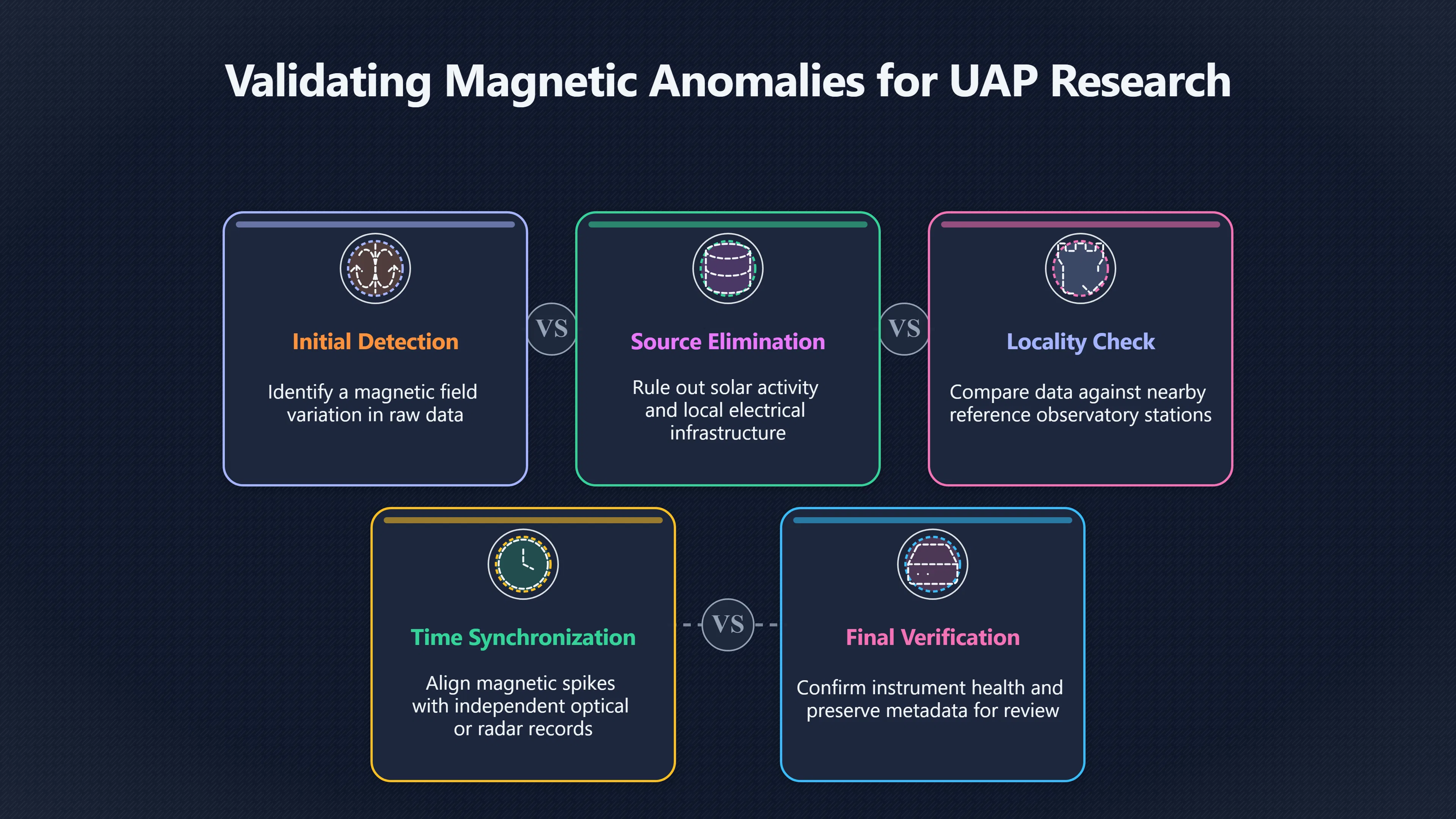
When is a magnetic spike worth attention?
A useful working definition is that a credible magnetic anomaly is a magnetic-field variation that cannot be readily explained by known natural or human-made causes after comparison with independent measurements and instrument diagnostics.
That definition is deliberately stricter than “the graph showed a spike”. Modern geomagnetic observatories routinely encounter magnetic changes caused by solar activity, nearby electrical equipment, vehicles, power infrastructure, construction work, lightning and instrument artefacts. A detector intended to investigate unusual aerial phenomena should therefore begin by attempting to eliminate these ordinary explanations before considering the event unusual.[Gi Copernicus+2USGS]gi.copernicus.orgGi Copernicus The deployment of a geomagnetic variometer station asby F Vervelidou · 2025 — The goal of the GP magnetometry investigation is to identify magnetic anomalies that cannot be readily explain…
For detector networks, the threshold for interest is not necessarily the size of the magnetic change. A modest but well-documented disturbance that satisfies multiple verification tests is scientifically more valuable than a large isolated excursion with poor documentation.
Timing the magnetic record to the sighting
The strongest single characteristic of a potentially useful magnetic anomaly is accurate timing.
A magnetometer should record continuously using a stable clock, preferably synchronised through GPS or another reliable time source. If an optical camera, infrared sensor, radar, acoustic array or radio receiver independently records an unusual event, the magnetic record can then be examined around exactly the same time window.
Timing matters because many apparent correlations disappear when clocks are checked carefully. A magnetic disturbance occurring several minutes before or after a reported sighting is much weaker evidence than one occurring simultaneously with an independently recorded object.
Useful timing information includes:
- UTC timestamps with known clock accuracy.
- Sensor sampling rate and any averaging applied.
- Start and end time of the anomaly.
- Time uncertainty for every instrument involved.
- Any gaps, dropped samples or software restarts.
The Galileo Project’s geomagnetic variometer programme was designed specifically so magnetic measurements could be analysed together with optical, infrared, acoustic and weather observations rather than interpreted in isolation.[Gi Copernicus]gi.copernicus.orgGi Copernicus The deployment of a geomagnetic variometer station asby F Vervelidou · 2025 — The goal of the GP magnetometry investigation is to identify magnetic anomalies that cannot be readily explain…
Checking locality with nearby instruments
One of the quickest ways to judge credibility is to ask whether the disturbance was local or regional.
A regional geomagnetic disturbance is expected during magnetic storms driven by solar activity. Such events appear simultaneously across many observatories over large geographical areas. Public observatory networks make these comparisons possible in near real time.[USGS+2Intermagnet]usgs.govGeomagnetism Program | U.S. Geological SurveyWe monitor the Earth's magnetic field. Using ground-based observatories, we provide cont…
By contrast, a genuinely local disturbance should show a different pattern:
- The detector station records the anomaly.
- Nearby reference observatories either do not record it or record a substantially different signature.
- The event cannot be attributed to local electrical infrastructure or nearby moving metal objects.
This comparison is exactly why the Galileo Project located its first variometer station near the long-established USGS Boulder magnetic observatory. The neighbouring observatory provides a high-quality reference against which local measurements can be compared, helping distinguish instrument problems from genuine local magnetic behaviour.[Gi Copernicus]gi.copernicus.orgGi Copernicus The deployment of a geomagnetic variometer station asby F Vervelidou · 2025 — The goal of the GP magnetometry investigation is to identify magnetic anomalies that cannot be readily explain…
The same principle is standard practice within the international INTERMAGNET observatory network, where neighbouring stations and independent measurements are routinely compared as part of quality assurance.[INTERMAGNET+2EGUsphere]tech-man.intermagnet.org5.2. Data Quality Control & Processing TasksAn observatory is best advised to adopt a routine of data inspection, inter-compar…
Ruling out equipment faults before interpreting the signal
Many apparent anomalies originate inside the measuring system rather than in the environment.
Potential causes include:[usgs.gov]usgs.govspace weather and magnetic storms invaders outer spacesortSpace Weather and Magnetic Storms: Invaders from Outer…20 Jul 2022 — The unique role of the USGS includes monitoring space weather on…
- Temporary sensor saturation.
- Power supply instability.
- Loose connectors.
- Software glitches.
- Clock synchronisation failures.
- Temperature-related drift.
- Nearby maintenance activity.
- Accidental movement of magnetic objects close to the sensor.
Professional geomagnetic observatories address these possibilities through routine inspection, baseline estimation, instrument inter-comparison and systematic data cleaning before accepting measurements as definitive. Rather than treating every spike as a discovery, quality-control procedures assume that unusual points require investigation first.[INTERMAGNET+2EGUsphere]tech-man.intermagnet.org5.2. Data Quality Control & Processing TasksAn observatory is best advised to adopt a routine of data inspection, inter-compar…
This philosophy is especially important for automated UAP detector stations operating unattended for long periods, where occasional hardware faults are inevitable.
Metadata needed for later review
A magnetic trace has limited scientific value without enough context to reconstruct the circumstances of the measurement.
At minimum, an archived event should include:
- Precise timestamp.
- GPS position of the station.
- Magnetometer model and calibration information.
- Sensor orientation.
- Sampling frequency.
- Raw measurements rather than only processed plots.
- Environmental conditions such as temperature and weather.
- Equipment health logs.
- Software version.
- Details of any coincident observations from cameras or other sensors.
Geomagnetic observatory practice places considerable emphasis on metadata because future investigators must be able to evaluate whether an apparent anomaly reflects the environment, changes in instrumentation or differences in processing methods.[NERC Open Research Archive]nora.nerc.ac.ukNERC Open Research Archive Chapter 7 Magnetic Observatory Data and MetadataNERC Open Research ArchiveChapter 7 Magnetic Observatory Data and MetadataJanuary 27, 2011 — by S Reay · 2011 · Cited by 30 — This chapte…
Without this supporting information, later reviewers cannot reliably distinguish a genuine environmental event from an undocumented change in the instrument.

Why isolated spikes rarely qualify as evidence
Historical reports of unexplained aerial phenomena have sometimes described compass deviations or other magnetic effects. However, those accounts typically lack calibrated instruments, continuous recording or independent verification.
Modern detector systems raise the evidential standard considerably. An isolated magnetic excursion, even if visually striking, is usually insufficient because there is no way to determine whether it resulted from electrical interference, passing vehicles, geomagnetic activity or instrument behaviour.
A magnetic anomaly becomes significantly more persuasive only when several independent conditions are satisfied simultaneously:
- An independently recorded aerial event exists.
- The magnetic disturbance is closely synchronised with that event.
- Regional observatories do not indicate a widespread geomagnetic disturbance.
- Instrument diagnostics show normal operation.
- Raw data remain available for independent analysis.
- The event can be reproduced through transparent review of the archived records.
Even then, the result is not evidence of an exotic object by itself. It is evidence that an unusual local magnetic disturbance coincided with another independently observed event and merits further investigation. That distinction keeps the interpretation aligned with normal scientific practice while avoiding conclusions that exceed the available evidence.[Gi Copernicus+2INTERMAGNET]gi.copernicus.orgGi Copernicus The deployment of a geomagnetic variometer station asby F Vervelidou · 2025 — The goal of the GP magnetometry investigation is to identify magnetic anomalies that cannot be readily explain…
Amazon book picks
Further Reading
Books and field guides related to When is a magnetic spike worth attention?. Use these as the next step if you want deeper reading beyond the article.
The UFO Experience
Focuses on systematic investigation and evaluating reports using evidence rather than anecdote.

Geomagnetism
Provides background on natural magnetic-field variation, helping distinguish local anomalies from broader geomagnetic effects.
eBay marketplace picks
Marketplace Samples
Live-tested eBay searches with available results related to this page.


Endnotes
1.
Source: gi.copernicus.org
Title: Gi Copernicus The deployment of a geomagnetic variometer station as
Link:https://gi.copernicus.org/articles/14/335/2025/
Source snippet
by F Vervelidou · 2025 — The goal of the GP magnetometry investigation is to identify magnetic anomalies that cannot be readily explain...
2.
Source: tech-man.intermagnet.org
Link:https://tech-man.intermagnet.org/latest/chapters/processdata/dataqualitycontrol.html
Source snippet
5.2. Data Quality Control & Processing TasksAn observatory is best advised to adopt a routine of data inspection, inter-compar...
3.
Source: usgs.gov
Link:https://www.usgs.gov/programs/geomagnetism
Source snippet
Geomagnetism Program | U.S. Geological SurveyWe monitor the Earth's magnetic field. Using ground-based observatories, we provide cont...
4.
Source: intermagnet.org
Link:https://intermagnet.org/
Source snippet
International Real-time Magnetic Observatory NetworkThe INTERMAGNET programme exists to establish a global network of cooperating digital...
5.
Source: egusphere.copernicus.org
Title: egusphere 2025 2396 manuscript version2
Link:https://egusphere.copernicus.org/preprints/2025/egusphere-2025-2396/egusphere-2025-2396-manuscript-version2.pdf
Source snippet
The INTERMAGNET framework for peer-review and...by J Reda — This article discusses key aspects of the collection, processing, a...
6.
Source: usgs.gov
Title: [space weather]({{ ‘space-weather/’ | relative_url }}) and magnetic storms invaders outer spacesort
Link:https://www.usgs.gov/news/featured-story/space-weather-and-magnetic-storms-invaders-outer-spacesort
Source snippet
Space Weather and Magnetic Storms: Invaders from Outer...20 Jul 2022 — The unique role of the USGS includes monitoring space weather on...
7.
Source: usgs.gov
Link:https://www.usgs.gov/programs/geomagnetism/publications?page=8
Source snippet
Geological SurveyWe present 29 movie‐maps of low‐latitude horizontal‐intensity magnetic disturbance for the years 1999–2006: 28 recording...
8.
Source: usgs.gov
Title: summer starts a simmering geomagnetic storm
Link:https://www.usgs.gov/news/featured-story/summer-starts-a-simmering-geomagnetic-storm
Source snippet
Summer Starts with a Simmering Geomagnetic StormA severe geomagnetic storm occurred from June 21-23, 2015; the storm arose in response to...
9.
Source: usgs.gov
Link:https://www.usgs.gov/media/videos/5-geomagnetic-storms-reshaped-society
Source snippet
5 Geomagnetic Storms that Reshaped SocietyWe thought it would be a good time to reflect on five geomagnetic storms that have reshaped Soc...
10.
Source: nora.nerc.ac.uk
Title: NERC Open Research Archive Chapter 7 Magnetic Observatory Data and Metadata
Link:https://nora.nerc.ac.uk/id/eprint/13033/1/Reay_etal-MagneticObservatoryDataAndMetadataTypesAndAvailability.pdf
Source snippet
NERC Open Research ArchiveChapter 7 Magnetic Observatory Data and MetadataJanuary 27, 2011 — by S Reay · 2011 · Cited by 30 — This chapte...
Published: January 27, 2011
Additional References
11.
Source: spaceweather.gov
Link:https://www.spaceweather.gov/phenomena/geomagnetic-storms
Source snippet
Geomagnetic Storms | NOAA / NWS...A geomagnetic storm is a major disturbance of Earth's magnetosphere that occurs when there is a very e...
12.
Source: researchgate.net
Link:https://www.researchgate.net/publication/368029199_Advanced_Production_of_Quasi-Definitive_Magnetic_Observatory_Data_of_the_INTERMAGNET_Standard
Source snippet
(PDF) Advanced Production of Quasi-Definitive Magnetic...Advanced Production of Quasi-Definitive Magnetic Observatory Data of the INTERM...
13.
Source: avi-loeb.medium.com
Link:https://avi-loeb.medium.com/commissioning-data-on-half-a-million-objects-in-the-sky-from-the-galileo-project-observatory-are-a23bd084233a
Source snippet
Data on Half a Million Objects in the Sky from...The GP Observatories offer an array of multi-modal, multi-spectral sensors that continu...
14.
Source: isgi.unistra.fr
Link:https://isgi.unistra.fr/iagaDivV/docs/IAGA_Workshop_proceedings/XthIAGA_ws.pdf
Source snippet
Magnetic Observatoryspace weather and large magnetic storms. A third purpose of the station will be to measure the secular variation. The...
15.
Source: youtube.com
Link:http://www.youtube.com/watch?v=mkm32Ss3_I0
Source snippet
UAP Summit 2026 science data tracker Sky360: A Global UAP Tracking Network for Science | Richard Hopf UAP Summit...
16.
Source: eos.org
Title: The Wobbly Anomaly and Other Magnetic Weirdness
Link:https://eos.org/agu-news/the-wobbly-anomaly-and-other-magnetic-weirdness
Source snippet
21 Dec 2020 — We take a look at the big dent known as the South Atlantic Anomaly, the origin of so-called geomagnetic jerks, and o...
17.
Source: phys.org
Title: 2020 07 reveals strange magnetic behaviour
Link:https://phys.org/news/2020-07-reveals-strange-magnetic-behaviour-.html
Source snippet
Study reveals strange magnetic behaviour 8-11 million...20 Jul 2020 — It reveals that the anomaly in the magnetic field in the South Atl...
18.
Source: pmc.ncbi.nlm.nih.gov
Link:https://pmc.ncbi.nlm.nih.gov/articles/PMC12804219/
Source snippet
database of geomagnetic observatory monthly means - PMCby W Brown · 2025 — There is a greater risk of false negatives in longer, quieter...
19.
Source: researchgate.net
Link:https://www.researchgate.net/publication/237998649_The_USGS_Geomagnetism_Program_and_Its_Role_in_Space_Weather_Monitoring
Source snippet
Large storms represent a potential...Read more...
20.
Source: youtube.com
Link:https://www.youtube.com/watch?v=az8KzgoE1Tw
Source snippet
in surface area since 2014. And it's still growing...
Topic Tree