Within ADS B
When Aircraft Data Should Close a Case
Clear match labels help a station decide whether a detection is known traffic, unrelated traffic or still worth review.
On this page
- Strong, weak and absent aircraft matches
- Rules for escalation and human review
- Recording uncertainty for later audits
Page outline Jump by section
Introduction
An automated UAP detector should not treat the absence or presence of an ADS-B signal as a verdict. Instead, ADS-B data should feed a structured decision policy that determines whether an event is closed as known aircraft activity, retained for automated reclassification, or escalated for human review. This distinction is important because ADS-B is a powerful contextual data source but not a complete picture of everything in the sky. Reception gaps, non-equipped aircraft, military operations, signal dropouts and timing errors all mean that “no ADS-B match” is not equivalent to “not an aircraft”. NASA’s Independent Study Team similarly emphasised that UAP investigations require calibrated sensors, complete metadata and rigorous data management rather than reliance on any single data source.[NASA Science]science.nasa.govScience Independent Study Team ReportNASA ScienceIndependent Study Team ReportSeptember 13, 2023 — The study of Unidentified Anomalous Phenomena (UAP) presents a unique scien…
 For an automated instrumented UAP station, the objective is therefore not simply aircraft identification but consistent governance: applying the same evidence thresholds to every detection, recording uncertainty, and ensuring that only genuinely unexplained events consume human attention.
When a Detection Should Be Closed Automatically
Most detections should never become UAP cases because they can be explained with high confidence through agreement between sensor observations and aircraft data.
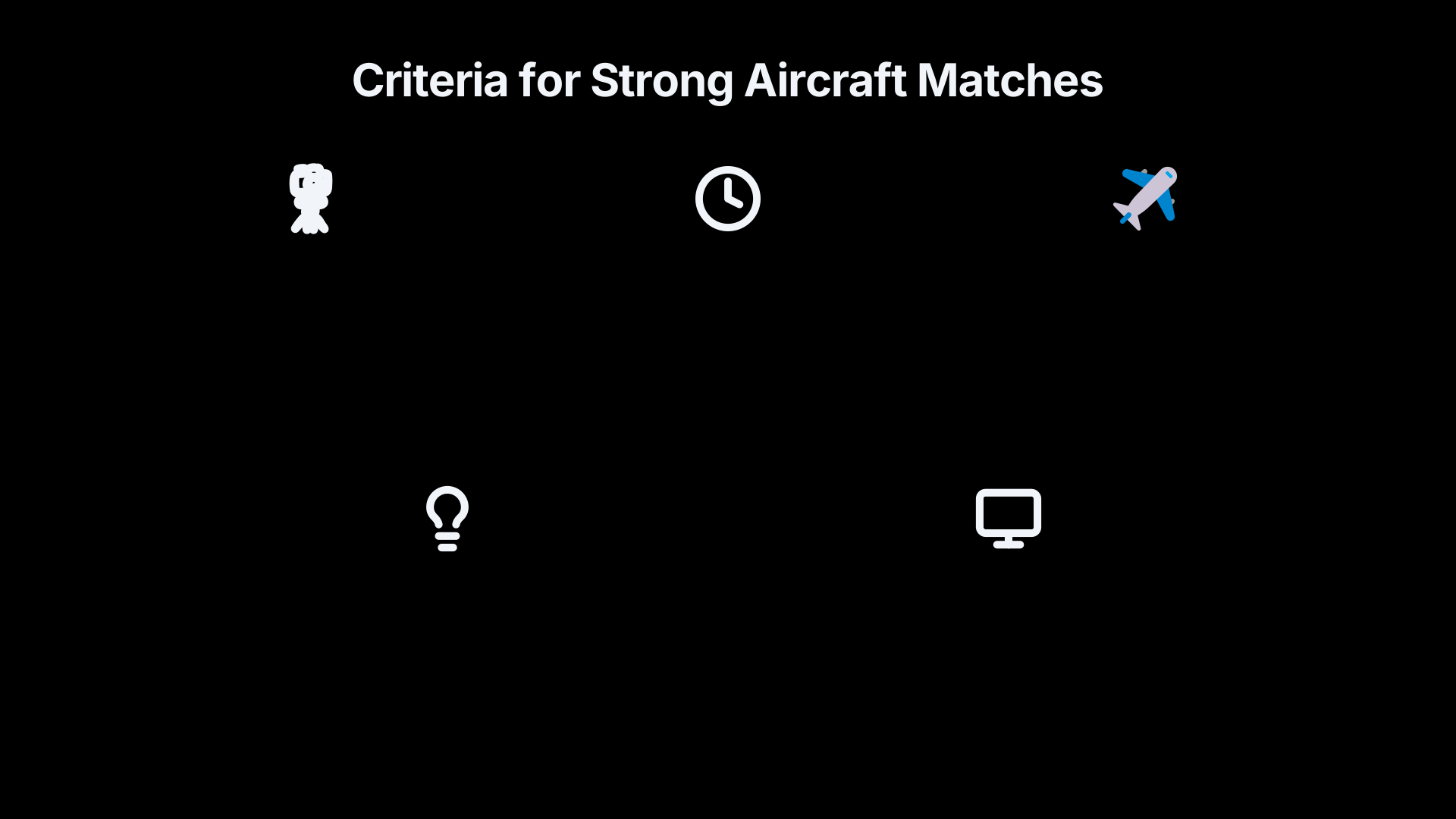
A strong aircraft match should normally satisfy several independent conditions rather than a single coincidence. Typical criteria include:
- The ADS-B track projects into the camera field of view within an acceptable positional tolerance.
- Detection time agrees with the aircraft position after accounting for clock synchronisation uncertainty.
- Apparent motion is consistent with the aircraft’s reported heading, altitude and ground speed.
- Expected lighting behaviour (navigation lights, strobes, landing lights or infrared signature) matches the observed object.
- The confidence remains stable over multiple frames rather than depending on one isolated observation.
Using several matching conditions reduces false associations that could occur in busy airspace where unrelated aircraft happen to be nearby. NASA’s report repeatedly stresses the importance of combining calibrated measurements with rich metadata rather than interpreting isolated observations.[NASA Science]science.nasa.govScience Independent Study Team ReportNASA ScienceIndependent Study Team ReportSeptember 13, 2023 — The study of Unidentified Anomalous Phenomena (UAP) presents a unique scien…
A detector operating under these rules should classify such events as identified aircraft, archive the supporting evidence and suppress further escalation unless conflicting sensor evidence later emerges.
Strong, Weak and Absent Aircraft Matches
The most useful decision policy distinguishes between different levels of confidence instead of making a binary aircraft/not-aircraft decision.
Match levelRecommended dispositionStrong matchClose automatically as known aircraft and retain supporting metadata.Weak matchKeep open for secondary automated analysis or delayed review.No matchContinue investigation rather than immediately labelling anomalous.
A weak match occurs when only some evidence agrees. Examples include:
- aircraft track aligns but timing differs noticeably;
- correct direction but inconsistent apparent speed;
- intermittent ADS-B reception;
- object remains visible after the reported aircraft has departed;
- multiple nearby aircraft make assignment ambiguous.
Weak matches deserve further processing because they often result from imperfect timing, camera calibration errors or incomplete reception rather than genuinely anomalous objects. The Galileo Project’s published observatory work demonstrates that ADS-B aircraft can also serve as calibration references, meaning an apparent mismatch may indicate a camera geometry problem rather than an unexplained target.[World Scientific]worldscientific.comWorld ScientificThe Scientific Investigation of Unidentified Aerial…by WA Watters · 2023 · Cited by 47 — Air traffic will continue to…
An absent match should be recorded precisely as that: no suitable ADS-B correspondence was found under current data quality conditions. It should never automatically become evidence for anomalous behaviour.
Rules for Escalation and Human Review
Escalation should depend on the accumulation of evidence rather than on the novelty of an individual observation.
A practical governance policy is to require human review whenever one or more of the following conditions are met:
- Persistent disagreement. Multiple sensors continue detecting an object despite repeated failure to associate it with any plausible aircraft track.
- High-quality measurements. The event includes calibrated imagery, precise timestamps and reliable pointing information.
- Independent confirmation. Two or more instruments agree on position or motion.
- Operational significance. The object appears close to protected airspace, critical infrastructure or aircraft operations.
- Repeated occurrence. Similar unmatched detections recur in the same location under comparable observing conditions.
- Conflict between evidence sources. ADS-B suggests an aircraft explanation while imaging, geometry or kinematics strongly disagree.
Equally important are rules that prevent unnecessary escalation. Events with poor calibration, incomplete timestamps, heavy cloud interference or uncertain camera pointing should generally remain in a provisional queue until supporting information can be collected rather than being promoted immediately to human investigation. NASA identified missing metadata and inadequate calibration as major obstacles to meaningful UAP analysis, making data quality itself an escalation criterion.[NASA Science]science.nasa.govScience Independent Study Team ReportNASA ScienceIndependent Study Team ReportSeptember 13, 2023 — The study of Unidentified Anomalous Phenomena (UAP) presents a unique scien…
Recording Uncertainty for Later Audits
Every automated decision should be reproducible months or years later.
Instead of storing only the final classification, the system should preserve:
- aircraft identifier (if matched);
- geometric separation between detection and projected aircraft position;
- timing offset;
- receiver confidence and reception quality;
- camera calibration version;
- weather or visibility conditions;
- software version and decision thresholds;
- final confidence score;
- explanation for the classification.
Maintaining an audit trail allows investigators to revisit historical cases after software improvements, corrected calibration parameters or newly available flight information. It also enables independent reviewers to understand why an event was dismissed or escalated instead of relying on undocumented judgement.

Accounting for ADS-B Limitations in Policy
Decision rules must explicitly acknowledge that ADS-B itself is imperfect.
Reception depends on antenna placement, terrain, aircraft altitude and line of sight. Aircraft equipment failures, transmission interruptions and data anomalies can also create temporary gaps. Studies of ADS-B performance document message dropouts, missing updates and confidence variations that can affect automated matching algorithms.[PMC]pmc.ncbi.nlm.nih.govAircraft trajectory prediction and aviation safety in ADS-B…by Z Yang · 2023 · Cited by 39 — This study adopts a data-driven approa…
For that reason, a robust policy distinguishes between:
- No aircraft detected (nothing received by the station);
- No aircraft expected (based on broader surveillance context);
- Insufficient ADS-B confidence (receiver quality too poor for exclusion).
Only the first statement is directly supported by the receiver itself. The latter two require additional evidence.
A Conservative Decision Hierarchy
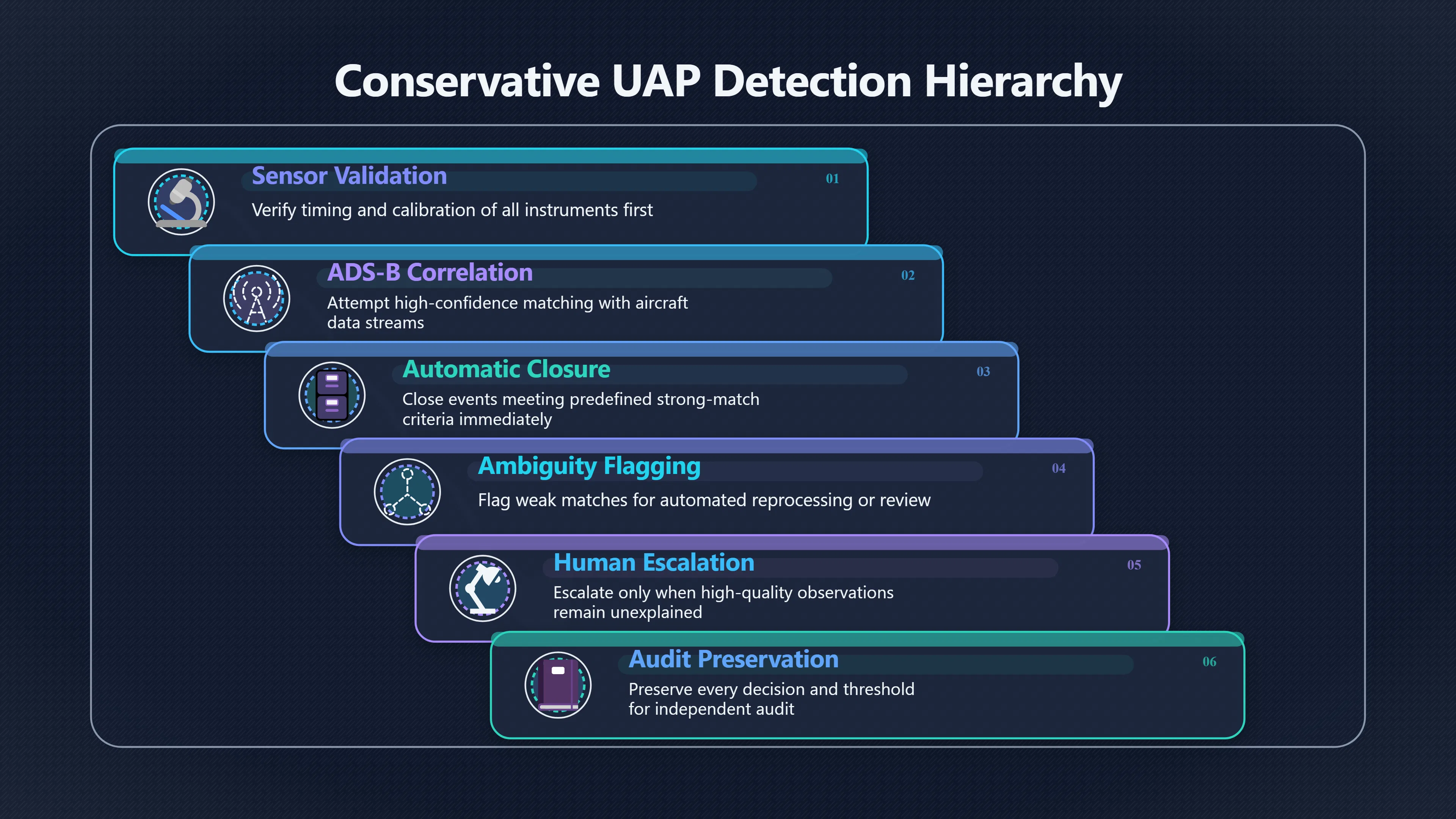
For automated instrumented UAP detectors, the safest governance approach follows a conservative sequence:
- Validate sensor timing and calibration.
- Attempt high-confidence ADS-B correlation.
- Close only events meeting predefined strong-match criteria.
- Flag ambiguous matches for automated reprocessing or delayed review.
- Escalate only when high-quality observations remain unexplained after contextual checks.
- Preserve every decision, threshold and uncertainty value for independent audit.
This approach minimises both false dismissals and unnecessary investigations. Rather than treating ADS-B as proof that an event is ordinary—or its absence as proof that it is extraordinary—it uses aircraft data as one weighted source of evidence within a transparent, repeatable decision framework.
Amazon book picks
Further Reading
Books and field guides related to When Aircraft Data Should Close a Case. Use these as the next step if you want deeper reading beyond the article.
The UFO Experience
Provides a rigorous framework for evaluating unexplained aerial reports rather than relying on single pieces of evidence.
Thinking, Fast and Slow
Helps readers understand evidence evaluation, bias, and disciplined decision-making in ambiguous cases.

Introduction to Avionics Systems
First published 2011. Subjects: Engineering, Astronautics, Electronics, Avionics.
eBay marketplace picks
Marketplace Samples
Example marketplace items related to this page. Use the search link to explore similar finds on eBay.



Endnotes
1.
Source: science.nasa.gov
Title: Science Independent Study Team Report
Link:https://science.nasa.gov/wp-content/uploads/2023/09/uap-independent-study-team-final-report.pdf
Source snippet
NASA ScienceIndependent Study Team ReportSeptember 13, 2023 — The study of Unidentified Anomalous Phenomena (UAP) presents a unique scien...
Published: September 13, 2023
2.
Source: pmc.ncbi.nlm.nih.gov
Link:https://pmc.ncbi.nlm.nih.gov/articles/PMC10640623/
Source snippet
Aircraft trajectory prediction and aviation safety in ADS-B...by Z Yang · 2023 · Cited by 39 — This study adopts a data-driven approa...
3.
Source: worldscientific.com
Link:https://www.worldscientific.com/doi/10.1142/S2251171723400068?srsltid=AfmBOorDuYieP2kWLxdhV8SkdWVfVgSkNZYjFDhoCdqKZWhIeTiAZDqc
Source snippet
World ScientificThe Scientific Investigation of Unidentified Aerial...by WA Watters · 2023 · Cited by 47 — Air traffic will continue to...
Additional References
4.
Source: nature.com
Link:https://www.nature.com/articles/s41599-024-04182-z
Source snippet
Looking up the sky: unidentified aerial phenomena and...by N Goldstein · 2024 · Cited by 1 — UAP sightings measure is highly correlated...
5.
Source: researchgate.net
Link:https://www.researchgate.net/publication/325659005_UAT_ADS-B_Data_Anomalies_and_the_Effect_of_Flight_Parameters_on_Dropout_Occurrences
Source snippet
(PDF) UAT ADS-B Data Anomalies and the Effect of Flight...The data investigation revealed ADS-B message suffered from different anomalie...
6.
Source: adsadvance.co.uk
Link:https://www.adsadvance.co.uk/
Source snippet
No responsibility or liability is accepted by ADS, the editorial team or the publisher for any loss...
7.
Source: adsgroup.org.uk
Link:https://www.adsgroup.org.uk/
Source snippet
ADS Group: HomeADS is the UK trade association advancing leadership in aerospace, defence, security and space, to enable prosperity and c...
8.
Source: avi-loeb.medium.com
Title: a new calculation on the fly to the nasa uap study 2dacaf860cac
Link:https://avi-loeb.medium.com/a-new-calculation-on-the-fly-to-the-nasa-uap-study-2dacaf860cac
Source snippet
New Calculation on the Fly to the NASA UAP Study - Avi LoebThe NASA Study will examine unclassified data on UAP in an attempt to separate...
9.
Source: thedebrief.org
Title: nasas unidentified anomalous phenomena report key takeaways
Link:https://thedebrief.org/nasas-unidentified-anomalous-phenomena-report-key-takeaways/
Source snippet
The DebriefNASA's Unidentified Anomalous Phenomena Report14 Sept 2023 — “At present, analysis of UAP data is hampered by poor sensor cali...
10.
Source: leonarddavid.com
Title: nasa report released unidentified anomalous phenomena uap
Link:https://www.leonarddavid.com/nasa-report-released-unidentified-anomalous-phenomena-uap/
Source snippet
Unidentified Anomalous Phenomena (UAP) – UPDATED14 Sept 2023 — NASA has released its Unidentified Anomalous Phenomena (UAP) report comple...
11.
Source: facebook.com
Link:https://www.facebook.com/NewsNationNow/posts/its-impossible-to-draw-firm-scientific-conclusions-about-uaps-according-to-nasa-/326808863059471/
Source snippet
Why it matters Pilot testimony forms a large share of credible UAP cases.Read more...
12.
Source: youtube.com
Title: How Anyone Can Track Every Plane and Ship in Real Time (ADS-B + AIS)
Link:https://www.youtube.com/watch?v=kSR5eCXa_nE
Source snippet
provides critical information on the [open-source]({{ 'open-source/' | relative_url }}) ADS-B protocol, signal coverage, and receiver limitations necessary for formulating trac...
13.
Source: flightsafetydetectives.com
Title: Use ASRS to Report UAP and UFO Encounters
Link:https://flightsafetydetectives.com/use-asrs-to-report-uap-and-ufo-encounters-episode-234/
Source snippet
Episode 234NASA's Aviation Safety Reporting System (ASRS) can be used by pilots, mechanics, flight attendants, to report UAP or UFO encou...
Topic Tree