Within Sky Detectors
Why One Camera Is Not Enough
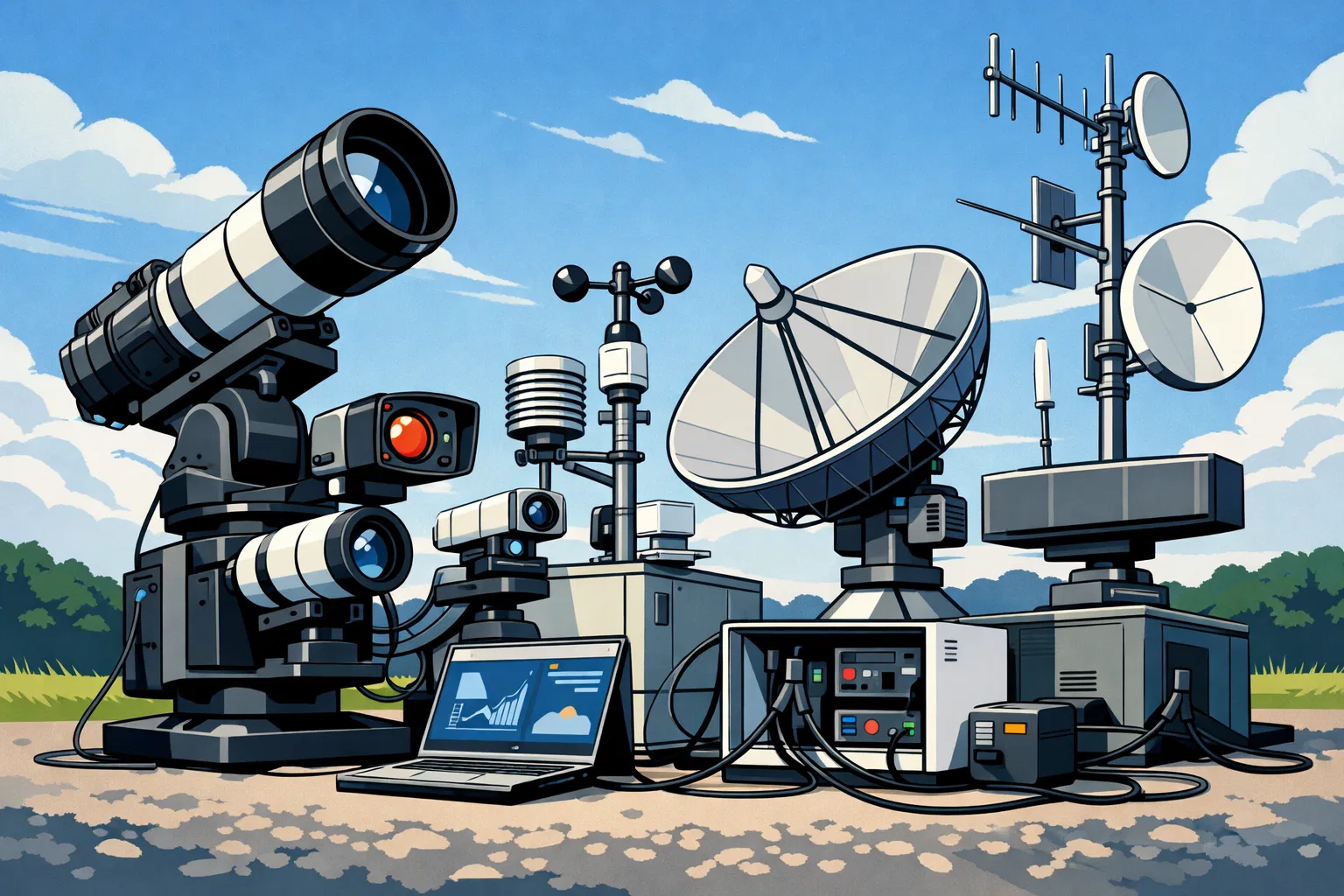
A real UAP detector is strongest when cameras, radio, sound, weather, and position data check one another.
On this page
- What each sensor can and cannot prove
- How independent channels reduce false alarms
- What a useful multi sensor event record includes
Page outline Jump by section
Introduction
A single camera can show that something appeared in the sky, but it usually cannot prove what it was, how far away it was, how fast it moved, or whether its apparent behaviour came from the object or from the camera system. That is why serious automated UFO or UAP detectors are moving towards multi-sensor records: optical and infrared cameras, radio receivers, microphones, weather instruments, aircraft tracking, timing, position data and, where possible, observations from more than one site. NASA’s independent UAP study identified poor calibration, missing sensor metadata and lack of multiple measurements as core obstacles to useful analysis, not minor paperwork problems.[NASA Science]science.nasa.govNASA ScienceIndependent Study Team ReportAt present, analysis of UAP data is hampered by poor sensor calibration, the lack of multiple me…
The practical aim is not to make a detector “believe” more reports. It is to make the system harder to fool. A camera track that is also matched to ADS-B aircraft data, local weather, a radio return, an acoustic signature, satellite geometry and a second observing station becomes a measurement problem rather than a guessing game. Conversely, a dramatic video that has no range, no calibration, no clock accuracy and no independent channel remains ambiguous, even if it looks extraordinary.
The single-camera trap
A camera records a two-dimensional image of a three-dimensional scene. Without reliable range, a small object nearby can resemble a large object far away, and a slow object at one distance can seem fast at another. This is the central weakness in many striking UAP clips: the image may be real, but the inferred size, altitude and speed may not be. AARO has explicitly highlighted parallax, forced perspective and sensor artefacts as sources of UAP reports in which apparent size or performance exceeds what the underlying geometry supports.[theforestawakening.com]theforestawakening.comEffect of Forced Perspective and Parallax View on UAP ObservationsJanuary 1, 2024 — AARO discusses specular and diffuse reflection from man-made satellites and how satellite flaring can be misinterpreted…
This matters because “fast” in a video often means “fast across the frame”, not fast through the air. A camera on a moving aircraft, a tracking mount or even a handheld phone can make a distant balloon, bird, aircraft or satellite appear to move dramatically against the background. The well-known “GOFAST” case illustrates the point: AARO told a 2024 Senate hearing that geospatial analysis placed the object much higher than it first appeared, with parallax making its motion look unusually rapid, while still not necessarily identifying the object itself.[New York Post]nypost.comDuring a Congressional hearing, Dr. Jon Kosloski from the All-Domain Anomaly Resolution Office reported that the object seen moving rapid…
Optics add another layer of uncertainty. Focus, zoom, exposure, rolling shutter, compression, glare and infrared blooming can all change what an object appears to be doing. A bright aircraft light can become a shapeless blob; a distant point source can become a polygonal blur; an infrared engine plume can look larger than the vehicle producing it. These are not excuses to dismiss every case, but they are reasons why one camera alone is weak evidence for extreme claims.

What each sensor can and cannot prove
A useful automated UAP detector treats every sensor as partial. No single channel is the truth machine. The value comes from knowing what each one measures well, what it cannot measure alone, and how it checks the others.
Visible-light cameras are best at recording direction, brightness changes, shape as seen in a particular band, and angular motion across the sky. They are relatively cheap, intuitive and easy to deploy in citizen systems such as Sky360, which describes its goal as an open-source global network of AI-powered tracking stations for detecting, tracking, identifying and analysing aerial phenomena.[sky360.org]sky360.orgObservational Citizen Science of Earth's AtmosphereSky360 is an open-source global sky observation network using AI-powered trac… But a visible camera usually cannot determine distance by itself, and therefore cannot reliably determine size or true speed without extra geometry.
Infrared cameras add heat contrast and night-time sensitivity. The Galileo Project’s all-sky infrared camera work uses an array of eight long-wave infrared cameras and explicitly calibrates them with synchronised ADS-B aircraft positions, showing how even a camera-centred instrument becomes more useful when tied to external aircraft data.[arXiv]arxiv.orgOpen source on arxiv.org. Infrared still has its own traps: hot exhaust, sensor gain, blooming, reflections and atmospheric absorption can all distort the apparent outline or intensity of a target.
Radar and passive radio systems can add the missing quantity that cameras often lack: range. The Galileo Project’s SkyWatch concept uses passive multistatic radar based on broadcast FM transmitters of opportunity, with receivers spaced geographically to estimate three-dimensional position and velocity time series for aerial objects.[arXiv]arxiv.orgOpen source on arxiv.org. This is why radar-like channels are so important: once range and velocity are measured independently, the video is no longer forced to carry the whole burden. But radar can also generate false tracks, multipath returns and clutter, so it still needs correlation with other channels.
Aircraft-tracking receivers such as ADS-B are not UAP sensors in the exotic sense; they are exclusion tools. ADS-B Out broadcasts an aircraft’s GPS-derived position, altitude, ground speed and other data, and the FAA describes it as updating once per second.[Federal Aviation Administration]faa.govins outsins outs For a sky detector, that means many “unknowns” can be checked against ordinary aircraft traffic before they become mystery clips. The limitation is equally important: not every object transmits ADS-B, and a missing ADS-B hit does not prove something is anomalous.
Acoustic sensors can help when an event is within range and loud enough to stand above background noise. The Galileo Project’s acoustic monitoring work uses infrasonic, audible and ultrasonic microphones to provide an independent signal modality, with audible aircraft detections reported up to about one kilometre under suitable conditions and infrasonic sources potentially detectable over longer ranges.[arXiv]arxiv.orgarXiv Multi-Band Acoustic Monitoring of Aerial SignaturesarXiv Multi-Band Acoustic Monitoring of Aerial Signatures Silence, however, is not decisive. Wind, terrain, distance, directionality and atmospheric conditions can erase or distort sound.
Weather stations are mundane but essential. Cloud base, wind, visibility, humidity, temperature gradients and storm activity can change what is visible, how sound travels and whether apparent motion might be drifting debris, balloons, birds, insects or atmospheric optics. Hessdalen’s automatic station was expanded with a weather station in 2002, a practical sign that long-term anomaly monitoring needs environmental context as well as cameras.[Hessdalen]old.hessdalen.orgAutomatic Measurement Station (AMSAutomatic Measurement Station (AMS
Magnetometers and other environmental sensors are weaker as identification tools but useful as context channels. Hessdalen’s Automatic Measurement Station has used cameras and magnetometry, while Galileo Project work has explored magnetometry as auxiliary instrumentation to test reported associations between UAP sightings and local electromagnetic disturbances.[Wikipedia]WikipediaHessdalen AMSHessdalen AMS A magnetic spike near an optical event would not identify an object by itself; it would create a testable correlation that analysts could compare against geomagnetic activity, local electrical equipment and other ordinary causes.
Independent channels reduce false alarms
The strongest reason for multi-sensor detection is not that every sensor adds drama. It is that independent channels fail in different ways. A lens reflection may appear on a camera but not on radar, ADS-B, acoustics or a second camera with a different angle. A satellite flare may be bright visually but should follow predictable orbital and illumination geometry. A drone may show optical motion, possible acoustic output and sometimes radio-frequency activity. A balloon may drift with wind and lack propulsion noise. A meteor may produce a fast luminous track but not a sustained low-altitude hover.
This is where automated instrumented detectors become different from ordinary sky-watching. They do not merely capture a clip; they record a decision environment. A detected object can be checked against aircraft broadcasts, satellite predictions, weather, camera calibration, local radio data and other stations. AARO’s 2025 satellite-flaring paper, for example, describes how sunlight reflected from Starlink satellite surfaces can be misinterpreted as UAP and gives observers a method for testing whether a sighting may be attributable to satellite flaring.[AARO]aaro.milCorrelations of Starlink Satellite Flaring with UAPCorrelations of Starlink Satellite Flaring with UAP
The same logic applies to “ordinary” aircraft. The Galileo infrared array’s use of ADS-B aircraft positions for extrinsic calibration is a good example of turning known air traffic into a calibration asset rather than treating it only as clutter.[arXiv]arxiv.orgOpen source on arxiv.org. If a detector can repeatedly recover the correct position and track of known aircraft, analysts gain confidence in the geometry of unknown tracks. If it cannot, then its anomalous detections are less persuasive.
Multi-sensor systems also help separate detection from identification. A camera may trigger the event; radar may estimate range; ADS-B may exclude cooperative aircraft; weather data may explain drift; acoustics may suggest propulsion or its absence; a second site may triangulate position. No one channel has to do everything. The event becomes stronger when different channels agree, and weaker when the supposed anomaly depends on one fragile interpretation.
Hessdalen shows both the promise and the limits
Hessdalen, Norway, is often cited because it moved beyond witness reports into long-term instrumented monitoring of unusual lights. Project Hessdalen’s own material describes field investigations using instruments such as radar, spectrum analysis, magnetometer, Geiger counter, laser and infrared viewing equipment, and later an Automatic Measurement Station with continuous cameras.[CO Meeting Organizer]meetingorganizer.copernicus.orgCO Meeting Organizer The Hessdalen PhenomenaCO Meeting Organizer The Hessdalen Phenomena
The important lesson is not that Hessdalen solved all mystery lights. It did not. The lesson is that multi-instrument monitoring changed the quality of the question. A light seen by a witness becomes an anecdote. A light recorded with time, direction, camera view, possible radar return, spectrum, environmental data and repeat observations becomes something that can be compared, rejected, modelled or revisited. Even so, the Hessdalen station’s own public descriptions acknowledge limits: earlier arrangements could not determine distance to the lights, and later expansions were partly motivated by the need for closer images and better measurement geometry.[Hessdalen]old.hessdalen.orgAutomatic Measurement Station (AMSAutomatic Measurement Station (AMS
That is exactly the point for modern automated UAP detection. More sensors do not automatically produce certainty; they expose what is still missing. If a light is recorded optically but not ranged, range remains unknown. If radar sees something but the camera does not, analysts must examine radar clutter, line of sight, sensitivity and timing. If a magnetic fluctuation occurs near a sighting, it must be tested against ordinary geomagnetic and local electrical causes. Multi-sensor detection improves the evidence by making uncertainty visible rather than hiding it inside a striking image.
What a useful event record includes
A serious multi-sensor UAP event record should be built so that another analyst can reconstruct what happened without trusting the original observer’s impression. The Galileo Project’s observatory-class computing platform was designed around this problem: existing UAP data are often fragmented, uncalibrated and missing critical metadata, so the system emphasises real-time acquisition, sensor optimisation, data provenance and post-processing workflows.[arXiv]arxiv.orgarXiv Galileo Project Observatory Class System ArchitecturearXiv Galileo Project Observatory Class System Architecture
A useful record normally needs:
- Accurate time: synchronised timestamps for every sensor, ideally precise enough to compare optical frames, radio data, ADS-B tracks, weather readings and acoustic signals.
- Known sensor position and pointing: GPS location, altitude, camera orientation, lens parameters, field of view, focus state and mount behaviour.
- Raw or minimally processed data: original frames, not just compressed social-media video; radio or radar samples where available; unedited logs; and full event metadata.
- Calibration history: evidence that the system can correctly observe known aircraft, satellites, stars or other reference targets.
- Context feeds: ADS-B or other aircraft data, satellite predictions, weather measurements, local sky conditions and nearby human activity.
- Cross-sensor correlation: a record of which sensors detected the event, which did not, and the timing offsets between them.
- Chain of custody: clear provenance showing how data were collected, stored, processed and altered.
This is why a networked detector is more than a camera in a box. A camera clip may be emotionally compelling, but a calibrated event package can be audited. It can show that the object was not a known aircraft, or that it probably was. It can show that an apparent acceleration was a tracking artefact, or that independent range data support unusual motion. It can show that a supposed silent hover happened in high wind and low cloud, or that several independent sensors recorded something worth deeper study.
The hard cases are correlation problems
The hardest events are not always the most visually dramatic. They are the ones where several independent channels register something that remains inconsistent with ordinary explanations after calibration, timing and context checks. NASA’s UAP report called for systematic data calibration, multiple measurements and thorough sensor metadata because without those ingredients even intriguing cases can remain scientifically weak.[NASA Science]science.nasa.govNASA ScienceIndependent Study Team ReportAt present, analysis of UAP data is hampered by poor sensor calibration, the lack of multiple me…
A multi-sensor detector therefore needs two opposite virtues. It must be sceptical enough to discard birds, balloons, aircraft, drones, satellites, insects, weather artefacts, lens effects and software errors. But it must also be disciplined enough not to discard a genuinely unusual multi-channel record merely because the topic is culturally awkward. This is where automation helps: the system can apply the same filters to ordinary and unusual events, preserve failed detections as well as successful ones, and build a baseline of what the local sky normally looks like.
AARO’s GREMLIN prototype reflects the same institutional turn towards instrumented collection. The FY2024 UAP annual report says GREMLIN contains several sensing modalities to detect, track, characterise and identify UAP, demonstrated functionality in a March 2024 test event, and was planned for a 90-day “pattern of life” collection at a national-security site.[U.S. Department of War]media.defense.govFY24 CONSOLIDATED ANNUAL REPORT ON UAP 508Department of WarFiscal Year 2024 Consolidated Annual Report on…14 Nov 2024 — AARO S&T has published a number of educational reports i… The phrase “pattern of life” is important: anomaly detection depends on knowing the normal background first.
Why one camera is not enough
One camera is not useless. It can trigger an event, preserve a visual record and provide angular motion. But it is not enough because most UAP questions are three-dimensional, time-dependent and context-heavy. The camera asks, “What did this look like from here?” A real detector has to ask, “Where was it, how far away, how fast, under what conditions, seen by which independent channels, and what ordinary objects were present at the same time?”
That is the mechanism behind multi-sensor UAP detection. Cameras, radio, sound, weather and position data do not merely add more information; they constrain one another. A claim about speed must survive range data. A claim about size must survive distance. A claim about unusual motion must survive mount geometry and parallax. A claim about unknown identity must survive aircraft, satellite, weather and local-context checks. The more independent constraints a record contains, the less room there is for a single optical illusion, missing metadata field or mistaken distance estimate to masquerade as something extraordinary.
Amazon book picks
Further Reading
Books and field guides related to Why One Camera Is Not Enough. Use these as the next step if you want deeper reading beyond the article.
How to Measure Anything
Provides practical thinking about uncertainty, evidence, and extracting useful measurements.
Introduction to Radar Systems
Explains independent sensing channels that complement optical observations.

UFOs : Generals, Pilots, and Government Officials Go on the R...
Emphasizes evidence quality, multiple witnesses, and the limits of single observations.
The UFO Enigma
Centers on measurement, data quality, and scientific evaluation of anomalous reports.
eBay marketplace picks
Marketplace Samples
Live-tested eBay searches with available results related to this page.
Endnotes
1.
Source: science.nasa.gov
Link:https://science.nasa.gov/wp-content/uploads/2023/09/uap-independent-study-team-final-report.pdf
Source snippet
NASA ScienceIndependent Study Team ReportAt present, analysis of UAP data is hampered by poor sensor calibration, the lack of multiple me...
2.
Source: nasa.gov
Title: update nasa shares uap independent study report names director
Link:https://www.nasa.gov/news-release/update-nasa-shares-uap-independent-study-report-names-director/
Source snippet
UPDATE: NASA Shares UAP Independent Study Report14 Sept 2023 — We found that NASA can help the whole-of-government UAP effort through...
3.
Source: theforestawakening.com
Title: Effect of Forced Perspective and Parallax View on UAP Observations
Link:https://theforestawakening.com/incidents/effect-of-forced-perspective-and-parallax-view-on-uap-observations-35a2093a
Source snippet
January 1, 2024 — AARO discusses specular and diffuse reflection from man-made satellites and how satellite flaring can be misinterpreted...
Published: January 1, 2024
4.
Source: media.defense.gov
Title: FY24 CONSOLIDATED ANNUAL REPORT ON UAP 508
Link:https://media.defense.gov/2024/Nov/14/2003583603/-1/-1/0/FY24-CONSOLIDATED-ANNUAL-REPORT-ON-UAP-508.PDF
Source snippet
Department of WarFiscal Year 2024 Consolidated Annual Report on...14 Nov 2024 — AARO S&T has published a number of educational reports i...
5.
Source: sky360.org
Link:https://www.sky360.org/
Source snippet
Observational Citizen Science of Earth's AtmosphereSky360 is an open-source global sky observation network using AI-powered trac...
6.
Source: arxiv.org
Link:https://arxiv.org/abs/2411.07956
7.
Source: arxiv.org
Link:https://arxiv.org/html/2411.07956v1
8.
Source: arxiv.org
Link:https://arxiv.org/abs/2305.18562
9.
Source: faa.gov
Title: ins outs
Link:https://www.faa.gov/air_traffic/technology/equipadsb/capabilities/ins_outs
10.
Source: arxiv.org
Title: arXiv Multi-Band Acoustic Monitoring of Aerial Signatures
Link:https://arxiv.org/abs/2305.18551
11.
Source: old.hessdalen.org
Title: Automatic Measurement Station (AMS)
Link:https://old.hessdalen.org/station/second.shtml
12.
Source: Wikipedia
Title: Hessdalen AMS
Link:https://en.wikipedia.org/wiki/Hessdalen_AMS
13.
Source: arxiv.org
Link:https://arxiv.org/abs/2507.11355
14.
Source: aaro.mil
Title: Correlations of Starlink Satellite Flaring with UAP
Link:https://www.aaro.mil/Portals/136/PDFs/Information%20Papers/AARO_Satellite_Flaring_Paper_508_FINAL_04222025.pdf
15.
Source: aaro.mil
Link:https://www.aaro.mil/Next-AARO-Home-redesign/Next-AARO-UAP-Records-DT/
16.
Source: old.hessdalen.org
Title: Project Hessdalen
Link:https://old.hessdalen.org/station/
17.
Source: arxiv.org
Title: arXiv Galileo Project Observatory Class System Architecture
Link:https://arxiv.org/abs/2506.00125
18.
Source: arxiv.org
Link:https://arxiv.org/html/2506.00125v1
19.
Source: old.hessdalen.org
Title: Hessdal article2000.shtml
Link:https://old.hessdalen.org/reports/Hessdal-article2000.shtml
20.
Source: nasa.gov
Link:https://www.nasa.gov/
21.
Source: science.nasa.gov
Link:https://science.nasa.gov/uap/
22.
Source: Wikipedia
Title: Galileo Galilei
Link:https://en.wikipedia.org/wiki/Galileo_Galilei
23.
Source: Wikipedia
Title: All domain Anomaly Resolution Office
Link:https://en.wikipedia.org/wiki/All-domain_Anomaly_Resolution_Office
24.
Source: Wikipedia
Title: NASA Unidentified Anomalous Phenomena Independent Study Team
Link:https://en.wikipedia.org/wiki/NASA_Unidentified_Anomalous_Phenomena_Independent_Study_Team
25.
Source: Wikipedia
Link:https://en.wikipedia.org/wiki/NASA
26.
Source: Wikipedia
Title: Automatic Dependent Surveillance–Broadcast
Link:https://en.wikipedia.org/wiki/Automatic_Dependent_Surveillance%E2%80%93Broadcast
27.
Source: Wikipedia
Title: Pentagon UFO videos
Link:https://en.wikipedia.org/wiki/Pentagon_UFO_videos
28.
Source: Wikipedia
Title: Hessdalen lights
Link:https://en.wikipedia.org/wiki/Hessdalen_lights
29.
Source: arxiv.org
Link:https://arxiv.org/html/2411.02401v1
30.
Source: arxiv.org
Link:https://arxiv.org/pdf/2405.13091
31.
Source: aaro.mil
Title: Official UAP Imagery
Link:https://www.aaro.mil/UAP-Cases/Official-UAP-Imagery/
32.
Source: aaro.mil
Link:https://www.aaro.mil/
33.
Source: aaro.mil
Link:https://www.aaro.mil/Portals/136/PDFs/Information%20Papers/AARO_Effect_of_Forced_Perspective_and_Parallax_View_on_UAP_Observations_2024.pdf
34.
Source: aaro.mil
Link:https://www.aaro.mil/Congressional-Press-Products/
35.
Source: war.gov
Title: department of defense releases the annual report on unidentified anomalous phen
Link:https://www.war.gov/News/Releases/Release/Article/3964824/department-of-defense-releases-the-annual-report-on-unidentified-anomalous-phen/
36.
Source: nypost.com
Link:https://nypost.com/2024/11/20/us-news/pentagon-claims-to-debunk-famous-gofast-ufo-radar-video/
Source snippet
During a Congressional hearing, Dr. Jon Kosloski from the All-Domain Anomaly Resolution Office reported that the object seen moving rapid...
37.
Source: meetingorganizer.copernicus.org
Title: CO Meeting Organizer The Hessdalen Phenomena
Link:https://meetingorganizer.copernicus.org/EGU2011/EGU2011-9137.pdf
38.
Source: dvidshub.net
Link:https://www.dvidshub.net/video/950338/satellite-flaring-phenomenon
39.
Source: ui.adsabs.harvard.edu
Link:https://ui.adsabs.harvard.edu/abs/arXiv%3A2411.07956
40.
Source: media.defense.gov
Title: DOPSR 2024 0263 AARO HISTORICAL RECORD REPORT VOLUME 1 2024
Link:https://media.defense.gov/2024/Mar/08/2003409233/-1/-1/0/DOPSR-2024-0263-AARO-HISTORICAL-RECORD-REPORT-VOLUME-1-2024.PDF
41.
Source: thecrimson.com
Title: galileo project
Link:https://www.thecrimson.com/article/2021/8/11/galileo-project/
Additional References
42.
Source: news.com.au
Title: ‘Black object’: Pentagon’s wild UFO revelation Dr
Link:https://www.news.com.au/technology/science/space/very-anomalous-objects-pentagon-reveals-bizarre-ufo-sightings-under-investigation/news-story/a41d822643c8faf3a4ebce168b1d1f92
Source snippet
Jon T. Kosloski, head of the Pentagon's UFO investigation office, detailed several anomalous UFO sightings that remain unexplained during...
43.
Source: youtube.com
Title: UAP Independent Study Event Post-Meeting Media Teleconference (
Link:https://www.youtube.com/watch?v=C3uXUfgSadU
Source snippet
Unidentified Anomalous Phenomena Independent Study Report...
Published: May 31, 2023
44.
Source: youtube.com
Title: How Military Sensors Proved UFO Craft Were Physically Real
Link:https://www.youtube.com/watch?v=H6eK1VbrHPY
Source snippet
UAP Independent Study Event Post-Meeting Media Teleconference (May 31, 2023)...
Published: May 31, 2023
45.
Source: youtube.com
Title: AI & Aliens: New Eyes on Ancient Questions // Richard Cloete
Link:https://www.youtube.com/watch?v=ZUBrIlxlNdI
Source snippet
How Military Sensors Proved UFO Craft Were Physically Real...
46.
Source: youtube.com
Title: Scientist explains how he hunts for alien life in space
Link:https://www.youtube.com/watch?v=i1rc-Z6RwTU
Source snippet
AI & Aliens: New Eyes on Ancient Questions // Richard Cloete...
47.
Source: reddit.com
Link:https://www.reddit.com/r/UFOs/comments/1gphsg7/link_to_new_galileo_project_article_under_peer/
48.
Source: space.com
Link:https://www.space.com/space-exploration/launches-spacecraft/no-one-thought-it-was-going-to-be-possible-a-space-telescope-is-falling-out-of-space-this-is-nasas-daring-plan-to-save-it
49.
Source: researchgate.net
Link:https://www.researchgate.net/publication/278390344Instrumented_Monitoring_of_Aerial_Anomalies-_A_Scientific_Approach_to_the_Investigation_On_Anomalous_Atmospheric_Light_Phenomena
50.
Source: researchgate.net
Link:https://www.researchgate.net/publication/377074224_Concordant_Deviance_Commonalties_of_Unidentified_Anomalous_Phenomena_UAP_and_Psi_Phenomena
51.
Source: researchgate.net
Link:https://www.researchgate.net/publication/388466760_Commissioning_an_All-Sky_Infrared_Camera_Array_for_Detection_of_Airborne_Objects
Topic Tree