Within Provenance
What belongs inside a UAP event file?
A useful event packet joins the image with timing, location, sensor identity, weather, sky traffic and processing history.
On this page
- The minimum metadata a reviewer needs
- How local sky context narrows explanations
- Why processing history belongs in the packet
Page outline Jump by section
Introduction
A complete UAP (Unidentified Anomalous Phenomena) event packet should be treated as a compact scientific dataset rather than a standalone image or video. The visual recording is only one component. To determine whether an object is genuinely unusual, another investigator must be able to reconstruct exactly when the event occurred, where the sensors were located, how they were configured, what else was present in the sky, and every processing step applied after capture. Without that context, even high-quality footage can become difficult or impossible to interpret reliably.
 This approach aligns with recommendations from scientific and government reviews of UAP data, which consistently identify missing metadata, poor calibration and incomplete contextual information as major obstacles to analysis. Rather than collecting “better videos”, an automated instrumented UFO detector should produce a self-contained event packet that preserves the evidence needed for independent verification.[NASA Science]science.nasa.govScience Independent Study Team ReportNASA ScienceIndependent Study Team ReportSeptember 13, 2023 — The study of Unidentified Anomalous Phenomena (UAP) presents a unique scien…
The minimum metadata every event packet should include
A reviewer should be able to answer four basic questions without referring to external notes:
- What happened? The captured images, video or sensor traces.
- Where and when did it happen? Precise position, pointing direction and timestamp.
- How was it recorded? Instrument identity, configuration and calibration.
- What happened to the data afterwards? Every processing and handling step.
In practice, a complete packet should contain:
CategoryInformation to preserveEvent identityUnique event ID, creation time, detector IDTimeUTC timestamp, clock source, estimated timing accuracy, synchronisation status (GPS, NTP or equivalent)LocationLatitude, longitude, altitude, camera orientation, azimuth, elevation and field of viewSensor identityCamera model, lens, firmware version, serial number, detector configurationCapture settingsExposure, gain, ISO, frame rate, shutter speed, focus distance, zoom, spectral band and compression settingsRaw observationsOriginal unmodified frames, associated telemetry and any simultaneous measurements from other instrumentsEnvironmental contextLocal weather, cloud cover, visibility, wind, temperature, humidity, atmospheric pressure and moon illuminationLocal trafficAircraft, satellites, rocket launches, astronomical objects and known airspace activityCalibrationCalibration date, reference files used, optical distortion model and sensor health statusProcessing historyEvery automated or manual operation applied after captureIntegrityChecksums, hashes, digital signatures and storage history
The raw data should always be retained alongside any processed versions. Cropped or enhanced imagery is useful for visual inspection but should never replace the original measurements. NASA’s independent UAP study specifically identifies calibrated measurements and comprehensive metadata as prerequisites for meaningful scientific analysis.[NASA Science]science.nasa.govScience Independent Study Team ReportNASA ScienceIndependent Study Team ReportSeptember 13, 2023 — The study of Unidentified Anomalous Phenomena (UAP) presents a unique scien…
How local sky context narrows ordinary explanations
Many apparently anomalous observations become understandable only after reconstructing the surrounding sky at the moment of detection. Context is therefore an essential part of the event packet rather than an optional appendix.
Useful contextual layers include:
- Civil and military aircraft transponder data where available.
- Satellite predictions, including bright passes and Starlink trains.
- Planetary positions and bright stars near the camera’s line of sight.
- Solar elevation, twilight state and lunar position.
- Meteor shower activity.
- Rocket launches and atmospheric re-entry predictions.
- Lightning, sprites or other transient atmospheric phenomena.
- Local weather radar and cloud observations.
These datasets allow investigators to eliminate common causes before considering more unusual possibilities. For example, a bright object close to the horizon may correspond precisely with the position of a planet, while a rapidly moving infrared target may coincide with a known aircraft whose transponder was temporarily unavailable. Likewise, balloons, birds, lens artefacts and reflections often become identifiable only after comparing environmental conditions with the instrument’s geometry.
Automated systems benefit from embedding this contextual information directly into the packet at the time of detection, rather than requiring investigators to reconstruct it months or years later when some external records may no longer be available.
Sensor state matters as much as the image
An image alone rarely contains enough information to estimate an object’s true speed, distance or size. Those quantities depend heavily on the observing instrument.
A complete packet should therefore preserve the operational state of every sensor, including:
- Lens focal length and optical configuration.
- Camera pointing direction.
- Mount orientation.
- Tracking mode.
- Exposure and gain adjustments during the event.
- Autofocus activity.
- Image stabilisation status.
- Thermal sensor calibration, where applicable.
- Detector saturation or clipping indicators.
- GPS lock and clock synchronisation status.
Without these measurements, later analysts cannot determine whether apparent motion originated from the object, the observing platform or the camera itself. This is one of the reasons official reviews repeatedly emphasise well-calibrated, multi-sensor observations over isolated imagery.[NASA Science]science.nasa.govScience Independent Study Team ReportNASA ScienceIndependent Study Team ReportSeptember 13, 2023 — The study of Unidentified Anomalous Phenomena (UAP) presents a unique scien…

Why processing history belongs in the packet
Modern automated detectors typically perform several operations immediately after an event:
- Object detection.
- Motion tracking.
- Background subtraction.
- Image stabilisation.
- Noise reduction.
- Compression.
- False-colour rendering.
- Machine-learning classification.
Each operation changes the data in some way. Even benign improvements can alter brightness, shape or apparent motion.
The event packet should therefore include an audit trail recording:
- Software version.
- Processing pipeline version.
- Processing timestamps.
- Algorithms applied.
- Configuration parameters.
- Operator interventions.
- Generated derivatives.
- Classification confidence scores.
- Links between the original and processed files.
This provenance allows another investigator to reproduce the processing chain or determine whether a particular visual feature originated from the observed phenomenon or from later software operations. Provenance models used throughout scientific data management similarly treat datasets, processing activities and responsible agents as separate but connected parts of the evidence record.[NASA Science]science.nasa.govScience Independent Study Team ReportNASA ScienceIndependent Study Team ReportSeptember 13, 2023 — The study of Unidentified Anomalous Phenomena (UAP) presents a unique scien…
Multi-sensor observations should remain linked
If several instruments observe the same event, the packet should preserve their relationships rather than storing them as independent files.
A single event packet may include:
- Visible-light imagery.
- Infrared imagery.
- Radio-frequency observations.
- Passive radar measurements.
- Acoustic recordings.
- Magnetometer data.
- Local weather station measurements.
- External ADS-B aircraft data.
- Satellite ephemerides.
- Observatory logs.
Every sensor should retain its own timestamps and calibration information while sharing a common event identifier. Synchronised timing makes it possible to compare measurements accurately across different sensing modalities.
Official UAP releases increasingly include reports derived from multiple sensor types, illustrating the value of preserving relationships between simultaneous observations rather than relying on a single video clip.[AARO]aaro.milNext UAP Report DocumentsUAP Report Documents29 Feb 2024 — The United States Central Command submitted a report of an unidentified anomalous phenomenon (UAP)…
Designing the packet as evidence rather than media
A useful event packet is closer to a scientific observation archive than a social-media upload. Its purpose is not simply to show that something unusual appeared on camera, but to provide enough structured information for another investigator to test ordinary explanations, reproduce processing steps and independently evaluate the evidence.
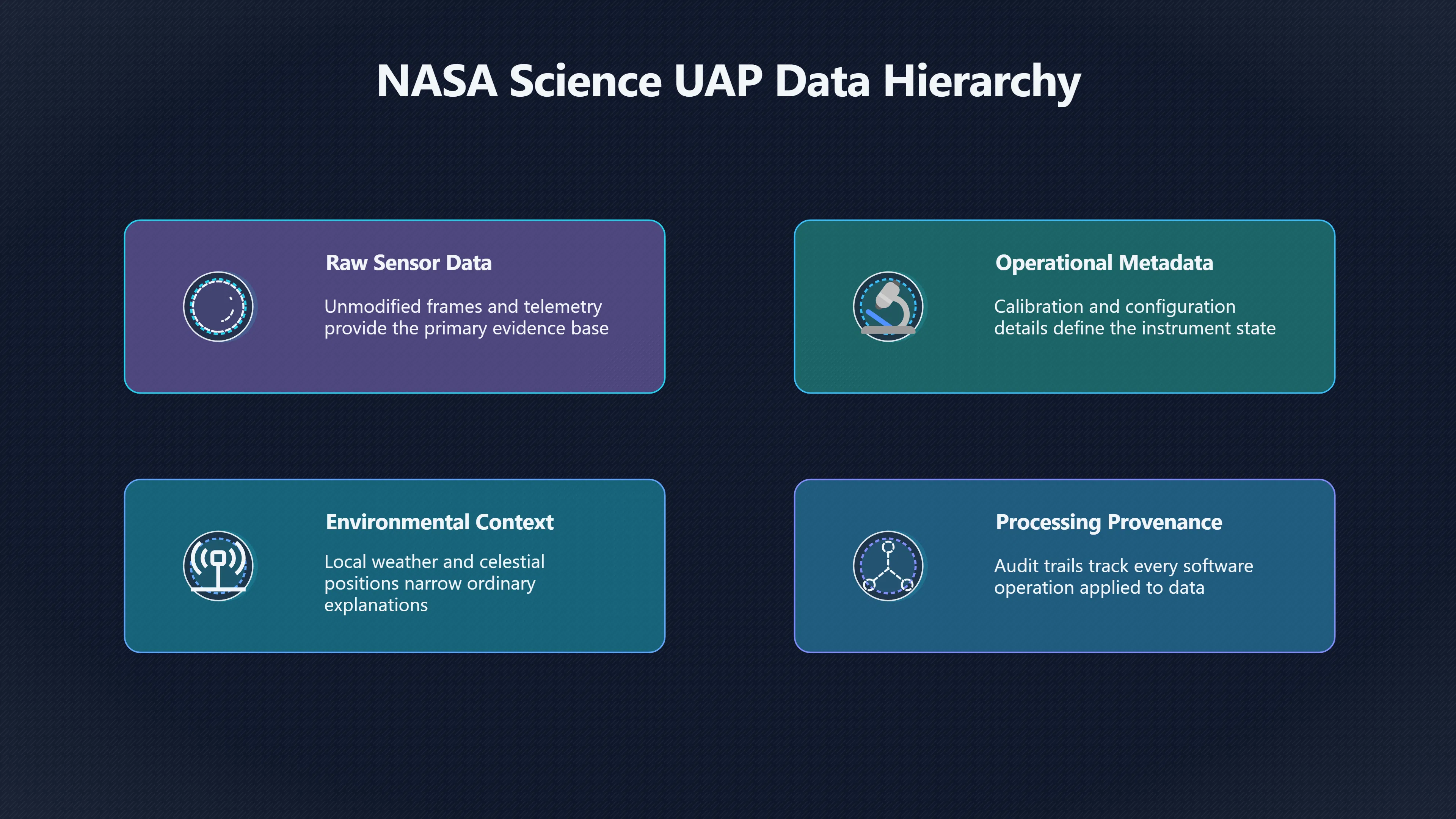
For automated instrumented UAP detection systems, the strongest event packet combines four inseparable components:
- The original sensor data.
- Complete observational metadata.
- Rich local sky and environmental context.
- A documented provenance and processing history.
When all four are preserved together, later investigators can evaluate the observation on its technical merits instead of relying on memory, anecdote or incomplete recordings. That transforms an intriguing video into a reusable piece of scientific evidence.[NASA Science]science.nasa.govScience Independent Study Team ReportNASA ScienceIndependent Study Team ReportSeptember 13, 2023 — The study of Unidentified Anomalous Phenomena (UAP) presents a unique scien…
Amazon book picks
Further Reading
Books and field guides related to What belongs inside a UAP event file?. Use these as the next step if you want deeper reading beyond the article.

Windows Forensics And Incident Recovery Covers Windows Server...
Explains preserving complete audit information.
Digital Evidence and Computer Crime
Directly applicable to complete evidence packages.

eBay marketplace picks
Marketplace Samples
Live-tested eBay searches with available results related to this page.


Endnotes
1.
Source: science.nasa.gov
Title: Science Independent Study Team Report
Link:https://science.nasa.gov/wp-content/uploads/2023/09/uap-independent-study-team-final-report.pdf
Source snippet
NASA ScienceIndependent Study Team ReportSeptember 13, 2023 — The study of Unidentified Anomalous Phenomena (UAP) presents a unique scien...
Published: September 13, 2023
2.
Source: aaro.mil
Title: Next UAP Report Documents
Link:https://www.aaro.mil/Next-AARO-Home-redesign/Next-Parent/Next-UAP-Report-Documents/
Source snippet
UAP Report Documents29 Feb 2024 — The United States Central Command submitted a report of an unidentified anomalous phenomenon (UAP)...
3.
Source: aaro.mil
Link:https://www.aaro.mil/UAP-Cases/Official-UAP-Imagery/
4.
Source: aaro.mil
Link:https://www.aaro.mil/
Source snippet
AARO HomeUnidentified Anomalous Phenomena (UAP) means (A) airborne objects that are not immediately identifiable; (B) transmedium objects...
5.
Source: dvidshub.net
Link:https://www.dvidshub.net/unit/AARO
Source snippet
In November 1962, journalist Walter Cronkite interviewed astronaut Gordon Cooper. In this...Read more...
Published: November 1962
Additional References
6.
Source: war.gov
Title: DOW UAP D077 [Unresolved]({{ ‘unresolved/’ | relative_url }}) Case Analysis Update Western United States Event
Link:https://www.war.gov/medialink/ufo/061226/release_03/documents/DOW-UAP-D077_Unresolved-Case-Analysis-Update_Western-United-States-Event.pdf
Source snippet
All-domain Anomaly Resolution Office (AARO) Unidentified...5 Jun 2026 — This memorandum summarizes the All-domain Anomaly Resolution Off...
7.
Source: facebook.com
Link:https://www.facebook.com/100092714784072/videos/official-declassified-media-file-dow-uap-pr050-titled-4-uap-formation-iran-26-au/977323195088382/
8.
Source: media.defense.gov
Title: DOPSR 2024 0263 AARO HISTORICAL RECORD REPORT VOLUME 1 2024
Link:https://media.defense.gov/2024/Mar/08/2003409233/-1/-1/0/DOPSR-2024-0263-AARO-HISTORICAL-RECORD-REPORT-VOLUME-1-2024.PDF
Source snippet
Historical Record Report Volume 18 Mar 2024 — SECTION I: Introduction. This report represents Volume I of the All-domain Anomaly Resoluti...
9.
Source: defensescoop.com
Title: dod ufo workshop uap research aaro
Link:https://defensescoop.com/2026/03/16/dod-ufo-workshop-uap-research-aaro/
Source snippet
Pentagon's AARO quietly held an invite-only workshop to...16 Mar 2026 — The Defense Department's All-domain Anomaly Resolution Office (A...
10.
Source: youtube.com
Title: Replay! NASA’s Release of the Unidentified Anomalous Phenomena Report
Link:https://www.youtube.com/watch?v=nuBMnluJfs0
Source snippet
AVI LOEB: "These objects could be a national security issue for the US"...
11.
Source: youtube.com
Title: Unidentified Anomalous Phenomena Independent Study Report
Link:https://www.youtube.com/watch?v=TQcqOW39ksk
Source snippet
Replay! NASA's Release of the Unidentified Anomalous Phenomena Report...
12.
Source: youtube.com
Title: [Open Source]({{ ‘open-source/’ | relative_url }}) Astronomy
Link:https://www.youtube.com/watch?v=rf1cyFFtYLs
Source snippet
A New Interstellar Object, Alien Technology, and the Scientific Debate | Avi Loeb...
13.
Source: youtube.com
Title: AVI LOEB: “These objects could be a national security issue for the US”
Link:https://www.youtube.com/watch?v=63yMz4QxWtU
Source snippet
Open Source Astronomy - Sky360...
14.
Source: youtube.com
Link:https://www.youtube.com/watch?v=zHn69IQSIcg
Topic Tree