Within Sky Detectors
Can Radar Make UAP Tracks Clearer?
Radio and radar-style sensing can add range, motion, and independent confirmation when optical evidence is uncertain.
On this page
- Active radar versus passive radio sensing
- Why range and motion matter
- Practical limits for civilian stations
Page outline Jump by section
Introduction
Radar can make UAP tracks clearer, but not in the dramatic “one magic screen solves the mystery” way often imagined. Its real value is more modest and more useful: radar-style sensing can add distance, range rate, velocity and independent confirmation to an automated instrumented UFO detector, especially when optical video alone cannot tell whether a light is a nearby insect, a drone, an aircraft, a balloon, a satellite or something genuinely hard to classify. NASA’s UAP study identified poor calibration, missing metadata and lack of multiple measurements as core obstacles in UAP analysis, while the Galileo Project’s proposed observatories explicitly include passive multistatic radar and radio-spectrum sensing alongside cameras and environmental instruments.[NASA Science]science.nasa.govNASA ScienceIndependent Study Team ReportAt present, analysis of UAP data is hampered by poor sensor calibration, the lack of multiple me…
The key distinction is between active radar, which transmits its own radio energy and listens for echoes, and passive radio sensing, which listens only: either for existing broadcasts reflected from objects or for signals emitted by known aircraft systems. For civilian UAP stations, passive methods are usually the more realistic path. They avoid many licensing and interference problems, can be built from receivers and software-defined radio equipment, and provide a second measurement channel when a camera track is ambiguous.[IET]theiet.orgIETFM radio based bistatic radarJune 22, 2021 — by PE Howland · 2005 · Cited by 913 — Abstract: An experimental bistatic radar system is described that detects and track…
Active Radar Versus Passive Radio Sensing
Active radar is the familiar model: a transmitter sends out radio pulses or continuous-wave signals, and a receiver measures the echoes that return from objects. In principle, that is attractive for UAP tracking because it can provide range and motion information directly, rather than inferring distance from a two-dimensional image. NASA’s UAP report notes that radar signatures, including Doppler information, could be important for testing claims of unusual acceleration or high-manoeuvre behaviour.[NASA Science]science.nasa.govNASA ScienceIndependent Study Team ReportAt present, analysis of UAP data is hampered by poor sensor calibration, the lack of multiple me…
For a private or citizen-science sky station, however, active radar is a difficult starting point. Transmitting radio energy is regulated because poorly designed or unauthorised equipment can interfere with aviation, communications, weather radar, navigation and other spectrum users. In the UK, Ofcom states that radio equipment use is regulated by national law, and its guidance distinguishes ordinary reception from transmission; general radio receivers are usually licence-exempt, but transmitting equipment is a different matter.[www.ofcom.org.uk]ofcom.org.ukwww.ofcom.org.uk Radio equipmentequipmentOctober 6, 2023 — The use of radio equipment is regulated by national laws. We explain the rules that apply and how Ofcom enforc…
Passive radio sensing turns the problem around. Instead of transmitting, the station listens. There are three useful versions for UAP-detector design:
- Passive radar using transmitters of opportunity. The receiver listens for echoes of existing FM radio, digital television, cellular or other broadcast signals bouncing off aerial objects.
- Radio-identification monitoring. The station receives ADS-B, Mode S or similar aircraft-related broadcasts so ordinary traffic can be identified or ruled out.
- Spectrum monitoring. The station records whether unusual radio emissions, interference or known control links occur at the same time as an optical event.
These are not equivalent to a military air-defence radar. They are better understood as supporting measurements. Their purpose is to reduce uncertainty, not to turn a backyard station into a surveillance authority.

Why Range and Motion Change the Evidence
A single optical camera usually records direction, angular size and apparent motion. That is often not enough. A dot moving across the frame may be a small object nearby, a large object far away, or a normal aircraft seen under poor geometry. Without range, “fast” may only mean “fast across the image”. Without distance, acceleration estimates can be wildly wrong.
Radar-style measurements are valuable because they attack that exact weakness. Passive radar can estimate delay and Doppler: delay relates to the extra path travelled by a reflected signal, while Doppler measures frequency shift caused by motion. With multiple receivers, a system can combine these measurements to estimate three-dimensional position and velocity. The Galileo-linked SkyWatch passive multistatic radar proposal describes using commercial FM broadcast transmitters as “illuminators of opportunity” and a network of geographically separated receivers to estimate 3D position and velocity time series for aerial objects.[galileo.hsites.harvard.edu]galileo.hsites.harvard.eduOpen source on harvard.edu.
This matters because many UAP claims hinge on kinematics: sudden turns, extreme speeds, hovering followed by rapid departure, or apparent motion inconsistent with known aircraft. A camera may suggest those behaviours, but radar-style range and velocity data can test whether the apparent motion survives measurement. NASA made a similar point when discussing synthetic aperture radar data: Doppler signatures could help validate or reject claims of rapid acceleration or high-G manoeuvres.[NASA Science]science.nasa.govNASA ScienceIndependent Study Team ReportAt present, analysis of UAP data is hampered by poor sensor calibration, the lack of multiple me…
There is also a more prosaic benefit. Many “unknowns” become less mysterious when an automated station can compare a camera track with ADS-B aircraft broadcasts, local flight routes, satellite predictions and radio returns. The FAA describes ADS-B Out as broadcasting an aircraft’s GPS location, altitude, ground speed and other data once per second to ground stations and other aircraft; for a civilian detector, receiving that data is one of the simplest ways to avoid mislabelling ordinary air traffic.[Federal Aviation Administration]faa.govFederal Aviation Administration Automatic Dependent SurveillanceFederal Aviation Administration Automatic Dependent Surveillance
The Galileo Project’s Passive Radar Idea
The most relevant contemporary example is SkyWatch, a passive multistatic radar concept associated with the Galileo Project. Its stated purpose is not to “hunt aliens”, but to add quantitative range, location and kinematic measurements to a broader UAP-observation suite that also includes optical, infrared, acoustic, radio-spectrum, magnetic-field and particle-detection instruments.[galileo.hsites.harvard.edu]galileo.hsites.harvard.eduOpen source on harvard.edu.
SkyWatch is built around a practical observation: the modern environment is already full of powerful transmitters. FM radio stations, for example, continuously illuminate the sky. A passive radar receiver can compare a direct copy of a broadcast signal with faint delayed echoes arriving from objects that reflected the signal. In favourable geometry, those echoes can reveal the object’s bistatic range and Doppler shift. With several receivers, the system can triangulate a time series of positions and velocities.[IET]theiet.orgIETFM radio based bistatic radarJune 22, 2021 — by PE Howland · 2005 · Cited by 913 — Abstract: An experimental bistatic radar system is described that detects and track…
The technical ambition is high. The SkyWatch paper says its network design aims to estimate object tracks at altitudes up to 80 km, horizontal distances up to 150 km, and velocities up to about plus or minus 2 km/s, depending on transmitter geometry, terrain, signal strength and processing conditions. Those numbers should not be read as a guarantee that every small drone, balloon or odd light will be captured. They describe a design envelope for a specific passive multistatic system, not a universal consumer capability.[arXiv]arxiv.orgOpen source on arxiv.org.
For automated UFO detectors, the deeper lesson is architectural. The radar channel is most useful when it is synchronised with cameras, environmental sensors and aircraft databases. A passive radar return with no optical track may be hard to interpret; an optical track with no range may be misleading; but a time-matched optical track, passive radar estimate and ADS-B non-match becomes a much stronger event record.
What Passive Radio Can Confirm, and What It Cannot
Passive radio methods can help answer several questions that ordinary video struggles with. Did something physically occupy a volume of air? Was it moving towards or away from the receiver? Did its apparent optical speed correspond to a plausible three-dimensional speed? Was there a conventional aircraft broadcasting in the same direction at the same time? Was there a radio-frequency event coincident with the sighting?
They cannot, by themselves, answer every UAP question. Passive radar performance depends on geometry: transmitter, receiver and target must be arranged so that useful reflections arrive. Coverage is not uniform. FM broadcast signals have different bandwidths, powers and locations; urban clutter, terrain, direct-signal leakage and multipath reflections can complicate processing. Classic FM-based bistatic radar experiments have demonstrated aircraft tracking beyond 150 km, but they also describe the need for adaptive filtering and processing to suppress the much stronger direct transmitter signal and recover weak target echoes.[IET]theiet.orgIETFM radio based bistatic radarJune 22, 2021 — by PE Howland · 2005 · Cited by 913 — Abstract: An experimental bistatic radar system is described that detects and track…
ADS-B is useful but incomplete. It identifies cooperative aircraft that are equipped and broadcasting; it does not prove that every non-ADS-B object is anomalous. Some aircraft may not broadcast in all circumstances, some small drones and balloons will not carry ADS-B, military flights may be filtered or absent from public feeds, and ADS-B itself is a dependent broadcast rather than an independent radar reflection. The FAA’s own description makes clear that ADS-B Out reports position and other data from onboard systems, which is precisely why it is valuable for identification but not a substitute for independent sensing.[Federal Aviation Administration]faa.govFederal Aviation Administration Automatic Dependent SurveillanceFederal Aviation Administration Automatic Dependent Surveillance
There is also a security and data-quality issue. Academic work on ADS-B has repeatedly noted the absence of strong built-in authentication and the possibility of spoofed or manipulated messages. That does not make ADS-B useless for sky monitoring, but it means a serious UAP station should treat it as one evidence layer, not as ground truth.[arXiv]arxiv.orgarXiv Detecting ADS-B Spoofing Attacks using Deep Neural NetworksarXiv Detecting ADS-B Spoofing Attacks using Deep Neural Networks
Civilian Stations Need Modest Expectations
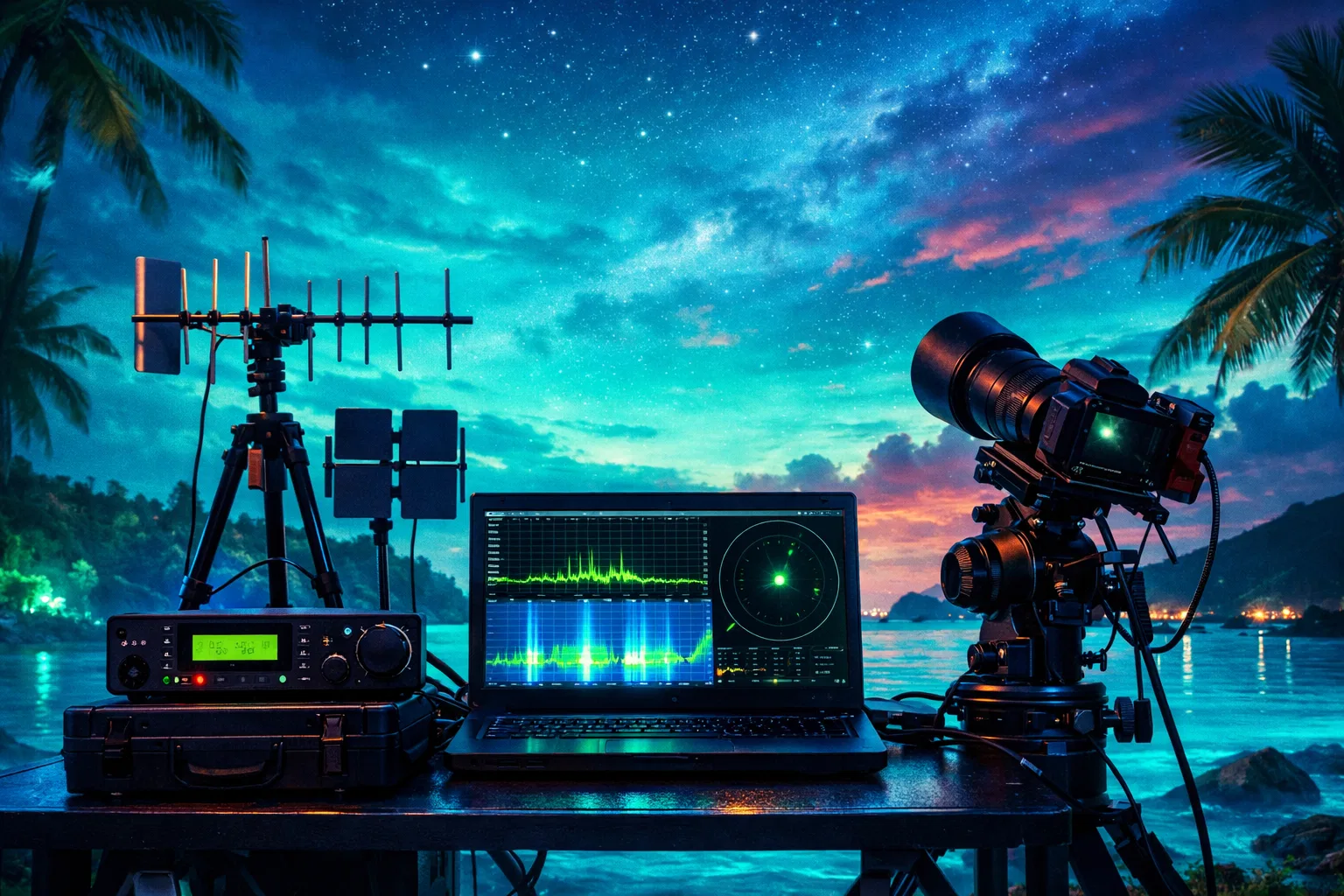
The most practical civilian design is not a homemade high-power radar. It is a receive-only station that combines wide-field optical detection with radio receivers, precise timekeeping and careful data logging. A sensible radio layer might include ADS-B reception, passive spectrum recording and, for more advanced groups, passive radar experiments using existing broadcast signals. This keeps the station closer to lawful, low-interference operation while still adding important measurements.[www.ofcom.org.uk]ofcom.org.ukradio spectrum and the lawon using radio equipment10 Jul 2023 — Generally, the use of radio receivers is exempt from requiring a licence unless it is also capable…
Even receive-only systems have demanding requirements. They need accurate clocks, known antenna locations, stable calibration, stored raw or near-raw data, and transparent processing. NASA’s criticism of existing UAP evidence applies directly here: without calibration, sensor metadata and multiple measurements, later analysts may be unable to tell whether an event was unusual or merely poorly recorded.[NASA Science]science.nasa.govNASA ScienceIndependent Study Team ReportAt present, analysis of UAP data is hampered by poor sensor calibration, the lack of multiple me…
There are also mundane failure modes that matter more than exotic speculation. A passive radar station may see reflections from ordinary aircraft outside the camera’s field of view. A camera may trigger on insects, birds, satellites or clouds while the radio system detects nothing. A radio spectrum analyser may record local interference unrelated to the visual event. A station near a city may face strong multipath reflections from buildings, while a rural station may lack favourable broadcast-transmitter geometry.
That is why a useful UAP detector should preserve negative evidence as well as positive evidence. If the camera tracked an object, the system should record whether ADS-B traffic was present, whether passive radar produced a matching return, whether weather or lightning data changed, and whether other nearby stations saw the same track. The absence of a radio return does not automatically make an object strange; it may only reveal a blind spot in the sensing geometry.
Government Sensor Kits Point to the Same Direction
AARO’s GREMLIN work shows that the institutional direction is also multi-sensor rather than camera-only. The US Department of Defense’s FY2024 consolidated UAP report says AARO began using GREMLIN, a prototype sensor system for detecting, tracking and characterising UAP, and that it successfully collected data during a March 2024 test event before a planned 90-day “pattern of life” collection at a national-security site.[U.S. Department of War]media.defense.govFY24 CONSOLIDATED ANNUAL REPORT ON UAP 508FY24 CONSOLIDATED ANNUAL REPORT ON UAP 508
Public reporting on GREMLIN describes it as a sensor suite rather than a single detector, which is important. The goal is to understand what normally appears in a given volume of airspace, then identify events that differ from that baseline. That approach is directly relevant to civilian projects: a detector becomes more valuable after weeks or months of routine measurements, because it learns the ordinary sky before flagging the unusual.[Breaking Defense]breakingdefense.comOpen source on breakingdefense.com.
This does not mean civilian stations can replicate classified or government-grade systems. They usually cannot access military radar feeds, restricted airspace data or high-end sensor fusion infrastructure. But they can adopt the same logic: continuous operation, known sensor geometry, multiple modalities, event correlation and careful rejection of ordinary explanations before escalating a case.
A Practical Radio Layer for Automated UFO Detectors
A useful radio-and-radar layer should be designed around questions, not gadgets. The aim is to make later analysis harder to fool.
A basic station can start with ADS-B reception to identify many conventional aircraft. This is inexpensive, passive and immediately useful, because it gives time-stamped aircraft identity, altitude, position and ground speed for cooperative traffic. It should be logged locally, not merely checked after the fact on a public map, because public feeds may be delayed, filtered or incomplete.[Federal Aviation Administration]faa.govFederal Aviation Administration Automatic Dependent SurveillanceFederal Aviation Administration Automatic Dependent Surveillance
A stronger station can add wideband radio-spectrum logging around each optical trigger. This does not prove that a UAP emitted radio energy, but it can show whether the event coincided with local transmissions, interference or known control bands. For drones, aircraft and local electronic noise, this can be a useful exclusion tool.
An advanced station or network can experiment with passive multistatic radar, especially where there are strong FM or digital broadcast transmitters and several receivers separated over useful baselines. The hard parts are synchronisation, reference-signal handling, clutter cancellation, range-Doppler processing and track association. The SkyWatch proposal is important because it treats those as a networked measurement problem rather than a single receiver trick.[arXiv]arxiv.orgOpen source on arxiv.org.
The station should also record what the radio system failed to see. A camera-only anomaly is weaker than a camera-plus-radio track, but it is still data. A radar-style return without matching optical evidence may point to geometry, weather, clutter or a target outside the camera field. The value comes from preserving enough context to decide later.
Where Radar Helps Most
Radar and passive radio sensing help most in the middle ground between obvious aircraft and unanalysable lights. They are especially useful when an event is bright but distance is unknown, when a camera track appears to accelerate, when two optical stations disagree on apparent motion, or when ordinary aircraft identification is uncertain. In those cases, even rough range and velocity constraints can change the interpretation.
They are less useful when the target is too small, too low, too close, too briefly visible or poorly placed relative to the transmitter and receiver geometry. They also struggle when the evidence question is not motion but identity: radar may show “something reflected radio energy along this path” without telling whether it was a drone, bird, aircraft, balloon, debris or unusual object. Classification still requires correlation with optics, weather, flight data and local context.
The honest promise is therefore not certainty. It is discipline. Radar-style sensing makes a UAP detector more scientific by forcing claims about speed, distance and motion into measurable form. It gives analysts a way to separate “looked fast” from “was fast”, “appeared to hover” from “was at measurable range”, and “not in ADS-B” from “independently tracked by another sensor”. For automated instrumented UFO detectors, that is exactly the difference between another intriguing clip and a record that can survive serious scrutiny.
Amazon book picks
Further Reading
Books and field guides related to Can Radar Make UAP Tracks Clearer?. Use these as the next step if you want deeper reading beyond the article.
Introduction to Radar Systems
Explains radar fundamentals, range, tracking, motion measurement and system limitations directly relevant to automated UAP sensing.
Fundamentals of Radar Signal Processing
Explains detection, estimation, tracking and signal processing behind reliable radar measurements.

Radar Handbook
Covers radar architectures, tracking, target detection and practical performance considerations.

The Hobbyist's Guide to the RTL-SDR
Shows how inexpensive SDR receivers can be used for passive radio monitoring and signal analysis.
eBay marketplace picks
Marketplace Samples
Live-tested eBay searches with available results related to this page.




Endnotes
1.
Source: science.nasa.gov
Link:https://science.nasa.gov/wp-content/uploads/2023/09/uap-independent-study-team-final-report.pdf
Source snippet
NASA ScienceIndependent Study Team ReportAt present, analysis of UAP data is hampered by poor sensor calibration, the lack of multiple me...
2.
Source: arxiv.org
Link:https://arxiv.org/abs/2305.18566
3.
Source: ofcom.org.uk
Title: radio spectrum and the law
Link:https://www.ofcom.org.uk/spectrum/radio-equipment/radio-spectrum-and-the-law
Source snippet
on using radio equipment10 Jul 2023 — Generally, the use of radio receivers is exempt from requiring a licence unless it is also capable...
4.
Source: ofcom.org.uk
Title: www.ofcom.org.uk Radio equipment
Link:https://www.ofcom.org.uk/spectrum/radio-equipment
Source snippet
equipmentOctober 6, 2023 — The use of radio equipment is regulated by national laws. We explain the [rules]({{ 'rules/' | relative_url }}) that apply and how Ofcom enforc...
Published: October 6, 2023
5.
Source: galileo.hsites.harvard.edu
Link:https://galileo.hsites.harvard.edu/publications/skywatch-passive-multistatic-radar-network-measurement-object-position-and
6.
Source: arxiv.org
Link:https://arxiv.org/abs/2305.18562
7.
Source: faa.gov
Title: Federal Aviation Administration Automatic Dependent Surveillance
Link:https://www.faa.gov/about/office_org/headquarters_offices/avs/offices/afx/afs/afs400/afs410/ads-b
8.
Source: arxiv.org
Title: arXiv Detecting ADS-B Spoofing Attacks using Deep Neural Networks
Link:https://arxiv.org/abs/1904.09969
9.
Source: media.defense.gov
Title: FY24 CONSOLIDATED ANNUAL REPORT ON UAP 508
Link:https://media.defense.gov/2024/Nov/14/2003583603/-1/-1/0/FY24-CONSOLIDATED-ANNUAL-REPORT-ON-UAP-508.PDF
10.
Source: aaro.mil
Link:https://www.aaro.mil/
11.
Source: ofcom.org.uk
Title: licence exempt devices
Link:https://www.ofcom.org.uk/spectrum/radio-equipment/licence-exempt-devices
12.
Source: ofcom.org.uk
Link:https://www.ofcom.org.uk/siteassets/resources/documents/spectrum/interface-requirements/ir2050.pdf?v=333720
13.
Source: ofcom.org.uk
Title: 3.4 band radar co ordination procedure
Link:https://www.ofcom.org.uk/siteassets/resources/documents/manage-your-licence/mobile-wireless-and-broadband/2.3-3.4-ghz/3.4-band-radar-co-ordination-procedure.pdf?v=323236
14.
Source: ofcom.org.uk
Title: short range devices
Link:https://www.ofcom.org.uk/spectrum/radio-equipment/short-range-devices
15.
Source: science.nasa.gov
Link:https://science.nasa.gov/uap/
16.
Source: nasa.gov
Title: update nasa shares uap independent study report names director
Link:https://www.nasa.gov/news-release/update-nasa-shares-uap-independent-study-report-names-director/
17.
Source: galileo.hsites.harvard.edu
Title: scientific investigation unidentified aerial phenomena uap using multimodal
Link:https://galileo.hsites.harvard.edu/publications/scientific-investigation-unidentified-aerial-phenomena-uap-using-multimodal
18.
Source: galileo.hsites.harvard.edu
Link:https://galileo.hsites.harvard.edu/search
19.
Source: aaro.mil
Link:https://www.aaro.mil/UAP-Cases/Official-UAP-Imagery/
20.
Source: aaro.mil
Title: Next UAP Report Documents
Link:https://www.aaro.mil/Next-AARO-Home-redesign/Next-Parent/Next-UAP-Report-Documents/
21.
Source: media.defense.gov
Title: DOPSR 2024 0263 AARO HISTORICAL RECORD REPORT VOLUME 1 2024
Link:https://media.defense.gov/2024/Mar/08/2003409233/-1/-1/0/DOPSR-2024-0263-AARO-HISTORICAL-RECORD-REPORT-VOLUME-1-2024.PDF
22.
Source: arxiv.org
Link:https://arxiv.org/html/2506.00125v1
23.
Source: war.gov
Title: dod examining unidentified anomalous phenomena
Link:https://www.war.gov/News/News-Stories/Article/Article/3965403/dod-examining-unidentified-anomalous-phenomena/
24.
Source: theiet.org
Title: IETFM radio based bistatic radar
Link:https://www.theiet.org/media/11278/fm-radio-based-bistatic-radar.pdf
Source snippet
June 22, 2021 — by PE Howland · 2005 · Cited by 913 — Abstract: An experimental bistatic radar system is described that detects and track...
Published: June 22, 2021
25.
Source: breakingdefense.com
Link:https://breakingdefense.com/2024/11/gremlin-but-no-aliens-pentagon-uap-office-plans-first-deployment-of-new-sensor-suite/
26.
Source: Wikipedia
Title: Passive radar
Link:https://en.wikipedia.org/wiki/Passive_radar
27.
Source: GOV.UK
Link:https://www.gov.uk/government/publications/min-662-mf-amendment-1-ofcom-requirement-for-protecting-the-general-public-from-radio-emissions/min-662-mf-amendment-1-ofcom-requirement-for-protecting-the-general-public-from-radio-emissions
Additional References
28.
Source: researchgate.net
Link:https://www.researchgate.net/figure/Color-online-The-SkyWatch-passive-multistatic-radar-network-consists-of-two-or-more_fig1_371163081
29.
Source: researchgate.net
Link:https://www.researchgate.net/publication/366121932_SkyWatch_A_Passive_Multistatic_Radar_Network_for_the_Measurement_of_Object_Position_and_Velocity
30.
Source: aui.edu
Link:https://aui.edu/aaro-releases-report-on-unidentified-anomalous-phenomena-uap/
31.
Source: l3harris.com
Link:https://www.l3harris.com/all-capabilities/ads-b-air-traffic-surveillance
32.
Source: txtav.com
Link:https://txtav.com/en/journey/articles/articles/adsb-out-explained
33.
Source: superiorskies.org
Link:https://superiorskies.org/learn/adsb-technology
34.
Source: aireon.com
Link:https://aireon.com/
35.
Source: researchgate.net
Link:https://www.researchgate.net/publication/260524424_Analysis_of_detection_range_of_FM-based_passive_radar
36.
Source: facebook.com
Link:https://www.facebook.com/CivilAviationSafetyAuthority/posts/can-atc-really-see-you-if-you-have-ads-b-well-it-depends-on-what-type-you-have-w/1134832368752089/
37.
Source: facebook.com
Link:https://www.facebook.com/spacecom/videos/ufo-videos-shown-to-us-senate-show-no-evidence-of-alien-technology/497484193323072/
Topic Tree
Follow this branch
Parent topic
Sky DetectorsRelated pages 29
- ADS B Checks The aircraft broadcast check every sky station needs
- Clutter Traps When passive radar sees the wrong thing
- FM Echoes How FM radio signals can reveal sky objects
- Passive Range Can passive radar give UAP videos real distance?
- Radar Rules Why backyard radar is not a casual upgrade
- +1 more in sidebar