Within Hessdalen
How the Blue Box Chose a UFO Event
The first Hessdalen station turned sky watching into software thresholds, saving only lights that met size, brightness and motion rules.
On this page
- What the first camera system watched
- Why thresholds shaped the event record
- What faint or slow lights could be missed
Page outline Jump by section
Introduction
The first Hessdalen Automatic Measurement Station, known locally as the Blue Box, did not record every light that appeared in the Norwegian night sky. Instead, it used a simple but important idea: a light became an “event” only if software judged it large enough, bright enough and different enough from the previous image to deserve attention. In practice, the station transformed sky watching into a set of numerical thresholds. That decision was crucial because the system operated unattended for long periods and could not save or analyse every frame continuously. The resulting event archive was therefore not a neutral record of everything visible over Hessdalen. It was a record of what the hardware and software were designed to notice.[Hessdalen Project]hessdalen.orgProject Project HessdalenHessdalen ProjectProject Hessdalen - AMS28 Dec 2019 — The threshold value, on which the alarm is triggered, can be adjusted. That was bot…
 Understanding those trigger rules helps explain both the value and the limitations of one of the earliest long-running automated UFO and anomalous-light detectors. The Blue Box reduced human subjectivity, but it replaced it with engineering choices about brightness, size and motion.[Hessdalen Project]hessdalen.orgProject Project HessdalenHessdalen ProjectProject Hessdalen - AMS28 Dec 2019 — The threshold value, on which the alarm is triggered, can be adjusted. That was bot…
What the First Camera System Watched
The original 1998 station used a black-and-white CCD camera aimed across the valley toward the mountain Finnsåhøgda. Images from the camera were continuously analysed by software running on a dedicated computer. Rather than asking whether a light looked mysterious, the software compared each new image with the previous one and searched for significant changes.[Hessdalen Project]hessdalen.orgProject Project HessdalenHessdalen ProjectProject Hessdalen - AMS28 Dec 2019 — The threshold value, on which the alarm is triggered, can be adjusted. That was bot…
The core mechanism was straightforward:
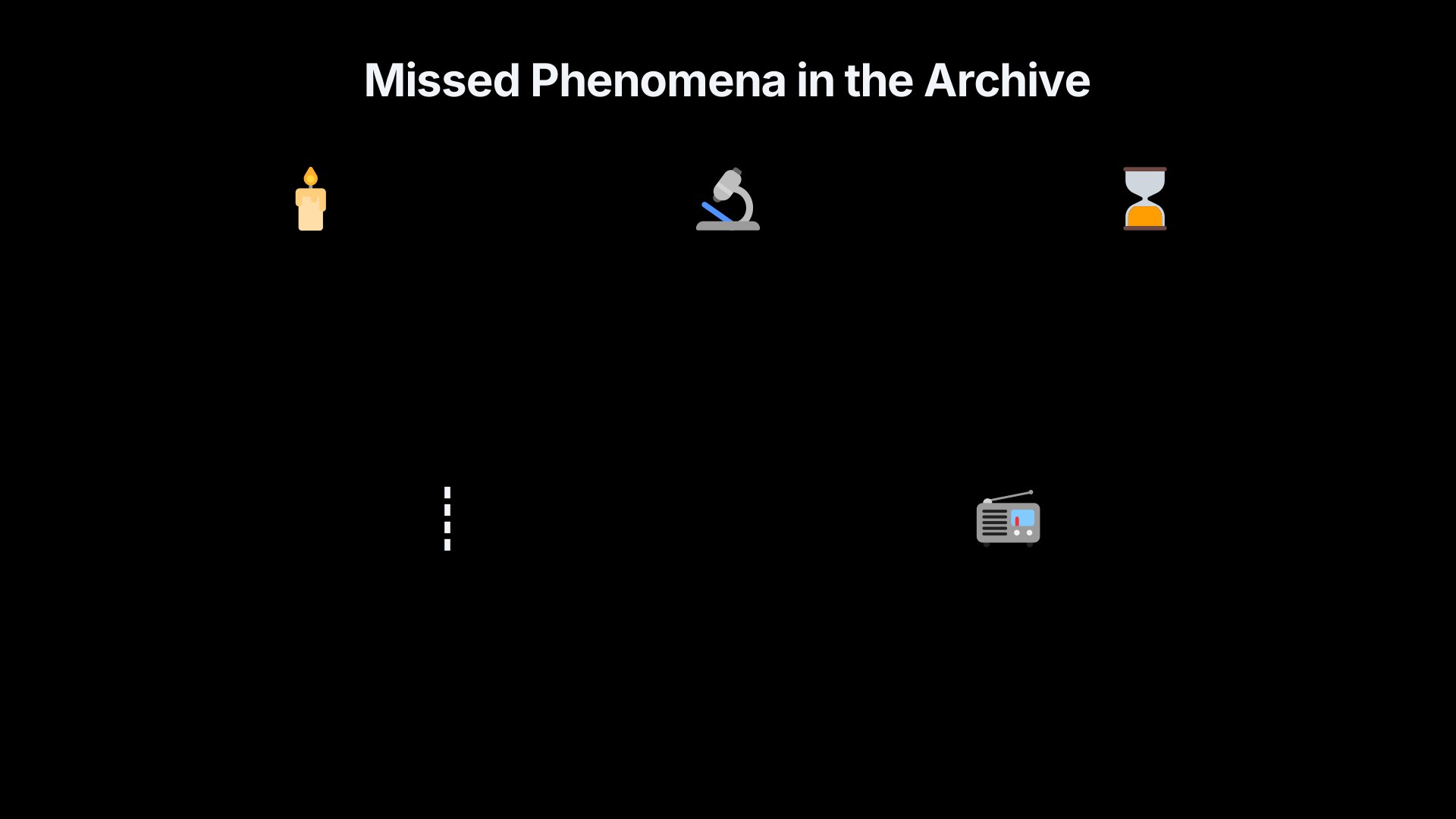
- Capture a new image.
- Compare it with the preceding image.
- Identify regions whose brightness had changed.
- Measure how many pixels were involved.
- Trigger an alarm only if the change exceeded preset thresholds. Hessdalen Project
When those conditions were met, the station switched into an alarm mode. A video recorder started automatically, and the image responsible for the trigger was saved and transmitted for later inspection. The system also preserved video from moments immediately before the trigger, allowing researchers to see how the event developed rather than only the instant when it crossed the threshold. Hessdalen Project
This design reflected a practical problem faced by all automated UFO detectors: most frames contain nothing unusual. Saving everything would have consumed storage, bandwidth and human review time. Thresholds acted as a filter that reduced millions of ordinary images into a manageable list of candidate events. Hessdalen Project
Why Thresholds Shaped the Event Record
The Blue Box’s software relied on two adjustable criteria: intensity difference and area size. Researchers could change the threshold values depending on observing conditions. A light that produced only a tiny brightness change or occupied too few pixels would not trigger an alarm, regardless of whether a human observer might have found it interesting. Hessdalen Project
That meant the event catalogue was partly a product of detector design.
A bright object moving against a dark background would usually stand out strongly from one frame to the next. Such an object generated a large intensity difference and often occupied enough pixels to satisfy the software. By contrast, a weak glow that changed only gradually might never exceed the trigger threshold. Hessdalen Project
The station also used image masks. Parts of the scene known to contain irrelevant sources were excluded from analysis. The system documentation notes that regions shown in red on the mask image were ignored by the software. This prevented the detector from repeatedly triggering on known features and reduced false alarms. Hessdalen Project
From an instrumentation perspective, this was a trade-off rather than a flaw. Lower thresholds would capture more potential phenomena but would also generate more false alarms from noise, weather effects, insects, reflections or ordinary lights. Higher thresholds reduced nuisance triggers but increased the chance of missing subtle events. Every automated detector must choose a position on that spectrum. Hessdalen Project
What Counted as a UFO Event
The Blue Box did not attempt to determine whether an object was extraterrestrial, atmospheric or mundane. Its definition of an event was purely operational.
An event was essentially:
- A detectable change from the previous image.
- A brightness increase above a configured intensity threshold.
- A region large enough in pixel count to pass the size filter.
- An occurrence outside masked portions of the image. Hessdalen Project
Only after the trigger occurred would researchers examine the saved image and video. Many alarms were eventually attributed to ordinary causes. Project Hessdalen’s own station documentation notes that most alarms came from known natural or conventional sources and were later removed from public displays. The automated system’s role was therefore not classification but selection. Hessdalen Project
This distinction is important. The Blue Box was designed as a detector, not an interpreter. It answered the question “Did something change enough to be worth recording?” rather than “What was it?” Hessdalen Project
What Faint or Slow Lights Could Be Missed
The most important consequence of the trigger design is that absence from the archive does not necessarily mean absence from the sky.
Several categories of phenomena could be under-recorded:
Very faint lights. If a light produced only a small increase above background brightness, it might never cross the intensity threshold. Hessdalen Project
Extremely small sources. A distant object occupying only a handful of pixels could fail the minimum-area requirement even if visible to a careful observer. Hessdalen Project
Slowly changing glows. Because the system looked for differences between successive images, gradual changes were inherently harder to detect than sudden appearances. Hessdalen Project
Events in masked regions. Any phenomenon occurring within excluded parts of the image would be ignored by design. Hessdalen Project
These limitations are familiar in modern automated sensing. Every detector has a detection threshold below which signals blend into background noise. The Hessdalen station made those limits visible because its trigger conditions were explicit and configurable rather than hidden inside human judgement. Hessdalen Project
The Broader Lesson for Automated UFO Detection
The Blue Box demonstrated a principle that remains central to contemporary automated UAP and UFO observatories: sensors do not simply observe reality; they filter it.
In Hessdalen, a light entered the scientific record only after software decided it differed enough from the background to merit storage. The resulting database was therefore shaped not only by whatever occurred in the valley but also by engineering choices about pixel counts, brightness differences, masks and alarm thresholds. Hessdalen Project
That insight is one of the station’s most enduring contributions. The Blue Box replaced eyewitness selection with algorithmic selection, creating a more consistent record but also a record defined by what its detection rules were capable of seeing. For anyone studying automated instrumented UFO detectors, the trigger logic is as important as the lights themselves. Hessdalen Project
Amazon book picks
Further Reading
Books and field guides related to How the Blue Box Chose a UFO Event. Use these as the next step if you want deeper reading beyond the article.
The Hynek UFO Report
Discusses how sightings are recorded, evaluated, and filtered through investigative criteria.

UFOs : Generals, Pilots, and Government Officials Go on the R...
Focuses on documented observations, instrumentation, and investigative methods rather than pure speculation.
The UFO Experience
Explains systematic observation, classification, and scientific approaches to unusual aerial phenomena.
Identified Flying Objects
Provides broader context for readers interested in interpreting unusual aerial events captured by monitoring systems.
eBay marketplace picks
Marketplace Samples
Example marketplace items related to this page. Use the search link to explore similar finds on eBay.
Endnotes
2.
Source: old.hessdalen.org
Link:https://old.hessdalen.org/station/
Source snippet
Hessdalen ProjectProject Hessdalen - AMS21 Jan 2019 — There are three CCD cameras which transmit live TV all the time (24/7). Two of thos...
3.
Source: hessdalen.org
Title: current activities
Link:https://www.hessdalen.org/current-activities
Source snippet
Stream Stacker29 Nov 2025 — It is a custom software that turns video files into a single picture similar to long time exposures with norm...
Additional References
4.
Source: researchgate.net
Link:https://www.researchgate.net/publication/228609015_A_long-term_scientific_survey_of_the_Hessdalen_phenomenon
Source snippet
A long-term scientific survey of the Hessdalen phenomenonPDF | The balls of light which appear in the Hessdalen valley in Norway are exem...
5.
Source: malvernpanalytical.com
Link:https://www.malvernpanalytical.com/en/products/category/software/x-ray-diffraction-software/amass
Source snippet
AMASS | XRD Analysis SoftwareAMASS provides comprehensive functionality for displaying, analyzing, simulating and fitting X-ray scatterin...
6.
Source: designbuilder.co.uk
Link:https://designbuilder.co.uk/helpv7.0/Content/AnnualDaylightingCalculationOptions.htm
Source snippet
Annual Daylighting Calculation OptionsAnnual daylighting calculations (aka Climate Base Daylight Modelling or CBDM) are based on a simula...
7.
Source: bmva-archive.org.uk
Link:https://www.bmva-archive.org.uk/bmvc/2016/papers/paper009/paper009.pdf
Source snippet
man perception system as they measure the per-pixel intensity change rather than the actual intensity level.Read more...
8.
Source: facebook.com
Link:https://www.facebook.com/61583174895936/videos/the-hessdalen-lights-have-stumped-scientists-for-40-yearsin-a-remote-valley-in-n/1607905727171889/
Source snippet
r than one the diameter of a proton and this valley in Norway 40...
9.
Source: youtube.com
Title: The Hessdalen Lights: Science’s Strangest Unexplained Glow
Link:https://www.youtube.com/watch?v=5djXIwHLkvQ
Source snippet
Hessdalen Lights: The Unusual Spectacle of this Strange Phenomenon | Phenomena E5S5 Hessdalen Lights: The Unusual Spectacle of this Stran...
10.
Source: naturphilosophie.co.uk
Title: The Hessdalen Light Phenomenon, Norway
Link:https://naturphilosophie.co.uk/2023/05/07/identifying-the-unidentified-the-hessdalen-light-phenomenon-norway/
Source snippet
7 May 2023 — The Hessdalen light phenomenon started in late 1981, when local people reported seeing lights down the valle...
Published: May 2023
11.
Source: researchgate.net
Link:https://www.researchgate.net/figure/Flow-chart-of-the-Automatic-Measurement-Station-in-Hessdalen-System-2_fig1_241556861
Source snippet
from publication: EMBLA 2001: The Optical Mission...
12.
Source: melioratestlab.com
Title: testlab hessdalen lights release
Link:https://www.melioratestlab.com/2024/08/24/testlab-hessdalen-lights-release/
Source snippet
Testlab – Hessdalen Lights release24 Aug 2024 — The Hessdalen Lights are unexplained luminous phenomena observed in the Hessdalen Valley...
13.
Source: isprs-annals.copernicus.org
Title: isprs annals X 1 W1 2023 1 2023
Link:https://isprs-annals.copernicus.org/articles/X-1-W1-2023/1/2023/isprs-annals-X-1-W1-2023-1-2023.pdf
Source snippet
OF A MACHINE VISION SYSTEM FOR...by F Alidoost · 2023 · Cited by 7 — The results highlight the most important parameters of the discusse...
Topic Tree