Within False Positives
When Bugs Look Like Fast UFOs
Tiny insects close to a camera can look like large fast objects when software treats angular motion as distance and speed.
On this page
- Why close insects become bright blobs and streaks
- How blur size and lighting expose near lens targets
- Detector rules that separate bugs from distant objects
Page outline Jump by section
Introduction
Automated UFO and UAP detectors frequently encounter a simple but deceptive problem: a tiny insect flying a few centimetres from a camera can appear to be a large object moving at extraordinary speed across the sky. A single camera records only angular position, brightness and time. Without an independent measurement of distance, software can mistakenly interpret a nearby gnat, moth or spider as a distant object covering huge distances in fractions of a second. This is one of the most common mechanisms behind apparent “high-speed UFO” tracks in automated sky-monitoring systems, security cameras and wildlife cameras. The error arises from geometry rather than anything unusual in the sky. Close objects move rapidly across a camera’s field of view, become badly out of focus, and can reflect illumination in ways that make them look far larger and brighter than they really are.[Wikipedia]WikipediaOpen source on wikipedia.org.
Why Close Insects Become Bright Blobs and Streaks
The key problem is that camera images do not directly contain distance information. A detector sees a bright moving feature and measures its apparent angular motion. If software assumes the object is far away, even a modest angular shift can imply enormous physical speed.
An insect passing a few centimetres from a lens can cross a large fraction of the image in a fraction of a second. Because it is so close, it experiences strong perspective effects and motion relative to the camera. The same angular movement would require a distant aircraft or unknown object to travel much farther. A single camera cannot determine which interpretation is correct.[Wikipedia+2UNL Astronomy]WikipediaOpen source on wikipedia.org.
Focus makes the illusion worse. Sky-monitoring cameras are normally focused near infinity to observe distant objects. An insect close to the lens therefore falls far outside the focal plane and appears as a diffuse disc, glowing orb or elongated smear rather than a recognisable insect. The resulting image often contains no visible wings, legs or body structure. Instead, software sees a bright moving blob.[Reolink]reolink.comFlying Bugs on Night Vision Cameras?How to Solve?July 3, 2025 — 26 Dec 2025 — Learn how to deal with flying bugs on night vision cameras. Find out what causes it and practic…
Night-time systems are especially vulnerable. Infrared illumination used in security and monitoring cameras can strongly illuminate insects flying near the lens. Because the insect is much closer to the light source than the distant background, it may reflect intense light directly back into the sensor and appear disproportionately bright. Security-camera operators routinely report insects appearing as luminous orbs, streaks and rapidly moving shapes that trigger motion alarms.[Reolink]reolink.comFlying Bugs on Night Vision Cameras?How to Solve?July 3, 2025 — 26 Dec 2025 — Learn how to deal with flying bugs on night vision cameras. Find out what causes it and practic…
Why Apparent Speed Becomes Grossly Exaggerated
The speed illusion comes from converting angular motion into physical motion without knowing range.
Imagine two objects crossing the same number of pixels between frames. One is a moth 5 cm from the lens. The other is assumed to be a craft several kilometres away. The distant interpretation implies a vastly larger physical displacement because the same angular change corresponds to a much greater distance at long range.
This effect is closely related to parallax. Nearby objects show much larger apparent motion than distant ones when viewed from slightly different positions or over time. Astronomers exploit parallax to measure distance, but a single fixed camera cannot perform that calculation. Consequently, a nearby insect can generate motion signatures that appear incompatible with ordinary aircraft or birds if distance is incorrectly assumed.[UCLA Astronomy+3Wikipedia+3Las Cumbres Observatory]WikipediaOpen source on wikipedia.org.
The resulting track may show:
- Extreme apparent acceleration.
- Sudden changes of direction.
- Instantaneous appearance and disappearance.
- Unrealistically high inferred speeds.
- Motion inconsistent with known aircraft.
These characteristics often emerge from geometry and focus effects rather than unusual flight behaviour.
How Blur Size and Lighting Reveal a Near-Lens Target
Fortunately, near-lens insects leave several tell-tale signatures.
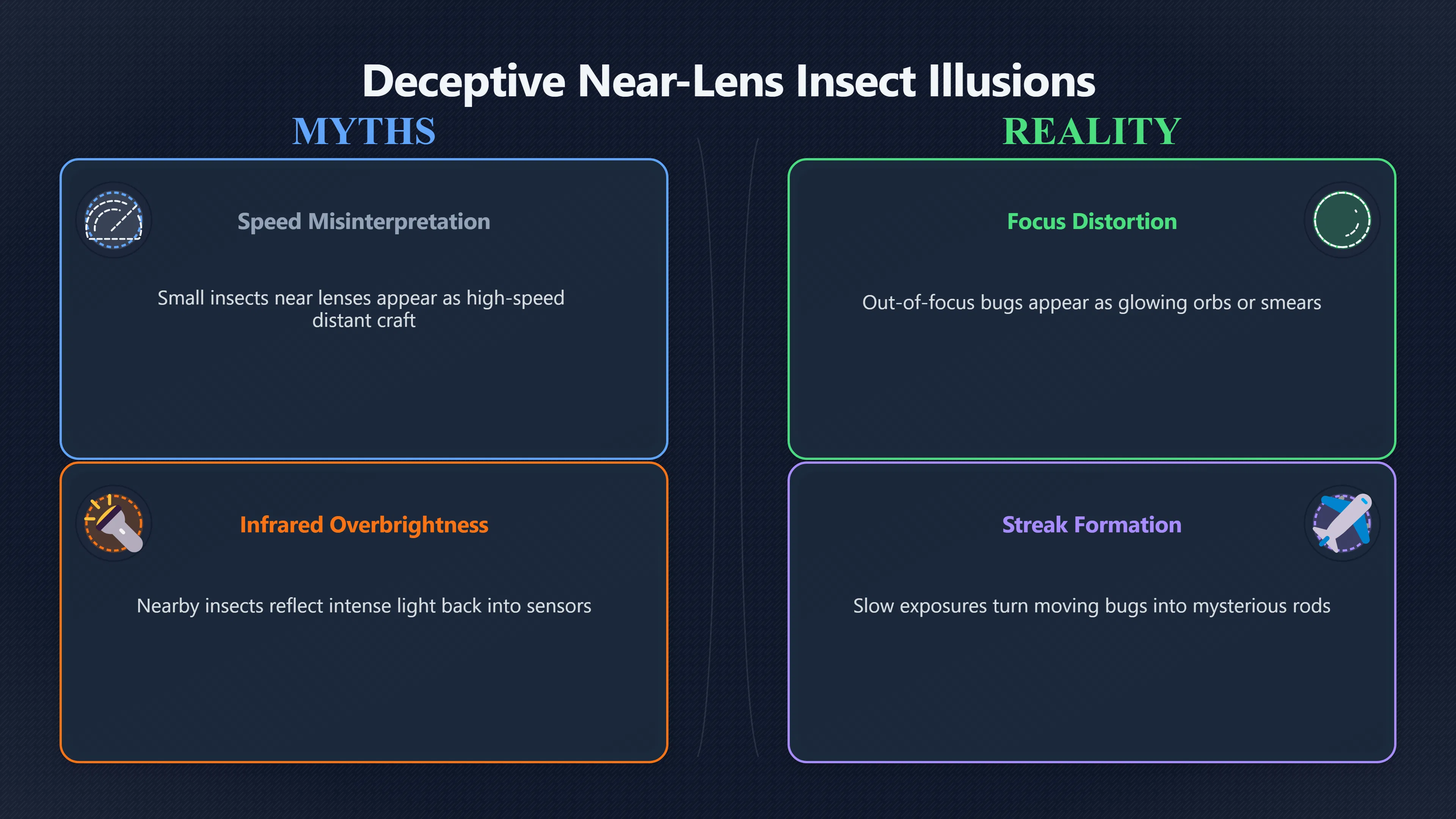
Oversized Defocus Patterns
A distant object observed by a camera focused at infinity should generally appear compact and reasonably sharp if atmospheric conditions are good. By contrast, a nearby insect often produces a large circular or irregular blur because it lies well outside the camera’s depth of field.
The apparent diameter of the blur can be much larger than the insect itself. In some recordings, a millimetre-scale insect creates an image occupying dozens of pixels or more. The mismatch between apparent image size and expected optical behaviour is often a strong clue that the target is close to the lens rather than far away.[arXiv]arxiv.orgarXiv Detecting Blurred Ground-based Sky/Cloud ImagesarXiv Detecting Blurred Ground-based Sky/Cloud Images
Infrared Overbrightness
Near-lens insects illuminated by infrared LEDs frequently appear brighter than distant objects. The illumination geometry is highly favourable: the insect sits close to both the light source and the sensor. As a result, tiny insects can become the brightest objects in the frame despite their small physical size. This effect is widely recognised in night-vision surveillance systems.[Reolink]reolink.comFlying Bugs on Night Vision Cameras?How to Solve?July 3, 2025 — 26 Dec 2025 — Learn how to deal with flying bugs on night vision cameras. Find out what causes it and practic…

Streak Formation
Long exposures or low-light imaging can turn an insect into a streak rather than a point. Community analyses of trail-camera footage repeatedly identify apparently mysterious rods or elongated luminous objects as insects moving during relatively slow exposures. The shape reflects camera timing rather than the object’s true form.[Reddit]reddit.comWhat is this thing?It vertically flew by the camera twice. We…It's an insect. The shutter speed is slow enough it looks like a long blur Cameras slow dow…
Inconsistent Focus Behaviour
A distant aircraft, satellite or star generally remains within a consistent focus regime throughout a short observation. A nearby insect may rapidly change appearance as it moves through different parts of the lens field, producing dramatic changes in size, brightness and shape from frame to frame. This instability is often diagnostic of a nearby target.[Reolink]reolink.comFlying Bugs on Night Vision Cameras?How to Solve?July 3, 2025 — 26 Dec 2025 — Learn how to deal with flying bugs on night vision cameras. Find out what causes it and practic…
Detector Rules That Separate Bugs From Distant Objects
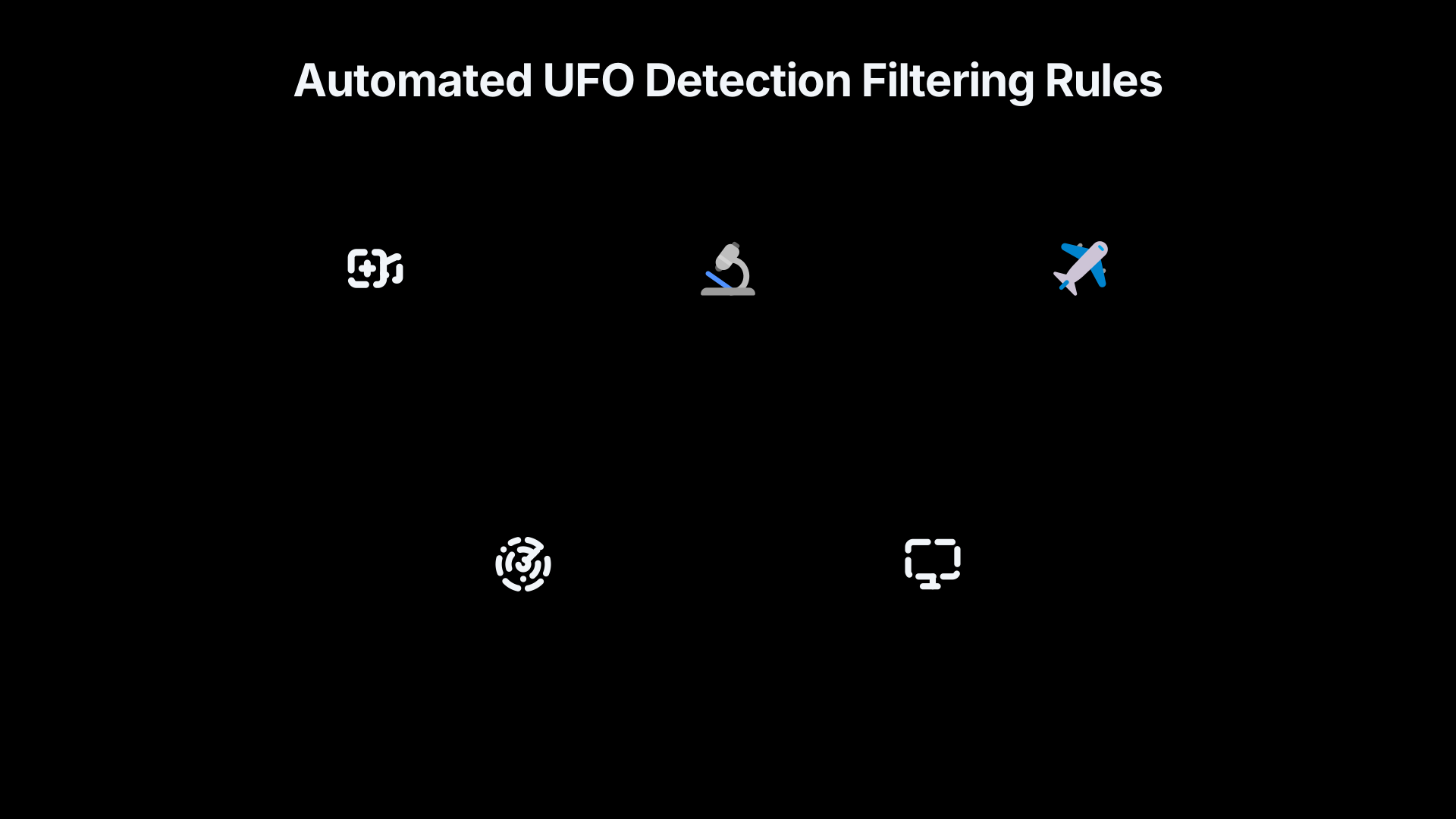
Modern automated UFO-detection systems can reduce insect false positives by explicitly testing for near-lens signatures rather than merely detecting motion.
Several practical rules are effective:
Blur-to-motion consistency tests. If an object exhibits extremely large blur while simultaneously showing extraordinary apparent speed, a nearby explanation becomes more likely than a distant one.
Multi-camera triangulation. Two separated cameras can estimate range through parallax. A nearby insect will appear in very different positions or may be visible in only one camera. A genuinely distant object should produce a consistent geometry across multiple sensors.[Wikipedia]WikipediaOpen source on wikipedia.org.
Focus-plane modelling. Knowing lens characteristics allows software to estimate whether an observed blur size is physically compatible with a distant target.
Infrared signature checks. Extremely bright objects appearing only within infrared imagery and lacking corresponding detections on other sensors are often consistent with insects illuminated near the camera.[Reolink]reolink.comFlying Bugs on Night Vision Cameras?How to Solve?July 3, 2025 — 26 Dec 2025 — Learn how to deal with flying bugs on night vision cameras. Find out what causes it and practic…
Track-shape filtering. Insects frequently generate erratic trajectories, abrupt reversals and variable image sizes that differ from the smoother motion expected from distant airborne objects.
Cross-sensor confirmation. The strongest defence is requiring independent confirmation from additional cameras, radar, acoustic sensors or other instruments. A near-lens insect may trigger one optical camera but usually fails multi-sensor verification. This principle aligns with broader recommendations that anomalous detections should rely on calibrated measurements and multiple independent observations rather than a single video stream.[PMC]pmc.ncbi.nlm.nih.govExploration of motion inhibition for the suppression of false…by A Melville-Smith · 2022 · Cited by 4 — These findings show that th…
A Useful Lesson for Automated UFO Detection
Near-lens insects illustrate a central challenge for automated UAP monitoring: cameras measure appearance, not distance. When range is unknown, tiny nearby objects can masquerade as enormous distant ones. The resulting tracks may seem to display impossible speed, acceleration or manoeuvrability even though the underlying object is a moth, fly or spider passing close to the lens.
For this reason, sophisticated detector networks increasingly treat extraordinary apparent motion as a warning sign requiring additional verification rather than as evidence of an extraordinary object. The most reliable systems assume that any single-camera high-speed track could be a range illusion until independent measurements prove otherwise.[Wikipedia+2UNL Astronomy]WikipediaOpen source on wikipedia.org.
Amazon book picks
Further Reading
Books and field guides related to When Bugs Look Like Fast UFOs. Use these as the next step if you want deeper reading beyond the article.
Understanding Exposure
Rating: 4.5/5 from 19 Google Books ratings
Helps readers understand shutter speed, depth of field, and lighting effects behind bug-related false positives.
Astrophotography
Explains focus, blur circles, exposure effects, reflections, and imaging artefacts that make insects resemble distant objects.

Digital SLR Astrophotography
Discusses focus, optics, sensor behavior, and image defects relevant to near-lens insect detections.

The handbook of astronomical image processing
Covers calibration and image interpretation relevant to distinguishing artefacts from real targets.
eBay marketplace picks
Marketplace Samples
Live-tested eBay searches with available results related to this page.

Endnotes
1.
Source: Wikipedia
Link:https://en.wikipedia.org/wiki/Parallax
2.
Source: astro.unl.edu
Title: Astronomy Parallax
Link:https://astro.unl.edu/naap/distance/parallax.html
Source snippet
UNL AstronomyParallax - Cosmic Distance Ladder - NAAPParallax is the apparent shift of an object's position relative to more distant back...
3.
Source: reolink.com
Title: Flying Bugs on Night Vision Cameras?
Link:https://reolink.com/blog/flying-bugs-on-night-vision-cameras/?srsltid=AfmBOoqzDK9uy2vvuLNqmH0kgdAyy-DlzBdkxV6Z8l3Zv-Z45azWFtvd
Source snippet
How to Solve?July 3, 2025 — 26 Dec 2025 — Learn how to deal with flying bugs on night vision cameras. Find out what causes it and practic...
Published: July 3, 2025
4.
Source: arxiv.org
Title: arXiv Detecting Blurred Ground-based Sky/Cloud Images
Link:https://arxiv.org/abs/2110.09764
5.
Source: astro.ucla.edu
Link:https://www.astro.ucla.edu/~wright/distance.htm
Source snippet
UCLA AstronomyThe ABC's of Distances7 Sept 2018 — TRIGONOMETRIC PARALLAX. This method rates an A because it is the gold standard for astr...
6.
Source: reddit.com
Title: What is this thing?
Link:https://www.reddit.com/r/trailcam/comments/1e9ebom/what_is_this_thing_it_vertically_flew_by_the/
Source snippet
It vertically flew by the camera twice. We...It's an insect. The shutter speed is slow enough it looks like a long blur Cameras slow dow...
7.
Source: pmc.ncbi.nlm.nih.gov
Link:https://pmc.ncbi.nlm.nih.gov/articles/PMC9691501/
Source snippet
Exploration of motion inhibition for the suppression of false...by A Melville-Smith · 2022 · Cited by 4 — These findings show that th...
8.
Source: reddit.com
Link:https://www.reddit.com/r/Ghosts/comments/k73nm8/bug_as_i_have_never_seen_a_bug_on_my_lense_all/
Source snippet
ction in to camera. Camera always tried to focus on it. Correct?Read more...
9.
Source: lco.global
Link:https://lco.global/spacebook/distance/parallax-and-distance-measurement/
Source snippet
Las Cumbres ObservatoryStellar ParallaxAstronomers use an effect called parallax to measure distances to nearby stars. Parallax is the ap...
10.
Source: pmc.ncbi.nlm.nih.gov
Link:https://pmc.ncbi.nlm.nih.gov/articles/PMC10956018/
Source snippet
Here we report a...Read more...
Additional References
11.
Source: instagram.com
Link:https://www.instagram.com/reel/DMiX-GQtoto/?hl=en-gb
12.
Source: livescience.com
Link:https://www.livescience.com/space/extraterrestrial-life/camera-trap-in-chile-detects-strange-lights-blazing-through-the-wilderness-researchers-are-scrambling-to-explain-them
Source snippet
Researchers are scrambling to explain them.In January 2025, a camera trap used by the University of Magallanes (UMAG) in Chile's remote P...
Published: January 2025
13.
Source: openaccess.thecvf.com
Title: Gebauer Towards a Dynamic Vision Sensor Based Insect Camera Trap WACV 2024 paper
Link:https://openaccess.thecvf.com/content/WACV2024/papers/Gebauer_Towards_a_Dynamic_Vision_Sensor-Based_Insect_Camera_Trap_WACV_2024_paper.pdf
Source snippet
a Dynamic Vision Sensor-Based Insect Camera Trapby E Gebauer · 2024 · Cited by 12 — This paper introduces a visual real-time insect monit...
14.
Source: youtube.com
Link:https://www.youtube.com/watch?v=RP_DDI6GZK8
15.
Source: youtube.com
Link:https://www.youtube.com/watch?v=3SuH7HPFm0E
16.
Source: alphauniverse.com
Title: its a small world camera setup tips for macro photography and insects in flight
Link:https://alphauniverse.com/stories/its-a-small-world-camera-setup-tips-for-macro-photography-and-insects-in-flight/
Source snippet
Here he shares his top camera setup tips to capture a small world with big action.Read more...
17.
Source: journals.plos.org
Link:https://journals.plos.org/sustainabilitytransformation/article?id=10.1371%2Fjournal.pstr.0000051
Source snippet
detection and identification of insects from camera...by K Bjerge · 2023 · Cited by 138 — Our camera system, dataset and deep learning f...
18.
Source: facebook.com
Link:https://www.facebook.com/groups/455730808110700/posts/2837051403311950/
Source snippet
et the camera to burst mode and try to move the camera...Read more...
19.
Source: cfa.harvard.edu
Title: distance measurement microlensing event
Link:https://www.cfa.harvard.edu/news/distance-measurement-microlensing-event
Source snippet
Measurement of a Microlensing Event - Harvard CfAThe most direct method is called parallax: When a celestial body is viewed from differen...
20.
Source: instagram.com
Link:https://www.instagram.com/reel/C51dBmSxBbd/?hl=en
Source snippet
space! 1. Parallax - an angle measurement between an...
Topic Tree