Within Timing
When Bad Timing Creates Strange Motion
A small clock offset can turn a normal aircraft, meteor, drone or insect track into a misleading speed or trajectory estimate.
On this page
- What clock drift means in a sky station
- How offsets distort speed and triangulation
- Checks that expose timing induced anomalies
Page outline Jump by section
Introduction
Automated instrumented UFO detectors are only as trustworthy as the timestamps attached to their measurements. A small clock error rarely changes what a camera records, but it can dramatically change what analysts infer from that recording. If two cameras, a camera and radar, or a camera and aircraft transponder data disagree by even fractions of a second, an ordinary aircraft, meteor, drone, bird or insect can appear to move at an impossible speed, follow an implausible trajectory or fail to match a known object at all. For this reason, clock drift is not merely a technical inconvenience. It is a mechanism that can manufacture apparently anomalous motion from otherwise ordinary events. Modern timing systems and calibration procedures exist specifically to prevent this kind of false anomaly.[DISCO+2Federal Aviation Administration]disco.ethz.chTime, Clocks & GPSNovember 15, 2019 — Clock drift is indicated in parts per mil- lion (ppm). One ppm corresponds to a time error gro…

What clock drift means in a sky station
Clock drift is the gradual divergence of a clock from true or reference time. Nearly every electronic clock drifts because the crystal oscillator controlling it is affected by temperature, ageing, manufacturing tolerances and supply voltage. Drift is commonly expressed in parts per million (ppm): a clock with a drift of 10 ppm gains or loses roughly 10 microseconds every second, accumulating almost one second of error over about 28 hours if left uncorrected.[DISCO]disco.ethz.chTime, Clocks & GPSNovember 15, 2019 — Clock drift is indicated in parts per mil- lion (ppm). One ppm corresponds to a time error gro…
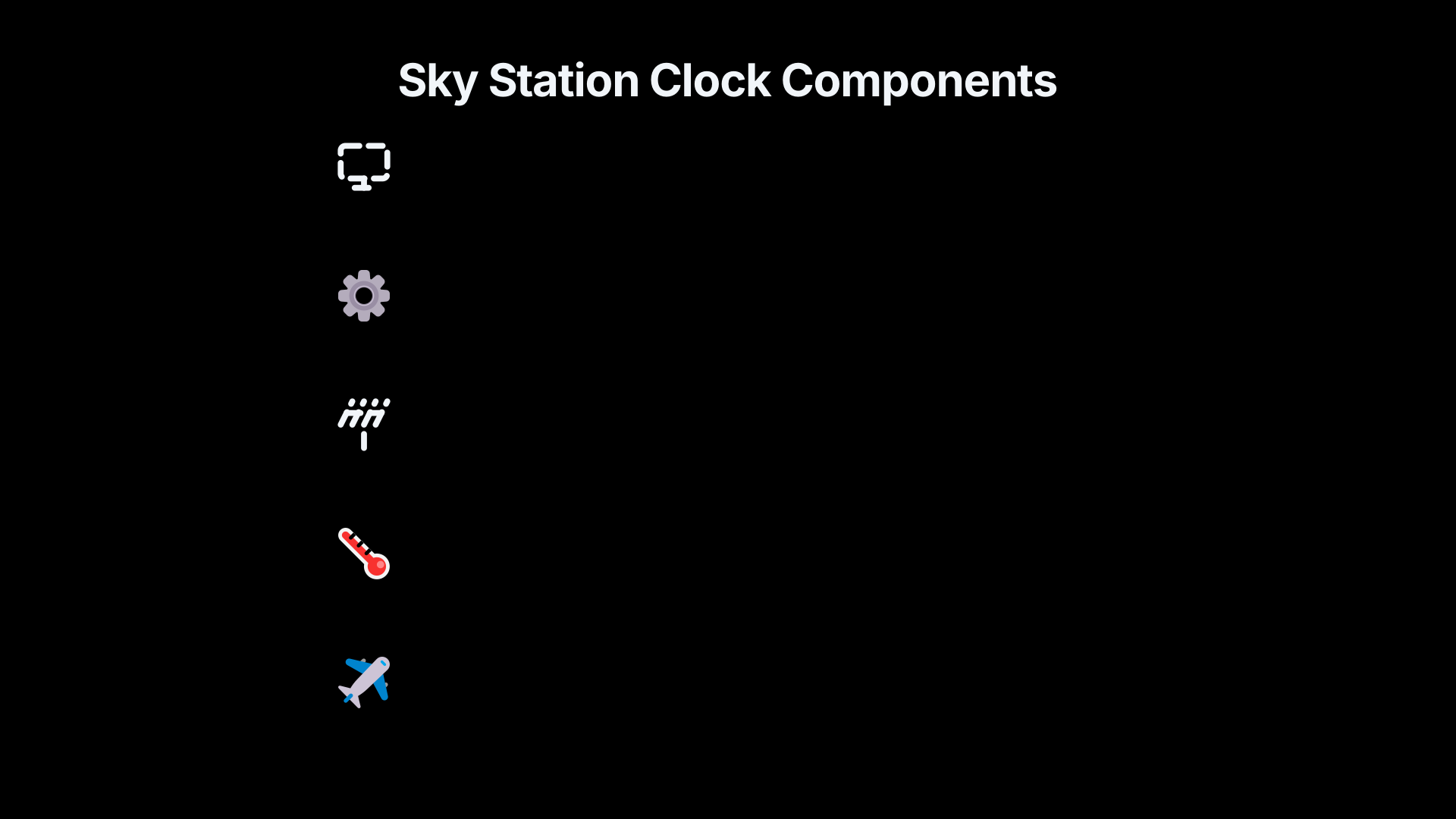
In an automated sky station, several independent clocks are usually involved:
- the computer recording video,
- the camera’s internal clock,
- pan-tilt mount controllers,
- radio receivers,
- weather sensors,
- external data sources such as ADS-B aircraft broadcasts.
Each may drift differently unless they are regularly synchronised. The recorded event therefore becomes a combination of measurements that are only comparable if they share a common, accurately maintained timescale. Precision timing systems such as GPS-disciplined clocks or IEEE 1588 Precision Time Protocol (PTP) exist because ordinary computer clocks are often insufficient for precise measurement tasks.[Federal Aviation Administration+2Wikipedia]faa.govPrecise time synchronization is an essential element for APNT technologies, such as wide area multi- lateration (WAM) and passive pseudo…
How offsets distort speed and triangulation
The most misleading effect of clock drift is that it changes the relationship between position and time rather than position itself.
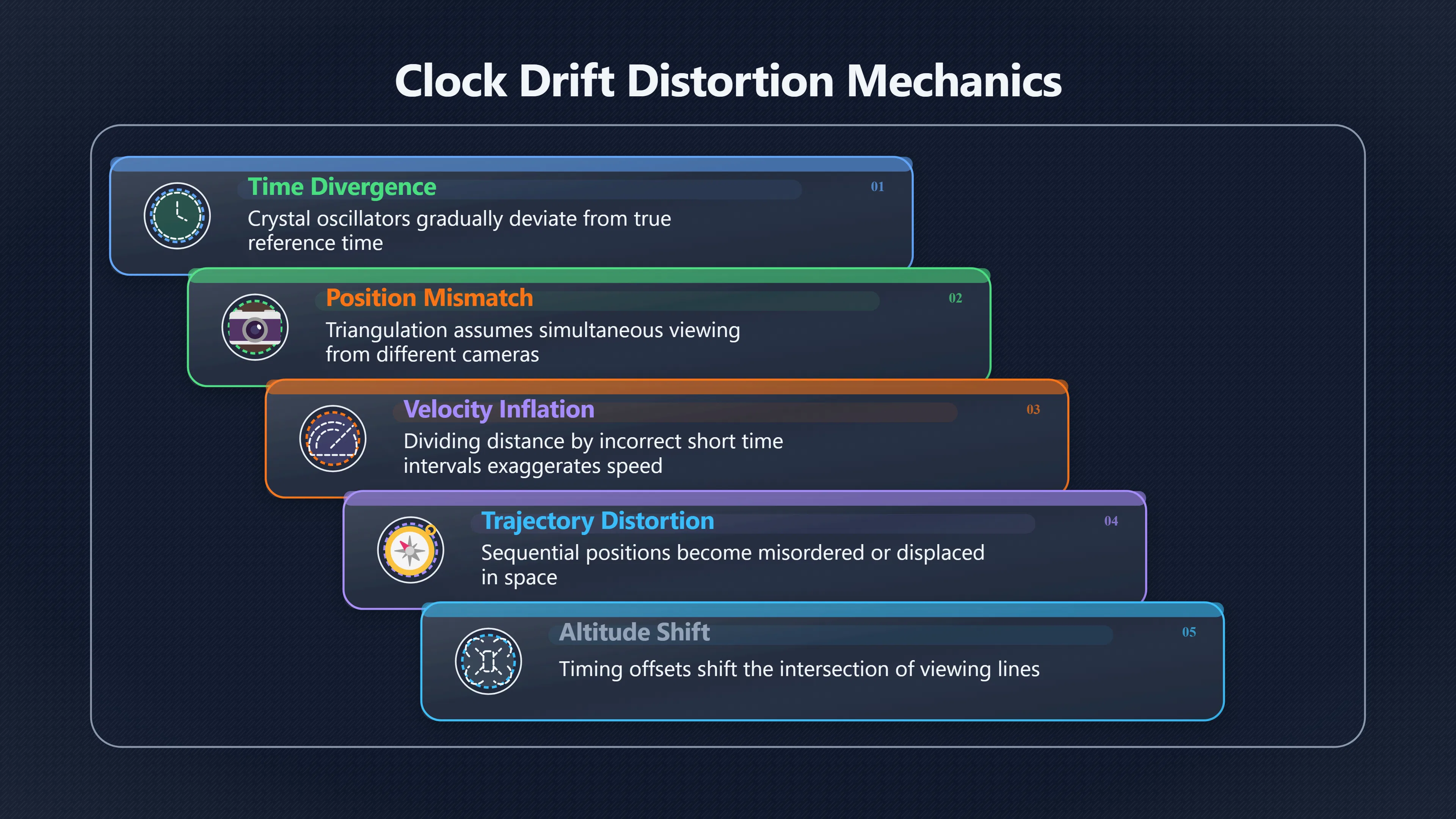
Suppose two cameras observe the same aircraft from different locations. Triangulation assumes that both images correspond to the same instant. If one camera’s clock is 0.4 seconds ahead, the aircraft has continued moving before the second observation is matched. The reconstruction algorithm may interpret this as a much faster object occupying inconsistent positions in space.
The resulting errors can include:
- Inflated apparent velocity. Dividing the correct distance by an incorrect, shorter time interval produces exaggerated speeds.
- Incorrect flight direction. Sequential positions become misordered or displaced.
- False acceleration. Small timestamp errors between successive measurements can create apparent bursts of acceleration that never occurred.
- Altitude errors. Triangulation assumes simultaneous viewing geometry; timing offsets shift the intersection of viewing lines and therefore the estimated height.
These effects become increasingly severe as the target moves faster or lies closer to the observing stations. A nearby bird or insect crossing the field of view can travel a significant angular distance within a fraction of a second, making even modest timing errors appear dramatic. Conversely, slow-moving celestial objects are much less sensitive to the same timing offset.[Federal Aviation Administration]faa.govPrecise time synchronization is an essential element for APNT technologies, such as wide area multi- lateration (WAM) and passive pseudo…
Why nearby objects are especially vulnerable
Angular motion depends strongly on distance.
An insect flying one metre from a camera may sweep across many degrees of sky in a fraction of a second. If timestamps drift, algorithms attempting to correlate that track with another sensor may infer an implausibly high physical speed because the object appears to occupy incompatible positions at nearly the same reported time.
The same timing error applied to a distant satellite usually has little effect because the satellite’s apparent angular motion changes much more slowly.
This difference explains why timing quality matters most when analysing events involving fast angular motion rather than simply bright or unusual lights.
Why timing errors can resemble anomalous behaviour
Many reported “impossible” motions depend on comparing observations from different instruments.
Examples include:
- a camera track compared with ADS-B aircraft positions;
- two observatories attempting three-dimensional reconstruction;
- optical detections matched with radar returns;
- optical observations compared with acoustic or radio measurements.
If one dataset drifts relative to another, several misleading outcomes become possible.
An ordinary aircraft may appear displaced from its published ADS-B position, suggesting an unknown object flying nearby. A meteor may seem inconsistent with expected atmospheric entry geometry because different stations associate different moments of the event. A drone making a simple turn may appear to execute a sudden acceleration if timestamps are unevenly spaced.
Importantly, the images themselves may be entirely accurate. The anomaly arises from the incorrect timing relationship between otherwise correct measurements.
Checks that expose timing-induced anomalies
Experienced investigators rarely accept surprising motion estimates without first testing the timing chain.
Several checks are particularly effective.
Independent time references. GPS-disciplined clocks or verified one-pulse-per-second (1 PPS) timing signals provide an external reference that reveals whether local clocks have drifted. Recent evaluations of GPS flash timing show that externally referenced timestamps can be measured with very high accuracy for scientific video recording.[ADS Astronomy Database]ui.adsabs.harvard.eduADS Astronomy Database Timing Accuracy Using GPS Flash TimingThe timing accuracy of short exposure video recordings that have been time stamped using GPS 1 PPS flashes has been measured.Read more…
Known targets. Commercial aircraft following published flight paths, bright satellites and predictable celestial objects provide calibration opportunities. If reconstructed positions consistently lag or lead these references, clock offsets become apparent.
Round-trip consistency. When two stations reconstruct an object’s position independently, their solutions should agree within known uncertainty. Persistent disagreement often indicates synchronisation problems before it indicates unusual object behaviour.
Drift monitoring over time. Clock errors generally accumulate gradually rather than appearing randomly. Logging clock corrections throughout an observing session can reveal steadily increasing offsets characteristic of oscillator drift rather than genuine changes in target motion.[DISCO]disco.ethz.chTime, Clocks & GPSNovember 15, 2019 — Clock drift is indicated in parts per mil- lion (ppm). One ppm corresponds to a time error gro…

Why clock drift deserves attention before extraordinary explanations
Clock drift has repeatedly been recognised as an operational problem in demanding engineering systems, including spacecraft, navigation networks and precision measurement platforms. Practical experience shows that uncompensated clocks affect pointing, attitude estimation, event scheduling and sensor fusion long before they cause complete system failure. On the Mars Exploration Rovers, accumulated clock drift eventually became large enough to degrade attitude estimation because the spacecraft no longer predicted the Sun’s position correctly for a given timestamp.[www-robotics.jpl.nasa.gov]www-robotics.jpl.nasa.govclock drift on the rovers, its relationship to temperature, how we measure it, what problems it causes…Read more…
The same principle applies to automated UFO detection, although on a different scale. Before concluding that a recorded object performed extraordinary manoeuvres, investigators should first verify that every sensor agreed on when the observation occurred. In many cases, correcting a modest timing offset restores a trajectory that is entirely consistent with an ordinary aircraft, meteor, drone or nearby biological object rather than an unexplained aerial phenomenon.
Amazon book picks
Further Reading
Books and field guides related to When Bad Timing Creates Strange Motion. Use these as the next step if you want deeper reading beyond the article.

Measurement Systems Application and Design
First published 1966. Subjects: Measuring instruments, Physical measurements, Meetinstrumenten, Capteurs (technologie), Messgerät.
eBay marketplace picks
Marketplace Samples
Topic-anchored marketplace searches for visual, collectible, or second-hand items related to this page.

Endnotes
1.
Source: disco.ethz.ch
Link:https://disco.ethz.ch/courses/hs19/distsys/lnotes/chapter20.pdf
Source snippet
Time, Clocks & GPSNovember 15, 2019 — Clock drift is indicated in parts per mil- lion (ppm). One ppm corresponds to a time error gro...
Published: November 15, 2019
2.
Source: www-robotics.jpl.nasa.gov
Link:https://www-robotics.jpl.nasa.gov/media/documents/AIAA2012_MER_Clock_Drift_final.pdf
Source snippet
clock drift on the rovers, its relationship to temperature, how we measure it, what problems it causes...Read more...
3.
Source: Wikipedia
Title: Precision Time Protocol
Link:https://en.wikipedia.org/wiki/Precision_Time_Protocol
4.
Source: faa.gov
Link:https://www.faa.gov/sites/faa.gov/files/about/office_org/headquarters_offices/ato/20120802TimingWhitePaperAPNT6-2012.pdf
Source snippet
Precise time synchronization is an essential element for APNT technologies, such as wide area multi- lateration (WAM) and passive pseudo...
5.
Source: ui.adsabs.harvard.edu
Title: ADS Astronomy Database Timing Accuracy Using GPS Flash Timing
Link:https://ui.adsabs.harvard.edu/abs/2024JOA….14c…7C/abstract
Source snippet
The timing accuracy of short exposure video recordings that have been time stamped using GPS 1 PPS flashes has been measured.Read more...
Additional References
6.
Source: youtube.com
Link:https://www.youtube.com/watch?v=GnG50qsUWbc
Source snippet
Time Synchronization in GNSS/INS Systems | Positioning Engine Deep Dive (Part 1) Time Synchronization in GNSS/INS Systems | Positioning E...
7.
Source: inria.hal.science
Link:https://inria.hal.science/hal-00725654/PDF/TOF.pdf
Source snippet
of Flight Cameras: Principles, Methods, and...by M Hansard · Cited by 800 — For both sensors, we observe two major errors; data drift an...
8.
Source: youtube.com
Link:https://www.youtube.com/watch?v=FJwhHFM0oDo
Source snippet
Have a look at [http://www.vision-campus.com](http://www.vision-campus.com) to find all of our exciting videos and articles about vision technology. Just make sure you s...
9.
Source: youtube.com
Link:https://www.youtube.com/watch?v=atoUpGgw2fE
Source snippet
"What is image quality? [https://www.youtube.com/watch?v=FJwhHFM0oDo..."](https://www.youtube.com/watch?v=FJwhHFM0oDo...")...
10.
Source: youtube.com
Title: More from the Vision Campus
Link:https://www.youtube.com/watch?v=HnAzL38pXeI
Source snippet
"What is a vision system?: [https://www.youtube.com/watch?v=atoUpGgw2fE](https://www.youtube.com/watch?v=atoUpGgw2fE) What is image quality? [https://www.youtube.com/watch?v=FJwhHFM0oDo..."](https://www.youtube.com/watch?v=FJwhHFM0oDo...")...
11.
Source: pmc.ncbi.nlm.nih.gov
Link:https://pmc.ncbi.nlm.nih.gov/articles/PMC12526708/
Source snippet
Dynamic Error of A-PNAS High-Precision Time...by Z Wang · 2025 · Cited by 4 — Therefore, the time-varying effect errors and Doppler effe...
12.
Source: youtube.com
Title: How Do Multi-Camera Setups Benefit from Gig E Vision 2.0?
Link:https://www.youtube.com/watch?v=nalWpxsFs5U
Source snippet
FPGA Horizons 2026: Timing in Embedded Systems – PTP, Clocking & RF Synchronization...
13.
Source: tf.nist.gov
Link:https://tf.nist.gov/general/pdf/1869.pdf
Source snippet
and time dissemination in a distributed space...by S Francis · Cited by 11 — This paper examines the timekeeping environments of several...
14.
Source: youtube.com
Title: Operational GPS Satellite Ranging, Pseudorange & Errors
Link:https://www.youtube.com/watch?v=C1LtkzuzpoY
Source snippet
OAK4 PTP Sync: Precise Multi-Camera Time/Data Sync Over Ethernet...
15.
Source: mdpi.com
Link:https://www.mdpi.com/1424-8220/25/14/4385
Source snippet
Assessing Geometry Perception of Direct Time-of-Flight...by J Gimpelj · 2025 · Cited by 4 — This study addresses one of the key challeng...
Topic Tree