Within Buy or Build
What Extra Sensors Actually Add
Magnetometers, weather sensors, GPS and radio receivers can enrich a sighting record, but they do not prove anything alone.
On this page
- Which sensors add context
- Why correlation is not confirmation
- When sensor packages justify their complexity
Page outline Jump by section
Introduction
Extra sensors can make an automated UAP detector substantially more useful, but they do not make an observation more extraordinary. In both commercial systems and DIY open-source builds, magnetometers, weather instruments, GPS receivers, radio-frequency (RF) receivers and other environmental sensors are best understood as providers of context rather than proof. Their value lies in helping investigators reconstruct what happened, eliminate ordinary explanations and compare independent measurements taken at the same time.
 This distinction is central to modern scientific approaches to UAP research. NASA’s independent study concluded that progress depends on multiple well-calibrated sensors, complete metadata and careful cross-correlation, not on any single sensor reporting an unusual value. Poor calibration, missing baseline measurements and incomplete metadata remain among the biggest obstacles to interpreting unusual observations.[NASA Science]science.nasa.govScience Independent Study Team ReportNASA ScienceIndependent Study Team ReportSeptember 13, 2023 — At present, analysis of UAP data is hampered by poor sensor calibration, th…
Which sensors add context?
A camera records what appears in the field of view. Additional sensors describe the conditions under which that image was captured. Each contributes a different piece of evidence, but each also has limitations.
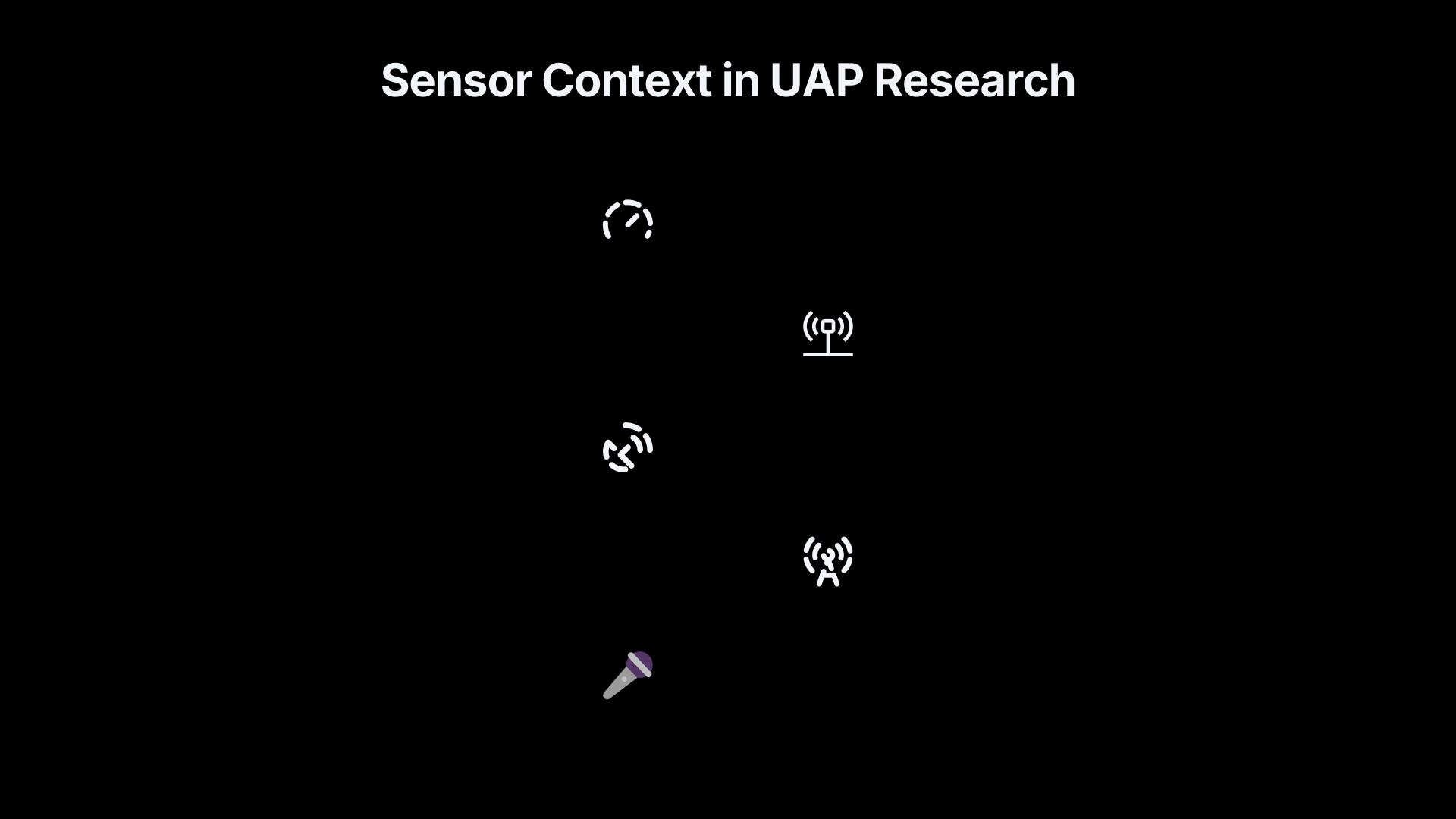
Magnetometers measure changes in the local magnetic field. In principle, they can detect nearby electrical equipment, passing vehicles, lightning-related disturbances or larger geomagnetic activity. However, they are extremely sensitive to ordinary environmental influences. Electric motors, household wiring, steel structures and even moving ferrous objects can generate measurable changes. A magnetometer spike therefore requires comparison with background conditions, nearby equipment and wider geomagnetic data before it can be considered unusual.[Space Weather Prediction Center]spaceweather.govSpace Weather Prediction CenterGOES Magnetometer | NOAA / NWS…GOES magnetometer data have been used for constructing magnetic field mo…
Weather sensors record temperature, humidity, pressure, wind and rainfall. These measurements rarely identify an object directly, but they help explain optical effects such as atmospheric refraction, haze, cloud development and visibility changes. Wind measurements also help evaluate whether a slowly moving light could simply be drifting with the prevailing air mass rather than exhibiting unusual motion.[NASA Science]science.nasa.govScience Independent Study Team ReportNASA ScienceIndependent Study Team ReportSeptember 13, 2023 — At present, analysis of UAP data is hampered by poor sensor calibration, th…
GPS receivers provide more than location. Accurate GPS timing allows every sensor in a station—or even across multiple stations—to share a common clock. Reliable timestamps are essential when comparing video frames with radio recordings, aircraft transponder data or observations from another site. Without synchronised timing, meaningful comparison becomes much harder.[NASA Science]science.nasa.govScience Independent Study Team ReportNASA ScienceIndependent Study Team ReportSeptember 13, 2023 — At present, analysis of UAP data is hampered by poor sensor calibration, th…
Radio receivers and software-defined radio (SDR) equipment monitor portions of the radio spectrum. They can capture transmissions from aircraft systems, local communications or unexpected radio interference occurring during an event. Importantly, RF activity is not evidence of an anomalous object. Most detected signals originate from familiar communication systems, consumer electronics or other terrestrial sources. Their main value is documenting the electromagnetic environment surrounding an observation.[arXiv]arxiv.org1 Introduction30 May 2025 — A system designed for the comprehensive scientific study of aerial phenomena which integrates multiple s…
Some experimental observatories also incorporate microphones, infrared cameras, or multiple optical cameras covering different fields of view. These combinations provide independent observations that can be compared rather than relying on one instrument alone.[arXiv]arxiv.org1 Introduction30 May 2025 — A system designed for the comprehensive scientific study of aerial phenomena which integrates multiple s…
Why correlation is not confirmation
The greatest misunderstanding surrounding multi-sensor systems is the assumption that simultaneous readings automatically validate one another.
Suppose a camera records an unusual light while a magnetometer shows a brief fluctuation. That coincidence alone does not establish a physical relationship. The two events may be unrelated, or both may share a mundane cause such as nearby electrical equipment, changing weather conditions or simple coincidence.
Good investigations therefore ask progressively stronger questions:
- Did multiple independent sensors detect something at precisely the same time?
- Were the sensors calibrated beforehand?
- Is the behaviour significantly different from normal background measurements?
- Can known aircraft, satellites, weather phenomena or local infrastructure explain the observations?
- Would another station located elsewhere have been expected to record the same event?
Only after these checks does an observation become worthy of deeper analysis.
NASA’s UAP study repeatedly emphasised that calibration, metadata and baseline observations are essential because otherwise sensor artefacts can easily be mistaken for unusual phenomena. The report also notes that multiple well-characterised sensors reduce false positives only when their measurements are properly understood and interpreted together.[NASA Science]science.nasa.govScience Independent Study Team ReportNASA ScienceIndependent Study Team ReportSeptember 13, 2023 — At present, analysis of UAP data is hampered by poor sensor calibration, th…
When sensor packages justify their complexity
Additional sensors increase cost, power consumption, maintenance and calibration requirements. They become worthwhile when they answer questions that cameras alone cannot.
A simple single-camera station may record an unidentified light but cannot establish whether changing atmospheric conditions affected visibility, whether nearby radio interference occurred or whether several stations observed the same event simultaneously.
A more complete sensor package becomes valuable when it can:
- provide accurate time synchronisation across all recordings;
- document environmental conditions throughout an observation;
- preserve continuous baseline measurements rather than recording only “interesting” events;
- support comparisons between different observing sites; and
- help eliminate conventional explanations before considering less familiar ones.
This philosophy increasingly appears in research-oriented observatories. Rather than treating magnetometers, RF receivers or environmental sensors as “anomaly detectors”, newer designs treat them as complementary data streams contributing to a comprehensive observational record. The Galileo Project’s published observatory architecture, for example, integrates optical, infrared, radio, acoustic and magnetic measurements specifically so that different sensing modalities can be compared, validated and interpreted together rather than independently.[arXiv]arxiv.org1 Introduction30 May 2025 — A system designed for the comprehensive scientific study of aerial phenomena which integrates multiple s…
Practical implementation choices for commercial and DIY systems
Commercial UAP detector packages often simplify sensor integration by supplying compatible hardware, unified software and common timestamps across cameras and environmental instruments. This reduces engineering effort and lowers the risk of configuration errors, particularly for users who want a working installation without designing electronics or data pipelines themselves.[arXiv]arxiv.org1 Introduction30 May 2025 — A system designed for the comprehensive scientific study of aerial phenomena which integrates multiple s…
DIY builders usually have greater flexibility. Open-source platforms based on inexpensive computers and widely available sensors allow users to choose exactly which environmental measurements to collect, experiment with new sensor combinations and retain complete control over raw data formats. The trade-off is that synchronisation, calibration and long-term reliability become the builder’s responsibility.
In practice, a modest collection of well-calibrated sensors producing consistent, timestamped data is generally more valuable than a large assortment of poorly characterised instruments. An accurately timed camera, reliable weather station and properly calibrated GPS receiver may contribute more to a credible observation than numerous auxiliary sensors whose noise characteristics and failure modes are unknown.
Ultimately, extra sensors strengthen an automated observing station not because they detect anomalies directly, but because they improve the quality, completeness and reproducibility of the evidence. Their greatest contribution is often helping investigators demonstrate that an apparently unusual observation has an ordinary explanation—or, more rarely, showing that an event deserves more rigorous investigation.[NASA Science+2arXiv]science.nasa.govScience Independent Study Team ReportNASA ScienceIndependent Study Team ReportSeptember 13, 2023 — At present, analysis of UAP data is hampered by poor sensor calibration, th…



eBay marketplace picks
Marketplace Samples
Example marketplace items related to this page. Use the search link to explore similar finds on eBay.
Endnotes
1.
Source: science.nasa.gov
Title: Science Independent Study Team Report
Link:https://science.nasa.gov/wp-content/uploads/2023/09/uap-independent-study-team-final-report.pdf
Source snippet
NASA ScienceIndependent Study Team ReportSeptember 13, 2023 — At present, analysis of UAP data is hampered by poor sensor calibration, th...
Published: September 13, 2023
2.
Source: arxiv.org
Link:https://arxiv.org/abs/2507.11355
3.
Source: arxiv.org
Link:https://arxiv.org/html/2506.00125v1
Source snippet
1 Introduction30 May 2025 — A system designed for the comprehensive scientific study of aerial phenomena which integrates multiple s...
Published: May 2025
4.
Source: arxiv.org
Link:https://arxiv.org/abs/2305.18566
5.
Source: space.com
Title: nasa ufo uap study team first results revealed
Link:https://www.space.com/nasa-ufo-uap-study-team-first-results-revealed
Source snippet
NASA UFO report finds no evidence of 'extraterrestrial...14 Sept 2023 — "The NASA independent study team did not find any evidence that...
6.
Source: spaceweather.gov
Link:https://www.spaceweather.gov/products/goes-magnetometer
Source snippet
[Space Weather]({{ 'space-weather/' | relative_url }}) Prediction CenterGOES Magnetometer | NOAA / NWS...GOES magnetometer data have been used for constructing magnetic field mo...
Additional References
7.
Source: youtube.com
Link:https://www.youtube.com/watch?v=TQcqOW39ksk
8.
Source: leonarddavid.com
Title: nasa report released unidentified anomalous phenomena uap
Link:https://www.leonarddavid.com/nasa-report-released-unidentified-anomalous-phenomena-uap/
Source snippet
Unidentified Anomalous Phenomena (UAP) – UPDATED14 Sept 2023 — NASA has released its Unidentified Anomalous Phenomena (UAP) report comple...
9.
Source: en.wikisource.org
Title: The panel notes that, at present, gathering data
Link:https://en.wikisource.org/wiki/NASA_Unidentified_Anomalous_Phenomena%3A_Independent_Study_Team_Report/Responses_to_Statement_of_Task
Source snippet
NASA Unidentified Anomalous Phenomena: Independent...14 Oct 2023 — The importance of detecting UAP with multiple, well-calibra...
10.
Source: cbsnews.com
Title: nasa ufo report uap study
Link:https://www.cbsnews.com/news/nasa-ufo-report-uap-study/
Source snippet
NASA UAP report finds no evidence of "extraterrestrial"...14 Sept 2023 — An independent group of scientist and experts convened by NASA...
11.
Source: youtube.com
Title: Extreme spotting machine OTDAU 2.17 Latest version Finally 360° tracking:)
Link:https://www.youtube.com/watch?v=VvKVlU7vTe4
Source snippet
UAP & Extraterrestrial Technosignatures | Avi Loeb...
12.
Source: youtube.com
Title: Why Scientists Stopped LISTENING For Aliens
Link:https://www.youtube.com/watch?v=sA376ly2cvo
Source snippet
Astrophysicist Avi Loeb Explains 3I/ATLAS, UAPs, and Potential for Alien Life | SME 006...
13.
Source: youtube.com
Title: UAP & Extraterrestrial Technosignatures | Avi Loeb
Link:https://www.youtube.com/watch?v=jNFmom6IaAQ
Source snippet
The Galileo Project's Search for UAP - with Andy Mead | Merged EP0115...
14.
Source: azosensors.com
Link:https://www.azosensors.com/article.aspx?ArticleID=3156
Source snippet
Evaluating Sensor Tech for Accurate UAP Detection20 Feb 2025 — This article examines whether modern sensor technologies—spanning [radar]({{ 'radar/' | relative_url }}), i...
15.
Source: youtube.com
Title: The Galileo Project’s Search for UAP
Link:https://www.youtube.com/watch?v=87POecVP-s4
Source snippet
Why Scientists Stopped LISTENING For Aliens...
16.
Source: youtube.com
Link:https://www.youtube.com/watch?v=dQdlEZVk0G4
Topic Tree