Within Open Data
What Hessdalen Teaches About Repeat Observations
Hessdalen shows the value of continuous instrumented observation, but also the difficulty of comparing changing local data over time.
On this page
- Why recurring lights made Hessdalen worth monitoring
- How changing stations complicate comparison
- What modern detector networks can learn
Page outline Jump by section
Introduction
The Hessdalen valley in central Norway is one of the strongest real-world examples of why long-running, automated sky monitoring matters when investigating unusual aerial phenomena. Unlike isolated sightings, Hessdalen has been observed repeatedly for decades, allowing researchers to move from eyewitness reports towards continuous instrumental recording. At the same time, it also illustrates a fundamental challenge for any automated UAP detector network: observations collected over many years are only directly comparable if the instruments, calibration methods and data practices remain consistent or are carefully documented when they change.
 For discussions about open data and replication, Hessdalen is valuable not because it has produced a universally accepted explanation for its recurring lights, but because it demonstrates both the strengths and limitations of persistent monitoring. The project has accumulated an unusually long observational record, yet changes in cameras, software, sensor layouts and observing strategies complicate comparisons across different periods. That experience offers important lessons for future automated detector networks.
Why recurring lights made Hessdalen worth monitoring
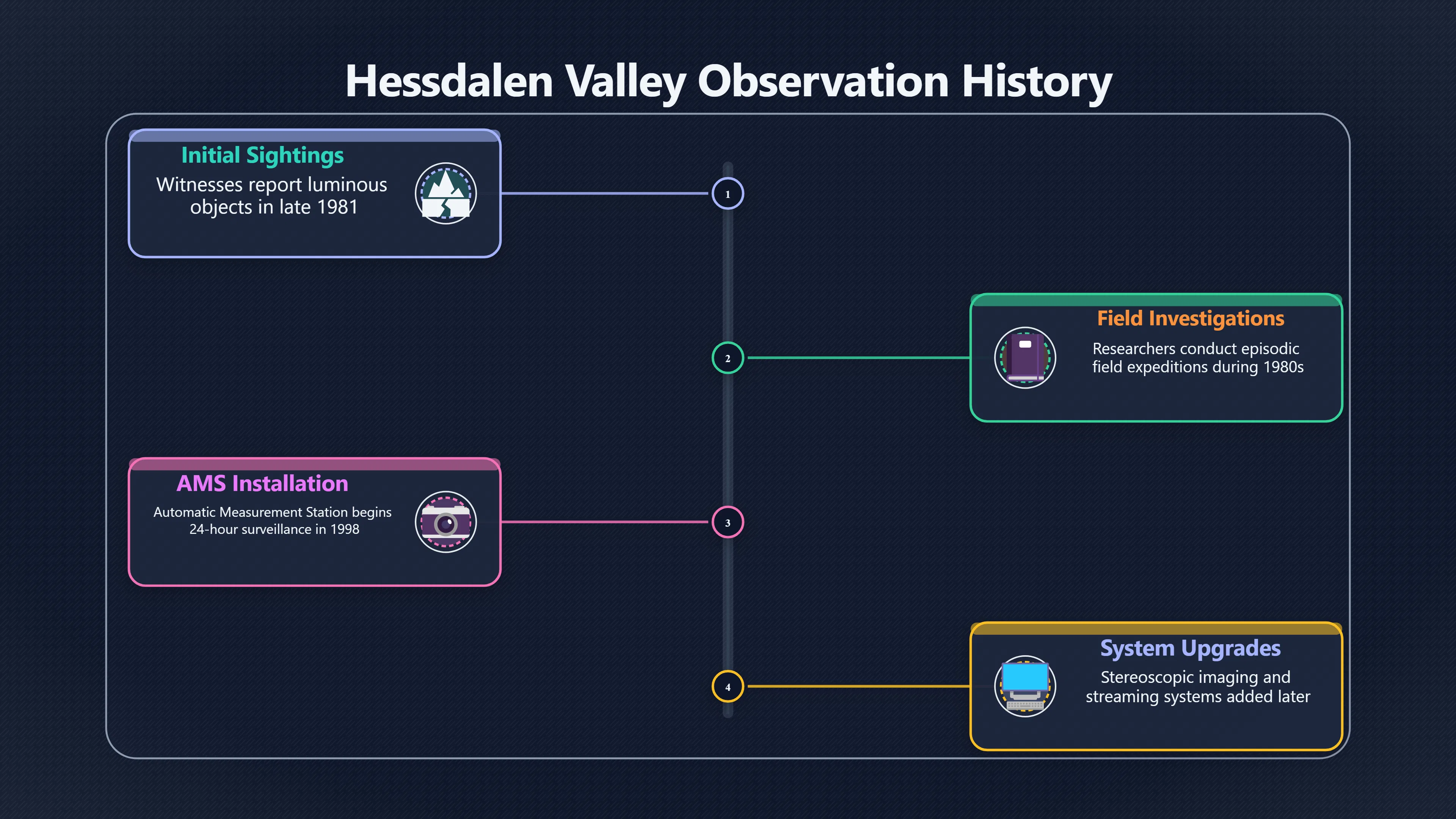
Reports of unusual luminous objects in the Hessdalen valley increased dramatically between late 1981 and the mid-1980s, with witnesses sometimes reporting multiple observations each week. Rather than treating the reports as isolated incidents, Norwegian investigators recognised that a recurring phenomenon created an opportunity for systematic observation. Continuous monitoring offered a better scientific strategy than waiting for occasional field expeditions.[Hessdalen Project]old.hessdalen.orgTelling about the history of the lights and the running of the project. Then it lists all the instruments.Read more…
This distinction is important. A single unexplained photograph rarely permits reliable estimates of distance, brightness or motion. Repeated observations from a fixed location, however, make it possible to:
- establish how often unusual events actually occur;
- compare suspected anomalies with ordinary night-sky activity;
- correlate optical observations with weather, magnetic or radio measurements;
- improve instrumentation after identifying weaknesses in earlier deployments.
The installation of the Hessdalen Automatic Measurement Station (AMS) in August 1998 represented a shift from episodic investigations towards continuous automated surveillance. Cameras operated around the clock, software detected candidate events automatically, and images and monitoring data could be archived over long periods instead of depending solely on human observers being present.[Hessdalen Project]old.hessdalen.orgHessdalen ProjectProject Hessdalen - Homepage21 May 2023 — An automatic measurement station was put up in Hessdalen in August 1998. Both…
The site’s value therefore lies less in any individual recording than in the accumulation of observations across many years. That philosophy closely matches modern proposals for automated UAP detector networks, which emphasise persistent monitoring rather than attempting to capture a single spectacular event.
How changing stations complicate comparison
Long-term monitoring creates a new problem that shorter investigations largely avoid: the observing system itself changes over time.
The Hessdalen project has evolved substantially since its early campaigns. Initial investigations in the 1980s relied on temporary field instruments deployed during dedicated observation periods. The permanent station introduced in 1998 later underwent further upgrades, including multiple cameras, automated detection software, stereoscopic imaging using separated cameras, streaming systems and revised processing pipelines.[Hessdalen Project+2Hessdalen Project]old.hessdalen.orgTelling about the history of the lights and the running of the project. Then it lists all the instruments.Read more…
These improvements increase capability, but they also complicate historical comparisons.
Detection rates do not necessarily measure the sky
If a modern camera detects fainter objects than an earlier analogue camera, an apparent increase in recorded events may reflect better sensitivity rather than any genuine change in the phenomenon itself.
Similarly, changes in:
- camera sensitivity,
- lens field of view,
- trigger thresholds,
- compression methods,
- frame rate,
- software algorithms,
can alter what counts as a recorded event.
Without careful documentation, researchers cannot easily determine whether differences between years reflect environmental changes or instrument changes.
This issue is familiar across astronomy and environmental monitoring, where long-term data sets require detailed calibration histories. Hessdalen demonstrates that automated UAP observation faces the same requirement.
Station geometry also matters
The Hessdalen AMS did not remain a single fixed camera looking in one direction. Additional cameras, different viewing angles and later two-camera distance estimation systems expanded observational capability. These upgrades improve scientific value but mean that observations collected in different eras are not strictly equivalent datasets.[Hessdalen Project]old.hessdalen.orgProject Automatic Measurement Station (AMSThe software took a picture from each camera each second. If a…Read more…
For example, the later introduction of separated cameras enabled triangulation for some detected lights, allowing distance estimates that were impossible with the original single-camera configuration. This represents a genuine improvement in evidence quality, but it also means measurements before and after the upgrade cannot simply be merged without accounting for the methodological difference.[Hessdalen Project]old.hessdalen.orgProject Automatic Measurement Station (AMSThe software took a picture from each camera each second. If a…Read more…
Declining activity illustrates another difficulty
Project Hessdalen reports indicate that observation frequency declined substantially after the exceptionally active early 1980s. Later reports commonly mention roughly 10–20 observations per year rather than the much higher rates reported during the initial outbreak.[Hessdalen Project]old.hessdalen.orgHessdalen ProjectProject Hessdalen - Homepage21 May 2023 — An automatic measurement station was put up in Hessdalen in August 1998. Both…
Because both the environment and the monitoring system evolved over the same period, interpreting that decline is not straightforward. It could reflect genuine changes in the underlying phenomenon, differences in reporting behaviour, altered observing conditions, or combinations of these factors. Long-running monitoring therefore requires stable reference measurements as well as continued data collection.
What modern detector networks can learn
Hessdalen provides practical lessons that extend well beyond the specific phenomenon being studied.
First, persistent monitoring is often more valuable than isolated investigations. Rare events become scientifically useful only when placed within a long baseline of ordinary observations. Modern automated detector proposals similarly rely on continuous operation so that unusual detections can be compared against thousands of hours of normal sky activity.
Second, instrumentation should be treated as part of the dataset. Camera replacements, software revisions, calibration changes and hardware upgrades should all be archived alongside observational records. Without that metadata, future researchers cannot reliably compare events separated by years.
Third, multi-sensor measurements are more informative than single-camera images. Hessdalen researchers have repeatedly argued for combining optical observations with spectrometers, radar, radio receivers, magnetic measurements and other environmental sensors because no single instrument can fully characterise transient luminous events. Later EMBLA campaigns specifically sought to expand this multi-instrument approach.[Project Hessdalen]hessdalen.orgProject HessdalenA Long-Term Scientific Survey of the…June 29, 2004 — by M TEODORANI · 2004 · Cited by 97 — Abstract—The balls of ligh…
Finally, openness increases scientific value. Project Hessdalen has historically published technical reports, station descriptions and many monitoring images, allowing outside researchers to examine methods, assess limitations and propose alternative explanations. While the archive is incomplete by modern open-data standards, it demonstrates the principle that long-running observational programmes become substantially more valuable when methods and instrumentation are documented rather than treated as proprietary.[Hessdalen Project+2Hessdalen Project]old.hessdalen.orgHessdalen ProjectProject Hessdalen - Homepage21 May 2023 — An automatic measurement station was put up in Hessdalen in August 1998. Both…

Why Hessdalen remains relevant
Hessdalen has not resolved the question of what every observed light represents, and no single explanation has achieved scientific consensus. Its lasting importance instead lies in showing how unusual recurring aerial events can be studied with progressively better instrumentation over decades.
For automated UAP detector research, that is arguably its most significant contribution. The valley demonstrates that continuous observation is feasible, that repeated measurements are far more informative than isolated sightings, and that maintaining scientific usefulness over decades depends as much on consistent calibration, documented upgrades and reproducible data practices as on the sensors themselves.[Project Hessdalen+2Hessdalen Project]hessdalen.orgProject HessdalenA Long-Term Scientific Survey of the…June 29, 2004 — by M TEODORANI · 2004 · Cited by 97 — Abstract—The balls of ligh…
Amazon book picks
Further Reading
Books and field guides related to What Hessdalen Teaches About Repeat Observations. Use these as the next step if you want deeper reading beyond the article.

UFOs : Generals, Pilots, and Government Officials Go on the R...
Covers systematic investigation and long-term evidence collection.
The handbook of astronomical image processing
Supports understanding of long-term imaging and calibration.
eBay marketplace picks
Marketplace Samples
Example marketplace items related to this page. Use the search link to explore similar finds on eBay.




Endnotes
1.
Source: old.hessdalen.org
Link:https://old.hessdalen.org/reports/hpreport84.shtml
Source snippet
Telling about the history of the lights and the running of the project. Then it lists all the instruments.Read more...
2.
Source: old.hessdalen.org
Link:https://old.hessdalen.org/index_e.shtml
Source snippet
Hessdalen ProjectProject Hessdalen - Homepage21 May 2023 — An automatic measurement station was put up in Hessdalen in August 1998. Both...
Published: May 2023
3.
Source: old.hessdalen.org
Link:https://old.hessdalen.org/station/
Source snippet
Hessdalen ProjectAMS21 Jan 2019 — They are analog CCD cams which have a sensivity of 0,00003 lux. With low light they change from colour...
4.
Source: old.hessdalen.org
Title: Project Automatic Measurement Station (AMS)
Link:https://old.hessdalen.org/station/second.shtml
Source snippet
The software took a picture from each camera each second. If a...Read more...
5.
Source: hessdalen.org
Link:https://hessdalen.org/reports/scex1802217251.pdf
Source snippet
Project HessdalenA Long-Term Scientific Survey of the...June 29, 2004 — by M TEODORANI · 2004 · Cited by 97 — Abstract—The balls of ligh...
Published: June 29, 2004
6.
Source: hessdalen.org
Title: EMBLA 2000
Link:https://hessdalen.org/reports/EMBLA-2000.pdf
Source snippet
Project HessdalenThe EMBLA 2000 Mission in Hessdalenby M Teodorani · Cited by 7 — The goal of EMBLA is of studying the electromagnetic be...
7.
Source: dictionary.cambridge.org
Link:https://dictionary.cambridge.org/dictionary/english/project
Source snippet
English meaning - Cambridge Dictionarya piece of planned work or an activity which is done over a period of time and intended to achiev...
8.
Source: Wikipedia
Title: Hessdalen AMS
Link:https://en.wikipedia.org/wiki/Hessdalen_AMS
Source snippet
Hessdalen AMSThe Hessdalen Automatic Measurement Station (or Hessdalen AMS) is an automatically working observation station in the Hes...
9.
Source: Wikipedia
Title: Hessdalen AMS
Link:https://de.wikipedia.org/wiki/Hessdalen_AMS
Source snippet
Hessdalen AMSEs handelt sich dabei um eine seit dem 7. August 1998 automatisch arbeitende Station zur Registrierung unidentifizierter...
Published: August 1998
Additional References
10.
Source: researchgate.net
Link:https://www.researchgate.net/publication/228609015_A_long-term_scientific_survey_of_the_Hessdalen_phenomenon
Source snippet
A long-term scientific survey of the Hessdalen phenomenonPDF | The balls of light which appear in the Hessdalen valley in Norway are exem...
11.
Source: medium.com
Link:https://medium.com/%40krindiri/six-minds-one-valley-one-big-mistery-remote-viewing-the-famous-hessdalen-lights-bca46c64c9a8
Source snippet
Remote Viewing the famous Hessdalen LightsProject Hessdalen operates an automated measurement station in the valley. The lights have been...
12.
Source: researchgate.net
Link:https://www.researchgate.net/figure/Flow-chart-of-the-Automatic-Measurement-Station-in-Hessdalen-System-2_fig1_241556861
Source snippet
Flow-chart of the Automatic Measurement Station in...Hessdalen Automatic Measurment Station consists of two main systems, which work sep...
13.
Source: discoveryuk.com
Title: hessdalen lights natural phenomenon or extraterrestrial signals
Link:https://www.discoveryuk.com/mysteries/hessdalen-lights-natural-phenomenon-or-extraterrestrial-signals/
Source snippet
Hessdalen Lights: Natural Phenomenon or Extraterrestrial...18 Sept 2023 — As well as Project Hessdalen, the Hessdalen Automatic Measurem...
14.
Source: semanticscholar.org
Link:https://www.semanticscholar.org/paper/Hessdalen-lights-produced-by-electrically-active-Paiva/28d99ad50b325481333baa9003632a993e1bb5b6
Source snippet
t shapes and light colors, observed in the Hessdalen valley in rural central...
15.
Source: facebook.com
Link:https://www.facebook.com/61583174895936/videos/the-hessdalen-lights-have-stumped-scientists-for-40-yearsin-a-remote-valley-in-n/1607905727171889/
Source snippet
rometers, photographed over 600,000 times by university equipment...
16.
Source: medium.com
Link:https://medium.com/%40missrennie/there-are-lights-in-a-norwegian-valley-that-science-cannot-explain-360488603100
Source snippet
ll appearing. Scientists from Norway, Italy, Germany...Read more...
17.
Source: research-collection.ethz.ch
Title: ch To Investigate or Not to Investigate?
Link:https://www.research-collection.ethz.ch/server/api/core/bitstreams/67dcdf4d-15f9-4538-95c7-201fad80ca03/content
Source snippet
Researchers' Views on...by E Caron · Cited by 1 — (A) Hessdalen phenomena and visualization of the visible light spectrum. The phenomeno...
18.
Source: facebook.com
Link:https://www.facebook.com/howtofeelgood.net/posts/in-the-middle-of-norway-theres-a-valley-where-something-unusual-happens-in-hessd/692636906985688/
Source snippet
In the middle of Norway, there's a valley where something...In Hessdalen, people have seen “mysterious lights” crossing the night sky si...
19.
Source: facebook.com
Link:https://www.facebook.com/100094408532133/posts/hessdalen-valley-norway-remote-rural-area-population-150historical-reports-light/828087327014878/
Source snippet
ion was put up in Hessdalen in August 1998.Read more...
Published: August 1998
Topic Tree