Within Review
When More Sensors Make UFO Alerts Clearer
Optical, infrared, radio, acoustic, and environmental data can turn a strange-looking clip into a testable event or reveal a sensor artefact.
On this page
- What corroboration can and cannot prove
- How sensor conflicts expose artefacts
- Why timing and provenance matter
Page outline Jump by section
Introduction
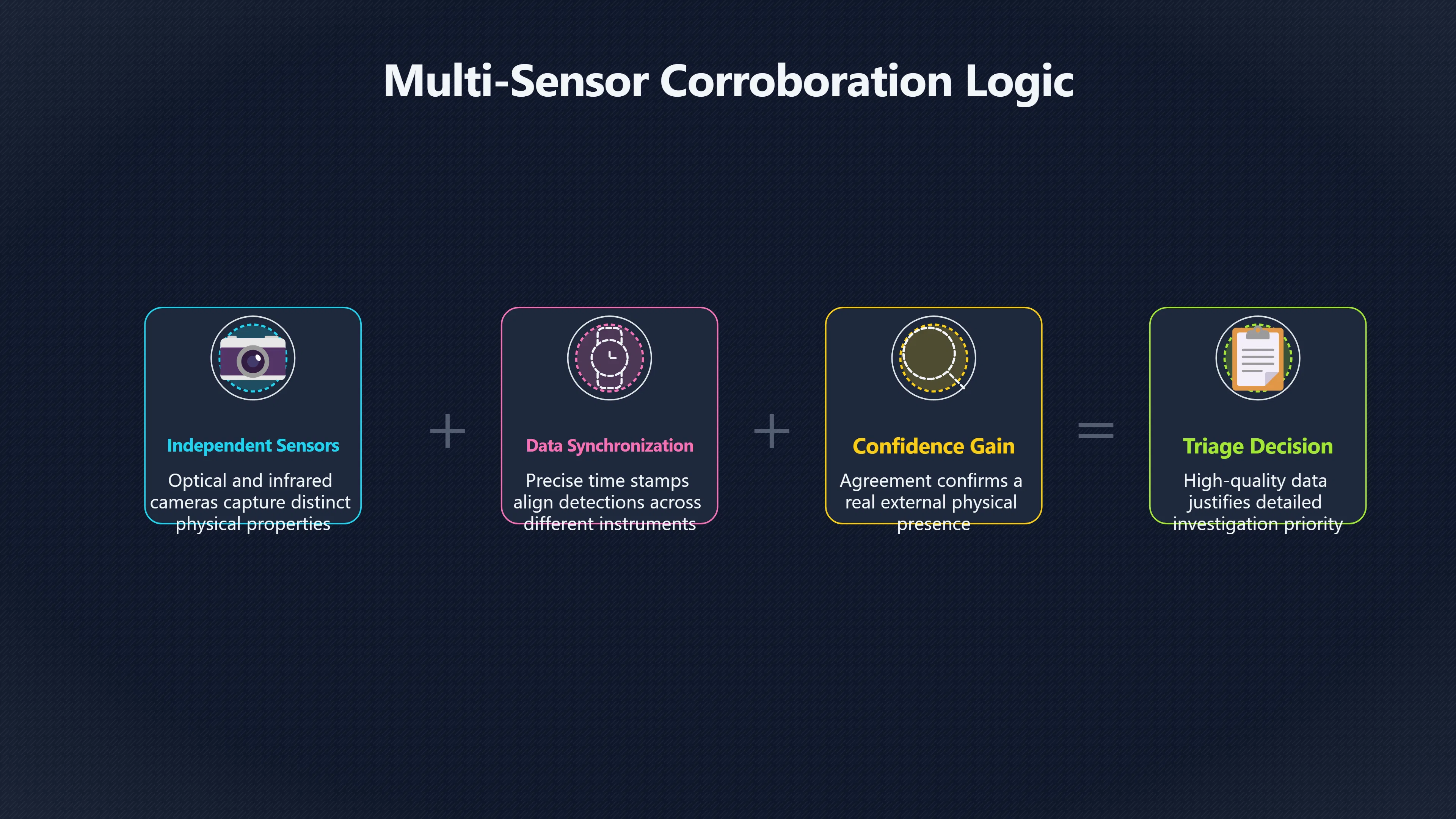
In an automated instrumented UFO or Unidentified Anomalous Phenomena (UAP) detection system, a single unusual camera clip is rarely enough to justify detailed investigation. Human reviewers make stronger triage decisions when multiple independent sensors observe the same event at the same place and time. Optical images, infrared measurements, radar or radio observations, acoustic recordings and environmental instruments each capture different physical properties. When those measurements agree, reviewers gain confidence that they are analysing a real external event rather than a camera illusion, software error or atmospheric effect. When they disagree, the mismatch often provides the clue needed to identify an artefact or ordinary explanation. NASA’s independent UAP study specifically identified the lack of multiple calibrated measurements and complete metadata as one of the biggest obstacles to reliable analysis.[NASA Science]science.nasa.govScience Independent Study Team ReportNASA ScienceIndependent Study Team ReportSeptember 13, 2023 — At present, analysis of UAP data is hampered by poor sensor calibration, th…
What corroboration can and cannot prove
Multi-sensor corroboration strengthens evidence, but it does not prove that an object is extraordinary. Instead, it changes the quality of the evidence available for triage.
A human reviewer is effectively asking two separate questions:
- Did something external to the sensor actually occur?
- If so, can it be identified using known explanations?
Multiple independent sensors help answer the first question far more reliably than the second.
For example, an optical camera may show a bright object crossing the sky. By itself, reviewers must consider possibilities including lens flare, sensor bloom, compression artefacts, insects close to the lens or distant aircraft. If an independently calibrated infrared camera records an object following the same trajectory at precisely the same time, the chance that the event is merely a visual artefact becomes much lower. If radar or radio tracking also detects a corresponding target, confidence increases further that the event represents a physical object rather than an imaging error.[arXiv]arxiv.orgThe Scientific Investigation of Unidentified Aerial Phenomena (UAP) Using Multimodal Ground-Based ObservatoriesMay 29, 2023…
However, corroboration is not identification. An aircraft, balloon or bird may also appear simultaneously on optical, infrared and radar sensors. Multi-sensor agreement therefore justifies more detailed investigation rather than an extraordinary conclusion. NASA’s study repeatedly emphasises improved measurement quality rather than assuming unusual explanations from unusual observations.[NASA Science]science.nasa.govScience Independent Study Team ReportNASA ScienceIndependent Study Team ReportSeptember 13, 2023 — At present, analysis of UAP data is hampered by poor sensor calibration, th…
How sensor conflicts expose artefacts
Disagreement between sensors is often more informative than agreement.
Different instruments fail in different ways because they measure different physical quantities. A careful reviewer therefore looks for expected consistency rather than assuming every instrument should respond identically.
Common examples include:
- Optical only: Bright reflections, lens flare, internal reflections, hot pixels or compression artefacts may appear on a visible-light camera but leave no corresponding infrared, radar or acoustic signature.
- Infrared without visible confirmation: Thermal effects, warm cloud edges, calibration drift or changing atmospheric transmission may create apparent infrared targets that do not correspond to solid objects.
- Radar without optical confirmation: Weather, anomalous propagation, clutter, interference or tracking artefacts can produce radar returns that are not matched by imaging sensors.
- Acoustic inconsistency: A supposedly low-altitude object producing no detectable sound may prompt reviewers to reconsider estimates of its range or size rather than immediately treating silence as anomalous.
Because each sensor has different strengths and weaknesses, conflicting measurements frequently narrow the list of explanations faster than additional visual inspection alone. Modern observatory concepts explicitly use multimodal sensing so that artefacts characteristic of one instrument can be recognised through comparison with the others.[arXiv]arxiv.orgThe Scientific Investigation of Unidentified Aerial Phenomena (UAP) Using Multimodal Ground-Based ObservatoriesMay 29, 2023…
Why timing and provenance matter
The value of multiple sensors depends on proving they observed the same event.
Human reviewers therefore examine much more than the recordings themselves. They verify:
- precise timestamps
- clock synchronisation between instruments
- pointing direction
- calibration status
- sensor configuration
- field of view
- processing history
- environmental conditions during acquisition
An optical event occurring at 21:14:06.327 UTC and an infrared detection at 21:14:08 may represent different objects entirely. Conversely, synchronised detections within the timing accuracy of the instruments provide much stronger evidence that the observations are physically related.
Data provenance—the documented history of how measurements were collected and processed—is equally important. If image stabilisation, interpolation or automated tracking algorithms have altered the original data, reviewers need to know exactly how those changes occurred before interpreting unusual motion or appearance. The Galileo Project’s Observatory Class Integrated Computing Platform explicitly treats provenance management as part of the observation pipeline so later investigators can reconstruct how every dataset was generated.[arXiv]arxiv.org1 Introduction30 May 2025 — A system designed for the comprehensive scientific study of aerial phenomena which integrates multiple s…
Environmental sensors often explain the mystery
Environmental instruments rarely produce dramatic imagery, but they frequently determine whether an alert survives triage.
Useful contextual measurements include:
- wind speed and direction
- humidity
- temperature
- atmospheric pressure
- cloud cover
- precipitation
- local electromagnetic conditions
- lightning activity
These measurements help reviewers evaluate whether apparent motion results from drifting balloons, cloud movement, turbulence, thermal gradients or atmospheric optical effects rather than unknown aerial objects.
Some proposed scientific observatories even include magnetometers and other environmental instruments. Importantly, these sensors are intended to test reported correlations objectively rather than assume they exist. If no corresponding environmental anomaly accompanies an event, that absence is itself useful evidence during review.[arXiv]arxiv.orgThe deployment of a geomagnetic variometer station as auxiliary instrumentation for the study of Unidentified Aerial PhenomenaJuly 1…

A practical triage example
Consider an automated alert triggered by a rapidly moving bright object.
An initial camera clip alone might appear difficult to classify.
During expert review:
- The optical camera shows a bright object moving across two seconds.
- Infrared cameras detect no corresponding thermal source.
- ADS-B data show no nearby aircraft.
- Radar detects nothing at the reported bearing.
- Environmental sensors record clear skies with no electrical activity.
- Frame-by-frame inspection reveals the object’s image remains fixed relative to internal lens reflections.
Rather than escalating the case, reviewers would likely classify it as an optical artefact because the expected corroboration from independent sensors is absent.
Now consider a different alert:
- Visible and infrared cameras independently track the same object.
- Two geographically separated stations triangulate its position.
- Radio receivers detect no obvious interference.
- Weather measurements remain stable.
- Raw sensor data and timestamps agree within calibration tolerances.
This event is not automatically judged extraordinary, but it would typically receive a higher investigation priority because multiple independent measurements indicate that a real airborne object existed and can be analysed quantitatively. The focus then shifts from asking whether the event was real to determining what the object actually was.[arXiv]arxiv.org1 Introduction30 May 2025 — A system designed for the comprehensive scientific study of aerial phenomena which integrates multiple s…
Why multi-sensor evidence changes review decisions
For human reviewers, the greatest value of multiple sensors is not that they reveal exotic phenomena but that they reduce ambiguity.
Instead of relying on appearance alone, reviewers can compare independent measurements of position, motion, temperature, radio emissions, acoustics and environmental context. Agreement between well-calibrated instruments increases confidence that an alert represents a genuine physical event worthy of further analysis. Disagreement often reveals sensor limitations, processing errors or ordinary environmental causes before investigators spend significant effort on a false lead.
This approach reflects a broader shift in instrumented UAP research: from evaluating striking images in isolation to assessing complete, traceable measurement records. In practice, the strongest multi-sensor dataset usually makes the triage decision easier—even when the final conclusion is entirely conventional.[NASA Science+2arXiv]science.nasa.govScience Independent Study Team ReportNASA ScienceIndependent Study Team ReportSeptember 13, 2023 — At present, analysis of UAP data is hampered by poor sensor calibration, th…
Amazon book picks
Further Reading
Books and field guides related to When More Sensors Make UFO Alerts Clearer. Use these as the next step if you want deeper reading beyond the article.
Introduction to Radar Systems
Provides context for radar corroboration of observations.
The Demon-Haunted World
Supports rigorous interpretation of multiple evidence sources.


eBay marketplace picks
Marketplace Samples
Live-tested eBay searches with available results related to this page.


Endnotes
1.
Source: science.nasa.gov
Title: Science Independent Study Team Report
Link:https://science.nasa.gov/wp-content/uploads/2023/09/uap-independent-study-team-final-report.pdf
Source snippet
NASA ScienceIndependent Study Team ReportSeptember 13, 2023 — At present, analysis of UAP data is hampered by poor sensor calibration, th...
Published: September 13, 2023
2.
Source: arxiv.org
Link:https://arxiv.org/html/2506.00125v1
Source snippet
1 Introduction30 May 2025 — A system designed for the comprehensive scientific study of aerial phenomena which integrates multiple s...
Published: May 2025
3.
Source: arxiv.org
Link:https://arxiv.org/abs/2305.18566
Source snippet
The Scientific Investigation of Unidentified Aerial Phenomena (UAP) Using Multimodal Ground-Based ObservatoriesMay 29, 2023...
Published: May 29, 2023
4.
Source: arxiv.org
Title: arXiv Galileo Project Observatory Class System Architecture
Link:https://arxiv.org/abs/2506.00125
5.
Source: arxiv.org
Link:https://arxiv.org/abs/2507.11355
Source snippet
The deployment of a geomagnetic variometer station as auxiliary instrumentation for the study of Unidentified Aerial PhenomenaJuly 1...
6.
Source: arxiv.org
Link:https://arxiv.org/abs/2312.00558
Source snippet
Initial Results From the First Field Expedition of UAPx to...by M Szydagis · 2023 · Cited by 14 — This paper reviews both the hardware a...
7.
Source: arxiv.org
Link:https://arxiv.org/html/2312.00558v4
Source snippet
laboration employed, and contains a frank discussion of the successes and failures.Read more...
Additional References
8.
Source: researchgate.net
Link:https://www.researchgate.net/publication/371163445_The_Scientific_Investigation_of_Unidentified_Aerial_Phenomena_UAP_Using_Multimodal_Ground-Based_Observatories
Source snippet
(PDF) The Scientific Investigation of Unidentified Aerial...PDF | (Abridged) The Galileo Project aims to investigate Unidentified Aerial...
9.
Source: researchgate.net
Link:https://www.researchgate.net/publication/391817538_Initial_results_from_the_first_field_expedition_of_UAPx_to_study_unidentified_anomalous_phenomena
Source snippet
Initial results from the first field expedition of UAPx to study...23 Jan 2026 — Just as in the Galileo project, the UAlbany-UAPx Collab...
10.
Source: medium.com
Link:https://medium.com/%40osirisuap/a-comprehensive-look-at-uapxs-groundbreaking-uap-study-80decdbd63a5
11.
Source: rev.com
Title: unidentified anomalous phenomena independent study report from nasa transcript
Link:https://www.rev.com/transcripts/unidentified-anomalous-phenomena-independent-study-report-from-nasa-transcript
Source snippet
UAP Independent Study Report from NASA18 Sept 2023 — NASA always takes a scientific approach of systematic data collection that involves...
12.
Source: avi-loeb.medium.com
Title: a new calculation on the fly to the nasa uap study 2dacaf860cac
Link:https://avi-loeb.medium.com/a-new-calculation-on-the-fly-to-the-nasa-uap-study-2dacaf860cac
Source snippet
New Calculation on the Fly to the NASA UAP Study - Avi LoebThe NASA Study will examine unclassified data on UAP in an attempt to separate...
13.
Source: leonarddavid.com
Title: nasa report released unidentified anomalous phenomena uap
Link:https://www.leonarddavid.com/nasa-report-released-unidentified-anomalous-phenomena-uap/
Source snippet
Unidentified Anomalous Phenomena (UAP) – UPDATED14 Sept 2023 — NASA has released its Unidentified Anomalous Phenomena (UAP) report comple...
14.
Source: linkedin.com
Link:https://www.linkedin.com/pulse/unconventional-uap-signatures-framed-within-optical-abu-faraj-pkrtf
Source snippet
movement, and sudden hovering without observable heat signatures...
15.
Source: newspaceeconomy.ca
Title: can modern sensors solve the uap mystery
Link:https://newspaceeconomy.ca/2025/07/31/can-modern-sensors-solve-the-uap-mystery/
Source snippet
?31 Jul 2025 — The most effective analysis of UAPs now relies on [sensor fusion]({{ 'sensor-fusion/' | relative_url }}), where data from radar, optical, IR, acoustic, and electro...
16.
Source: facebook.com
Link:https://www.facebook.com/FOX7Austin/posts/a-diamond-shaped-uap-moving-at-approximately-434-knots-the-observer-also-reporte/1462526139246970/
Source snippet
d that the UAP was only detectable by using a short-wave...
17.
Source: researchgate.net
Link:https://www.researchgate.net/publication/252803383_Sensor_data_fusion_of_optical_and_active_radar_data
Source snippet
false alarm threshold of local radar sensors are derived...
Topic Tree