Within Sky Detectors
Can Software Spot False UFO Alarms?
Machine vision can reduce review time, but it must be tested against the ordinary things that trigger sky alarms.
On this page
- Motion detection and tracking boxes
- Labelling obvious aircraft and birds
- Why automated labels still need caution
Page outline Jump by section
Introduction
Machine vision filters are the part of an automated UFO or UAP detector that tries to answer a very ordinary question before a human ever reviews the clip: is this just an aircraft, a bird, foliage, cloud movement or another routine sky trigger? They matter because a 24-hour sky camera will see far more mundane motion than genuinely puzzling events. Good software does not make a sighting “extraordinary”; it reduces the pile of obvious false alarms so that unusual tracks can be reviewed with better context.
The practical answer is that software can spot many false UFO alarms, but only when it is treated as a filtering and triage tool rather than an oracle. Modern systems use motion detection, bounding boxes, object tracking, aircraft databases, labelled training data and sometimes thermal imagery. The strongest published UAP-related example is the Galileo Project’s all-sky infrared array, which uses YOLO object detection and SORT tracking to reconstruct aerial trajectories, while also showing why automated labels still need cautious human and multi-sensor review.[MDPI]mdpi.comCommissioning an All-Sky Infrared Camera Array for…by L Domine · 2025 · Cited by 11 — Using a You Only Look Once (YOLO) machine le…
Motion Detection and Tracking Boxes
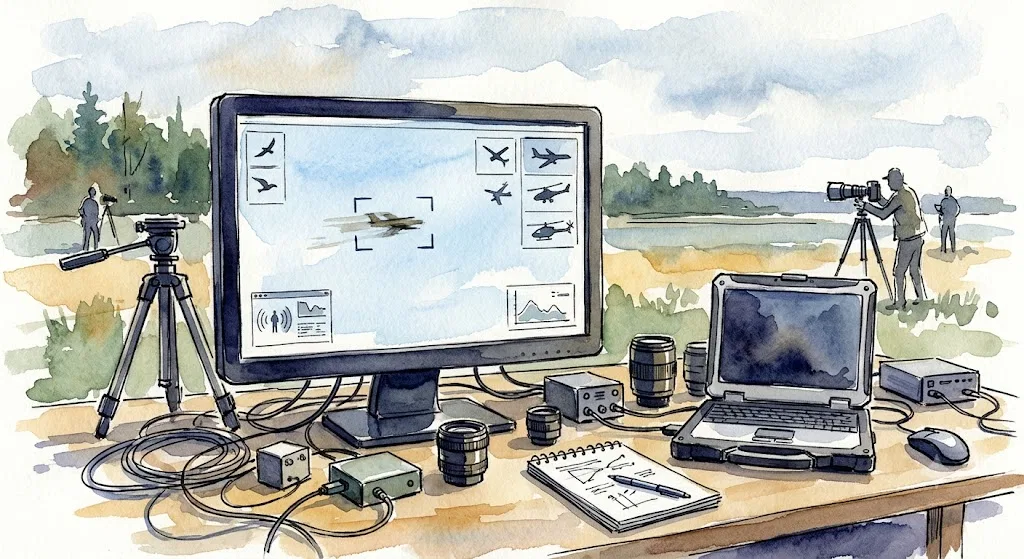
The first layer of a machine-vision sky watcher is usually not “identify the UFO”. It is “notice something moving and keep following it”. In many systems, software marks a region of interest around a moving target, draws a bounding box, then updates that box as the object crosses the frame. This is a simple idea with difficult edge cases: a bird may flutter, an aircraft may blink, leaves may sway, insects may pass near the lens, and a distant object may occupy only a few pixels.
UFODAP describes this mechanism in practical terms. Its optical tracking and data acquisition unit detects and tracks an object as it moves into a bounding-box area, then shrinks the box around the target to avoid being distracted by background objects. The same system says it uses automatic processes to reduce false triggers from flickering stars, birds and moving foliage, and at night samples the background sky to decide what to ignore during runtime.[UFODAP]ufodap.comDap Camera, Science and TechnologyA number of automatic processes reduce the possibility of triggering recording on false positives, such…
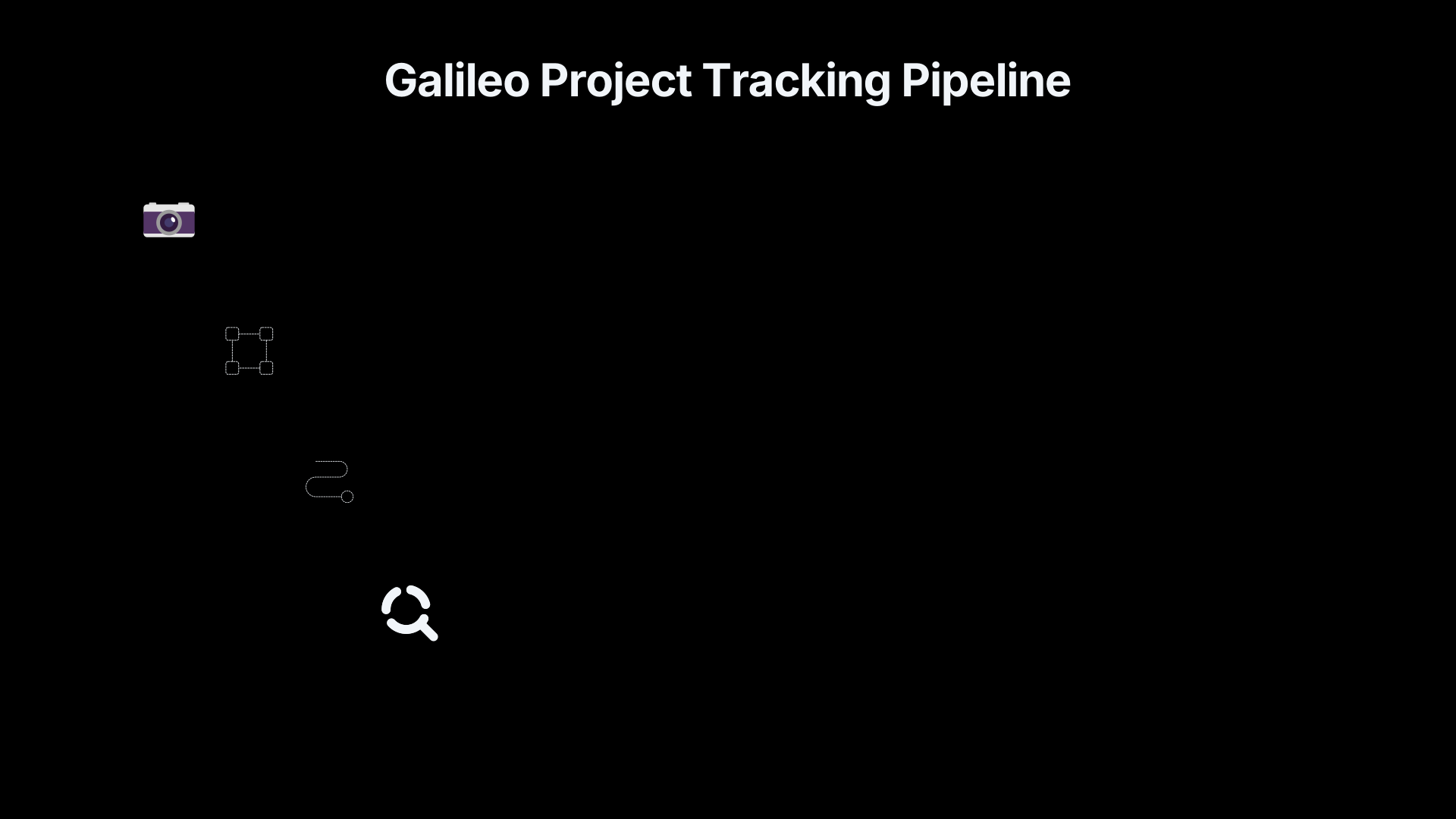
The Galileo Project’s published camera work gives a more research-grade version of the same pattern. Its infrared array uses eight long-wave infrared FLIR Boson 640 cameras and processes detections with YOLOv5, a version of the “You Only Look Once” object-detection family, followed by SORT, a real-time tracking algorithm. In plain language, YOLO proposes boxes around objects in images, while SORT links detections across frames into tracks. The original YOLO paper framed object detection as predicting bounding boxes and class probabilities from full images in one pass, while the SORT paper showed that fast multi-object tracking can be built from detector outputs, Kalman filtering and frame-to-frame association.[MDPI+2arXiv]mdpi.comCommissioning an All-Sky Infrared Camera Array for…by L Domine · 2025 · Cited by 11 — Using a You Only Look Once (YOLO) machine le…
That pairing is attractive for automated UAP stations because it is fast enough for continuous monitoring. The trade-off is that fast detection is not the same as confident identification. The Galileo commissioning paper reports that its model can detect many true objects while still producing false positives, and that a later “toy” outlier search based on unusually sinuous two-dimensional tracks flagged about 16% of trajectories before manual review reduced the ambiguous set to 144. Those remaining cases were considered likely mundane, but not fully explainable at that development stage without better distance, kinematics or other sensor data.[arXiv]arxiv.orgOpen source on arxiv.org.
This is exactly the level at which machine vision is most useful in automated UFO detection: not as a final judge of origin, but as a disciplined event sorter. It can say, “this moved; this track persisted; this path looks like a candidate; this one resembles a known category; this one deserves review”.
Labelling Obvious Aircraft and Birds
Aircraft are the most important “false UFO” class because they are common, bright, structured and often surprising to casual observers. A detector that cannot filter normal aircraft traffic will drown its reviewer in clips. The strongest systems therefore combine visual tracking with external aircraft information, especially ADS-B, the broadcast data many aircraft transmit with position and identity information.
The Galileo Project’s infrared-camera commissioning work used synchronised ADS-B data both for calibration and for generating a real-world aircraft dataset. The paper reports a method for extrinsic calibration using airplane positions from ADS-B collected on site, then uses real-world ADS-B-derived data, synthetic trajectories and hand-labelled images to evaluate detection performance over five months.[arXiv]arxiv.orgOpen source on arxiv.org.
That matters because an aircraft label should not rest only on what a blob looks like. A distant aircraft can appear as a point, a short streak, a blinking light or a warm shape in infrared. Matching a visual track against ADS-B gives the software a way to say: this object was where a known aircraft should have been. In a wider UAP workflow, that does not solve every case, because not all aircraft broadcast ADS-B and not all tracks are easy to associate. But it turns a large class of ordinary alarms into documented exclusions.
Birds are harder in a different way. They are small, deformable, numerous and often erratic. They can look anomalous when they are out of focus, close to the camera, seen in infrared, or crossing the frame quickly. AARO’s official imagery page includes a case from Africa in 2023 that was resolved as migratory birds after initially being submitted as a UAP report from an infrared sensor, illustrating why bird filtering is not just a hobbyist concern but a real issue in formal UAP review.[AARO]aaro.milOpen source on aaro.mil.
Bird-detection research shows why a single still frame is often inadequate. A 2023 flying-bird detection paper describes the problem as one of small size, low signal-to-noise ratio and weak single-frame features, then uses motion information across adjacent frames to improve detection. Another panoramic-video bird-tracking study focuses specifically on small, fast birds, where both detection and association across frames become difficult.[arXiv]arxiv.orgOpen source on arxiv.org.
For UFO detectors, the lesson is straightforward: a bird filter should pay attention to motion, scale, shape change and track behaviour, not just a one-frame label. A bird close to the lens may cross the sky faster than a distant aircraft. A flock may split into several moving targets. A gliding bird may look steadier than expected. Machine vision can catch many of these patterns, but only after being trained and tested on ordinary sky footage from the same kind of camera, lens, weather and location.
Foliage Is a Sky Alarm Too
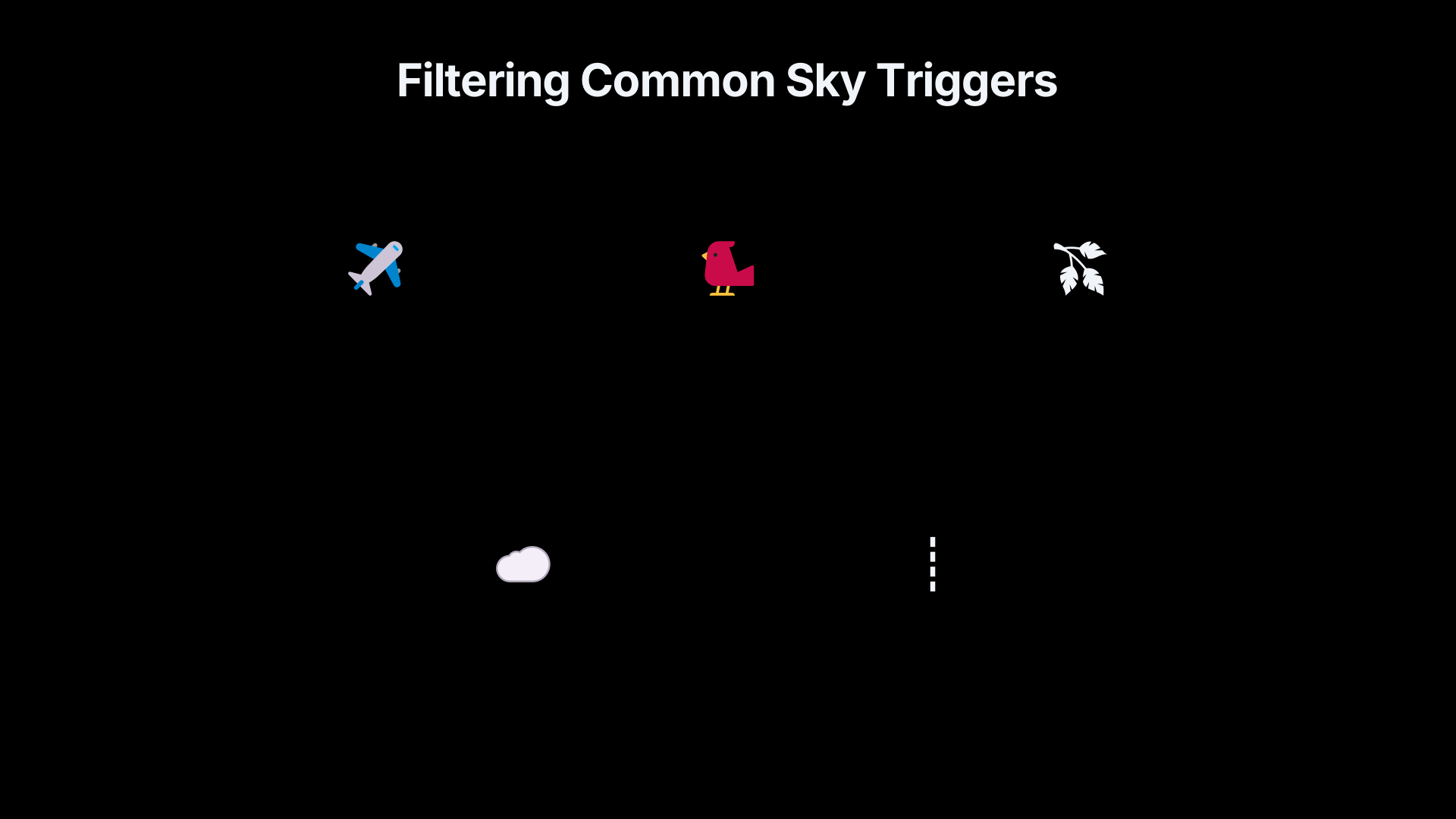
Moving foliage sounds trivial until a detector is left running all day. A camera pointed at the sky often includes treetops, rooflines, wires, masts or vegetation at the edge of the frame. Wind turns those static background features into motion. Sunlight can change contrast. Thermal cameras can see heated surfaces shift in intensity. A naïve motion detector will happily record every branch, leaf shimmer or shadow flicker.
This is why background modelling remains important even in systems that also use neural networks. Classical techniques such as background subtraction compare the current frame with an expected background image and flag the difference. They are well suited to fixed cameras but fragile when the background itself changes. A bird-detection system design from KTH explicitly included trees, clouds, windmill blades and birds as categories to be separated using grayscale background subtraction, which shows how closely “real target” and “moving background” problems overlap in sky-facing video.[Diva Portal]diva-portal.orgDiva Portal Bird Detection SystemDiva Portal Bird Detection System
Thermal imagery adds another trap. In long-wave infrared bird-detection work, researchers note that false positives can arise from differing absorption and emissivity of materials; in one example, grass heated unevenly by the sun produced a false detection even though the scene looked effectively unchanged to a human viewer. For a UAP detector, that kind of effect matters because a warm, changing patch near the horizon or frame edge can be treated as motion unless the software understands the local background.[MDPI]mdpi.com2313 433X2313 433X
Practical foliage filtering therefore needs several safeguards working together:
- Masking: exclude known problem zones such as treetops, roof edges and nearby poles where possible.
- Background learning: update the expected background slowly, so normal swaying or flicker is not treated as a new aerial object every time.
- Track quality checks: reject detections that do not form coherent motion across the open sky.
- Sensor placement: reduce the problem at source by choosing camera views with minimal foreground clutter.
The last point is easy to overlook. A clever model can reduce false triggers, but a badly placed camera gives the model a harder job than necessary.
Why Automated Labels Still Need Caution
The central caution is that a machine-vision label is a probability, not a fact. “Aircraft”, “bird” or “unknown” is the output of a model trained on particular data, under particular lighting, weather, sensor and viewing conditions. Change the camera, lens, exposure, sky background or local wildlife, and performance can change.
NASA’s 2023 UAP independent study report makes the broader version of this point: the field needs high-quality, calibrated data, and artificial intelligence or machine learning is useful only when there is suitable data to analyse. The report argues for better sensors, metadata and data standards rather than treating AI as a magic shortcut.[NASA Science]science.nasa.govScience Independent Study Team ReportScience Independent Study Team Report
The 2021 ODNI preliminary assessment made a similar point about pattern recognition. It said machine learning could become useful as databases accumulate examples of known objects such as balloons, wildlife and other aerial items, allowing future reports to be pre-assessed against similar events. That is a conservative use of machine learning: not “the computer found aliens”, but “the computer found that this resembles a known class of ordinary event”.[Director of National Intelligence]dni.govOpen source on dni.gov.
Published field work also shows the limits. UAPx’s first field expedition reported practical difficulties with its software and hardware integration, including criticisms of object tracking and identification reliability in the UFODAP setup used during that expedition. The team’s paper is valuable because it is candid about failures as well as findings: in real outdoor conditions, a sky detector has to contend with incomplete metadata, imperfect triggers, and ambiguous events that may require later manual analysis.[arXiv]arxiv.orgOpen source on arxiv.org.
The Galileo Project’s half-million-trajectory commissioning dataset is a useful benchmark for how to be careful. The system reconstructed around 500,000 aerial-object trajectories over five months, used an outlier search to flag unusual tracks, then manually reviewed candidates and treated the remaining ambiguous cases as likely mundane but unresolved at that stage. That is a healthier model than either overclaiming every anomaly or dismissing every odd-looking track without evidence.[arXiv]arxiv.orgOpen source on arxiv.org.
What a Good False-Alarm Filter Should Prove
A useful machine-vision filter for automated UFO detectors should be judged less by whether it produces exciting clips and more by whether it can survive boring tests. The essential test set is not only dramatic unknowns; it is aircraft, birds, foliage, clouds, insects, satellites, balloons, lens artefacts and weather under different lighting conditions.
For aircraft, the filter should show how often it correctly associates visual tracks with known flight data, and where it fails: low elevation, poor weather, missing ADS-B, overlapping tracks, glare or distant point sources. For birds, it should be tested on local species, flocks, close fly-bys and infrared imagery, not only on clean benchmark images. For foliage, it should be tested on windy days, changing sunlight, thermal backgrounds and camera views with partial obstructions.
The most credible systems also preserve the evidence trail. A label should be stored with the raw or near-raw clip, time stamp, camera settings, pointing geometry, weather, ADS-B context and any other sensor data. That way, a reviewer can challenge the label later. If the software says “bird”, the record should still allow a human to ask why.
In automated instrumented UFO detection, machine vision is therefore best understood as a disciplined reduction layer. It makes continuous sky watching manageable by removing obvious aircraft, birds and foliage-triggered clips from the front of the queue. Its real value is not certainty. Its value is that the remaining “unknown” cases become fewer, better documented and easier to test against ordinary explanations.
Amazon book picks
Further Reading
Books and field guides related to Can Software Spot False UFO Alarms?. Use these as the next step if you want deeper reading beyond the article.
Deep Learning
Rating: 3.5/5 from 6 Google Books ratings
Explains neural networks used in image classification.
Artificial Intelligence
Rating: 4.5/5 from 10 Google Books ratings
Provides broader context for automated decision systems.


Programming Computer Vision With Python
Useful for practical computer vision workflows.
eBay marketplace picks
Marketplace Samples
Live-tested eBay searches with available results related to this page.


Endnotes
1.
Source: mdpi.com
Link:https://www.mdpi.com/1424-8220/25/3/783
Source snippet
Commissioning an All-Sky Infrared Camera Array for...by L Domine · 2025 · Cited by 11 — Using a You Only Look Once (YOLO) machine le...
2.
Source: arxiv.org
Link:https://arxiv.org/abs/2411.07956
3.
Source: ufodap.com
Link:https://ufodap.com/technology
Source snippet
Dap Camera, Science and TechnologyA number of automatic processes reduce the possibility of triggering recording on false positives, such...
4.
Source: arxiv.org
Title: arXiv You Only Look Once: Unified, Real-Time Object Detection
Link:https://arxiv.org/abs/1506.02640
5.
Source: arxiv.org
Title: arXiv Simple Online and Realtime Tracking
Link:https://arxiv.org/abs/1602.00763
6.
Source: arxiv.org
Link:https://arxiv.org/html/2411.07956v1
7.
Source: aaro.mil
Link:https://www.aaro.mil/UAP-Cases/Official-UAP-Imagery/
8.
Source: arxiv.org
Link:https://arxiv.org/abs/2301.01917
9.
Source: arxiv.org
Link:https://arxiv.org/abs/2405.17323
10.
Source: diva-portal.org
Title: Diva Portal Bird Detection System
Link:https://www.diva-portal.org/smash/get/diva2%3A1653806/FULLTEXT02
11.
Source: mdpi.com
Title: 2313 433X
Link:https://www.mdpi.com/2313-433X/7/12/272
12.
Source: science.nasa.gov
Title: Science Independent Study Team Report
Link:https://science.nasa.gov/wp-content/uploads/2023/09/uap-independent-study-team-final-report.pdf
13.
Source: nasa.gov
Title: update nasa shares uap independent study report names director
Link:https://www.nasa.gov/news-release/update-nasa-shares-uap-independent-study-report-names-director/
14.
Source: arxiv.org
Link:https://arxiv.org/html/2312.00558v4
15.
Source: arxiv.org
Link:https://arxiv.org/abs/2312.00558
16.
Source: mdpi.com
Link:https://www.mdpi.com/2076-3417/13/13/7787
17.
Source: mdpi.com
Link:https://www.mdpi.com/2079-9292/14/19/3831
18.
Source: mdpi.com
Link:https://www.mdpi.com/2079-9292/14/17/3536
19.
Source: arxiv.org
Link:https://arxiv.org/html/2506.04048v1
20.
Source: arxiv.org
Link:https://arxiv.org/html/2508.18136v1
21.
Source: arxiv.org
Link:https://arxiv.org/html/2403.12573v1
22.
Source: arxiv.org
Link:https://arxiv.org/html/2601.08319v1
23.
Source: arxiv.org
Link:https://arxiv.org/html/2411.02401v1
24.
Source: arxiv.org
Link:https://arxiv.org/pdf/1506.02640
25.
Source: ntrs.nasa.gov
Title: JAIS Detection and Tracking of Aircraft Systems R1b4
Link:https://ntrs.nasa.gov/api/citations/20210010503/downloads/JAIS%20Detection%20and%20Tracking%20of%20Aircraft%20%20Systems%20R1b4.pdf
26.
Source: science.nasa.gov
Link:https://science.nasa.gov/uap/
27.
Source: ufodap.com
Title: UFODA P
Link:https://ufodap.com/
28.
Source: dni.gov
Link:https://www.dni.gov/files/ODNI/documents/assessments/Prelimary-Assessment-UAP-20210625.pdf
29.
Source: ui.adsabs.harvard.edu
Link:https://ui.adsabs.harvard.edu/abs/arXiv%3A2301.01917
30.
Source: ui.adsabs.harvard.edu
Link:https://ui.adsabs.harvard.edu/abs/arXiv%3A2411.07956
31.
Source: trackers.roboflow.com
Link:https://trackers.roboflow.com/latest/trackers/sort/
32.
Source: Wikipedia
Title: The Galileo Project
Link:https://en.wikipedia.org/wiki/The_Galileo_Project
Additional References
33.
Source: youtube.com
Title: Inventor says his new [radar]({{ ‘radar/’ | relative_url }}) network could spot UAPs | Reality Check
Link:https://www.youtube.com/watch?v=mwsEatnZ358
Source snippet
YOLOv8-Based Object Detection from UAV Aerial Imagery | Computer Vision & Artificial Intelligence...
34.
Source: youtube.com
Title: Real-Time Detection & Tracking With YOLO | Real Traffic Project (Part 1)
Link:https://www.youtube.com/watch?v=By7EyE-WsxI
Source snippet
The UFO Data Acquisition Project UFODAP | Ronald Olch...
35.
Source: youtube.com
Title: The UFO Data Acquisition Project UFODAP | Ronald Olch
Link:https://www.youtube.com/watch?v=6bDGoVNyvh8
Source snippet
Inventor says his new radar network could spot UAPs | Reality Check...
36.
Source: youtube.com
Title: Bird’s Eye View Traffic Analysis with YOLO26
Link:https://www.youtube.com/watch?v=jlfMyvnxdh0
Source snippet
Real-Time Detection & Tracking With YOLO | Real Traffic Project (Part 1)...
37.
Source: researchgate.net
Link:https://www.researchgate.net/publication/294823923_Evaluation_of_the_DTBird_video-system_at_the_Smola_wind-power_plant_Detection_capabilities_for_capturing_near-turbine_avian_behaviour
38.
Source: academia.edu
Link:https://www.academia.edu/48839724/Real_Time_Object_Detection_using_YOLO_A_review
39.
Source: researchgate.net
Link:https://www.researchgate.net/publication/340562522_Automatic_Identification_of_Flying_Bird_Species_Using_Computer_Vision_Technique_for_Ecological_Data_Analysis
40.
Source: researchgate.net
Link:https://www.researchgate.net/publication/371163445_The_Scientific_Investigation_of_Unidentified_Aerial_Phenomena_UAP_Using_Multimodal_Ground-Based_Observatories
41.
Source: researchgate.net
Link:https://www.researchgate.net/publication/382636106_Automated_Detection_of_Satellite_Trails_in_Ground-Based_Observations_Using_U-Net_and_Hough_Transform
42.
Source: researchgate.net
Link:https://www.researchgate.net/publication/388466760_Commissioning_an_All-Sky_Infrared_Camera_Array_for_Detection_of_Airborne_Objects
Topic Tree
Follow this branch
Parent topic
Sky DetectorsRelated pages 29
- Bird Motion Why Birds Are Harder Than They Look
- Foliage Alerts The Tree That Keeps Reporting UFOs
- Human Review Why the Software Should Not Be the Judge
- In An Automated Instrumented UFO Detector, Aircraft Why a Plane Can Still Look Unknown
- Thermal Traps When Heat Looks Like a Moving Object
- +1 more in sidebar