Within Starlink
Why Pilots Report Starlink as UAP
Low-angle Starlink glints can appear to blink, race, or reappear in ways that are especially confusing from cockpit windows.
On this page
- Why cockpit geometry changes the sighting
- How low horizon flares mimic motion
- What flight data can test afterward
Page outline Jump by section
Introduction
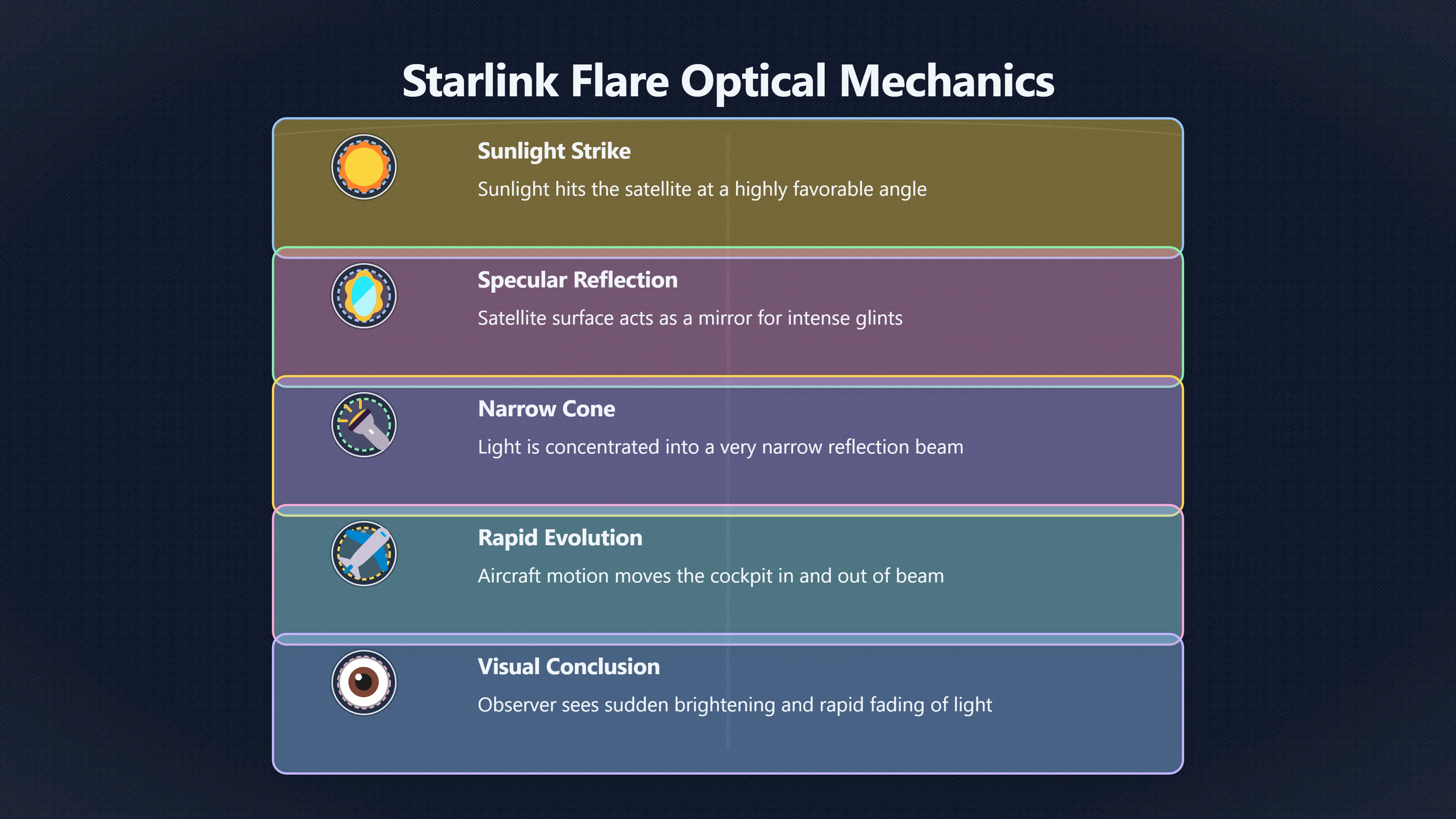
Low-horizon Starlink flares are among the most convincing ways ordinary satellites can be mistaken for unidentified aerial phenomena (UAP) from an aircraft cockpit. Unlike the familiar overhead passage of a faint satellite, these events occur when a Starlink spacecraft sits low above the horizon while sunlight strikes it at a highly favourable angle. The result can be an intense flash that appears to blink on and off, brighten suddenly, or seem to move in unexpected ways. For airline crews flying at night over dark oceans or sparsely lit terrain, where there are few visual references, these effects can be especially misleading. For automated, instrumented UFO detection systems, pilot reports of such events illustrate why optical observations alone are insufficient without satellite tracking, aircraft position data and geometric reconstruction.[AARO]aaro.milAARO Satellite Flaring Paper 508 FINAL 04222025Specular reflection from…Read more…
Why cockpit geometry changes the sighting
The cockpit offers a viewing geometry that differs substantially from that of an observer on the ground. Airline crews typically cruise between 30,000 and 40,000 feet, extending their horizon by hundreds of kilometres. This wider horizon allows pilots to see satellites under viewing angles unavailable to most ground observers, particularly during astronomical twilight when satellites remain sunlit even though the aircraft is flying through darkness.[AARO]aaro.milAARO Satellite Flaring Paper 508 FINAL 04222025Specular reflection from…Read more…
A second factor is orientation. Pilots spend long periods looking towards the horizon rather than overhead because that is where weather, traffic and navigation cues naturally appear. The geometry responsible for the brightest Starlink flares also favours low elevation angles in the direction of the Sun’s azimuth, even when the Sun itself is well below the horizon. Mallama and Cole found that extremely bright reflections occur when the off-specular angle—the difference between perfect mirror reflection and the observer’s line of sight—is exceptionally small. Under these conditions, the normally diffuse appearance of a satellite changes into an intense mirror-like glint.[arXiv]arxiv.orgarXiv Extreme Flaring of Starlink SatellitesarXiv Extreme Flaring of Starlink Satellites
Because aircraft are moving rapidly, the viewing geometry evolves continuously. A slight change in aircraft heading or position can move the cockpit into or out of the narrow reflection cone within seconds, making the light appear to switch on abruptly, disappear, and sometimes reappear.
How low-horizon flares mimic motion
The most confusing aspect of these sightings is not simply their brightness but their apparent behaviour.
Several visual effects combine:
- Sudden appearance. A satellite invisible for most of its pass can brighten dramatically once the reflection geometry becomes favourable.
- Rapid fading. The same reflection disappears almost immediately after the aircraft leaves the narrow specular beam.
- Apparent blinking. Multiple nearby satellites can flare sequentially, giving the impression that one object is flashing or changing position.
- Illusion of acceleration. With no depth cues against a dark sky, a distant satellite crossing the horizon can appear to race laterally even though its angular motion remains smooth.
- Perceived manoeuvring. Aircraft motion changes the observer’s viewpoint, producing parallax-like impressions that can make stationary orbital motion appear to curve or reverse relative to the cockpit window.[AARO]aaro.milAARO Satellite Flaring Paper 508 FINAL 04222025Specular reflection from…Read more…
These effects are strongest when observers cannot estimate distance. A bright point source against a featureless night sky provides almost no information about whether the object is hundreds of metres away or hundreds of kilometres away. Human perception therefore tends to interpret changes in brightness as changes in motion or range.
Why pilots are especially susceptible
Commercial pilots are experienced observers, but their expertise does not eliminate the limitations imposed by human vision under unusual conditions.
Several operational factors increase the likelihood of confusion:
- Night adaptation makes brief bright flashes particularly conspicuous.
- Cockpit windscreens introduce reflections, scattering and small optical distortions.
- Crews are simultaneously monitoring instruments, weather and traffic rather than conducting controlled astronomical observations.
- Over oceans or deserts there may be no fixed landmarks against which to judge motion.
- Flight crews rarely have immediate access to real-time satellite ephemerides during an unexpected sighting.
The result is not poor observation but incomplete context. A pilot can accurately report a sequence of bright lights while reasonably concluding that they behave unlike familiar aircraft or stars, even when orbital reconstruction later shows the source was a satellite flare.[Sky & Telescope]skyandtelescope.orgstarlink flares can fool anyone even airline pilotsSky & TelescopeStarlink Flares Can Fool Anyone — Even Airline Pilots10 Jun 2024 — The flare from numerous Starlink satellites, launched b…
AARO has highlighted this distinction by noting that some aviation reports correlate well with Starlink launch timing and satellite geometry, illustrating that reliable witnesses can still encounter unfamiliar optical phenomena.[AARO]aaro.milCorrelations of Starlink Satellite Flaring with UAPCorrelations of Starlink Satellite Flaring with UAP…January 24, 2025 — by A An · 2024 — AARO received a Federal Aviation Administr…
A concrete example from commercial aviation
One of the best-studied examples involved commercial airline crews flying over the Pacific during August 2022. Multiple pilots on separate aircraft reported unusually bright lights that appeared to move in coordinated patterns and were initially treated as potential UAP.
Subsequent reconstruction combined:
- aircraft ADS-B flight tracks,
- Starlink orbital elements,
- launch timing,
- cockpit viewing geometry, and
- satellite brightness modelling.
Researchers concluded that a recently launched Starlink train occupied precisely the portion of sky reported by the crews. Later work by Mallama and Cole demonstrated that the satellites’ brightness could reach approximately visual magnitude –4 to –5 under the observed geometry, easily explaining why the lights appeared far brighter than ordinary satellites. Rather than requiring unusual manoeuvres, the observations were consistent with sequential extreme flares from satellites moving along predictable orbital paths.[arXiv+2arXiv]arxiv.orgarXiv Extreme Flaring of Starlink SatellitesarXiv Extreme Flaring of Starlink Satellites
The importance of this case lies less in explaining one report than in demonstrating that multiple independent witnesses can all experience the same optical illusion under identical viewing geometry.
What flight data can test afterward
Low-horizon flare reports become much easier to evaluate when independent measurements accompany the visual observation.
The most useful datasets include:
- Aircraft position and heading. ADS-B or flight recorder data establish the observer’s exact location and viewing direction.
- Time to the second. Specular reflections are highly geometry-dependent, so accurate timing is essential.
- Satellite ephemerides. Two-Line Element (TLE) orbital data allow reconstruction of Starlink positions during the event.
- Solar geometry. The Sun’s depression angle below the horizon determines whether satellites remain illuminated.
- Camera imagery. Even imperfect cockpit photographs can constrain brightness and angular position.
- Multiple aircraft reports. Independent observations from different locations help distinguish distant orbital objects from nearby atmospheric phenomena.[AARO]aaro.milAARO Satellite Flaring Paper 508 FINAL 04222025Specular reflection from…Read more…
For automated instrumented UFO detectors, this means that an optical anomaly should not be classified from imagery alone. Cross-checking against orbital catalogues, aircraft navigation data and illumination models is often sufficient to determine whether a seemingly extraordinary observation is consistent with predictable satellite reflections.
Why this matters for automated UAP detection
Low-horizon Starlink flares expose a weakness shared by both humans and automated systems: neither can reliably infer distance, size or intent from a single bright point of light.
An instrument that records only brightness over time may classify a flare as an object that accelerates, disappears and reappears. A human observer may describe the same sequence as intelligent manoeuvring. Yet when orbital mechanics, aircraft motion and solar illumination are reconstructed together, the event may fit an ordinary satellite passing through a narrow reflection geometry.
For automated UAP detection, the practical lesson is straightforward. Any system intended to identify genuinely anomalous aerial events should incorporate current satellite ephemerides, accurate aircraft or sensor position, solar illumination modelling and multi-sensor correlation before treating low-horizon flashing lights as unexplained. Without those contextual layers, one of the most common false positives in the modern night sky can closely resemble exactly the kind of anomaly the system is designed to detect.[AARO+2arXiv]aaro.milAARO Satellite Flaring Paper 508 FINAL 04222025Specular reflection from…Read more…
Amazon book picks
Further Reading
Books and field guides related to Why Pilots Report Starlink as UAP. Use these as the next step if you want deeper reading beyond the article.
Satellite Orbits
Explains orbital geometry and observation conditions that underlie Starlink flare sightings from aircraft.

UFOs : Generals, Pilots, and Government Officials Go on the R...
Provides context for why pilot observations of unusual aerial phenomena receive attention while encouraging critical evaluation.
Fundamentals of Astrodynamics
Rating: 4.5/5 from 12 Google Books ratings
Helps readers understand orbital mechanics that govern satellite positions and apparent motion.
Introduction to Flight
Covers aircraft operating environments and viewing geometry relevant to pilot observations.
eBay marketplace picks
Marketplace Samples
Example marketplace items related to this page. Use the search link to explore similar finds on eBay.

Endnotes
1.
Source: aaro.mil
Title: AARO Satellite Flaring Paper 508 FINAL 04222025
Link:https://www.aaro.mil/Portals/136/PDFs/Information%20Papers/AARO_Satellite_Flaring_Paper_508_FINAL_04222025.pdf
Source snippet
Specular reflection from...Read more...
2.
Source: arxiv.org
Title: arXiv Extreme Flaring of [Starlink Satellites]({{ ‘starlink/’ | relative_url }})
Link:https://arxiv.org/abs/2405.13091
3.
Source: aaro.mil
Title: Correlations of Starlink Satellite Flaring with UAP
Link:https://www.aaro.mil/Portals/136/PDFs/Information%20Papers/AARO_Satellite_Flaring_Paper.pdf
Source snippet
Correlations of Starlink Satellite Flaring with UAP...January 24, 2025 — by A An · 2024 — AARO received a Federal Aviation Administr...
Published: January 24, 2025
4.
Source: arxiv.org
Link:https://arxiv.org/pdf/2405.13091
Source snippet
Extreme Flaring of Starlink Satellitesby A Mallama · 2024 · Cited by 2 — This paper reports on extreme flares of many magnitudes that occ...
5.
Source: arxiv.org
Link:https://arxiv.org/abs/2507.00107
Source snippet
Cole satellites of the Starlink, BlueBird, Qianfan, Guowang and OneWeb constellations are reported...
6.
Source: arxiv.org
Link:https://arxiv.org/abs/2405.12007
Source snippet
The Brightness of Starlink Mini Satellites During Orbit-Raisingby A Mallama · 2024 —...
7.
Source: arxiv.org
Link:https://arxiv.org/pdf/2405.12007
Source snippet
Anthony Mallama*1, Richard E. Cole, Jay Respler1. Scott Harrington, Ron Lee...Read more...
8.
Source: starlink.com
Title: starlinkProgressReport 2025
Link:https://starlink.com/public-files/starlinkProgressReport_2025.pdf?srsltid=AfmBOopuOoQi7rYBF4nhy4wfn_B8CE2qp0BEuVAn4oQxFSKHHCdtv96A
Source snippet
ProgressReport_2025.pdf27 Jan 2026 — 2025. This year, SpaceX completed deployment of the first generation of the Starlink Direct...
9.
Source: skyandtelescope.org
Title: starlink flares can fool anyone even airline pilots
Link:https://skyandtelescope.org/astronomy-news/starlink-flares-can-fool-anyone-even-airline-pilots/
Source snippet
Sky & TelescopeStarlink Flares Can Fool Anyone — Even Airline Pilots10 Jun 2024 — The flare from numerous Starlink satellites, launched b...
Additional References
10.
Source: reddit.com
Link:https://www.reddit.com/r/UFOs/comments/1i9iqy3/aaro_paper_on_uap_starlink_flares/
Source snippet
AARO paper on UAP & Starlink Flares: r/UFOsAARO has published a paper detailing the phenomenon of Starlink flares that have been reporte...
11.
Source: facebook.com
Link:https://www.facebook.com/groups/2365809903441367/posts/6866734786682167/
Source snippet
Starlink flares study by pilot and air crash investigatorHere's a great study of starlink flares by pilot and air crash investigator Juan...
12.
Source: jglobal.jst.go.jp
Link:https://jglobal.jst.go.jp/en/public/202402221356811440
Source snippet
Flaring of Starlink Satellites | Article InformationExtreme Flaring of Starlink Satellites. This is a preprint. Author (2): Mallama Antho...
13.
Source: thedebrief.org
Link:https://thedebrief.org/spacex-starlink-extreme-flaring-increases-reported-uap-sightings-and-poses-aviation-risks-new-research-finds/
Source snippet
SpaceX Starlink "Extreme Flaring" Increases Reported...28 May 2024 — New research shows SpaceX's Starlink satellites can cause extreme f...
Published: May 2024
14.
Source: facebook.com
Link:https://www.facebook.com/groups/2365809903441367/posts/26893349406927409/
Source snippet
Some seven years ago I created the Starlink Satellite Observing Group. I can run simulations that show which Starlink satellites...
15.
Source: youtube.com
Link:https://www.youtube.com/watch?v=aWpeN3cU17Q
Source snippet
SpaceX's Starlink, [satellite flares]({{ 'satellite-flares/' | relative_url }}), and spectacular twilight...The geometry behind satellite flare and how you can see sunlight and ref...
16.
Source: universetoday.com
Title: starlinks can produce surprisingly bright flares to pilots
Link:https://www.universetoday.com/articles/starlinks-can-produce-surprisingly-bright-flares-to-pilots
Source snippet
27 May 2024 — For the study, the researchers conducted a geometrical analysis of the brightness of Starlink satellites based on the Sun's...
Published: May 2024
17.
Source: spaceweatherarchive.com
Link:https://spaceweatherarchive.com/2019/05/29/starlink-satellite-flares/
Source snippet
Starlink Satellite Flares (Part 1) - Spaceweather.com29 May 2019 — The Train is still worth catching, however, because the satellites are...
Published: May 2019
18.
Source: researchgate.net
Title: 380821064 Extreme Flaring of Starlink Satellites
Link:https://www.researchgate.net/publication/380821064_Extreme_Flaring_of_Starlink_Satellites
Source snippet
(PDF) Extreme Flaring of Starlink Satellites20 May 2024 — Extreme Flaring of Starlink Satellites Anthony Mallama1* and Richard E.Cole 202...
Published: May 2024
19.
Source: rev.com
Title: senate hearing on unidentified aerial phenomena
Link:https://www.rev.com/transcripts/senate-hearing-on-unidentified-aerial-phenomena
Source snippet
UAP UFO Senate Hearing Unidentified Aerial Phenomena23 Jan 2026 — The Senate holds a hearing on unidentified aerial phenomena, better kno...
Topic Tree