Within Parallax
Why the Sky Has No Ruler
Clouds, ocean surfaces, and empty sky can make an object look close even when its actual altitude or range is unknown.
On this page
- How clouds and sea create false depth cues
- Why infrared glare and zoom confuse size estimates
- How detectors can flag weak distance references
Page outline Jump by section
Introduction
When people watch an object against a featureless sky, a layer of clouds, or the open sea, they naturally try to estimate its distance by comparing it with the background. The problem is that these backgrounds are often poor distance references. A cloud may be a few hundred metres away or more than 10 kilometres away. A calm ocean provides almost no three-dimensional structure, while an empty blue sky offers virtually none at all. Without a reliable range reference, apparent size, speed and altitude become highly uncertain. For automated instrumented UFO detectors, this is not a minor observational nuisance but a central measurement problem. A single camera records where an object appears, not how far away it is. Unless additional information constrains range, dramatic-looking motion may simply reflect missing depth information rather than extraordinary flight behaviour.[AARO]aaro.milEffect of Forced Perspective and Parallax View on UAPAll-domain Anomaly Resolution Office (AARO). 1. An AARO Information Paper. Effect of Forced Perspective and Parallax View on UAP Observat…

Why the Sky Has No Ruler
Humans judge distance by combining many visual cues, including familiar object sizes, shadows, texture, perspective and overlapping objects. Most of these disappear during skywatching.
A small aircraft against a uniform blue sky may look surprisingly close because there are no nearby landmarks. Conversely, a balloon drifting many kilometres away may appear almost stationary because nothing reveals its true distance. Clouds often worsen the problem because observers instinctively treat them as a fixed background even though clouds themselves occupy a wide range of altitudes and move independently.
The ocean creates a similar illusion. Apart from the horizon, there are few stable reference points. An object seen above the sea may appear to skim the surface simply because the observer cannot accurately judge whether it lies hundreds of metres away or tens of kilometres away. This visual ambiguity was one of the geometric issues highlighted by the U.S. All-domain Anomaly Resolution Office (AARO) when discussing forced perspective and parallax in UAP observations.[AARO]aaro.milEffect of Forced Perspective and Parallax View on UAPAll-domain Anomaly Resolution Office (AARO). 1. An AARO Information Paper. Effect of Forced Perspective and Parallax View on UAP Observat…
How Clouds and Sea Create False Depth Cues
Clouds seem useful because they appear solid and textured, but they rarely provide dependable geometric references.
Several factors contribute:
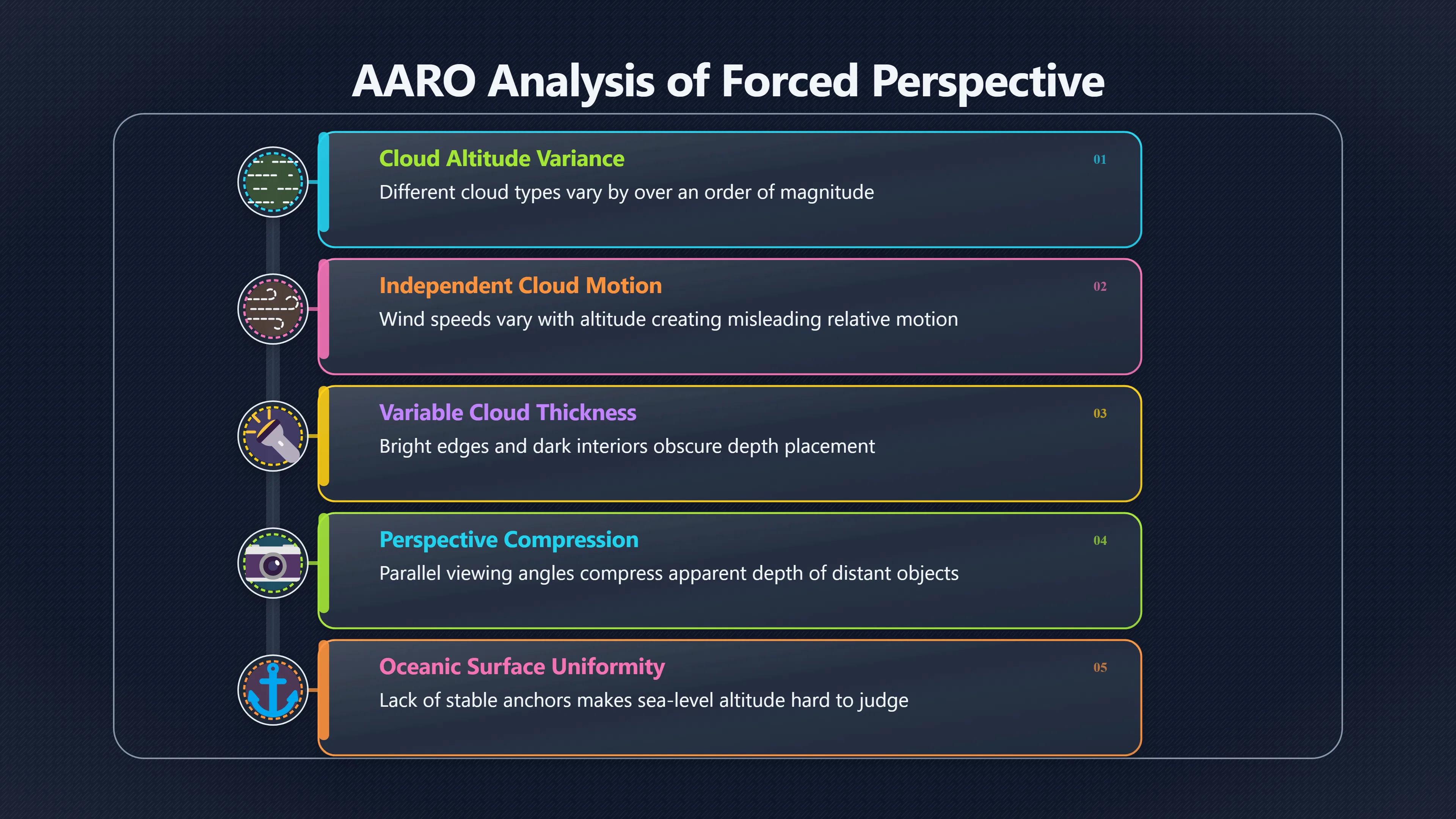
- Unknown cloud altitude. Low stratocumulus, mid-level altocumulus and high cirrus can differ in altitude by more than an order of magnitude while appearing adjacent from the observer’s viewpoint.
- Independent cloud motion. Wind speeds and directions frequently vary with altitude. A cloud layer moving differently from the observed object can create misleading impressions of relative motion.
- Variable cloud thickness. Bright cloud edges and darker interiors make it difficult to determine whether an object is in front of, within or behind the cloud.
- Perspective compression. Looking nearly parallel to a cloud layer compresses apparent depth, making distant objects appear embedded within the clouds.
The sea introduces different but equally important ambiguities.
Because the water surface is comparatively uniform, an airborne object lacks nearby visual anchors. Atmospheric haze near the horizon also reduces contrast, making distant objects appear lower than they really are. As a result, observers frequently overestimate how close an object is to the water and underestimate its true altitude. This effect has been discussed extensively in analyses of apparent high-speed UAP footage over the ocean, including AARO’s reconstruction of the well-known “Go Fast” case.[AARO]aaro.milEffect of Forced Perspective and Parallax View on UAPAll-domain Anomaly Resolution Office (AARO). 1. An AARO Information Paper. Effect of Forced Perspective and Parallax View on UAP Observat…

Why Infrared Glare and Zoom Confuse Size Estimates
Infrared imagery introduces additional pitfalls because apparent object size is often determined by sensor behaviour rather than physical dimensions.
Bright thermal sources may produce blooming or glare that enlarges the visible infrared signature beyond the object’s true outline. Atmospheric effects, detector characteristics and image processing can all alter the apparent diameter of a target. A glowing infrared spot therefore cannot automatically be interpreted as a physically large object.[Flir]flir.comThis makes IR cameras excellentCan Thermal Imaging See Through Fog and Rain?December 30, 2020 — 30 Dec 2020 — Thermal imaging cameras see in total darkness, produci…
Long focal-length zoom lenses create another problem. As magnification increases, the field of view narrows and the image loses surrounding context. Without visible landmarks, it becomes increasingly difficult to estimate range. Digital stabilisation and tracking systems can also keep a target centred while the observing platform continues moving, masking the contribution of the observer’s own motion to the apparent trajectory.
Together, infrared blooming, narrow fields of view and missing environmental references can make a distant aircraft, balloon or other ordinary target appear unusually large or unusually fast even when its actual motion is unremarkable. AARO specifically cautions that forced perspective and parallax can exaggerate apparent object size and velocity under these conditions.[AARO]aaro.milEffect of Forced Perspective and Parallax View on UAPAll-domain Anomaly Resolution Office (AARO). 1. An AARO Information Paper. Effect of Forced Perspective and Parallax View on UAP Observat…
How Automated Detectors Can Flag Weak Distance References
Automated instrumented UFO detection systems can reduce these ambiguities by evaluating the quality of the available distance information rather than assuming every detection supports reliable speed estimates.
Useful design features include:
- Background classification. Automatically identify whether the background consists primarily of open sky, cloud layers or ocean, then lower confidence in any range estimate derived from a single optical view.
- Cloud mapping. Use weather data, cloud-height products or multiple spectral bands to estimate cloud altitude instead of treating clouds as fixed scenery.[asdc.larc.nasa.gov]asdc.larc.nasa.govCAL_LID_L2_05kmCLay-Prov-V3-01Cloud-Aerosol Lidar and Infrared Pathfinder Satellite Observations (CALIPSO) was launched on April 28, 2006…
- Metadata integration. Combine camera orientation, observer position, aircraft telemetry, wind information and time synchronisation before estimating motion.
- Multi-sensor triangulation. Independent cameras separated by known distances can estimate range directly through geometry, removing much of the ambiguity that affects single-camera observations.
- Quality scoring. Record not only the detected object but also whether the scene contains sufficient reference features to support meaningful calculations of altitude or velocity.
Modern experimental sky-monitoring systems increasingly follow this philosophy. Rather than relying on a single video stream, they combine calibrated optical or infrared cameras with external information such as aircraft transponder data and carefully measured camera geometry to improve trajectory reconstruction and reduce false interpretations caused by poor depth cues.[MDPI]mdpi.comCommissioning an All-Sky Infrared Camera Array for…by L Domine · 2025 · Cited by 11 — One of the key instruments is an all-sky inf…

The Practical Lesson for UAP Analysis
Featureless backgrounds should be treated as missing information rather than neutral scenery. A spectacular-looking track across clouds, the sea or empty sky does not by itself establish extraordinary speed, acceleration or low-altitude flight.
For both human investigators and automated detection systems, the key question is not simply whether an object crossed the frame quickly, but whether the observation contained enough independent depth information to support a trustworthy estimate of range. When the answer is no, responsible analysis should lower confidence in any derived claims about size, altitude or performance instead of treating visual appearance as a direct measurement.[AARO+2Wexler]aaro.milEffect of Forced Perspective and Parallax View on UAPAll-domain Anomaly Resolution Office (AARO). 1. An AARO Information Paper. Effect of Forced Perspective and Parallax View on UAP Observat…
Amazon book picks
Further Reading
Books and field guides related to Why the Sky Has No Ruler. Use these as the next step if you want deeper reading beyond the article.
Multiple view geometry in computer vision
Shows how multiple viewpoints overcome missing range information.


eBay marketplace picks
Marketplace Samples
Live-tested eBay searches with available results related to this page.

Endnotes
1.
Source: aaro.mil
Title: Effect of Forced Perspective and Parallax View on UAP
Link:https://www.aaro.mil/Portals/136/PDFs/Information%20Papers/AARO_Effect_of_Forced_Perspective_and_Parallax_View_on_UAP_Observations_2024.pdf
Source snippet
All-domain Anomaly Resolution Office (AARO). 1. An AARO Information Paper. Effect of Forced Perspective and Parallax View on UAP Observat...
2.
Source: flir.com
Title: This makes IR cameras excellent
Link:https://www.flir.com/en-gb/discover/rd-science/can-thermal-imaging-see-through-fog-and-rain/
Source snippet
Can Thermal Imaging See Through Fog and Rain?December 30, 2020 — 30 Dec 2020 — Thermal imaging cameras see in total darkness, produci...
Published: December 30, 2020
3.
Source: asdc.larc.nasa.gov
Link:https://asdc.larc.nasa.gov/project/CALIPSO/CAL_LID_L2_05kmCLay-Prov-V3-01_V3-01
Source snippet
CAL_LID_L2_05kmCLay-Prov-V3-01Cloud-Aerosol Lidar and Infrared Pathfinder Satellite Observations (CALIPSO) was launched on April 28, 2006...
Published: April 28, 2006
4.
Source: mdpi.com
Link:https://www.mdpi.com/1424-8220/25/3/783
Source snippet
Commissioning an All-Sky Infrared Camera Array for...by L Domine · 2025 · Cited by 11 — One of the key instruments is an all-sky inf...
5.
Source: mdpi.com
Link:https://www.mdpi.com/1424-8220/22/23/9374
Source snippet
Parallax Inference for Robust Temporal Monocular Depth...by M Fonder · 2022 · Cited by 8 — In this paper, we present a new depth estimat...
6.
Source: wexler.free.fr
Title: gibson (1959) motion parallax as a determinant of perceived depth
Link:https://wexler.free.fr/library/files/gibson%20%281959%29%20motion%20parallax%20as%20a%20determinant%20of%20perceived%20depth.pdf
Source snippet
It is often.Read more...
Additional References
7.
Source: preprints.opticaopen.org
Link:https://preprints.opticaopen.org/articles/preprint/Comparison_of_plane-to-sky_contrast_and_detection_range_performance_in_the_visible_short-wave_infrared_mid-wave_infrared_and_long-wave_infrared_bands/25285402
Source snippet
of plane-to-sky contrast and detection range...by R Cavanaugh · 2024 · Cited by 4 — This study compares plane-to-sky contrast in the VIS...
8.
Source: researchgate.net
Link:https://www.researchgate.net/publication/330200888_Slew-to-Cue_Electro-Optical_and_Infrared_Sensor_Network_for_small_UAS_Detection_Tracking_and_Identification
Source snippet
All-sky camera system to narrow the size of EO/IR re-detection search space.Read more...
9.
Source: researchgate.net
Link:https://www.researchgate.net/publication/283167088_Investigation_on_Light_Effect_on_Spatial_Illusion_Resulting_from_Forced_Perspective
Source snippet
The original design has a series of skylights...Read more...
10.
Source: pubs.ssec.wisc.edu
Link:https://pubs.ssec.wisc.edu/research_Resources/publications/pdfs/SSECPUBS/SSEC_Publication_No_10_08_A1.pdf
Source snippet
IFOV size on cloud detection, clear sky fractions were determined by increasing the MODIS. IFOV from 1 km to larger groupings (e.g....Read...
11.
Source: 3dom.fbk.eu
Title: conference articles
Link:https://3dom.fbk.eu/publications/conference-articles
Source snippet
articlesSci., XLVIII-2/W8-2024, 335–342. Fol, C. R., Murtiyoso, A., Mazzacca, G., Saint-André, T., Remondino, F., Griess, V. C., 2024: La...
12.
Source: acp.copernicus.org
Link:https://acp.copernicus.org/articles/21/12273/2021/
Source snippet
the model representation of clouds based on...by S Geiss · 2021 · Cited by 26 — In this study, the benefits of using both visible and in...
13.
Source: amt.copernicus.org
Link:https://amt.copernicus.org/articles/17/1851/2024/
Source snippet
of clouds and aerosols on downwelling surface solar...by K Papachristopoulou · 2024 · Cited by 33 — In this study, we introduce improvem...
14.
Source: scholar.google.com
Link:https://scholar.google.com/citations?citation_for_view=pMT5lrwAAAAJ%3AVno172sVVMwC&hl=en&user=pMT5lrwAAAAJ&view_op=view_citation
Source snippet
google.com[https://scholar.google.com/citations?view_op=view_...No](https://scholar.google.com/citations?view_op=view_...No) information is available for this page...
15.
Source: arxiv.org
Link:https://arxiv.org/html/2411.02401v1
Source snippet
A Civilian Astronomer's Guide to UAP Research5 Nov 2024 — All-domain Anomaly Resolution Office (AARO), 2024, “Effect of Forced Perspectiv...
16.
Source: pmc.ncbi.nlm.nih.gov
Link:https://pmc.ncbi.nlm.nih.gov/articles/PMC4568659/
Source snippet
coding underlying the cue preference for celestial...by B el Jundi · 2015 · Cited by 192 — We combined behavioral experiments with physi...
Topic Tree