Within Open Data
Why the Clip Is Not the Evidence
Edited or compressed UAP videos can hide the details needed to separate real motion from birds, insects, optics, and software artefacts.
On this page
- What compression and editing remove
- Common false positives hidden by video alone
- When near raw release is enough for review
Page outline Jump by section
Introduction
A striking UAP clip may be compelling to watch, but it is rarely the evidence that investigators need. For automated instrumented UFO detector systems, the scientific value lies in the original sensor record, not in a compressed or edited video prepared for public viewing. Modern video compression removes information, smooths detail, predicts motion between frames and introduces its own visual artefacts. Editing can remove the moments before and after an event, strip away metadata and hide the processing history needed to determine whether an apparent anomaly is a genuine object, an optical effect or a software artefact. As a result, a dramatic clip can be useful for public discussion while remaining inadequate for scientific replication or independent verification.[NASA Science]science.nasa.govwill enable the elimination of false positives due to sensor artifacts.Read moreNASA ScienceIndependent Study Team ReportSeptember 13, 2023 — The cavitation is likely a sensor artifact resulting from video compression…

Why the clip is not the evidence
Automated detection systems are designed to measure physical events, not merely to produce visually impressive footage. A detector records a chain of information: individual image frames or sensor samples, timestamps, camera settings, pointing direction, calibration data and often parallel measurements from other sensors. Once a video is compressed for distribution, much of that chain is weakened or lost.
Most consumer and professional codecs, including H.264 and H.265, achieve dramatic reductions in file size by exploiting similarities between successive frames. Rather than storing every frame independently, they predict motion, discard information judged unlikely to be noticed by viewers and reconstruct an approximation during playback. This approach is excellent for efficient video delivery, but it means the distributed file is no longer an exact representation of what the sensor recorded.[NASA Technical Reports Server]ntrs.nasa.govNASA Technical Reports ServerVideo Compression Study h.265 vs h.264by J Pryor · 2016 — Compression methods such as h.264 and h.265 use pr…
For ordinary filmmaking this compromise is acceptable. For anomaly investigation it can remove precisely the subtle details needed to distinguish an unusual observation from a mundane explanation.
What compression and editing remove
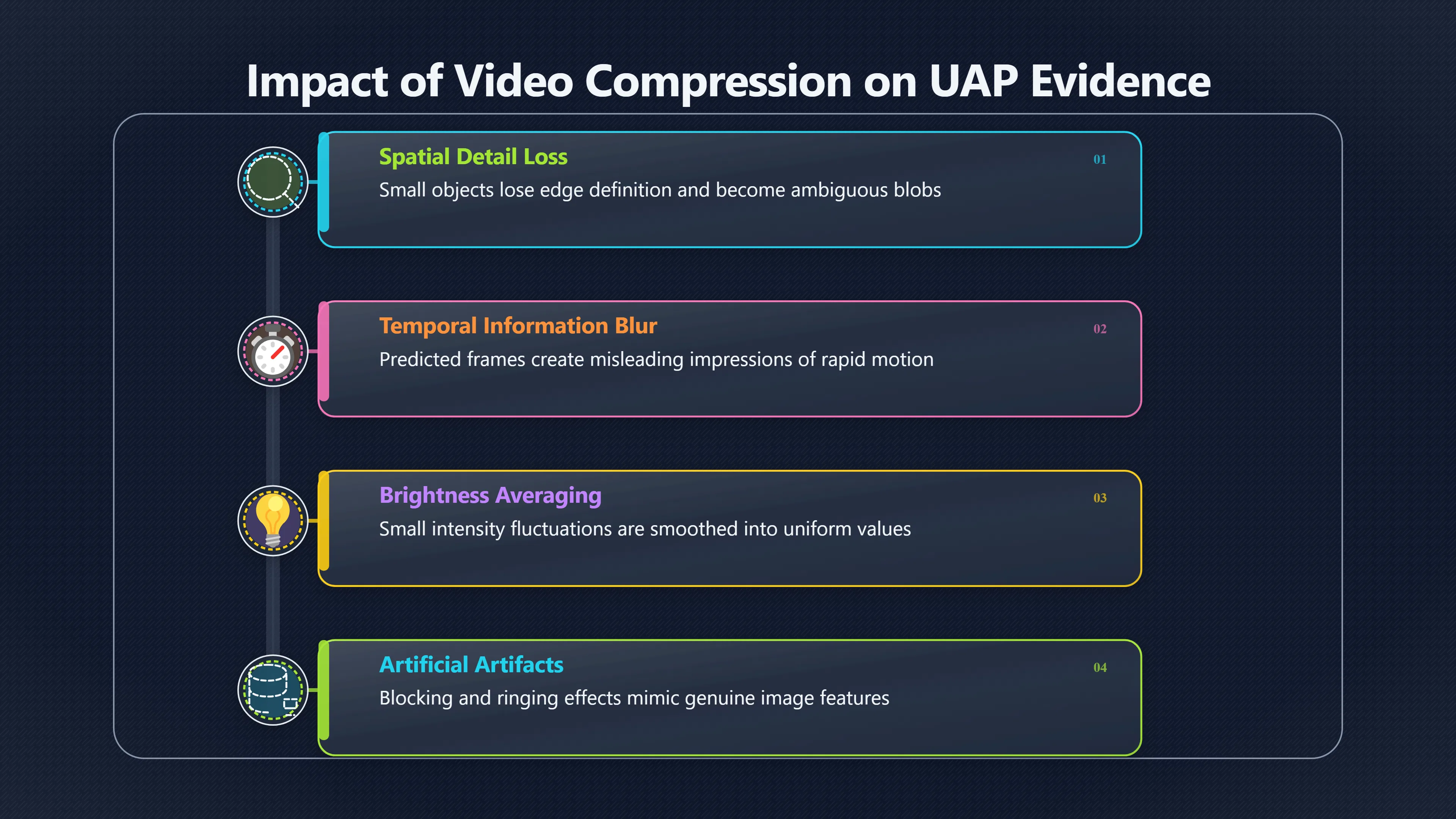
Compression affects far more than image sharpness. It can alter the evidence in ways that matter directly to UAP analysis.
- Fine spatial detail. Small objects near the resolution limit may lose edge definition, making birds, insects, balloons or distant aircraft appear as ambiguous blobs.
- Temporal information. Predicted frames can blur rapid motion or create misleading impressions of acceleration, direction changes or object shape.
- Brightness variation. Small fluctuations in intensity that might reveal reflections, navigation lights or sensor saturation can be averaged away.
- Compression artefacts. Blocking, ringing, flickering and blurring are well-known consequences of aggressive video compression and may resemble genuine image features.[DIVA Portal]diva-portal.orgBlocking, ringing and…Read more…
Editing introduces additional problems that are independent of compression itself. Public releases often crop the image, stabilise the footage, slow it down, add annotations or trim away the minutes before and after the event. Each change may improve presentation while simultaneously reducing forensic value.
Context outside the highlighted sequence is often essential. A supposedly abrupt manoeuvre may disappear when the preceding camera movement is included. An apparent disappearance may instead coincide with an autofocus adjustment, exposure change or sensor mode switch.
Common false positives hidden by video alone
Many recurring UAP explanations depend on details that compressed clips no longer preserve clearly.
Nearby insects and birds. Objects close to the lens can appear surprisingly fast because their angular motion is much greater than distant objects. Compression may erase wing motion or body detail, leaving only an indistinct bright target.
Camera autofocus and exposure changes. Sudden changes in focus or automatic gain control can make stationary objects appear to pulse, stretch or disappear. Without access to camera metadata, these effects are difficult to identify confidently.
Rolling-shutter effects. Many digital sensors record images line by line rather than instantaneously. Fast motion or vibration can distort object shapes into elongated or skewed forms. If compression and stabilisation are added afterwards, separating genuine motion from sensor behaviour becomes even harder.[Naval Postgraduate School]nps.eduAg- gressive in-camera processing can cause frame-toNaval Postgraduate SchoolUnidentified Anomalous Phenomena: Science and AnalysisAARO has received many videos of purported UAP rolling-shu…
Optical artefacts. Lens flare, internal reflections, diffraction and atmospheric distortion often evolve over multiple frames in subtle ways. Compression may simplify these patterns, making ordinary optical phenomena appear more structured than they originally were.
Motion estimation errors. Video codecs estimate how objects move between frames. When scenes contain fine detail, noise or rapid movement, prediction errors can leave artificial trails, halos or apparent wakes that never existed in the original sensor output.[NASA Technical Reports Server]ntrs.nasa.govNASA Technical Reports ServerVideo Compression Study h.265 vs h.264by J Pryor · 2016 — Compression methods such as h.264 and h.265 use pr…
These are not hypothetical concerns. They arise routinely in video engineering and are well documented across the compression literature.
A concrete example: apparent wakes created by compression
One of the clearest public illustrations comes from the U.S. government’s released UAP imagery.
A widely discussed MQ-9 video appeared to show an object producing an atmospheric wake or “cavitation”. After reviewing the complete motion video, additional footage, longer focal-length imagery and commercial flight data, the analysis concluded that the object was most likely a conventional aircraft. The apparent wake was assessed as a sensor artefact resulting from video compression rather than evidence of unusual propulsion.[AARO]aaro.milUAP ImageryAARO assesses that the object likely is a commercial aircraft and that the trailing cavitation is a sensor artifact result…
This case demonstrates an important principle. The compressed public clip suggested one interpretation, while access to additional imagery and contextual information supported a different conclusion. The change did not result from speculation but from having more of the original evidence available for analysis.
Why metadata matters as much as pixels
Even perfectly preserved raw frames are insufficient without accompanying metadata.
Investigators typically need to know:
- precise timestamps;
- frame rate and dropped-frame history;
- exposure time and gain;
- lens focal length and zoom state;
- sensor pointing direction;
- software version and processing pipeline;
- calibration records;
- synchronisation with other sensors.
Without these details, estimating an object’s true speed, distance or trajectory becomes much less reliable. A bright point moving rapidly across the frame could represent a nearby insect, a distant aircraft, a satellite or camera motion. Metadata provides the geometric constraints needed to discriminate between these possibilities.
NASA’s independent UAP study emphasised that calibrated sensors, known system characteristics and robust data acquisition are essential for reducing false positives caused by sensor artefacts.[NASA Science]science.nasa.govwill enable the elimination of false positives due to sensor artifacts.Read moreNASA ScienceIndependent Study Team ReportSeptember 13, 2023 — The cavitation is likely a sensor artifact resulting from video compression…
When near-raw release is enough for review
Public release of complete uncompressed sensor archives is not always practical. Security restrictions, privacy concerns and large file sizes can make unrestricted publication impossible.
However, a scientifically useful “near-raw” release can often preserve most of the evidential value if it includes:
- minimally processed event footage rather than heavily edited highlight reels;
- lossless or very lightly compressed frames where possible;
- complete processing history from acquisition to publication;
- camera calibration and acquisition settings;
- several minutes of footage before and after the event;
- synchronised timestamps;
- environmental context such as weather, astronomical conditions and nearby aircraft information;
- disclosure of any withheld material and the reason for its omission.
This approach allows independent analysts to test alternative explanations without necessarily exposing sensitive operational information.
Why this matters for automated instrumented UFO detectors
Automated detector networks are intended to move UAP investigation from anecdotal reports towards repeatable measurement. That goal depends on preserving enough information for independent researchers to reproduce the original analysis.
A compressed highlight clip may persuade viewers that something unusual occurred, but it cannot reliably establish what occurred. Scientific confidence comes from preserving the underlying measurements, documenting every processing step and allowing others to determine whether an apparent anomaly survives scrutiny once ordinary explanations—birds, insects, aircraft, optical effects, sensor limitations and compression artefacts—have been systematically eliminated. The clip may begin the investigation, but the raw or near-raw data determine whether it can be completed.[NASA Science+2AARO]science.nasa.govwill enable the elimination of false positives due to sensor artifacts.Read moreNASA ScienceIndependent Study Team ReportSeptember 13, 2023 — The cavitation is likely a sensor artifact resulting from video compression…
Amazon book picks
Further Reading
Books and field guides related to Why the Clip Is Not the Evidence. Use these as the next step if you want deeper reading beyond the article.


UFOs : Generals, Pilots, and Government Officials Go on the R...
Places clip quality into broader investigative context.

Data Reduction and Error Analysis for the Physical Sciences
Supports preservation of reproducible evidence.

Digital Image Processing, Global Edition
First published 2018. Subjects: Image processing, digital techniques.
eBay marketplace picks
Marketplace Samples
Example marketplace items related to this page. Use the search link to explore similar finds on eBay.



Endnotes
1.
Source: science.nasa.gov
Title: will enable the elimination of false positives due to sensor artifacts.Read more
Link:https://science.nasa.gov/wp-content/uploads/2023/09/uap-independent-study-team-final-report.pdf
Source snippet
NASA ScienceIndependent Study Team ReportSeptember 13, 2023 — The cavitation is likely a sensor artifact resulting from video compression...
Published: September 13, 2023
2.
Source: ntrs.nasa.gov
Link:https://ntrs.nasa.gov/api/citations/20170000636/downloads/20170000636.pdf
Source snippet
NASA Technical Reports ServerVideo Compression Study h.265 vs h.264by J Pryor · 2016 — Compression methods such as h.264 and h.265 use pr...
3.
Source: diva-portal.org
Link:https://www.diva-portal.org/smash/get/diva2%3A833137/FULLTEXT01.pdf
Source snippet
Blocking, ringing and...Read more...
4.
Source: aaro.mil
Link:https://www.aaro.mil/UAP-Cases/Official-UAP-Imagery/
Source snippet
UAP ImageryAARO assesses that the object likely is a commercial aircraft and that the trailing cavitation is a sensor artifact result...
5.
Source: aaro.mil
Title: Next UAP Report Documents
Link:https://www.aaro.mil/Next-AARO-Home-redesign/Next-Parent/Next-UAP-Report-Documents/
Source snippet
UAP Report Documents29 Feb 2024 — The Department of the Army submitted a report of an unidentified anomalous phenomenon to the All-domain...
6.
Source: nps.edu
Title: Ag- gressive in-camera processing can cause frame-to
Link:https://nps.edu/documents/110773463/165192597/CTX-EAG-Special-Issue-2026.pdf
Source snippet
Naval Postgraduate SchoolUnidentified Anomalous Phenomena: Science and AnalysisAARO has received many videos of purported UAP rolling-shu...
Additional References
7.
Source: reddit.com
Link:https://www.reddit.com/r/shutterencoder/comments/1j43gqf/artifacts_with_h264_encoding/
8.
Source: researchgate.net
Link:https://www.researchgate.net/publication/222175887_Perceivable_artifacts_in_compressed_video_and_their_relation_to_video_quality
Source snippet
introduction of coding artifacts. A two-step. H.264 compressed video...
9.
Source: video.stackexchange.com
Title: It may just be corruption in the bitstream
Link:https://video.stackexchange.com/questions/24725/grime-like-blocking-compression-artifacts-on-the-decompressed-video-h-264
Source snippet
stackexchange.comGrime-like blocking compression artifacts on the...27 Aug 2018 — Data errors in the compressed bit-stream, possibly due...
10.
Source: youtube.com
Title: Pentagon UFO files show no alien evidence, analyst says
Link:https://www.youtube.com/watch?v=Rn39Hhyk7WE
Source snippet
This NASA media briefing discusses the importance of high-quality data, rigorous sensor calibration, and the scientific limitations that...
11.
Source: youtube.com
Title: UAP Independent Study Event Post-Meeting Media Teleconference (
Link:https://www.youtube.com/watch?v=C3uXUfgSadU
Source snippet
WATCH LIVE: NASA releases report on 'unidentified anomalous phenomena'...
Published: May 31, 2023
12.
Source: youtube.com
Title: Replay! NASA’s Release of the Unidentified Anomalous Phenomena Report
Link:https://www.youtube.com/watch?v=nuBMnluJfs0
Source snippet
UAP Independent Study Event Post-Meeting Media Teleconference (May 31, 2023)...
Published: May 31, 2023
13.
Source: youtube.com
Title: WATCH LIVE: NASA releases report on ‘unidentified anomalous phenomena’
Link:https://www.youtube.com/watch?v=xQJAx9HQ5j8
Source snippet
AVI LOEB: "These objects could be a national security issue for the US"...
14.
Source: youtube.com
Title: AVI LOEB: “These objects could be a national security issue for the US”
Link:https://www.youtube.com/watch?v=63yMz4QxWtU
Source snippet
Pentagon UFO files show no alien evidence, analyst says...
15.
Source: arxiv.org
Title: arXiv PEA265: Perceptual Assessment of Video Compression Artifacts
Link:https://arxiv.org/abs/1903.00473
Topic Tree