Within Vision Filters
The Tree That Keeps Reporting UFOs
Leaves, branches and shadows can trigger sky cameras unless the system masks clutter and learns the local background.
On this page
- Why foreground clutter triggers motion detection
- How masking and background learning reduce noise
- Why camera placement matters before software
Page outline Jump by section
Introduction
A fixed sky camera used for automated UFO or UAP detection spends most of its time watching an apparently empty scene. In practice, however, the edge of that scene often contains treetops, hedges, rooflines or utility wires. When wind moves leaves and branches, the camera sees genuine pixel changes even though nothing unusual has entered the sky. Unless the system is designed to recognise this predictable foreground motion, the same tree can repeatedly generate “unknown object” alerts.
 This is not a problem unique to UFO detection. Outdoor machine vision systems in surveillance, wildlife monitoring and traffic analysis all struggle with dynamic backgrounds such as swaying vegetation, changing shadows and weather. The difference for an all-sky detector is that these false triggers consume storage, waste reviewer time and can obscure genuinely unusual events. The practical solution is a combination of careful camera placement, foreground masking and adaptive background learning rather than relying on motion detection alone.[HAL Science]hal.scienceBackground subtraction in real applications: Challenges…by B Garcia-Garcia · 2020 · Cited by 431 — Visual surveillance is the main ap…
Why foreground clutter triggers motion detection
Most automated sky cameras begin with a simple question: which pixels changed between one frame and the next? If enough neighbouring pixels change together, the software marks that region as motion and passes it to later stages of tracking or classification.
Leaves and branches satisfy this rule surprisingly well because they produce exactly the kind of local movement that motion detectors are designed to notice. Wind rarely moves every leaf identically. Instead, thousands of small surfaces rotate, exposing different brightness values, casting new shadows and revealing patches of sky behind them. The resulting pattern appears as continuous motion, even though nothing is travelling across the sky.
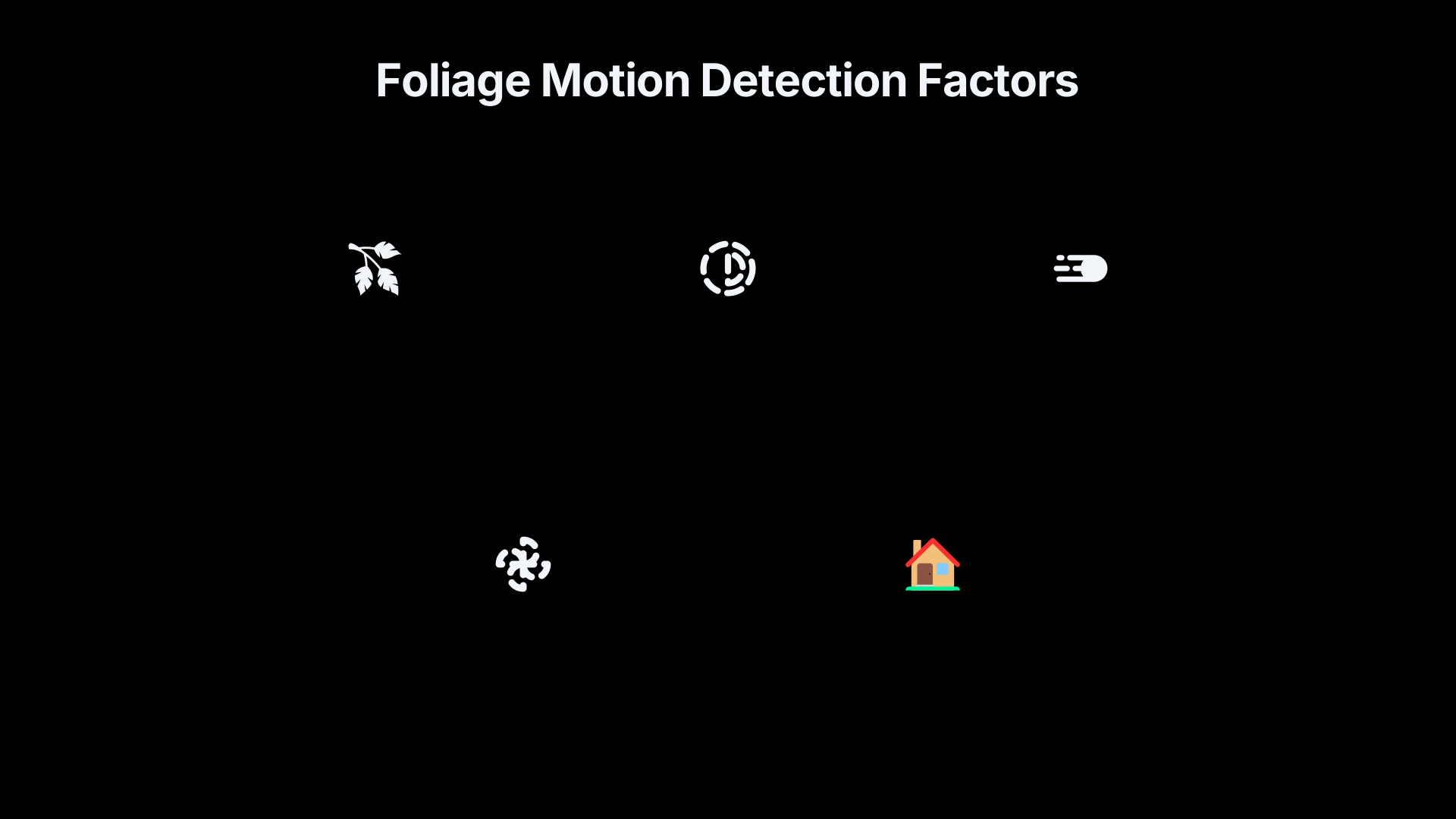
Several characteristics make foliage particularly troublesome:
- Irregular movement. Branches bend in changing directions and at changing speeds, making their motion difficult to predict.
- High-contrast edges. Dark leaves against a bright sky create strong intensity changes that are easy to detect.
- Partial occlusion. Moving foliage repeatedly reveals and hides pieces of background sky, producing rapid pixel changes.
- Wind variability. Calm periods followed by gusts prevent simple threshold-based systems from settling into a stable model.
Research on outdoor background subtraction consistently identifies swaying vegetation as one of the principal causes of false foreground detection, alongside lighting changes and camera vibration.[HAL Science+2Rutgers Computer Science]hal.scienceBackground subtraction in real applications: Challenges…by B Garcia-Garcia · 2020 · Cited by 431 — Visual surveillance is the main ap…
How masking and background learning reduce noise
The most effective systems do not attempt to classify every moving leaf correctly. Instead, they prevent those regions from becoming candidate aerial targets in the first place.
Static exclusion masks
The simplest technique is to define permanent exclusion zones.
If a camera always sees the top of the same oak tree in its lower-left corner, there is little value in analysing that area for airborne objects. Software can permanently ignore those pixels while still monitoring the open sky above them.
Many operational sky-camera installations use manually defined masks for tree lines, chimneys, roof edges and other fixed foreground features because they remove a large fraction of recurring false alerts at almost no computational cost. This is especially valuable when the clutter occupies only the frame edges.
The disadvantage is obvious: a genuine object passing through the masked region will also be ignored. For this reason, masks are generally kept as small as possible.
Adaptive background models
More sophisticated systems build a statistical model of what “normal” looks like at every pixel.
Rather than comparing each frame only with the immediately preceding one, algorithms such as Gaussian Mixture Models (often abbreviated to GMM or MOG2), ViBe and related background subtraction methods learn that certain pixels naturally oscillate within predictable limits. A branch that repeatedly sways back and forth becomes part of the expected background instead of a new target.
The challenge is choosing how quickly the model adapts. If adaptation is too slow, moving leaves continue producing alarms. If adaptation is too fast, genuinely slow-moving aerial objects risk being absorbed into the background. Outdoor computer vision research treats this balance as one of the central design problems in long-term surveillance.[Helios 2+2HAL Science]helios2.mi.parisdescartes.frHelios 2Comparative Study of Background Subtraction AlgorithmsApril 19, 2013 — by Y Benezeth · Cited by 485 — In this paper, we present a…
Dynamic background suppression
Recent work goes beyond treating each pixel independently.
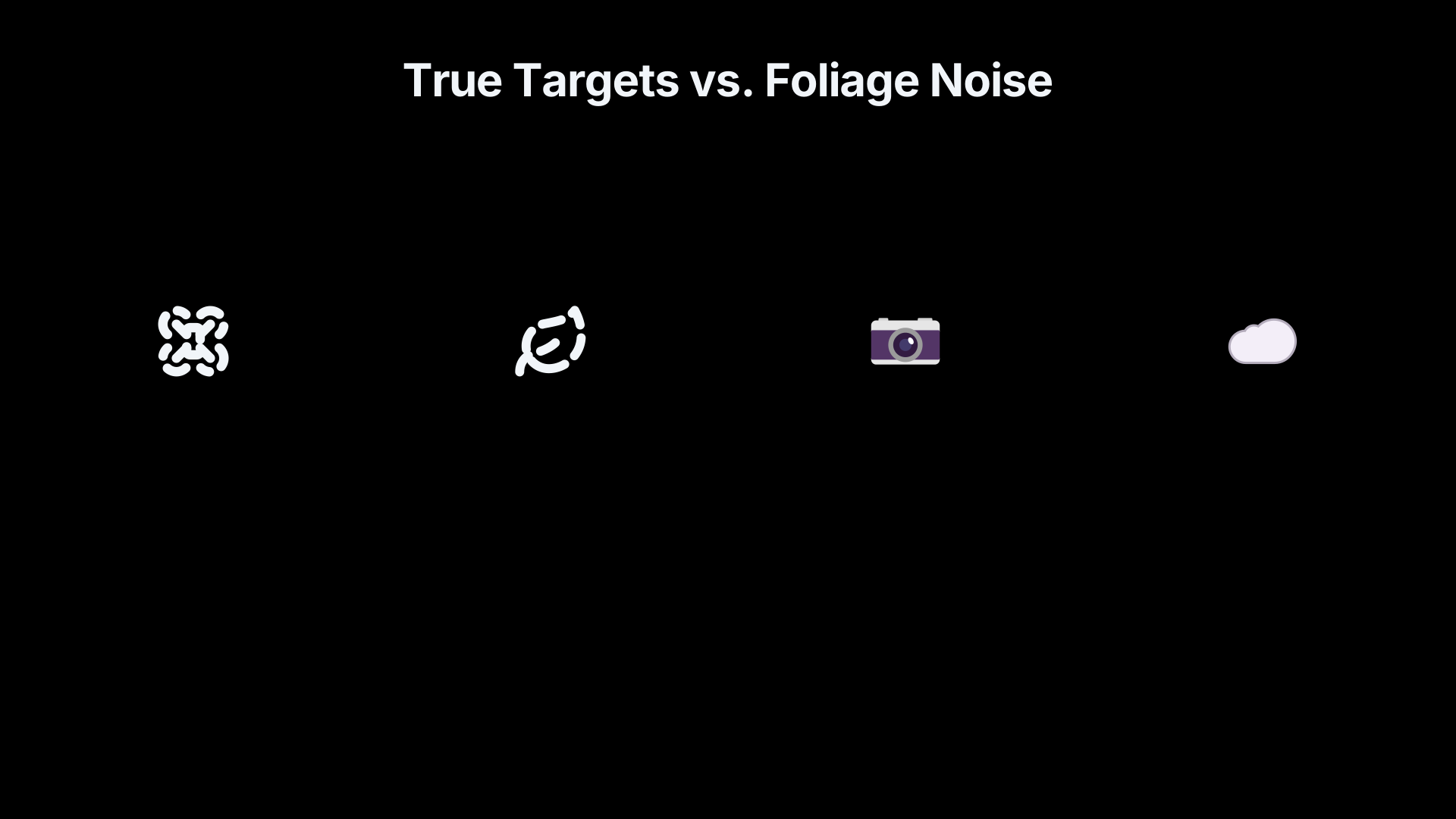
Instead, algorithms analyse both spatial relationships and temporal consistency. A true flying object generally maintains a coherent trajectory across multiple frames. Wind-driven foliage produces chaotic local motion with little long-range continuity.
Studies evaluating foreground extraction in scenes containing violent branch and leaf motion show that combining multiple motion cues and post-processing substantially reduces false detections compared with relying on a single background subtraction method alone. Even so, extremely vigorous vegetation can still generate residual false positives.[MDPI]mdpi.comThe Extraction of Foreground Regions of the Moving…by Y Zhang · 2023 · Cited by 2 — In actual video surveillance, there are two ma…
Why shadows make the problem worse
Leaves rarely move alone. They also move their shadows.
Passing clouds, low-angle sunlight and wind combine to create large brightness fluctuations across roofs, walls and the ground. Basic motion detectors interpret these illumination changes as moving objects because they alter pixel values even though no physical object has appeared.
Outdoor surveillance literature consistently lists rapid lighting variation alongside vegetation motion as a major source of false foreground extraction. More advanced systems therefore attempt to separate brightness changes from structural changes, reducing alerts caused purely by illumination.[Andrew Senior]andrewsenior.comAndrew SeniorRobust and Efficient Foreground Analysis in Complex…by YL Tian · Cited by 85 — In this paper, we focus on problems of bac…
Why camera placement matters before software
Software cannot completely compensate for a poor installation.
A camera aimed so that branches occupy twenty percent of the field of view will inevitably devote processing time to those branches. Moving the camera a few metres, increasing mounting height or slightly adjusting the viewing angle may eliminate thousands of unnecessary detections before any algorithm runs.
Good placement generally follows several practical principles:
- Keep the horizon and nearby vegetation near the frame boundary rather than the centre.
- Avoid allowing branches to intrude into the monitored sky whenever possible.
- Minimise nearby objects that can cast moving shadows across the scene.
- Mount cameras securely so that wind does not shake both the vegetation and the camera itself.
- Reassess seasonal growth, as trees that are harmless in winter may occupy much more of the frame during summer.
These changes reduce computational load while also simplifying later tracking and classification.
What a recurring “tree UFO” looks like in practice
A characteristic false-alert pattern develops when foliage is responsible.
The detector repeatedly reports activity from almost exactly the same image location, usually during windy periods. Bounding boxes appear near the frame edge, persist briefly, disappear and then reappear seconds later. The apparent “object” rarely develops into a smooth trajectory across open sky because the motion is tied to the branch rather than to an independently moving target.
Reviewing detection histories often reveals that alerts cluster under similar weather conditions, especially gusty winds or rapidly changing sunlight. Recognising this pattern allows operators either to refine exclusion masks or adjust background-learning parameters for that specific site.
Practical design lessons for automated UFO detectors
Within an automated instrumented UFO detection system, moving foliage should be treated as an expected environmental condition rather than an unusual event. Effective implementations usually combine several complementary defences instead of relying on any single filter.
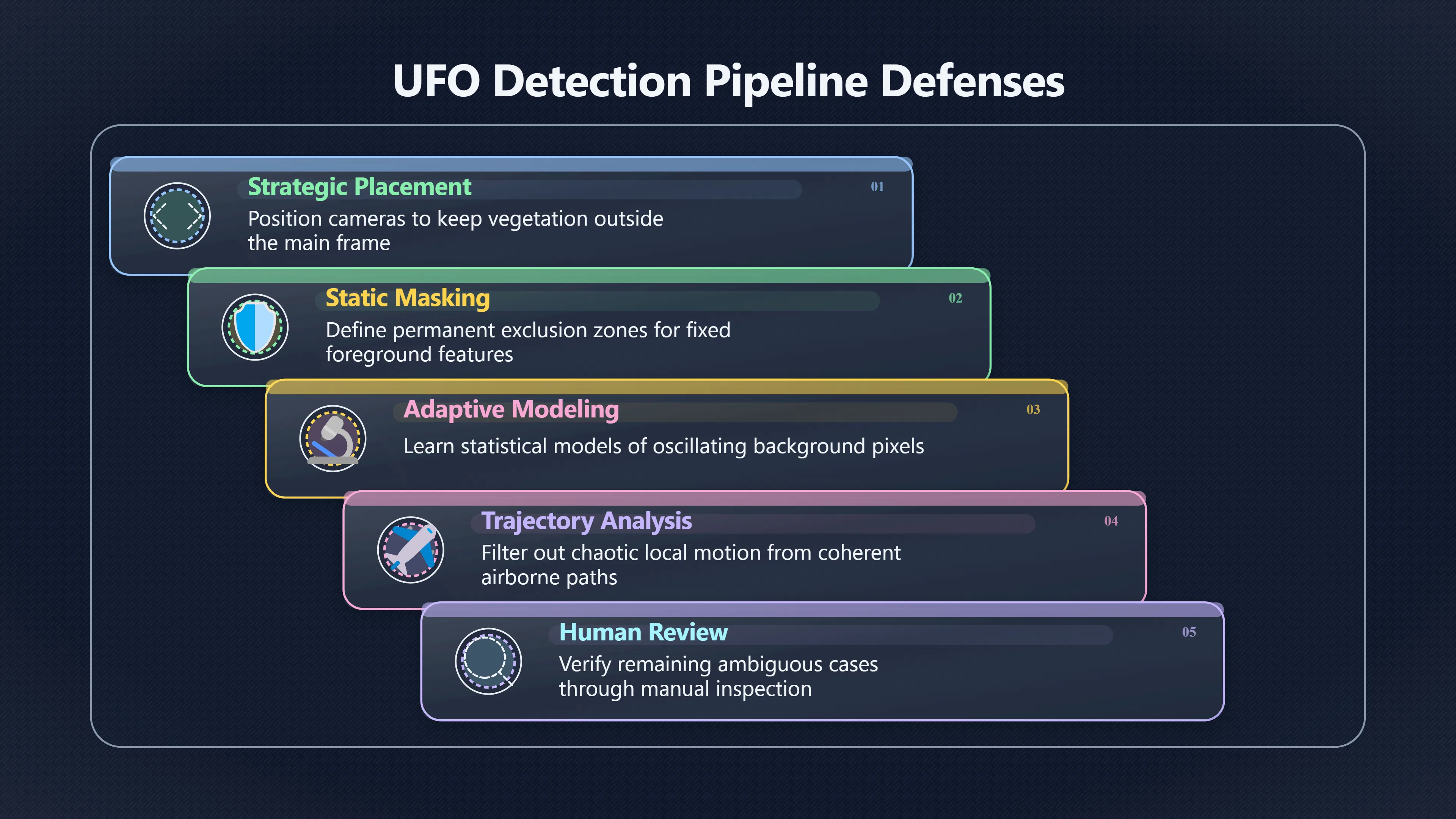
A robust pipeline typically includes careful camera placement, permanent masking of unavoidable foreground clutter, adaptive background models that learn predictable vegetation motion, trajectory analysis that favours coherent airborne movement over local oscillation, and human review of any remaining ambiguous cases. Together these measures greatly reduce the number of alerts generated by the same wind-blown tree while preserving sensitivity to objects that genuinely traverse the monitored sky.[SCIEPublish+3HAL Science+3Rutgers Computer Science]hal.scienceBackground subtraction in real applications: Challenges…by B Garcia-Garcia · 2020 · Cited by 431 — Visual surveillance is the main ap…
Amazon book picks
Further Reading
Books and field guides related to The Tree That Keeps Reporting UFOs. Use these as the next step if you want deeper reading beyond the article.

Hands-On Machine Learning with Scikit-Learn, Keras, and Tenso...
Useful for later-stage classification after basic motion detection.

Programming Computer Vision With Python
Explains image processing and object detection concepts applicable to false motion filtering.

Computer Vision
Provides deeper background on segmentation, motion analysis and scene understanding.
eBay marketplace picks
Marketplace Samples
Example marketplace items related to this page. Use the search link to explore similar finds on eBay.


Endnotes
1.
Source: hal.science
Link:https://hal.science/hal-02560129v1/file/1-s2.0-S1574013718303101-am.pdf
Source snippet
Background subtraction in real applications: Challenges...by B Garcia-Garcia · 2020 · Cited by 431 — Visual surveillance is the main ap...
2.
Source: cs.rutgers.edu
Link:https://www.cs.rutgers.edu/~elgammal/pub/bgmodel_ECCV00_postfinal.pdf
Source snippet
Rutgers Computer ScienceNon-parametric Model for Background Subtractionby A Elgammal · Cited by 3558 — Second, there are false detection...
3.
Source: mdpi.com
Link:https://www.mdpi.com/2079-9292/12/15/3346
Source snippet
The Extraction of Foreground Regions of the Moving...by Y Zhang · 2023 · Cited by 2 — In actual video surveillance, there are two ma...
4.
Source: sciepublish.com
Link:https://www.sciepublish.com/article/pii/491
Source snippet
Evaluating a Motion-Based Region Proposal Approach...by E Ucurum · 2025 — In the proposed detection algorithm, background sub...
5.
Source: mdpi.com
Title: 2504 446X
Link:https://www.mdpi.com/2504-446X/5/3/65
Source snippet
Moving People Tracking and False Track Removing with...by S Yeom · 2021 · Cited by 28 — The multirotor equipped with a thermal imaging c...
6.
Source: hal.science
Link:https://hal.science/hal-02962156v1/file/S157401372030410X.pdf
Source snippet
• Foreground aperture Changes inside a...Read more...
7.
Source: helios2.mi.parisdescartes.fr
Link:https://helios2.mi.parisdescartes.fr/~lomn/Cours/CV/SeqVideo/Articles2017/backgroundEstimationReview_2.pdf
Source snippet
Helios 2Comparative Study of Background Subtraction AlgorithmsApril 19, 2013 — by Y Benezeth · Cited by 485 — In this paper, we present a...
Published: April 19, 2013
8.
Source: andrewsenior.com
Link:https://www.andrewsenior.com/papers/TianMVA11.pdf
Source snippet
Andrew SeniorRobust and Efficient Foreground Analysis in Complex...by YL Tian · Cited by 85 — In this paper, we focus on problems of bac...
Additional References
9.
Source: researchgate.net
Link:https://www.researchgate.net/publication/321506955_Moving_object_detection_using_background_subtraction_for_a_moving_camera_with_pronounced_parallax
Source snippet
Moving object detection using background subtraction for a...6 Dec 2017 — The right updating of a reference backdrop model and the suita...
10.
Source: vip.bu.edu
Link:https://vip.bu.edu/projects/vsns/background-subtraction/fa/
Source snippet
BU Visual Information ProcessingForeground-Adaptive Background SubtractionThis combination of foreground and prior Markov models leads to...
11.
Source: youtube.com
Link:https://www.youtube.com/watch?v=A6tKT3agVbY
Source snippet
Stop False Security Camera Alerts with Smart Motion Detection - YouTube Stop False Security Camera Alerts with Smart Motion Detection - Y...
12.
Source: researchgate.net
Link:https://www.researchgate.net/publication/47696352Background_Subtraction_for_Automated_Multisensor_Surveillance_A_Comprehensive[Review
Source snippet
separating the expected scene (the background) from the unexpected...Read more...
13.
Source: search.proquest.com
Link:https://search.proquest.com/openview/038eea5c7ef06833992c5c0d8bec6907/1?cbl=18750&diss=y&pq-origsite=gscholar
Source snippet
proquest.comSpot, an Algorithm for Low-Resolution, Low-Contrast...by CL Crutchfield · 2023 — This write-up introduces Spot, an algorithm...
14.
Source: youtube.com
Link:https://www.youtube.com/watch?v=vgrfaO7Aa6g
Source snippet
How to disable [false alarms]({{ 'false-alarms/' | relative_url }}) on cameras? | Hikvision's AcuSense technology explained...
15.
Source: youtube.com
Title: Swann NVW-490CAM Security Camera Thermal Sensing PIR True Detect Tips
Link:https://www.youtube.com/watch?v=zEpZLrUAaDw
Source snippet
Uniview OwlViewplus 8MP Camera Test | Tri-Guard 3.0, Wise-ISP & Full Colour at Night...
16.
Source: uniview.com
Link:https://www.uniview.com/News/Blog/202509/1055106_169683_0.htm
Source snippet
The Science Behind Motion Detection and Its Use in Scene...4 Sept 2025 — Sensors that pick up even small actions are great, but if they'...
17.
Source: pmc.ncbi.nlm.nih.gov
Link:https://pmc.ncbi.nlm.nih.gov/articles/PMC9610167/
Source snippet
Novel Background Modeling Algorithm for Hyperspectral...by D Schreiber · 2022 · Cited by 1 — This work presents a novel background model...
18.
Source: pmc.ncbi.nlm.nih.gov
Link:https://pmc.ncbi.nlm.nih.gov/articles/PMC9691501/
Source snippet
of motion inhibition for the suppression of false...by A Melville-Smith · 2022 · Cited by 4 — These findings show that the application o...
Topic Tree