Within Infrared
Why One Thermal Camera Is Not Enough
Multiple infrared cameras trade simplicity for coverage, giving a station a better chance of recording unpredictable night-sky tracks.
On this page
- The field of view problem
- Coverage versus image detail
- When a single camera still makes sense
Page outline Jump by section
Introduction
A single thermal camera can record only the part of the sky within its field of view. For automated night-time UAP detection, that is a fundamental limitation because unexpected aerial events are, by definition, not scheduled to appear where a fixed camera is pointing. An all-sky infrared array addresses this problem by dividing the sky between several overlapping cameras, allowing continuous unattended monitoring across almost the entire hemisphere while retaining enough angular resolution to detect and track moving objects. Rather than making individual images dramatically sharper, the principal advantage of an array is that it greatly increases the chance of capturing an event at all, while also providing overlapping observations that improve tracking, calibration and quality control. This design philosophy has become central to modern instrumented UAP observatories, including the Galileo Project’s “Dalek” infrared array.[MDPI]mdpi.comCommissioning an All-Sky Infrared Camera Array for…by L Domine · 2025 · Cited by 11 — One of the key instruments is an all-sky inf…

The field-of-view problem
Wide-angle imaging always involves a compromise. A camera fitted with an extremely wide lens can observe much of the sky, but each object occupies fewer pixels on the detector. Conversely, a narrow-field camera provides but watches only a small patch of sky.
For an unattended monitoring station, missing an event altogether is usually a greater problem than recording it at modest resolution. Most reported anomalous aerial events are brief and unpredictable. A camera aimed at a fixed azimuth may never see an object that passes overhead or behind it, regardless of image quality.
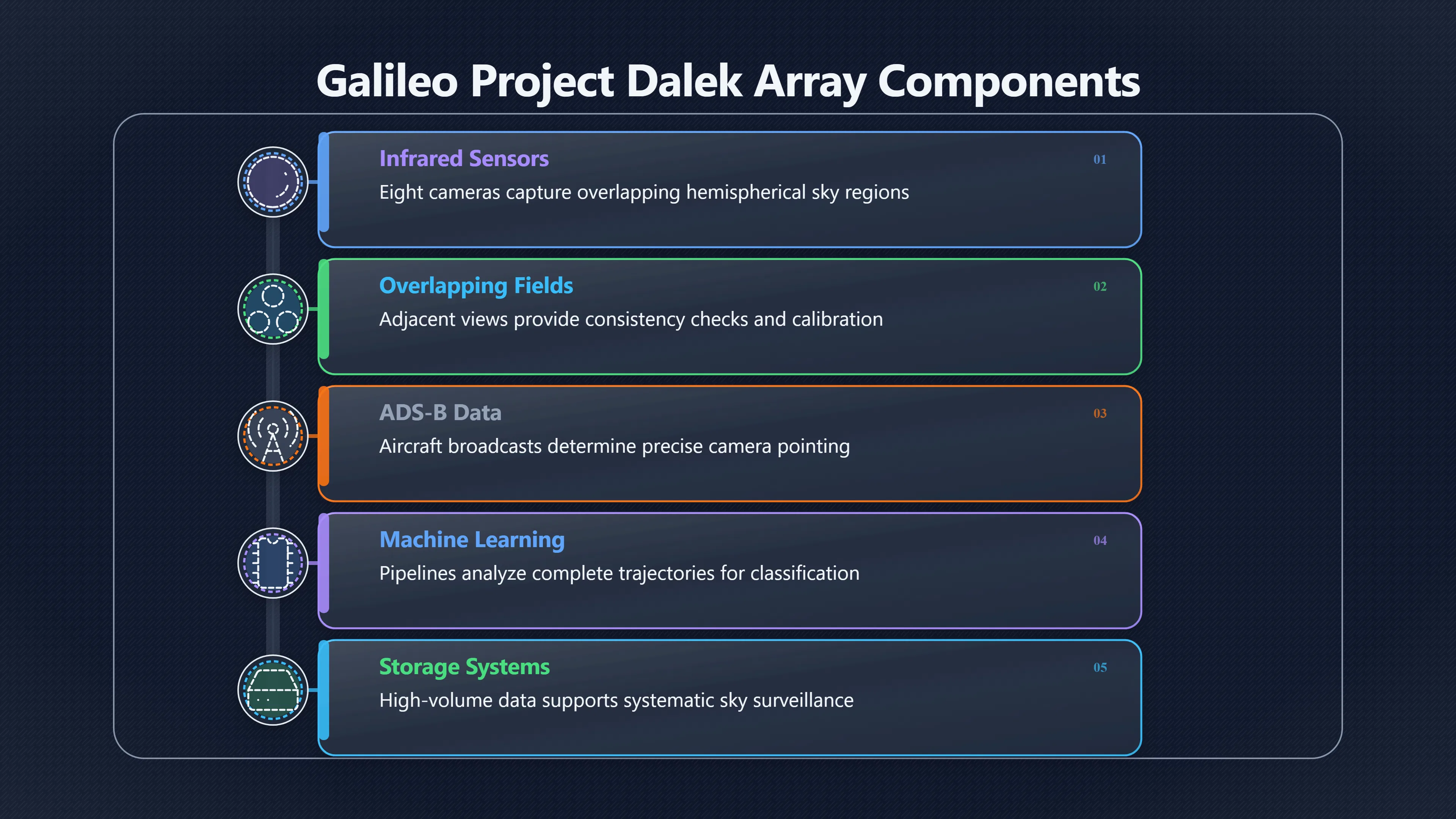
An all-sky array tackles this geometrical problem by assigning neighbouring sectors of the sky to multiple cameras. Instead of forcing one sensor to cover everything through an extreme fisheye lens, each camera observes a more manageable region. Together they provide nearly continuous hemispherical coverage with intentional overlap between adjacent views. The Galileo Project selected an eight-camera arrangement after evaluating configurations ranging from four to fourteen cameras, balancing sky coverage, angular resolution, system complexity and cost.[MDPI]mdpi.comCommissioning an All-Sky Infrared Camera Array for…by L Domine · 2025 · Cited by 11 — One of the key instruments is an all-sky inf…
Coverage versus image detail
The principal engineering trade-off is not simply “more cameras versus fewer cameras”, but coverage versus usable spatial information.
A single ultra-wide thermal camera can image most of the sky, but because every pixel subtends a large angle, distant aircraft or small objects occupy very few pixels. That makes automatic classification considerably harder.
Splitting the sky across multiple sensors provides several practical benefits:
- Higher angular resolution. Each camera covers a smaller angle, allowing distant objects to occupy more pixels without sacrificing overall sky coverage.
- Longer detection range. Better angular resolution increases the volume of airspace within which an object remains detectable.
- Improved tracking. Objects travelling across the sky can pass smoothly from one camera into another instead of disappearing at the edge of a single frame.
- Overlap for verification. Adjacent cameras intentionally observe common regions, reducing blind spots and providing consistency checks during calibration.
The Galileo Project reports that its eight-camera configuration was specifically chosen because it offered better angular resolution and a larger effective detection volume than lower-camera-count alternatives while remaining practical to build and calibrate. The team is nevertheless developing a simpler four-camera version to quantify exactly how much performance is sacrificed for lower cost and complexity.[MDPI]mdpi.comCommissioning an All-Sky Infrared Camera Array for…by L Domine · 2025 · Cited by 11 — One of the key instruments is an all-sky inf…
Why overlapping cameras matter
The value of an array extends beyond simply covering more sky.
When neighbouring cameras observe the same object during a handover, engineers gain additional information about whether the detection is genuine or the result of image noise, thermal reflections or processing artefacts. Overlap also makes geometric calibration easier because the same aircraft or moving target can appear simultaneously in multiple views.
For infrared systems this is particularly important because stars, commonly used to calibrate visible-light astronomical cameras, are generally not detectable in long-wave infrared. The Galileo Project therefore developed an alternative calibration approach using aircraft broadcasting Automatic Dependent Surveillance–Broadcast (ADS-B) positions to determine precisely where each infrared camera is pointing. Consistent observations across overlapping fields help validate those calibrations over time.[MDPI]mdpi.comCommissioning an All-Sky Infrared Camera Array for…by L Domine · 2025 · Cited by 11 — One of the key instruments is an all-sky inf…
Catching events a single camera would miss
The greatest advantage of an all-sky array appears before any object is identified.
Imagine an aircraft, meteor, bird or unexplained light entering from behind a building, crossing overhead and disappearing towards the opposite horizon. A narrow-field camera may never record it. A single very-wide camera may detect it but with insufficient detail for reliable classification. An array increases the likelihood that:
- the object is detected immediately on entering monitored airspace;
- it remains visible throughout its trajectory rather than leaving the frame;
- software can reconstruct a continuous path instead of isolated detections;
- other sensors can be synchronised with the same event.
This continuous coverage is especially valuable because automated observatories increasingly rely on machine-learning pipelines that analyse complete trajectories rather than isolated images. Longer tracks generally provide stronger evidence for distinguishing ordinary aircraft, birds or insects from unusual-looking detections created by viewing geometry or environmental conditions.[MDPI]mdpi.comCommissioning an All-Sky Infrared Camera Array for…by L Domine · 2025 · Cited by 11 — One of the key instruments is an all-sky inf…

When a single camera still makes sense
Multiple cameras are not always the best solution.
A single thermal camera remains appropriate when the objective is to monitor a known location rather than search an entire sky. Examples include observing a launch corridor, airport approach path, research range or other region where interesting targets are expected within a limited field of view.
Single-camera systems also offer practical advantages:
- lower purchase and maintenance costs;
- simpler calibration;
- reduced computing and storage requirements;
- easier deployment in remote locations.
For exploratory scientific surveys, however, these advantages come at the cost of greatly reduced observational coverage. Since the overwhelming majority of the sky is outside a single camera’s view at any moment, the probability of recording an unexpected transient event is correspondingly lower. Modern survey instruments in astronomy often solve the same problem by deploying arrays of cameras or telescopes that collectively monitor much larger areas of sky than any individual sensor could observe efficiently.[arXiv+2Wikipedia]arxiv.orgThe Multi-site All-Sky CAmeRA: Finding transiting exoplanets around bright ($m_V < 8$) starsFebruary 13, 2017…
Why array coverage is the more important improvement
Within automated instrumented UAP detection, the chief contribution of an all-sky infrared array is not that it produces spectacular thermal images. Its main contribution is statistical: it observes vastly more of the available sky, continuously and without requiring an operator to guess where an event will occur.
That broader coverage supports better trajectory reconstruction, more reliable calibration, smoother integration with complementary sensors and a larger baseline of ordinary aerial traffic against which genuinely unusual observations can be assessed. In this sense, the transition from one thermal camera to an overlapping all-sky array represents a shift from opportunistic observation towards systematic sky surveillance, where reducing missed events is often more valuable than maximising the detail in any single frame.[MDPI+2World Scientific]mdpi.comCommissioning an All-Sky Infrared Camera Array for…by L Domine · 2025 · Cited by 11 — One of the key instruments is an all-sky inf…
Amazon book picks
Further Reading
Books and field guides related to Why One Thermal Camera Is Not Enough. Use these as the next step if you want deeper reading beyond the article.
UFOs : Generals, Pilots, and Government Officials Go on the R...
Places aircraft identification within broader UAP investigations.

Introduction to infrared and electro-optical systems
Explains thermal imaging fundamentals, field of view, optics, detectors and system design relevant to multi-camera arrays.

Building scientific apparatus
Useful for designing, integrating and calibrating multi-sensor observational systems.
Handbook of CCD astronomy
Covers astronomical imaging principles, calibration and detector considerations applicable to automated sky monitoring.
Endnotes
1.
Source: mdpi.com
Link:https://www.mdpi.com/1424-8220/25/3/783
Source snippet
Commissioning an All-Sky Infrared Camera Array for...by L Domine · 2025 · Cited by 11 — One of the key instruments is an all-sky inf...
2.
Source: arxiv.org
Link:https://arxiv.org/abs/2411.07956
Source snippet
Commissioning An All-Sky Infrared Camera Array for...by L Dominé · 2024 · Cited by 11 — The Galileo Project is designing, building, and...
3.
Source: arxiv.org
Link:https://arxiv.org/abs/1702.03931
Source snippet
The Multi-site All-Sky CAmeRA: Finding transiting exoplanets around bright ($m_V < 8$) starsFebruary 13, 2017...
Published: February 13, 2017
4.
Source: Wikipedia
Title: GOTO (telescope array)
Link:https://en.wikipedia.org/wiki/GOTO_%28telescope_array%29
5.
Source: youtube.com
Title: Sky360 UAP Tracking Project v1promo
Link:https://www.youtube.com/watch?v=YHK_SY3cmA8
Source snippet
The Galileo Project | Prof. Avi Loeb...
6.
Source: youtube.com
Title: The Galileo Project | Prof. Avi Loeb
Link:https://www.youtube.com/watch?v=aHNqktsrMSY
Source snippet
Meteor Moment: What is the All-Sky Camera Network?...
7.
Source: worldscientific.com
Link:https://www.worldscientific.com/doi/10.1142/S2251171723400068?srsltid=AfmBOoqER2ZyWD6zE3YJBgLcMBke13x0fVLko3E-8dlXqwQZ1NQdh9Gr
Source snippet
The Scientific Investigation of Unidentified Aerial...by WA Watters · 2023 · Cited by 47 — A primary objective of the Galileo Project is...
Additional References
8.
Source: researchgate.net
Link:https://www.researchgate.net/publication/388466760_Commissioning_an_All-Sky_Infrared_Camera_Array_for_Detection_of_Airborne_Objects
Source snippet
(PDF) Commissioning an All-Sky Infrared Camera Array for...10 Jan 2025 — The Galileo Project's simultaneous multi-channel recording arch...
9.
Source: avi-loeb.medium.com
Link:https://avi-loeb.medium.com/commissioning-data-on-half-a-million-objects-in-the-sky-from-the-galileo-project-observatory-are-a23bd084233a
Source snippet
Data on Half a Million Objects in the Sky from...The workhorse of the uniquely designed GP Observatories is called Dalek, an array of ei...
10.
Source: digitalcameraworld.com
Link:https://www.digitalcameraworld.com/photography/astrophotography/harvard-researchers-are-using-this-strange-looking-camera-to-look-for-extraterrestrial-evidence-in-the-skies
Source snippet
Harvard researchers are using this strange-looking...11 Apr 2025 — The Galileo Project's Dalek uses eight infared cameras to scan the en...
11.
Source: phys.org
Title: 2025 04 sky infrared camera dalek alien
Link:https://phys.org/news/2025-04-sky-infrared-camera-dalek-alien.html
Source snippet
An all-sky infrared camera named Dalek continues the...9 Apr 2025 — A new study led by the Harvard-Smithsonian Center for Astrophysics (...
12.
Source: universetoday.com
Title: an all sky infrared camera could search for alien spacecraft 1
Link:https://www.universetoday.com/articles/an-all-sky-infrared-camera-could-search-for-alien-spacecraft-1
Source snippet
An All-Sky Infrared Camera Named Dalek Continues...8 Apr 2025 — A new study led by the Harvard-Smithsonian Center for Astrophysics (CfA)...
13.
Source: youtube.com
Title: Meteor Moment: What is the All-Sky Camera Network?
Link:https://www.youtube.com/watch?v=WuSgvaweBtE
Source snippet
Inside the AI Alien Hunting Project at Harvard - YouTube Inside the AI Alien Hunting Project at Harvard - YouTube...
14.
Source: hou.usra.edu
Link:https://www.hou.usra.edu/meetings/lpsc2025/pdf/2865.pdf
Source snippet
OF AN ALL-SKY INFRARED CAMERA...To address this deficiency, the Galileo Project is designing, building, and commissioning a multi-modal...
15.
Source: youtube.com
Title: Inside the AI Alien Hunting Project at Harvard
Link:https://www.youtube.com/watch?v=oDAY0_wRjxA
Source snippet
Using AI to detect strange events in the sky...
16.
Source: youtube.com
Title: Using AI to detect strange events in the sky
Link:https://www.youtube.com/watch?v=nHMEfP68jqI
Source snippet
Sky360 UAP Tracking Project v1promo...
Topic Tree