Within Fixed vs Portable
Why Move a Detector to the Mystery?
Portable stations are strongest when reports, tests, exercises, or security concerns make one location suddenly important.
On this page
- When a temporary site is worth instrumenting
- What portability gains over permanent waiting
- Why every move resets local uncertainty
Page outline Jump by section
Introduction
Portable UAP detector stations are designed for one job that permanent observatories cannot perform as effectively: moving quickly to places where unusual reports, military activity, scientific field campaigns or repeated sightings make short-term monitoring worthwhile. Rather than waiting years for an event to occur over a fixed installation, a portable station follows the question. This makes portability especially valuable when interest is concentrated around a temporary hotspot, provided that the deployment uses calibrated instruments, records complete metadata and remains scientifically agnostic about what will be observed. NASA’s independent UAP study emphasised that better data collection—not assumptions about causes—is the central requirement for progress.[NASA Science]science.nasa.govNASA ScienceUAPJune 16, 2022 — 9 Jun 2022 — A study team to examine unidentified anomalous phenomena (UAPs) – that is, observations of ev…
 Portable deployments do not replace permanent observatories. Instead, they complement them by collecting intensive measurements during limited windows of opportunity. The trade-off is that mobility sacrifices long-term familiarity with a location in exchange for the chance to observe an event where and when it is most likely to occur.
When a temporary site is worth instrumenting
Most locations are not monitored because they have a reputation. They become candidates for portable deployment because something changes.
Examples include:
- A cluster of credible reports within a short period.
- A scientific expedition investigating recurring atmospheric light phenomena.
- A military exercise or restricted test range where authorised measurements are possible.
- A coastal region experiencing repeated reports over several weeks.
- A temporary research campaign intended to compare observations across different environments.
The key principle is that the location is selected because it offers an opportunity to answer a specific observational question rather than because it is assumed to be permanently anomalous.
This mirrors how many other environmental sciences operate. Temporary observatories are routinely deployed to investigate volcanic activity, severe weather, atmospheric chemistry and geophysical events before moving elsewhere once the campaign ends. Portable UAP stations apply the same field-science logic: move the instruments rather than waiting indefinitely for an event to come to them.[Argonne National Laboratory]anl.govArgonne National LaboratoryMobile climate observatory prepares for campaign aboard…16 Aug 2012 — Some sensors are located on the roof…
What portability gains over permanent waiting
A portable station gains flexibility rather than completeness.
Because the system is transported to the area of interest, researchers can concentrate resources where observational value is temporarily highest. Instead of operating dozens of expensive permanent installations, a smaller number of mobile systems can be reassigned as priorities change.
Modern multimodal designs proposed for scientific UAP investigations typically combine several complementary sensor types, such as:
- Wide-field optical cameras to detect and track targets.
- Narrow-field cameras for detailed imaging.
- Radio-frequency monitoring.
- Passive radio or radar-related receivers where appropriate.
- Acoustic sensors.
- Weather and environmental instruments.
- Accurate timing and positioning systems.
Combining independent measurements reduces reliance on a single photograph or video, making it easier to distinguish ordinary aircraft, satellites, insects, atmospheric effects or sensor artefacts from genuinely unexplained observations.[The Galileo Project]galileo.hsites.harvard.eduWe describe an approach for highlighting outlier…
Portability also supports controlled testing. Researchers can deliberately deploy instruments during known aviation exercises, astronomical events or drone trials to evaluate how well detection algorithms classify ordinary objects before claiming that any observation is anomalous.

Why every move resets local uncertainty
Mobility comes with an important scientific cost.
Every new deployment begins without the historical baseline that a permanent observatory gradually develops. Local conditions differ dramatically between sites:
- Air traffic density.
- Satellite visibility.
- Terrain masking.
- Coastal reflections.
- Weather patterns.
- Radio-frequency interference.
- Light pollution.
- Wildlife activity.
An object that appears unusual during the first night at a new location may later prove to be a routine local phenomenon once additional observations accumulate.
NASA’s study repeatedly stresses the importance of metadata, calibration and contextual information because unidentified observations often become identifiable only after environmental conditions are reconstructed. A portable station therefore starts each campaign with greater uncertainty than a long-established fixed installation.[NASA Science]science.nasa.govNASA ScienceUAPJune 16, 2022 — 9 Jun 2022 — A study team to examine unidentified anomalous phenomena (UAPs) – that is, observations of ev…
For this reason, operators typically spend part of a deployment characterising ordinary local activity before treating apparent anomalies as scientifically interesting.
Portable campaigns in practice
Historical field investigations provide useful examples of why mobility matters.
The investigations in Norway’s Hessdalen valley began as concentrated field campaigns using multiple portable instruments after repeated reports of unusual luminous phenomena. Those temporary deployments helped determine which measurements were worth continuing and eventually contributed to the development of longer-term monitoring in the valley. The progression from expedition to permanent instrumentation illustrates how portable systems often act as reconnaissance rather than final infrastructure.[Project Hessdalen]hessdalen.orgProject HessdalenProject HessdalenHessdalen offers a rare opportunity to study a persistent natural mystery with modern tools. During the…
More recent scientific proposals make a similar distinction. Publications associated with the Galileo Project describe portable systems as a separate class of instrument package intended for deployment where specific research opportunities arise. Compared with observatory-class installations, portable systems use fewer instruments, lower cost hardware and shorter operational periods while preserving multimodal observations wherever practical.[arXiv]arxiv.org1 Introduction30 May 2025 — The Observatory system class is designed for the long-term study of UAP and is intended for comprehensiv…
This approach reflects an important implementation philosophy: begin with a deployable system that can gather credible data rapidly, then decide whether sustained monitoring justifies a permanent observatory.
Deployment decisions that matter most
Moving equipment is only one part of portability. Successful field deployments also depend on operational planning.
Important considerations include:
- Rapid installation: Instruments should become operational quickly without sacrificing calibration.
- Stable geometry: Camera alignment, timing accuracy and sensor orientation must remain consistent throughout the campaign.
- Environmental logging: Continuous records of weather, temperature, humidity and local conditions provide context for later analysis.
- Power and communications: Portable stations often rely on batteries, generators or temporary mains connections, together with local data storage and remote monitoring.
- Security: Equipment placed near public viewpoints or remote locations must be protected against theft, accidental disturbance and environmental damage.
These practical constraints often determine whether a deployment produces usable scientific evidence or only isolated imagery with insufficient context.
Knowing when to stay and when to move on
One advantage of portability is that resources are not permanently committed to locations that prove unproductive.
If repeated observations identify conventional explanations—such as busy air corridors, satellite glints, atmospheric optics or persistent sensor interference—the station can be relocated to investigate another area. Conversely, if a temporary campaign consistently records phenomena that remain unexplained after routine analysis, the evidence may justify establishing a longer-term fixed observatory.
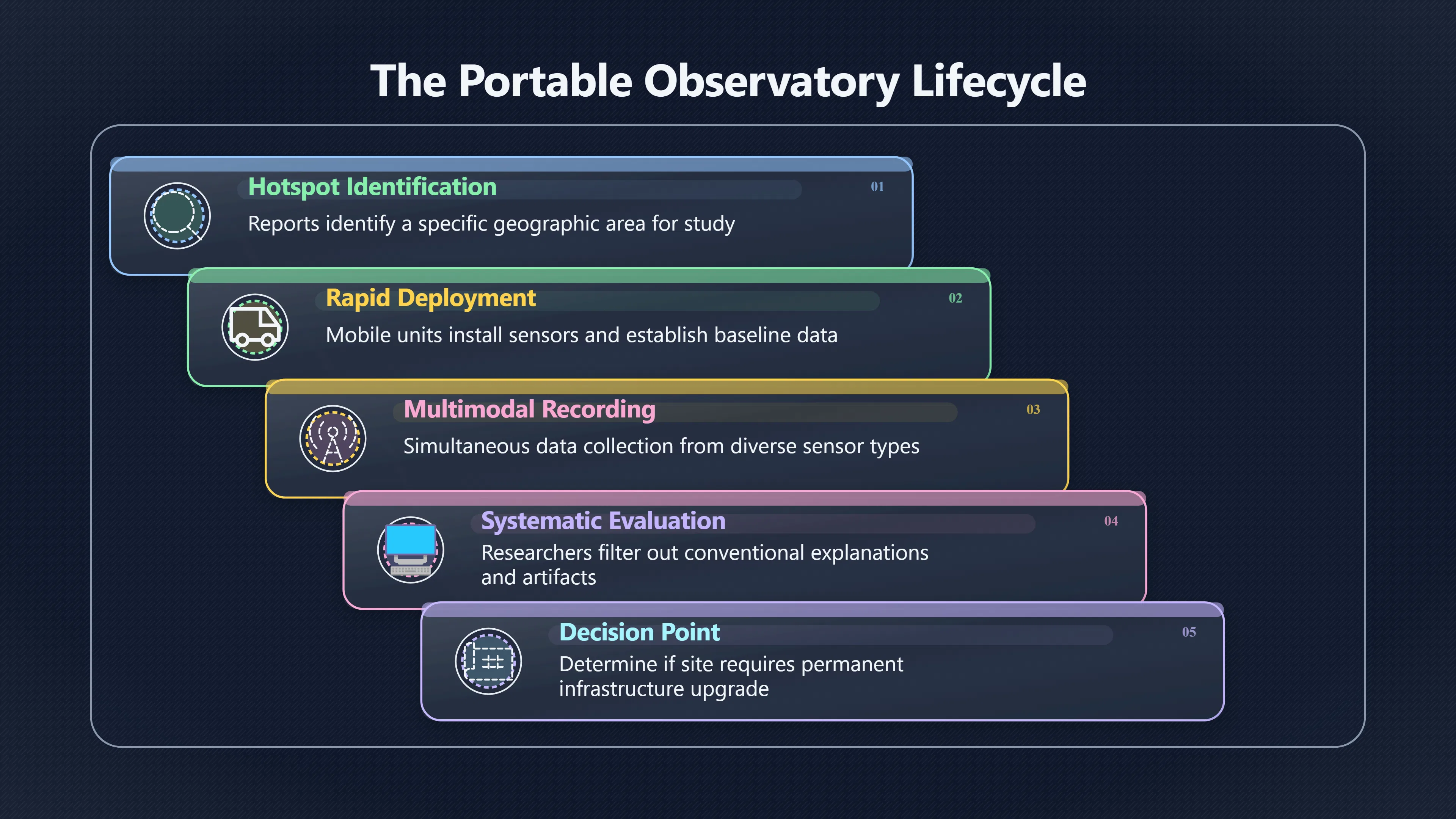
This creates an efficient investigative cycle:
- Reports identify a possible hotspot.
- A portable station conducts intensive multimodal observations.
- Ordinary explanations are systematically evaluated.
- The site is either retired or upgraded to longer-term monitoring if warranted.
Rather than treating reported hotspots as inherently mysterious, portable detector stations treat them as testable field locations whose value depends on the quality, repeatability and completeness of the data collected there.
Amazon book picks
Further Reading
Books and field guides related to Why Move a Detector to the Mystery?. Use these as the next step if you want deeper reading beyond the article.

UFOs : Generals, Pilots, and Government Officials Go on the R...
Emphasizes collecting credible evidence from multiple sources.
Identified Flying Objects
Provides broader context for organized investigations of unusual aerial reports.
eBay marketplace picks
Marketplace Samples
Example marketplace items related to this page. Use the search link to explore similar finds on eBay.

Endnotes
1.
Source: science.nasa.gov
Link:https://science.nasa.gov/uap/
Source snippet
NASA ScienceUAPJune 16, 2022 — 9 Jun 2022 — A study team to examine unidentified anomalous phenomena (UAPs) – that is, observations of ev...
Published: June 16, 2022
2.
Source: hessdalen.org
Link:https://www.hessdalen.org/
Source snippet
Project HessdalenProject HessdalenHessdalen offers a rare opportunity to study a persistent natural mystery with modern tools. During the...
3.
Source: arxiv.org
Link:https://arxiv.org/html/2506.00125v1
Source snippet
1 Introduction30 May 2025 — The Observatory system class is designed for the long-term study of UAP and is intended for comprehensiv...
Published: May 2025
4.
Source: arxiv.org
Link:https://arxiv.org/pdf/2305.18566
Source snippet
The Scienti¯c Investigation of Unidenti¯ed Aerial...by WA Watters · 2023 · Cited by 47 — A primary objective of the Galileo Project is t...
5.
Source: anl.gov
Link:https://www.anl.gov/article/mobile-climate-observatory-prepares-for-campaign-aboard-ship
Source snippet
Argonne National LaboratoryMobile climate observatory prepares for campaign aboard...16 Aug 2012 — Some sensors are located on the roof...
6.
Source: galileo.hsites.harvard.edu
Link:https://galileo.hsites.harvard.edu/publications/scientific-investigation-unidentified-aerial-phenomena-uap-using-multimodal
Source snippet
We describe an approach for highlighting outlier...
7.
Source: ui.adsabs.harvard.edu
Link:https://ui.adsabs.harvard.edu/abs/2023JAI….1240006W/abstract
Source snippet
Scientific Investigation of Unidentified Aerial...by WA Watters · 2023 · Cited by 47 — Our instrument package is multimodal and multispe...
Additional References
8.
Source: abdn.elsevierpure.com
Title: the scientific investigation of unidentified aerial phenomena uap
Link:https://abdn.elsevierpure.com/en/publications/the-scientific-investigation-of-unidentified-aerial-phenomena-uap
Source snippet
Aberdeen Research PortalThe Scientific Investigation of Unidentified Aerial...13 May 2023 — Our instrument package is multimodal and mul...
Published: May 2023
9.
Source: Wikipedia
Title: NASA Unidentified Anomalous Phenomena Independent Study Team
Link:https://en.wikipedia.org/wiki/NASA_Unidentified_Anomalous_Phenomena_Independent_Study_Team
Source snippet
NASA Unidentified Anomalous Phenomena Independent...UAPs are defined as phenomena or observations of events in the air, sea, space, a...
10.
Source: semanticscholar.org
Link:https://www.semanticscholar.org/paper/The-Scientific-Investigation-of-Unidentified-Aerial-Watters-Loeb/8ca4ac9526333072a07108952912a53c7894239c
Source snippet
ltimodal Ground-based Observatories · 14 Citations · 99 References.Read more...
11.
Source: researchgate.net
Link:https://www.researchgate.net/publication/371163445_The_Scientific_Investigation_of_Unidentified_Aerial_Phenomena_UAP_Using_Multimodal_Ground-Based_Observatories
Source snippet
The project employs various instruments...Read more...
12.
Source: youtube.com
Title: UAP Revelations with AARO’s Dep. Director Lt. Col. (ret.) Tim Phillips
Link:https://www.youtube.com/watch?v=yAaO4P4Jc1U
Source snippet
Kevin knuth "UFO Under Water, UAPX, A Tear In The Sky"...
13.
Source: youtube.com
Title: SOMETHING IS HAPPENING — We Are Detecting Anomalous Objects
Link:https://www.youtube.com/watch?v=op_wCAep23o
Source snippet
UAP Revelations with AARO's Dep. Director Lt. Col. (ret.) Tim Phillips...
14.
Source: facebook.com
Link:https://www.facebook.com/NOVAeducation/posts/there-have-been-reports-of-ufo-and-uap-sightings-for-decades-but-these-accounts-/1309792357853756/
Source snippet
are often difficult to verify...
15.
Source: gi.copernicus.org
Link:https://gi.copernicus.org/articles/14/335/2025/
Source snippet
by F Vervelidou · 2025 — We presented the first geomagnetic variometer station deployed within the context of the Galileo Project for t...
16.
Source: youtube.com
Title: Kevin knuth “UFO Under Water, UAPX, A Tear In The Sky”
Link:https://www.youtube.com/watch?v=bIKUwmnPV94
Source snippet
Inventor says his new radar network could spot UAPs | Reality Check...
17.
Source: authors.library.caltech.edu
Title: rcjwj zr809
Link:https://authors.library.caltech.edu/records/rcjwj-zr809
Source snippet
Scientific Investigation of Unidentified Aerial...by WA Watters · Cited by 47 — Our instrument package is multimodal and multispectral...
Topic Tree