Within Infrared
Why Ordinary Planes Make Better UAP Data
Known aircraft can become calibration targets that reveal whether an infrared station is pointing and detecting correctly.
On this page
- Aircraft as moving calibration targets
- Matching broadcasts to thermal detections
- What missed aircraft reveal about the system
Page outline Jump by section
Introduction
A night-time infrared sky camera is only useful for identifying genuinely unusual events if it can first demonstrate that it reliably detects ordinary ones. For all-sky long-wave infrared (LWIR) systems, routine aircraft provide one of the best available calibration targets because their positions are independently reported through Automatic Dependent Surveillance–Broadcast (ADS-B), their flight paths cover much of the sky, and they appear under a wide range of distances, headings and weather conditions. By matching thermal detections with known aircraft tracks, researchers can verify where each camera is pointing, measure detection performance and identify systematic errors before classifying anything as unexplained. This approach has become a central feature of modern instrumented UAP observatories, including the Galileo Project’s all-sky infrared array, because it replaces subjective interpretation with repeatable engineering tests.[MDPI]mdpi.comCommissioning an All-Sky Infrared Camera Array for…by L Domine · 2025 · Cited by 11 — One of the key instruments is an all-sky inf…
Why aircraft are ideal moving calibration targets
Infrared all-sky cameras cannot usually rely on the traditional astronomical calibration methods used by visible-light observatories. Stars are often too faint to appear in uncooled LWIR cameras, making celestial plate-solving impractical for determining precise camera orientation. Instead, aircraft with independently known positions become convenient moving reference points.[MDPI]mdpi.comCommissioning an All-Sky Infrared Camera Array for…by L Domine · 2025 · Cited by 11 — One of the key instruments is an all-sky inf…
An aircraft contributes several useful calibration properties simultaneously:
- Known three-dimensional position. ADS-B broadcasts provide latitude, longitude and altitude at frequent intervals, allowing the expected azimuth and elevation from the observing station to be calculated.
- Continuous movement. As an aircraft crosses the sky it samples many parts of the camera’s field of view rather than just one point.
- Wide operating range. Commercial, regional and general aviation aircraft pass at different altitudes and distances, testing the detector across realistic operating conditions.
- Regular occurrence. Busy airspace naturally produces hundreds or thousands of calibration opportunities without requiring dedicated test flights.
Unlike artificial calibration sources placed near the instrument, aircraft also test the complete observing chain, including atmospheric transmission, optics, timing, detection software and object tracking.
Matching broadcasts to thermal detections
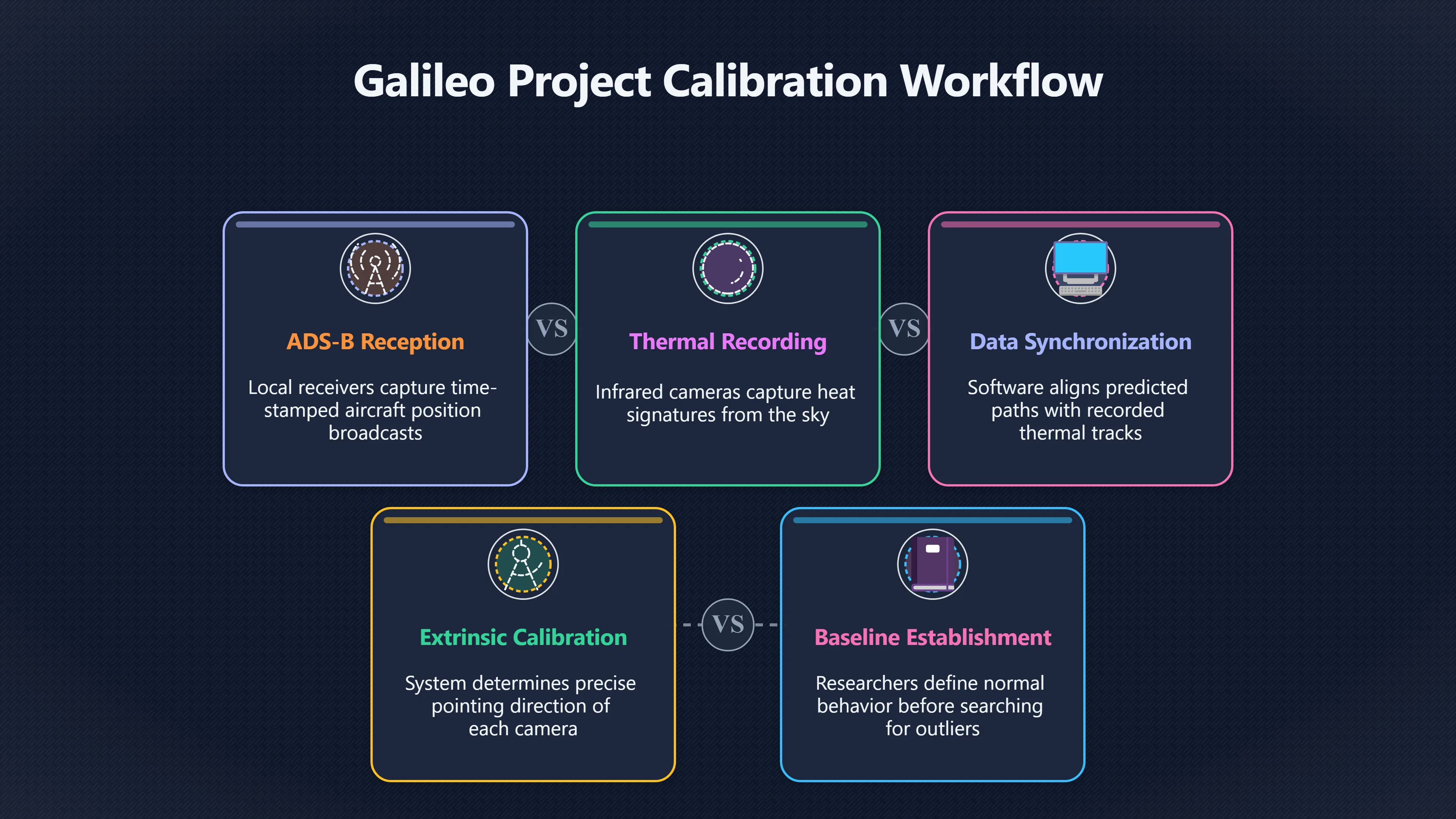
The calibration process depends on synchronising several independent datasets rather than simply checking whether an aeroplane appears in an image.
First, the observing station records ADS-B transmissions using a local receiver. These broadcasts provide time-stamped aircraft positions that can be converted into predicted viewing angles from the camera location. Simultaneously, the infrared cameras record thermal video while object-detection software identifies moving heat sources.
Researchers then compare the predicted aircraft position with the detected infrared object. If the camera geometry is correct, the thermal track should follow the expected path with only small residual errors. If consistent offsets appear, they indicate that the camera orientation or geometric model requires adjustment.[MDPI]mdpi.comCommissioning an All-Sky Infrared Camera Array for…by L Domine · 2025 · Cited by 11 — One of the key instruments is an all-sky inf…
The Galileo Project’s commissioning paper describes this as a novel method of extrinsic calibration—determining the precise pointing direction of each camera after intrinsic lens and thermal calibrations have already been completed. Because the system contains overlapping cameras covering almost the entire sky, matching aircraft across adjacent views also helps verify that neighbouring cameras share a consistent geometric reference frame.[MDPI]mdpi.comCommissioning an All-Sky Infrared Camera Array for…by L Domine · 2025 · Cited by 11 — One of the key instruments is an all-sky inf…
Aircraft passes also measure detection performance
Calibration is not only about pointing accuracy. Once the expected aircraft population is known from ADS-B, every flight becomes a controlled performance test.
Researchers can calculate measures such as:
- Acceptance rate: the proportion of aircraft that should have been visible within the instrument’s field of view and were successfully recorded.
- Detection efficiency: the proportion of recorded aircraft that the automated detection software correctly identified.
- Tracking quality: how consistently the software follows an aircraft through consecutive frames without fragmenting the trajectory.
These statistics can then be grouped by distance, aircraft size, elevation angle and environmental conditions. Instead of asking whether the system “works”, engineers obtain quantitative performance curves showing where it succeeds and where it begins to fail.[MDPI]mdpi.comCommissioning an All-Sky Infrared Camera Array for…by L Domine · 2025 · Cited by 11 — One of the key instruments is an all-sky inf…
This baseline is especially important in UAP studies because an apparently unusual event may simply occur in a region of parameter space where ordinary aircraft are already difficult to detect.

What missed aircraft reveal about the system
A missed aircraft is often more informative than a successful detection.
When ADS-B predicts an aircraft but no thermal track appears, investigators can examine why. Possible explanations include:
- poor atmospheric transmission caused by humidity or precipitation;
- low thermal contrast between the aircraft and background sky;
- temporary lens contamination such as rain droplets;
- obstruction from trees or buildings near the horizon;
- image-processing thresholds that are too conservative;
- tracking software losing weak or partially obscured targets.
The Galileo Project’s commissioning study found that weather and environmental conditions—including precipitation, reduced visibility, high relative humidity and local obstructions—significantly affected aircraft detection performance. These effects become measurable only because the expected aircraft population is already known from ADS-B records.[MDPI]mdpi.comCommissioning an All-Sky Infrared Camera Array for…by L Domine · 2025 · Cited by 11 — One of the key instruments is an all-sky inf…
Without this comparison, a missing detection might be mistaken for random variability rather than evidence of a specific instrumental limitation.
Why ordinary aircraft strengthen claims about unusual detections
One common misconception is that aircraft calibration merely filters out known aeroplanes. Its larger scientific value is establishing confidence in the entire observing system.
Suppose an infrared object appears that has no corresponding ADS-B transmission. Before considering it anomalous, investigators can ask several evidence-based questions:
- Was the camera accurately aligned at that time?
- Were ordinary aircraft being detected normally during the same observing period?
- Was the weather within the system’s validated operating envelope?
- Was the object reconstructed consistently across multiple cameras?
If the instrument was simultaneously tracking numerous known aircraft with expected accuracy, confidence increases that the unknown detection represents a genuine external object rather than a calibration error or software malfunction. Conversely, if the station was already missing many ordinary aircraft because of degraded observing conditions, caution is warranted before interpreting any unexplained track.
This reflects a broader recommendation made by NASA’s Independent UAP Study Team: scientific progress depends less on isolated videos than on well-calibrated sensors, complete metadata and multiple independent measurements.[NASA Science]science.nasa.govNASA ScienceIndependent Study Team ReportThe panel notes that, at present, gathering data on UAP is hampered by sensor calibration challe…
From calibration target to operational baseline
The Galileo Project’s published commissioning campaign reconstructed approximately half a million aerial trajectories over five months of observations. Most represented ordinary airborne traffic whose independently known positions allowed the researchers to establish baseline system behaviour before conducting any search for statistical outliers. Rather than treating routine aircraft as unwanted clutter, the project treated them as the reference population against which detection algorithms, uncertainty estimates and later anomaly searches could be evaluated.[arXiv]arxiv.orgOpen source on arxiv.org.
This philosophy marks an important shift in automated UAP detection. Ordinary aircraft are not simply objects to exclude from analysis—they are the continuous, real-world calibration source that demonstrates whether an infrared sky camera is accurately pointed, correctly detecting moving targets and operating within its validated performance limits. Only after that foundation has been established can unidentified events be interpreted with scientific confidence.
Amazon book picks
Further Reading
Books and field guides related to Why Ordinary Planes Make Better UAP Data. Use these as the next step if you want deeper reading beyond the article.

UFOs : Generals, Pilots, and Government Officials Go on the R...
Provides context for evidence-based UAP research and why high-quality instrumented observations matter.
The UFO Enigma
Emphasizes careful analysis of physical evidence, aligning with the article's calibration-first approach.
Identified Flying Objects
Focuses on scientific approaches to unusual aerial observations rather than anecdotal accounts.

Introduction to infrared and electro-optical systems
Explains infrared imaging fundamentals relevant to aircraft detection, calibration, and sensor performance.
eBay marketplace picks
Marketplace Samples
Example marketplace items related to this page. Use the search link to explore similar finds on eBay.

Endnotes
1.
Source: mdpi.com
Link:https://www.mdpi.com/1424-8220/25/3/783
Source snippet
Commissioning an All-Sky Infrared Camera Array for...by L Domine · 2025 · Cited by 11 — One of the key instruments is an all-sky inf...
2.
Source: science.nasa.gov
Link:https://science.nasa.gov/wp-content/uploads/2023/09/uap-independent-study-team-final-report.pdf
Source snippet
NASA ScienceIndependent Study Team ReportThe panel notes that, at present, gathering data on UAP is hampered by sensor calibration challe...
3.
Source: arxiv.org
Link:https://arxiv.org/abs/2411.07956
4.
Source: nasa.gov
Title: update nasa shares uap independent study report names director
Link:https://www.nasa.gov/news-release/update-nasa-shares-uap-independent-study-report-names-director/
Source snippet
UPDATE: NASA Shares UAP Independent Study Report14 Sept 2023 — We found that NASA can help the whole-of-government UAP effort through sys...
5.
Source: science.nasa.gov
Link:https://science.nasa.gov/uap/
Source snippet
9, 2022 — A study team to examine unidentified anomalous phenomena (UAPs) – that is, observations of events in the sky that cannot be ide...
6.
Source: nasa.gov
Title: to release discuss unidentified anomalous phenomena report
Link:https://www.nasa.gov/news-release/nasa-to-release-discuss-unidentified-anomalous-phenomena-report/
Source snippet
NASA to Release, Discuss Unidentified Anomalous...12 Sept 2023 — NASA defines UAP as observations of events in the sky that cannot be id...
7.
Source: ilrs.gsfc.nasa.gov
Title: session5 Wilkinson presentation
Link:https://ilrs.gsfc.nasa.gov/2019_Technical_Workshop/docs/2019/presentations/Session5/session5_Wilkinson_presentation.pdf
Source snippet
3. An observer beside...Read more...
8.
Source: phys.org
Title: 2025 04 sky infrared camera dalek alien
Link:https://phys.org/news/2025-04-sky-infrared-camera-dalek-alien.html
Source snippet
the calibration...
9.
Source: space.com
Title: sensor metadata, and the lack of [baseline data]({{ ‘baseline-data/’ | relative_url }}),” the report states.Read more
Link:https://www.space.com/nasa-ufo-uap-study-team-first-results-revealed
Source snippet
NASA UFO report finds no evidence of 'extraterrestrial...14 Sept 2023 — "At present, analysis of UAP data is hampered by poor sensor cal...
10.
Source: ui.adsabs.harvard.edu
Link:https://ui.adsabs.harvard.edu/abs/arXiv%3A2411.07956
Source snippet
an All-Sky Infrared Camera Array for...an all-sky infrared camera array performing intrinsic and thermal calibrations, we implement a no...
Additional References
11.
Source: digitalcameraworld.com
Link:https://www.digitalcameraworld.com/photography/astrophotography/harvard-researchers-are-using-this-strange-looking-camera-to-look-for-extraterrestrial-evidence-in-the-skies
Source snippet
Harvard researchers are using this strange-looking...11 Apr 2025 — The Galileo Project's Dalek uses eight infared cameras to scan the en...
12.
Source: rev.com
Title: unidentified anomalous phenomena independent study report from nasa transcript
Link:https://www.rev.com/transcripts/unidentified-anomalous-phenomena-independent-study-report-from-nasa-transcript
Source snippet
UAP Independent Study Report from NASA18 Sept 2023 —... data collection that involves calibrating instruments, multiple measurements and...
13.
Source: youtube.com
Link:https://www.youtube.com/watch?v=TQcqOW39ksk
Source snippet
Unidentified Anomalous Phenomena Independent Study ReportNASA commissioned an independent study team to examine unidentified anomalous ph...
14.
Source: en.wikisource.org
Title: Page:UAP Independent Study Team Final Report
Link:https://en.wikisource.org/wiki/Page%3AUAP_Independent_Study_Team_-_Final_Report.pdf/31
Source snippet
Status of Existing Data. NASA collects an enormous amount of data using highly-calibrated, validated equipment from a variety of...Read...
15.
Source: thedebrief.org
Link:https://thedebrief.org/nasas-unidentified-anomalous-phenomena-report-key-takeaways/
Source snippet
NASA's Unidentified Anomalous Phenomena Report14 Sept 2023 — “At present, analysis of UAP data is hampered by poor sensor calibration...
16.
Source: universetoday.com
Title: an all sky infrared camera could search for alien spacecraft 1
Link:https://www.universetoday.com/articles/an-all-sky-infrared-camera-could-search-for-alien-spacecraft-1
Source snippet
An All-Sky Infrared Camera Named Dalek Continues...8 Apr 2025 — A new study led by the Harvard-Smithsonian Center for Astrophysics (CfA)...
17.
Source: researchgate.net
Link:https://www.researchgate.net/publication/388466760_Commissioning_an_All-Sky_Infrared_Camera_Array_for_Detection_of_Airborne_Objects
Source snippet
Dalek frame-by-frame object detection stage has an...
18.
Source: en.wikisource.org
Title: Responses to Statement of Task
Link:https://en.wikisource.org/wiki/NASA_Unidentified_Anomalous_Phenomena%3A_Independent_Study_Team_Report/Responses_to_Statement_of_Task
Source snippet
Unidentified Anomalous Phenomena: Independent...14 Oct 2023 — Indeed, several apparent UAP have been demonstrated to be sensor artifacts...
19.
Source: inverse.com
Title: uap public meeting may 2023
Link:https://www.inverse.com/science/uap-public-meeting-may-2023
Source snippet
NASA Says Some "Unidentified Anomalous Phenomena"...31 May 2023 — roughly 16 to 40 cannot be explained by more common issues like incorr...
Published: may 2023
20.
Source: youtube.com
Link:https://www.youtube.com/watch?v=bQo08JRY0iM
Source snippet
and categorizing unidentified anomalous phenomena...
Topic Tree