Within Radar
Can passive radar give UAP videos real distance?
Passive radar can turn a moving light from a flat video dot into a track with distance, motion and uncertainty limits.
On this page
- Why optical video loses distance
- How reflected broadcasts add range clues
- Where passive radar still leaves uncertainty
Page outline Jump by section
Introduction
Passive radar can help turn a puzzling point of light in a video into something that is physically measurable. A conventional camera records where an object appears in the sky and how its apparent position changes from frame to frame, but it usually cannot determine how far away that object is. Passive radar addresses that gap by exploiting existing radio transmissions, such as FM radio or digital television broadcasts, and measuring how their reflections from an object arrive at one or more receivers. Combined with camera imagery, these measurements can provide estimates of distance, speed and associated uncertainty rather than relying solely on visual interpretation. This is one reason passive multistatic radar has attracted interest for automated, instrumented UAP observatories, although it remains a supporting measurement rather than a definitive identifier. galileo.hsites.harvard.edu+2ftp.idu.ac.id[galileo.hsites.harvard.edu]galileo.hsites.harvard.eduOpen source on harvard.edu.

Why optical video loses distance
A single camera measures angles, not absolute position. If a bright object crosses the field of view, the recording shows its changing direction against the background sky but contains little direct information about range.
This creates a fundamental ambiguity. A nearby insect, a drone a few hundred metres away, a commercial aircraft tens of kilometres distant or even a satellite can all appear as similarly sized points of light under certain conditions. Apparent speed is equally deceptive because angular motion depends on both true velocity and distance. A nearby slow-moving object may sweep rapidly across the frame, while a distant fast-moving aircraft may appear almost stationary.
This limitation explains why many dramatic acceleration claims based on video alone later prove to be artefacts of perspective, zoom changes or camera motion. Without an independent estimate of range, converting image motion into real-world velocity is inherently uncertain. NASA’s independent UAP study highlighted the importance of calibrated, multi-sensor measurements precisely because optical imagery alone often lacks the metadata needed to reconstruct an object’s true motion.[MathWorks]mathworks.comMath Works How Do Radars Work?How Do Radars Work? - MATLAB & SimulinkDecember 24, 2021 — Learn how radar uses RF energy to sense the environment for detection…
How reflected broadcasts add range clues
Passive radar does not transmit any radio signal itself. Instead, it listens for radio waves already present in the environment and looks for faint reflections from airborne objects.
The basic geometry involves three components:
- a known broadcast transmitter, such as an FM radio station;
- one or more passive receiving stations;
- the reflecting object.
The receiver simultaneously records the direct broadcast signal and any delayed copy reflected by the target. By comparing these signals, signal-processing algorithms estimate the extra travel time, known as the bistatic delay, and the frequency shift caused by motion, known as the Doppler shift. These measurements define where the object could be relative to the transmitter and receiver. With several receivers, or several transmitters, the possible locations intersect, allowing estimation of three-dimensional position and velocity.[ftp.idu.ac.id+2ResearchGate]ftp.idu.ac.id31 Mar 2012 — Readers will find practical guidance on direct signal suppression, passive radar performance prediction, and detection and…
For an automated UAP detector, this means the optical system no longer has to infer distance entirely from appearance. Instead, the passive radar contributes an independently measured geometric constraint that can be fused with the camera track.
Turning a camera track into a measured trajectory
The greatest value comes from combining the two sensor types rather than treating either as complete on its own.
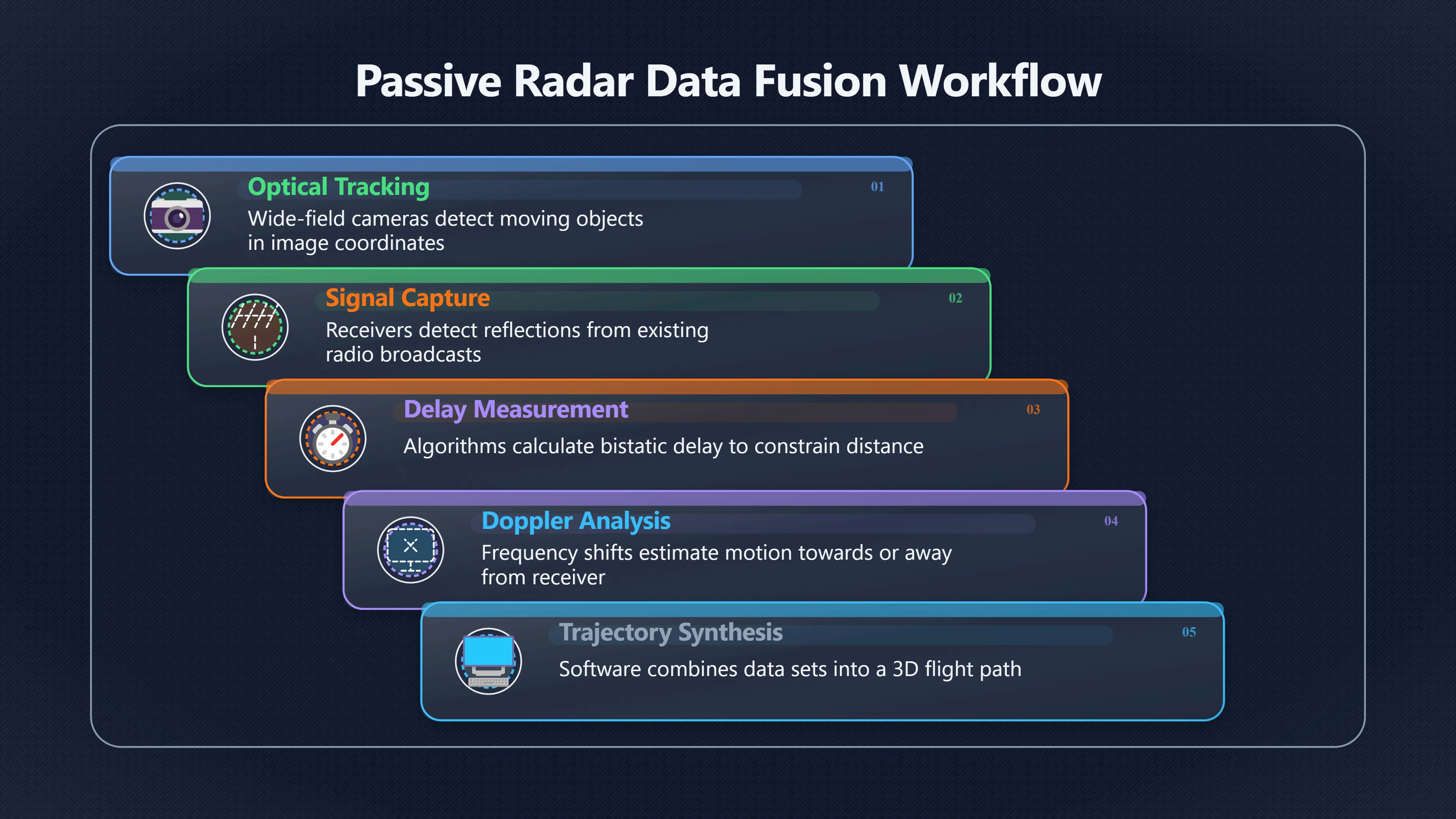
A typical data fusion process works as follows:
- A wide-field camera detects and tracks a moving object in image coordinates.
- Passive radar independently detects a reflection associated with the same time and direction.
- Delay measurements constrain the object’s distance from the transmitter-receiver geometry.
- Doppler measurements estimate motion towards or away from the receiver.
- Software combines both datasets to estimate a three-dimensional trajectory together with statistical confidence limits.
Instead of reporting that “a light crossed the sky”, the system can produce statements such as:
- estimated range;
- estimated altitude;
- radial velocity;
- uncertainty bounds;
- consistency with known aircraft performance.
This makes later investigation far more rigorous because alternative explanations can be tested quantitatively rather than visually.

Why multiple receivers matter
A single passive radar receiver usually cannot determine a unique position. The measured delay corresponds to a family of possible locations rather than one exact point.
Adding more receivers dramatically improves the situation. Each additional receiver contributes another independent delay and Doppler measurement. Their combined geometry allows triangulation and reduces ambiguity, much as multiple cameras improve optical triangulation.
The Galileo Project’s proposed SkyWatch passive multistatic radar illustrates this approach. Rather than relying on one station, it distributes receivers across a region and combines delay and Doppler measurements centrally to estimate three-dimensional position and velocity. Published design goals include tracking objects out to roughly 150 km horizontally and altitudes approaching 80 km using commercial FM broadcasts as illuminators of opportunity.[galileo.hsites.harvard.edu]galileo.hsites.harvard.eduOpen source on harvard.edu.
For a UAP observatory, this means that the “distance” attached to a video track is not guessed from image size but estimated from measured radio propagation.
Where passive radar still leaves uncertainty
Passive radar does not eliminate uncertainty. It changes the type of uncertainty from purely visual interpretation to measurable estimation.
Important limitations include:
- Dependence on existing transmitters. Performance varies with the strength, location and waveform of available broadcasts.
- Limited range resolution. FM radio has relatively narrow bandwidth, producing coarser range estimates than some digital television signals. Digital broadcast systems generally offer finer range resolution but introduce different tracking challenges for moving targets.[Norsk]ffi.noNorsk DVB-T based Passive Bistatic RadarNorskDVB-T based Passive Bistatic RadarJanuary 1, 2010 — The next generation Passive Bistatic Radar systems will be based on digital tran…
- Weak reflections. Small objects, low radar cross-sections or unfavourable viewing angles may produce echoes too weak to detect reliably.
- Multipath reflections. Buildings, terrain and other structures can create additional reflected signals that complicate localisation.
- Association errors. A radar detection and a camera detection must genuinely correspond to the same object; otherwise, incorrect tracks can be created.
Modern passive radar research focuses heavily on improving localisation algorithms, clutter rejection and uncertainty estimation because these practical issues dominate real-world performance.[MDPI+2ebuah.uah.es]mdpi.comCompact Bistatic Iterative Passive Radar Based on…by VP Gil Jiménez · 2025 · Cited by 1 — This paper presents the design of a comp…
What changes for automated UAP detection
The practical contribution of passive radar is not that it proves an unidentified object is extraordinary. Rather, it converts an ambiguous optical observation into one that can be analysed using physical measurements.
A camera alone may show an unexplained moving light. A camera combined with passive radar can often estimate where that light was, how fast it moved and how uncertain those estimates are. Those measurements make it easier to compare the event against aircraft, balloons, drones, satellites and atmospheric phenomena before considering more unusual possibilities.
Within an automated instrumented UAP detector, passive radar therefore serves as an independent ranging and kinematic sensor. Its greatest strength lies in reducing one of the largest weaknesses of sky video—the absence of reliable distance—while still recognising that every measurement carries uncertainty that must be quantified rather than ignored.[galileo.hsites.harvard.edu+2arXiv]galileo.hsites.harvard.eduOpen source on harvard.edu.
Amazon book picks
Further Reading
Books and field guides related to Can passive radar give UAP videos real distance?. Use these as the next step if you want deeper reading beyond the article.
Introduction to Radar Systems
Provides the essential concepts behind range measurement and radar-based target localization.
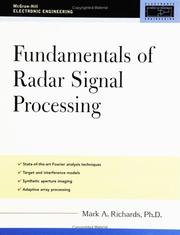
Fundamentals of Radar Signal Processing
Covers estimation, detection and signal processing concepts that influence passive radar range estimation.

Radar Handbook
Includes advanced discussion of radar performance, tracking and measurement accuracy.

The Hobbyist's Guide to the RTL-SDR
Demonstrates practical passive radio reception using low-cost SDR equipment.
eBay marketplace picks
Marketplace Samples
Example marketplace items related to this page. Use the search link to explore similar finds on eBay.
Endnotes
1.
Source: galileo.hsites.harvard.edu
Link:https://galileo.hsites.harvard.edu/publications/skywatch-passive-multistatic-radar-network-measurement-object-position-and
2.
Source: ftp.idu.ac.id
Link:https://ftp.idu.ac.id/wp-content/uploads/ebook/tdg/ADNVANCED%20MILITARY%20PLATFORM%20DESIGN/An%20Introduction%20to%20Passive%20Radar.pdf
Source snippet
31 Mar 2012 — Readers will find practical guidance on direct signal suppression, passive radar performance prediction, and detection and...
3.
Source: arxiv.org
Link:https://arxiv.org/abs/2305.18566
4.
Source: mathworks.com
Title: Math Works How Do Radars Work?
Link:https://www.mathworks.com/discovery/how-do-radars-work.html
Source snippet
How Do Radars Work? - MATLAB & SimulinkDecember 24, 2021 — Learn how radar uses RF energy to sense the environment for detection...
Published: December 24, 2021
5.
Source: arxiv.org
Link:https://arxiv.org/html/2506.00125v1
Source snippet
1 Introduction30 May 2025 — A system designed for the comprehensive scientific study of aerial phenomena which integrates multiple sensor...
Published: May 2025
6.
Source: researchgate.net
Link:https://www.researchgate.net/publication/331723832_Tutorial_Passive_radar_tutorial
Source snippet
Tutorial: Passive radar tutorial | Request PDFThe radar receiver aims to estimate the initial range (delay), range-rate (Doppler shift)...
7.
Source: arxiv.org
Link:https://arxiv.org/abs/2305.18562
8.
Source: researchgate.net
Link:https://www.researchgate.net/publication/328033052_Passive_bistatic_radar_using_digital_video_broadcasting-terrestrial_receivers_as_general-purpose_software-defined_radio_receivers
Source snippet
(PDF) Passive bistatic radar using digital video...19 Oct 2018 — We demonstrate the detection of static and moving targets as well as sh...
9.
Source: mdpi.com
Link:https://www.mdpi.com/2076-3417/15/7/3460
Source snippet
Compact Bistatic Iterative Passive Radar Based on...by VP Gil Jiménez · 2025 · Cited by 1 — This paper presents the design of a comp...
10.
Source: ebuah.uah.es
Link:https://ebuah.uah.es/xmlui/bitstream/handle/10017/50902/Thesis%20Pedro%20Jose%20Gomez%20del%20Hoyo.pdf?isAllowed=y&sequence=1
Source snippet
Improvement of detection and tracking techniques in...This PhD Thesis is the result of a intense research activity focused on the improv...
11.
Source: mdpi.com
Title: 2504 446X
Link:https://www.mdpi.com/2504-446X/9/1/76
Source snippet
UAV Detection with Passive Radar: Algorithms...by Z Tang · 2025 · Cited by 39 — This [review]({{ 'review/' | relative_url }}) aims to offer insights that can support furt...
12.
Source: researchgate.net
Title: 392334596 Galileo Project Observatory Class System Architecture
Link:https://www.researchgate.net/publication/392334596_Galileo_Project_Observatory_Class_System_Architecture
Source snippet
(PDF) Galileo Project Observatory Class System Architecture30 May 2025 — The Galileo Project aims to investigate Unidentified Aerial Phen...
Published: May 2025
13.
Source: galileo.hsites.harvard.edu
Title: scientific investigation unidentified aerial phenomena uap using multimodal
Link:https://galileo.hsites.harvard.edu/publications/scientific-investigation-unidentified-aerial-phenomena-uap-using-multimodal
Source snippet
Scientific Investigation of Unidentified Aerial Phenomena...A primary objective of the Galileo Project is to build an integrated softwar...
14.
Source: mdpi.com
Link:https://www.mdpi.com/1424-8220/19/7/1672
Source snippet
Tracking Multiple Targets from Multistatic Doppler Radar...by CT Do · 2019 · Cited by 31 — This paper proposes a method for tracking mul...
15.
Source: ffi.no
Title: Norsk DVB-T based Passive Bistatic Radar
Link:https://www.ffi.no/en/publications-archive/dvb-t-based-passive-bistatic-radar
Source snippet
NorskDVB-T based Passive Bistatic RadarJanuary 1, 2010 — The next generation Passive Bistatic Radar systems will be based on digital tran...
Published: January 1, 2010
Additional References
16.
Source: avi-loeb.medium.com
Link:https://avi-loeb.medium.com/commissioning-data-on-half-a-million-objects-in-the-sky-from-the-galileo-project-observatory-are-a23bd084233a
Source snippet
Data on Half a Million Objects in the Sky from...The GP Observatories offer an array of multi-modal, multi-spectral sensors that continu...
17.
Source: jmfriedt.free.fr
Link:https://jmfriedt.free.fr/dvbt_hardware.pdf
Source snippet
bistatic radar using DVB-T receivers as general...We demonstrate the detection of static and moving targets as well as short-range targe...
18.
Source: thedebrief.org
Link:https://thedebrief.org/galileo-project-releases-commissioning-data-on-half-a-million-aerial-objects-are-any-of-them-uap/
Source snippet
Galileo Project Releases Commissioning Data on Half a...12 Nov 2024 — The Galileo Project Observatories offer an array of multimodal, mu...
19.
Source: youtube.com
Link:https://www.youtube.com/watch?v=mvFCjX1HHGo
Source snippet
Fundamental Concepts in Radar Signal ProcessingThis video dives into the core principles of radar signal processing such as waveforms, ra...
20.
Source: youtube.com
Link:https://www.youtube.com/watch?v=FpAJm6X2a4c
Source snippet
»Radar in Action« DVB-S based passive radar imagingOne of the most recent development in the field of passive radar is the possibility to...
21.
Source: publications.sto.nato.int
Link:https://publications.sto.nato.int/publications/STO%20Educational%20Notes/RTO-EN-SET-119-2009/EN-SET-119%282009%29-03.pdf
Source snippet
(PBR) systems, and in particular the nature of the waveforms of illuminators of opportunity that...Read more...
22.
Source: sto.nato.int
Title: passive radar for satellite detection and tracking
Link:https://www.sto.nato.int/document/passive-radar-for-satellite-detection-and-tracking/
Source snippet
Radar for Satellite Detection and Tracking20 Jan 2026 — This lecture presents an overview of passive radar techniques for the detection a...
23.
Source: youtube.com
Title: Inventor says his new radar network could spot UAPs | Reality Check
Link:https://www.youtube.com/watch?v=mwsEatnZ358
Source snippet
Project Dark Track: Filtering UAP Telemetry - YouTube Project Dark Track: Filtering UAP Telemetry - YouTube...
24.
Source: youtube.com
Title: More “Reality Check” episodes
Link:https://www.youtube.com/watch?v=rEYDY2EMm8c
Source snippet
"Retired U.S. Navy Rear Admiral Tim Gallaudet on Grusch, UAP claims: Full Interview | Reality Check: [https://www.youtube.com/watch?v=Qh_h5..."](https://www.youtube.com/watch?v=Qh_h5...")...
25.
Source: scribd.com
Link:https://www.scribd.com/document/990347377/IEEE-a-E-SYSTEMS-MAGAZINE-Heiner-Kuschel-Diego-Cristallini-Fraunhofer-Germany-Karl-Erik-Olsen-Norwegian-Defence-Research-Establishment-Norway
Source snippet
pment, and processing techniques over the past...Read more...
Topic Tree