Within Edge Computer
Why the seconds before a trigger matter
A rolling buffer can turn a late trigger into a complete event record by preserving what happened just before the alert.
On this page
- What rolling buffers keep and discard
- Why pre event frames change interpretation
- Storage tradeoffs for all night stations
Page outline Jump by section
Introduction
A rolling buffer, also known as a circular or ring buffer, is one of the simplest but most valuable mechanisms in an automated sky station. Instead of waiting for an event before recording, the system records continuously into a fixed block of memory while constantly overwriting its oldest data. When a trigger finally occurs—perhaps a fast-moving object, an unusual infrared signature or a multi-sensor coincidence—the buffer is “frozen” and preserved together with the following seconds of data. The result is a complete event record that includes what happened before the alert, not just after it. This solves a fundamental problem in automated UFO or UAP detector design: by the time software decides that something is interesting, the beginning of the event has already happened. Circular buffering is therefore an implementation choice that allows edge computing to recover the moments that would otherwise be permanently lost.[Spectrum Instrumentation+2Shane Colton]spectrum-instrumentation.comSpectrum InstrumentationRing Buffer ModeThe ring buffer mode is the standard mode of all digitizer/oscilloscope boards. Data is written i…

Why the seconds before a trigger matter
Most automated triggers are necessarily reactive. Motion detection, object classification or sensor fusion all require at least a small amount of time to gather evidence before deciding that an observation deserves protection. Even delays measured in hundreds of milliseconds can hide critical information when an object crosses a wide-field camera rapidly or appears only briefly.
Pre-trigger recording changes what investigators can reconstruct afterwards. Instead of beginning with an already-moving target, analysts can examine:
- where the object first entered the field of view;
- whether its apparent brightness changed before detection;
- whether another sensor showed activity slightly earlier;
- whether the trigger itself was delayed by software processing;
- whether the event emerged gradually or appeared suddenly.
For a scientific observatory, this distinction is important because interpretation often depends on the lead-up to the detection rather than the detection itself. An aircraft light emerging from cloud, an insect flying close to the lens, or a satellite flare may all produce similar trigger moments, yet their pre-event behaviour differs markedly. Continuous buffering preserves those diagnostic clues.[Spectrum Instrumentation+2Shane Colton]spectrum-instrumentation.comSpectrum InstrumentationRing Buffer ModeThe ring buffer mode is the standard mode of all digitizer/oscilloscope boards. Data is written i…
What rolling buffers keep and discard
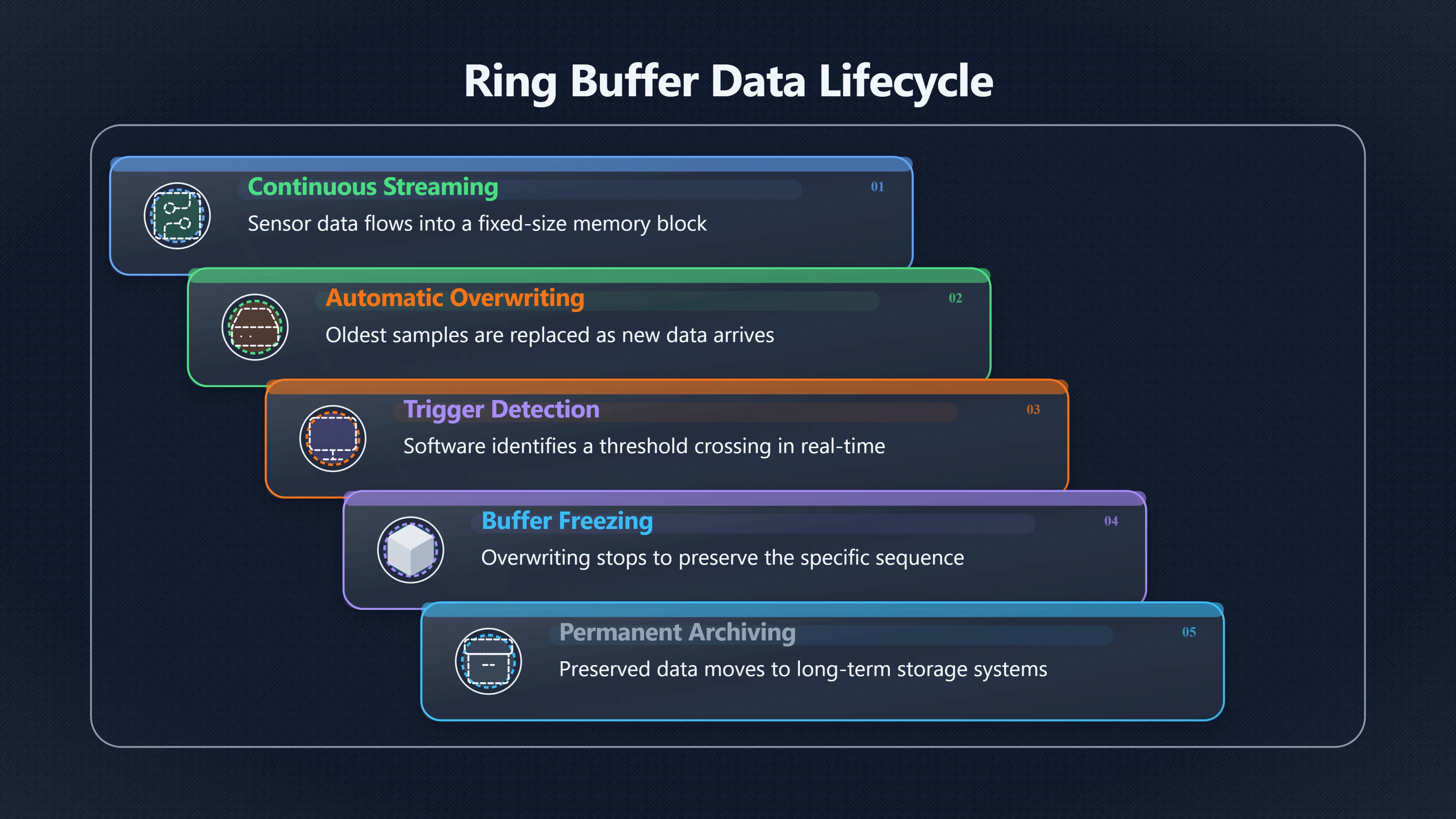
A rolling buffer maintains a fixed amount of recent history in fast storage, usually RAM or high-speed local memory.
Conceptually, the process is straightforward:
- Sensor data streams continuously into the buffer.
- When the buffer becomes full, the oldest samples are overwritten automatically.
- Detection software evaluates incoming data independently of the buffer itself.
- If a trigger threshold is exceeded, overwriting stops for that event.
- The preserved pre-trigger data is written to permanent storage together with post-trigger recording and metadata.
Because the buffer size never grows, memory use remains predictable regardless of how long the station operates. This makes the technique well suited to observatories expected to run throughout the night without interruption. Ring-buffer operation has long been standard in oscilloscopes and high-speed scientific instruments for exactly this reason: it guarantees access to samples recorded before the triggering event.[Spectrum Instrumentation]spectrum-instrumentation.comSpectrum InstrumentationRing Buffer ModeThe ring buffer mode is the standard mode of all digitizer/oscilloscope boards. Data is written i…
The preserved record is typically richer than video alone. A well-designed implementation stores synchronised timestamps, camera settings, sensor status, pointing information, environmental measurements and any concurrent observations from infrared, radio or acoustic instruments. The Galileo Project’s observatory architecture similarly emphasises local management of multi-sensor acquisition and data provenance before later post-processing, making pre-trigger preservation part of maintaining scientifically useful records rather than merely saving video.[arXiv]arxiv.org1 Introduction30 May 2025 — The first is the Edge Computing Subsystem which directly interfaces with the sensors and is located with…
Why pre-event frames change interpretation
The first frames of an observation often answer questions that later frames cannot.
A bright point already crossing half the sky when recording begins gives little information about its origin. If recording instead begins several seconds earlier, investigators may discover that:
- the object emerged from behind cloud;
- navigation lights identify a conventional aircraft;
- autofocus briefly failed before recovering;
- the apparent acceleration resulted from camera motion;
- the object originated at the image edge with an ordinary trajectory.
Equally important are negative findings. If no object exists in the pre-trigger frames despite a later detection, investigators can ask whether the trigger resulted from sensor artefacts, compression effects or a transient electronic fault instead of a genuine aerial target.
For automated UAP observatories, these earlier frames improve classification rather than increasing the number of reported anomalies. The objective is not simply to capture unusual images but to reduce ambiguity by preserving the sequence leading to detection.[arXiv]arxiv.org1 Introduction30 May 2025 — The first is the Edge Computing Subsystem which directly interfaces with the sensors and is located with…

Storage trade-offs for all-night stations
Rolling buffers exist because continuous permanent recording at maximum quality is often impractical.
Modern observatories may collect visible imagery, infrared video, environmental telemetry and other sensor streams simultaneously, producing hundreds of gigabytes per day even before multiple stations are networked. Saving every frame indefinitely would increase storage costs, bandwidth requirements and later analysis time.[arXiv]arxiv.org1 Introduction30 May 2025 — The first is the Edge Computing Subsystem which directly interfaces with the sensors and is located with…
Choosing the buffer duration therefore becomes an engineering trade-off.
Longer buffers provide more context before an event but require more memory and increase the amount of data written whenever a trigger occurs.
Shorter buffers reduce memory demands but risk losing the earliest evidence if software takes longer than expected to recognise an event.
Designers also balance:
- video resolution against available RAM;
- frame rate against retention time;
- compression efficiency against forensic quality;
- trigger frequency against nightly storage consumption.
Many systems therefore separate volatile buffering from permanent archiving. Only triggered intervals, together with their preserved pre-history, are committed to long-term storage while routine observations continue to be overwritten in memory. This allows continuous surveillance without requiring continuous archival recording.[Shane Colton+2Spectrum Instrumentation]scolton.blogspot.comShane ColtonCircular Buffer, Post Triggering, and Continuous Modes7 Sept 2014 — A circular buffer, where the oldest images are continuous…
Implementation considerations at the edge
Although the underlying data structure is simple, reliable pre-trigger capture depends on careful timing.
The rolling buffer should use a common clock across every participating sensor so that visible imagery, infrared frames, acoustic measurements and auxiliary telemetry refer to the same time base. Without synchronised timestamps, preserving several seconds before the trigger provides little benefit because observations cannot be aligned accurately afterwards.
Trigger handling also needs to avoid introducing additional latency. Once the decision threshold has been crossed, the edge computer should immediately preserve the existing buffer, continue recording for a configurable post-trigger interval and package both with calibration and provenance information before resuming normal circular operation. This fits naturally within edge-computing architectures that perform acquisition, optimisation and data integrity checks locally before forwarding selected observations for detailed analysis.[arXiv]arxiv.org1 Introduction30 May 2025 — The first is the Edge Computing Subsystem which directly interfaces with the sensors and is located with…
A small mechanism with a disproportionate scientific payoff
Rolling buffers are not sophisticated detection algorithms, yet they often determine whether an event becomes scientifically interpretable. They transform a late trigger into a complete observational record by preserving the seconds that would otherwise disappear through routine overwriting.
For automated instrumented UFO or UAP detector stations, that preserved context frequently matters more than extending the recording after the trigger. The evidence needed to distinguish an ordinary object from an anomalous one often lies not in what happened after software noticed it, but in what the instruments quietly recorded just beforehand.
Amazon book picks
Further Reading
Books and field guides related to Why the seconds before a trigger matter. Use these as the next step if you want deeper reading beyond the article.
Designing Data-Intensive Applications
Relevant to buffering, storage and event capture.



eBay marketplace picks
Marketplace Samples
Live-tested eBay searches with available results related to this page.


Endnotes
1.
Source: spectrum-instrumentation.com
Link:https://spectrum-instrumentation.com/support/knowledgebase/hardware_features/Ring_Buffer_Mode.php
Source snippet
Spectrum InstrumentationRing Buffer ModeThe ring buffer mode is the standard mode of all digitizer/oscilloscope boards. Data is written i...
2.
Source: arxiv.org
Link:https://arxiv.org/html/2506.00125v1
Source snippet
1 Introduction30 May 2025 — The first is the Edge Computing Subsystem which directly interfaces with the sensors and is located with...
Published: May 2025
3.
Source: arxiv.org
Title: arXiv [Galileo]({{ ‘galileo/’ | relative_url }}) Project Observatory Class System Architecture
Link:https://arxiv.org/abs/2506.00125
4.
Source: scolton.blogspot.com
Link:https://scolton.blogspot.com/2014/09/grasshopper3-circular-buffer-post.html
Source snippet
Shane ColtonCircular Buffer, Post Triggering, and Continuous Modes7 Sept 2014 — A circular buffer, where the oldest images are continuous...
5.
Source: Wikipedia
Title: The Galileo Project
Link:https://en.wikipedia.org/wiki/The_Galileo_Project
Source snippet
The Galileo ProjectThe Galileo Project is an international scientific research project to search for extraterrestrial intelligence or...
Additional References
6.
Source: Wikipedia
Link:https://en.wikipedia.org/wiki/Circular_buffer
Source snippet
Circular bufferA circular buffer, circular queue, cyclic buffer or ring buffer is a data structure that uses a single, fixed-size buff...
7.
Source: stackoverflow.com
Link:https://stackoverflow.com/questions/52256704/circular-buffer-for-recording-seconds-before-and-after-trigger-using-mediacaptur
Source snippet
Circular buffer for recording seconds before and after...I'm looking for an example of how to create a circular buffer using MediaCaptur...
8.
Source: forums.raspberrypi.com
Link:https://forums.raspberrypi.com/viewtopic.php?t=65450
Source snippet
Raspberry Pi ForumsCircular buffer functionalityBasically the video is recorded continuously into a large memory buffer until it either r...
9.
Source: rpg.ifi.uzh.ch
Link:https://rpg.ifi.uzh.ch/research_dvs.html
Source snippet
uzh.chEvent-based Vision, Event Cameras, Event Camera SLAMEvent cameras deliver visual data with high temporal resolution, low latency, a...
10.
Source: avi-loeb.medium.com
Link:https://avi-loeb.medium.com/commissioning-data-on-half-a-million-objects-in-the-sky-from-the-galileo-project-observatory-are-a23bd084233a
Source snippet
Data on Half a Million Objects in the Sky from...The GP Observatories offer an array of multi-modal, multi-spectral sensors that continu...
11.
Source: thedebrief.org
Link:https://thedebrief.org/galileo-project-releases-commissioning-data-on-half-a-million-aerial-objects-are-any-of-them-uap/
Source snippet
Galileo Project Releases Commissioning Data on Half a...12 Nov 2024 — The Galileo Project Observatories offer an array of multimodal, mu...
12.
Source: reddit.com
Link:https://www.reddit.com/r/BlueIris/comments/q293b0/pretrigger_video_buffer/
Source snippet
Pre-trigger video buffer: r/BlueIrisI have a group of two cameras, both are set to detect motion and trigger the group. Both are set to...
13.
Source: metrology.news
Link:https://metrology.news/event-camera-enables-process-monitoring-through-event-driven-image-and-video-sequences/
Source snippet
Event Camera Enables Process Monitoring Through...25 Nov 2025 — Due to the integrated circular buffer, videos are continuously buffered...
14.
Source: galileo.hsites.harvard.edu
Title: scientific investigation unidentified aerial phenomena uap using multimodal
Link:https://galileo.hsites.harvard.edu/publications/scientific-investigation-unidentified-aerial-phenomena-uap-using-multimodal
Source snippet
Scientific Investigation of Unidentified Aerial Phenomena...A primary objective of the Galileo Project is to build an integrated softwar...
15.
Source: youtube.com
Link:https://www.youtube.com/watch?v=zjOTAEfbnUc
Topic Tree