Within Radar
The aircraft broadcast check every sky station needs
Receiving aircraft broadcasts gives automated stations a simple way to label ordinary traffic before calling an event unusual.
On this page
- What aircraft broadcasts can identify
- Why non matches are not proof of anomaly
- How to sync ADS B with camera events
Page outline Jump by section
Introduction
For an automated instrumented UFO detector, the most important first question is often not “What is it?” but “Is it simply an aircraft?”. Automatic Dependent Surveillance–Broadcast (ADS-B) provides one of the easiest and most effective ways to answer that question. Many civil aircraft continuously broadcast their identity, position, altitude, speed and heading, allowing a ground station with an inexpensive receiver to recognise ordinary traffic before it is logged as a potential unidentified aerial phenomenon (UAP). This dramatically reduces false alerts, improves confidence in genuine anomalies and creates an auditable record explaining why an event was classified as mundane rather than unexplained. At the same time, ADS-B is not a perfect filter. Not every aircraft transmits ADS-B, reception can fail, and some tracks are reconstructed using other techniques. For that reason, the absence of a matching aircraft broadcast should never be treated as evidence of something anomalous.
What aircraft broadcasts can identify
ADS-B is a cooperative surveillance system. Instead of waiting for a radar interrogation, an equipped aircraft periodically broadcasts its own navigation solution and identification. Typical messages include:
- Aircraft identity or callsign.[skybrary.aero]skybrary.aeroAutomatic Dependent SurveillanceAutomatic Dependent Surveillance - Broadcast (ADS-B)ADS-B is a Surveillance technique that relies on aircraft or airport vehicles…
- A unique ICAO aircraft address.
- Latitude and longitude.
- Pressure altitude.
- Ground speed and track.[faa.gov]faa.govFederal Aviation Administration Automatic Dependent SurveillanceFederal Aviation AdministrationAutomatic Dependent Surveillance - Broadcast (ADS-B)29 Sept 2025 — ADS-B Out works by broadcasting informa…
- Vertical rate.
- Status information indicating whether the aircraft is climbing, descending or manoeuvring.
These broadcasts are transmitted approximately once per second on the internationally used 1090 MHz Extended Squitter (1090ES) link, with an additional 978 MHz Universal Access Transceiver (UAT) system used primarily by general aviation within the United States.[Federal Aviation Administration+2Skybrary]faa.govFederal Aviation Administration Automatic Dependent SurveillanceFederal Aviation AdministrationAutomatic Dependent Surveillance - Broadcast (ADS-B)29 Sept 2025 — ADS-B Out works by broadcasting informa…
For a UAP-monitoring station, the practical workflow is straightforward. A software-defined radio (SDR) tuned to 1090 MHz receives nearby ADS-B transmissions. Open-source software decodes the messages and stores them with accurate timestamps. If an optical camera records an unusual light, the station checks whether an ADS-B-equipped aircraft occupied the same position at the same time.
If the timing, bearing and elevation agree within expected measurement uncertainty, the event can normally be classified as known aircraft traffic rather than an unexplained object.
Why ADS-B is an unusually effective false-alarm filter
Many reported “mystery lights” are ordinary aircraft viewed under unusual lighting, atmospheric conditions or camera settings. ADS-B helps eliminate these routine cases because it provides an independent measurement rather than relying on image interpretation alone.
Compared with image-only classification, an ADS-B match offers several advantages:
- Independent confirmation. The aircraft reports its own position instead of being inferred from pixels.
- High temporal resolution. Frequent broadcasts allow the track to be matched closely to video frames.
- Trajectory prediction. The reported heading and speed make it possible to verify whether subsequent camera observations remain consistent with the aircraft’s expected movement.
- Permanent audit trail. Every rejected UAP candidate can be documented with the corresponding aircraft identifier and recorded broadcast data.
This is especially valuable when automated systems generate large numbers of candidate detections each night. Most are expected to be aircraft, and ADS-B removes many of them before more computationally expensive analysis is performed.
Why non-matches are not proof of anomaly
An ADS-B receiver is a powerful filter, but it is not a complete catalogue of everything flying overhead. Treating every non-match as unexplained would create many false positives.
Several limitations matter in practice.
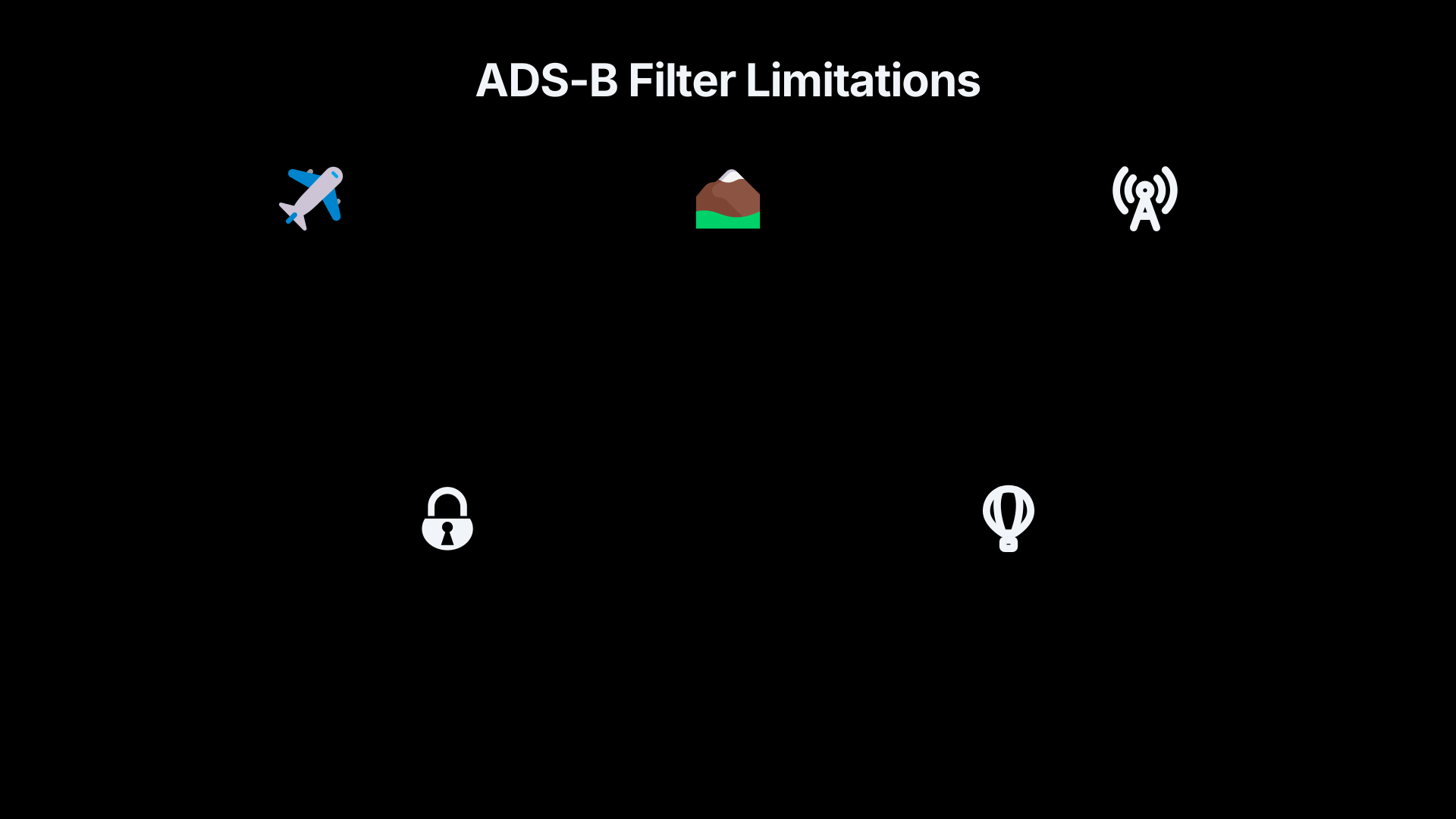
Not every aircraft broadcasts ADS-B. Equipage requirements differ between countries, airspace classes and aircraft categories. Some older aircraft, certain military flights and aircraft operating outside mandated airspace may not provide usable ADS-B transmissions.[Skybrary]skybrary.aeroAutomatic Dependent SurveillanceAutomatic Dependent Surveillance - Broadcast (ADS-B)ADS-B is a Surveillance technique that relies on aircraft or airport vehicles…
Reception depends on radio conditions. ADS-B is essentially line-of-sight. Terrain, buildings, antenna placement and receiver sensitivity all affect whether broadcasts are successfully decoded.
Coverage is incomplete in some areas. Public flight-tracking services rely on networks of volunteer receivers. Aircraft outside reception coverage may disappear even though they continue transmitting. Mode S multilateration (MLAT) can reconstruct positions for some aircraft, but only when multiple receivers detect compatible transponder signals.[ADS-B Exchange+2support.adsbexchange.com]adsbexchange.comADS-B ExchangeADS-B ExchangeADS-B Exchange connects the world's largest independent ADS-B receiver network, displaying all aircraft broad…
Privacy programmes exist. Some operators limit the public availability of flight information, although this should not be confused with the aircraft ceasing to transmit ADS-B itself. Public tracking websites may intentionally display less information than a local receiver captures.[Federal Aviation Administration]faa.govFederal Aviation AdministrationADS-B Privacy | Federal Aviation Administration22 Mar 2025 — The FAA acknowledges the desire of some opera…
Aircraft are not the only aerial objects. Balloons, birds, insects, satellites and drones generally require different identification methods. ADS-B should therefore be viewed as an aircraft filter, not a universal aerial-object detector.
For these reasons, a missing ADS-B correlation simply means “no suitable aircraft broadcast was found.” It does not establish that the object is unknown.

How to sync ADS-B with camera events
Successful implementation depends less on sophisticated algorithms than on disciplined time synchronisation.
A practical workflow is:
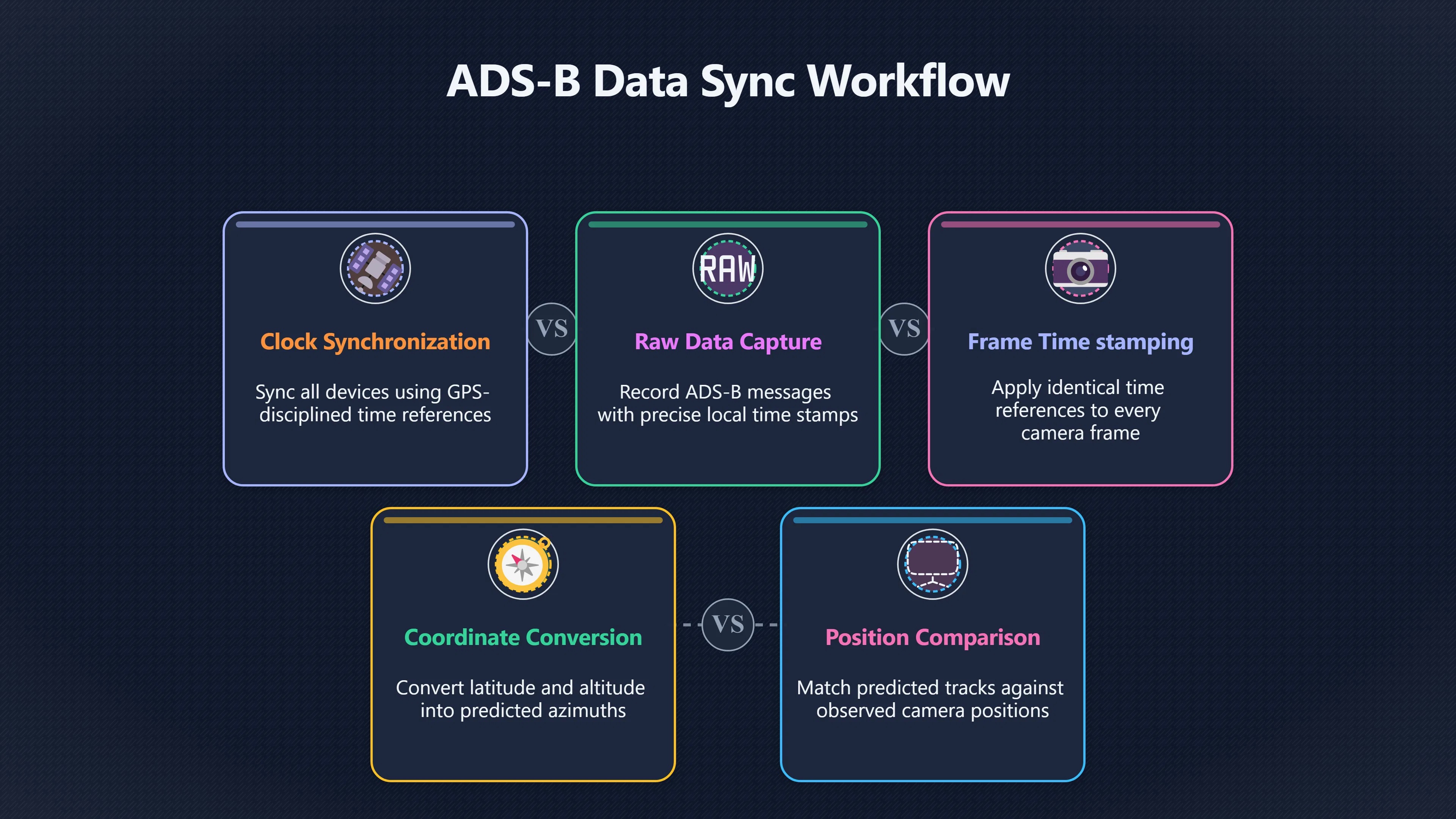
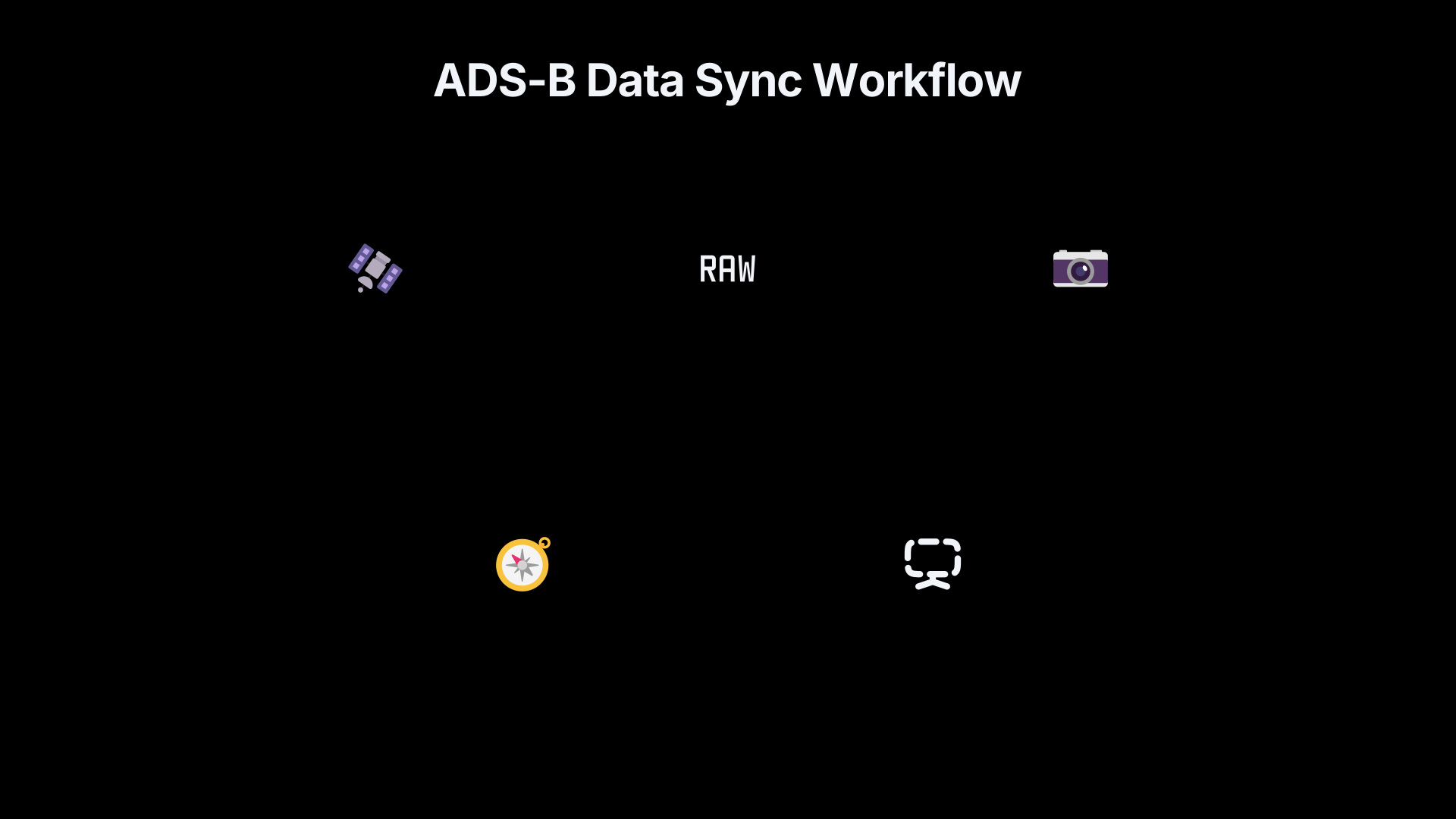
- Synchronise every device to a common clock using Network Time Protocol (NTP) or, preferably, GPS-disciplined time.
- Record raw ADS-B messages with precise timestamps rather than relying only on screenshots from flight-tracking websites.
- Timestamp every camera frame using the same time reference.
- Convert aircraft latitude, longitude and altitude into predicted azimuth and elevation from the observing station.
- Compare predicted and observed positions using a reasonable uncertainty window that accounts for camera calibration and receiver latency.
- Store both the original detection and the matching ADS-B evidence so later investigators can independently verify the classification.
Direct radio reception is generally preferable to relying exclusively on internet flight-tracking sites because local reception avoids network delays, data filtering and service outages while preserving the original timing of received broadcasts.
Practical implementation choices
For an automated sky station, ADS-B monitoring is inexpensive compared with most optical equipment.
A typical implementation consists of:
- A software-defined radio capable of receiving 1090 MHz signals.
- A dedicated ADS-B antenna with a clear view of the sky.
- Decoding software that outputs aircraft positions in real time.
- A local database storing decoded messages.
- Software linking aircraft tracks with camera detections through shared timestamps.
Many citizen-science observatories also compare their locally received data with independent public networks. Services built from distributed receiver networks can provide additional confirmation when local reception is incomplete, although locally recorded broadcasts remain the preferred evidence for precise event correlation.[ADS-B Exchange]adsbexchange.comADS-B ExchangeADS-B ExchangeADS-B Exchange connects the world's largest independent ADS-B receiver network, displaying all aircraft broad…
Common pitfalls that create unnecessary UAP alerts
Several implementation mistakes repeatedly generate avoidable false alarms.
Using public flight maps instead of raw broadcasts. Online maps may introduce delays, filtering or interpolation that reduce timing accuracy.
Ignoring clock drift. Even a few seconds of timestamp error can cause a genuine aircraft to appear unmatched.
Comparing only horizontal position. Aircraft altitude matters because the apparent direction changes significantly with elevation.
Using too small a matching window. Camera calibration errors, radio latency and optical distortion require realistic tolerance rather than exact pixel agreement.
Assuming all aircraft should appear. Missing broadcasts are expected under some operational conditions and should trigger additional checks rather than immediate anomaly classification.
ADS-B should be the first filter, not the final verdict
Within an automated UAP detection system, ADS-B works best as an exclusion tool. Its purpose is to remove the largest class of ordinary aerial objects before more specialised analysis begins.
A positive match strongly supports an aircraft explanation because it combines an independently transmitted position with an optical observation. A negative result is much weaker: it indicates only that no suitable broadcast was received or matched. Robust observatories therefore combine ADS-B with calibrated cameras, astronomical databases, weather information and, where available, passive radio or radar-style measurements. Together these layers minimise false UAP alerts while ensuring that genuinely unusual events are retained for closer examination rather than being lost among routine aircraft traffic.
Amazon book picks
Further Reading
Books and field guides related to The aircraft broadcast check every sky station needs. Use these as the next step if you want deeper reading beyond the article.
The 1090 Megahertz Riddle
Directly explains ADS-B transmissions, aircraft identification, and surveillance data.
Skunk Works
Offers accessible context on aircraft technology and aerospace development.

Introduction to Avionics Systems
Explains aircraft navigation, surveillance, and onboard electronic systems.

Stimson's Introduction to Airborne Radar
First published 2014. Subjects: Radar in aeronautics.
eBay marketplace picks
Marketplace Samples
Example marketplace items related to this page. Use the search link to explore similar finds on eBay.




Endnotes
1.
Source: skybrary.aero
Title: Automatic Dependent Surveillance
Link:https://skybrary.aero/articles/automatic-dependent-surveillance-broadcast-ads-b
Source snippet
Automatic Dependent Surveillance - Broadcast (ADS-B)ADS-B is a Surveillance technique that relies on aircraft or airport vehicles...
2.
Source: adsbexchange.com
Link:https://www.adsbexchange.com/
Source snippet
ADS-B ExchangeADS-B ExchangeADS-B Exchange connects the world's largest independent ADS-B receiver network, displaying all aircraft broad...
3.
Source: support.adsbexchange.com
Title: 36733937229837 Why Can t I See a Specific Aircraft or Aircraft in a Certain Area
Link:https://support.adsbexchange.com/hc/en-us/articles/36733937229837-Why-Can-t-I-See-a-Specific-Aircraft-or-Aircraft-in-a-Certain-Area
Source snippet
MLAT is derived from multiple receivers receiving Mode S messages from the same aircraft.Read more...
4.
Source: globe.adsbexchange.com
Link:https://globe.adsbexchange.com/
Source snippet
adsbexchange.comADS-B Exchange - track aircraft liveMLAT requires the contact to have a ModeS transponder and reception by 4 receivers. P...
5.
Source: faa.gov
Title: Federal Aviation Administration Automatic Dependent Surveillance
Link:https://www.faa.gov/about/office_org/headquarters_offices/avs/offices/afx/afs/afs400/afs410/ads-b
Source snippet
Federal Aviation AdministrationAutomatic Dependent Surveillance - Broadcast (ADS-B)29 Sept 2025 — ADS-B Out works by broadcasting informa...
6.
Source: adsbx.discourse.group
Link:https://adsbx.discourse.group/t/adsb-exchange-frequently-asked-questions/341
Source snippet
ADSB Exchange - Frequently Asked Questions - Articles17 Feb 2024 — To detect aircraft with MLAT, we need a minimum of 4 feeders to receiv...
7.
Source: faa.gov
Link:https://www.faa.gov/air_traffic/technology/equipadsb/privacy
Source snippet
Federal Aviation AdministrationADS-B Privacy | Federal Aviation Administration22 Mar 2025 — The FAA acknowledges the desire of some opera...
8.
Source: Wikipedia
Title: Automatic Dependent Surveillance–Broadcast
Link:https://en.wikipedia.org/wiki/Automatic_Dependent_Surveillance%E2%80%93Broadcast
Source snippet
Automatic Dependent Surveillance–BroadcastADS-B is an aviation surveillance technology and form of electronic conspicuity in which an...
Additional References
9.
Source: nbaa.org
Link:https://nbaa.org/aircraft-operations/security/privacy/ads-b-privacy-faq/
Source snippet
ADS-B Privacy FAQTo unblock your FAA [flight data]({{ 'flight-data/' | relative_url }}), submit a “No Blocking/Unblocking” request to remove any data limits previously requeste...
10.
Source: txtav.com
Link:https://txtav.com/en/journey/articles/articles/adsb-out-explained
Source snippet
ADS-B Out ExplainedADS-B allows equipped aircraft and ground vehicles to broadcast their identification, position, altitude and velocity...
11.
Source: nbaa.org
Link:https://nbaa.org/aircraft-operations/communications-navigation-surveillance-cns/ads-b/
Source snippet
fields including aircraft type, speed, flight number, and whether the...Read more...
12.
Source: aopa.org
Link:https://www.aopa.org/go-fly/aircraft-and-ownership/ads-b
Source snippet
r traffic controllers. It's also transmitted to aircraft...Read more...
13.
Source: blog.flightaware.com
Title: from radar to revolution the story of ads b
Link:https://blog.flightaware.com/from-radar-to-revolution-the-story-of-ads-b
Source snippet
Radar to Revolution: The Story of ADS-B25 Feb 2026 — Learn what ADS-B is, how it works, and why it's essential to modern flight tracking...
14.
Source: embention.com
Link:https://www.embention.com/embention-uam-academy/lesson/what-is-the-ads-b-system-automatic-dependent-surveillance-broadcast/
Source snippet
including 1090 ES, 978 UAT, and its integration into UAS avionics...
15.
Source: facebook.com
Link:https://www.facebook.com/groups/348704483442978/posts/1127108198935932/
Source snippet
ore? I havent seen planes i used to spot alot on the app...
16.
Source: youtube.com
Title: Anomalous phenomena and aerospace safety – solving the unknown is tough!
Link:https://www.youtube.com/watch?v=v4uqp6SXC3g
Source snippet
How Anyone Can Track Every Plane and Ship in Real Time (ADS-B + AIS)...
17.
Source: youtube.com
Title: How does ADS-B work?
Link:https://www.youtube.com/watch?v=7K1xFb1REHU
Source snippet
UAP tracking ADS-B ISpy ADSB Live Tracking Implementierung für die UAP Aufnahme Technische Ufoforschung mittels Bewegungserkennung...
18.
Source: youtube.com
Title: The UFO Data Acquisition Project [UFODAP]({{ ‘ufodap/’ | relative_url }}) | Ronald Olch
Link:https://www.youtube.com/watch?v=6bDGoVNyvh8
Source snippet
Anomalous phenomena and aerospace safety – solving the unknown is tough...
Topic Tree