Within False Positives
When Stars Turn Into Glowing Discs
Stars near poor focus or lens edges can become glowing discs, making a fixed point seem like an object with size and structure.
On this page
- How focus turns points into discs
- Why edge distortion can suggest structure
- Simple checks using star charts and camera metadata
Page outline Jump by section
Introduction
In automated instrumented UFO detection systems, some of the most convincing-looking “objects” are not objects at all. A bright star can be transformed by poor focus, lens aberrations, atmospheric effects and camera processing into a glowing disc that appears to have size, structure, colour changes and even apparent motion. To an observer reviewing footage, the result can resemble a distant craft rather than a point source of starlight. The risk is particularly high for unattended night cameras, which often operate with fixed focus, aggressive exposure settings and wide-angle optics. Understanding how stars become discs is therefore an essential part of filtering false positives from genuine anomalies. Astronomical imaging research and optical engineering both show that point sources change shape dramatically when focus shifts or optical aberrations are present.[arXiv]arxiv.orgThe M4 Core Project with HST – V. Characterizing the PSFs of WFC3/UVIS by FocusJune 1, 2017…

How Focus Turns Points Into Discs
A star is effectively a point source at astronomical distances. In a properly focused optical system, that point is recorded as a tiny image determined by the system’s point-spread function (PSF), the characteristic way an optical system renders a point of light. When focus is lost, the star’s light is no longer concentrated into a tiny spot and instead spreads across a larger area of the sensor. Astronomers routinely use the changing size and shape of stellar images to measure focus because the effect is so pronounced.[arXiv]arxiv.orgThe M4 Core Project with HST – V. Characterizing the PSFs of WFC3/UVIS by FocusJune 1, 2017…
For a UFO observer, this matters because the enlarged image no longer resembles a star. Instead it can appear as:
- A luminous circular disc.
- A glowing orb with a bright centre.
- A ring-like shape.
- A soft-edged object that seems larger than nearby stars.
- A coloured object that changes appearance as focus drifts.
The illusion becomes stronger when digital zoom is applied. Enlarging a defocused star enlarges the blur pattern rather than revealing detail. Viewers often interpret the resulting shape as surface structure, windows, rotating features or energy effects when they are actually looking at an enlarged optical artefact. This is a common failure mode in night-sky UFO videos because stars are among the brightest fixed targets available to the camera.[forums.sharpcap.co.uk]forums.sharpcap.co.ukI can't see any stars at all with any cameraplease help!If you are out of focus by a long way, the star light is spread over a large, faint, disk, but with these settings you should…
A further complication is that many camera systems continuously adjust focus or exposure. As the camera hunts for focus, the star’s apparent size can expand and contract, creating the impression that the object itself is changing shape or distance.[arXiv]arxiv.orgThe M4 Core Project with HST – V. Characterizing the PSFs of WFC3/UVIS by FocusJune 1, 2017…
Why Edge Distortion Can Suggest Structure
Defocus is only part of the problem. Optical aberrations become increasingly important away from the centre of the frame. A star near the edge of an image may no longer appear circular even when the central region is reasonably focused.
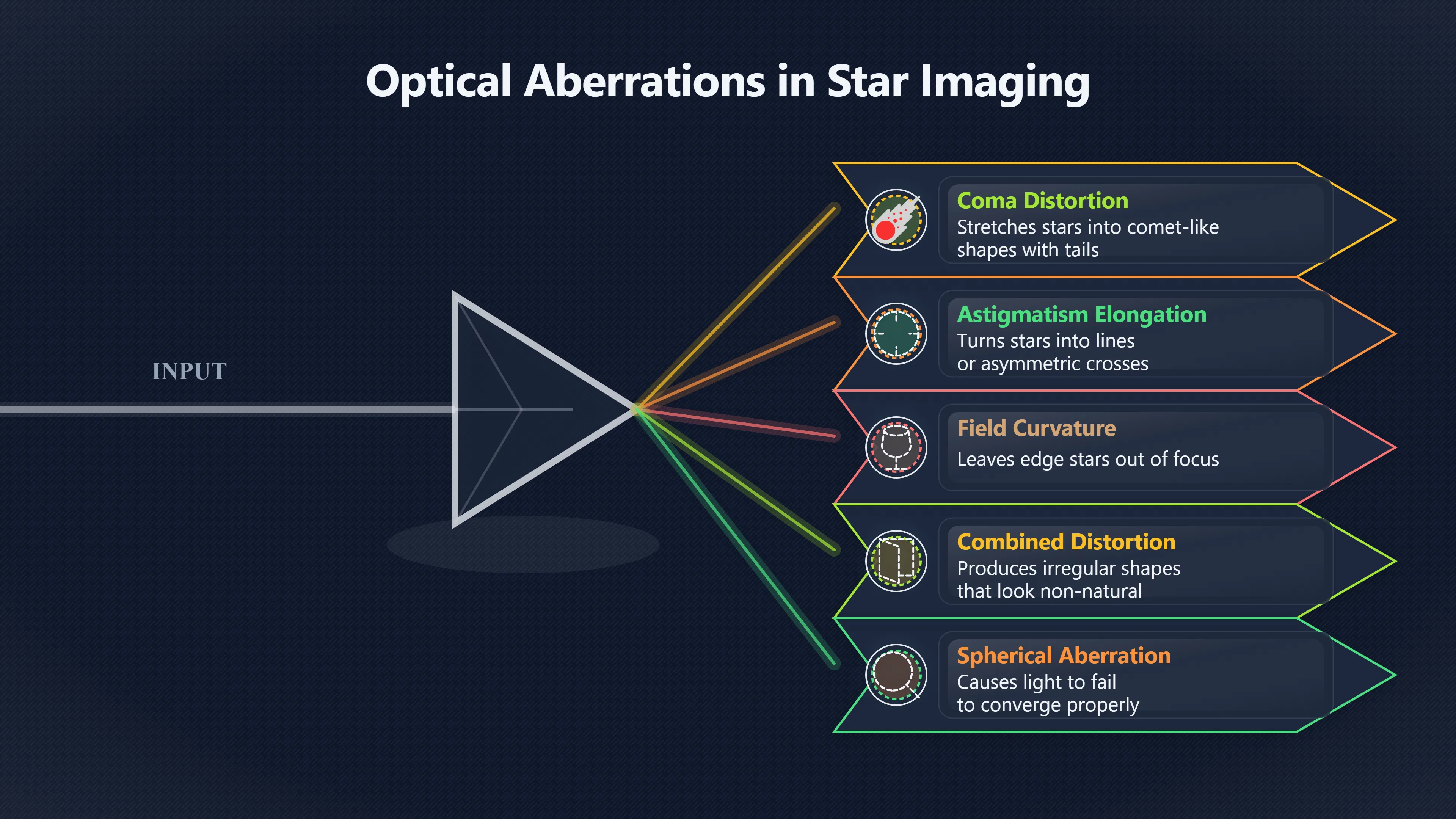
Several aberrations are particularly relevant:
- Coma can stretch stars into comet-like shapes with apparent tails.
- Astigmatism can elongate stars into lines, crosses or asymmetric forms.
- Field curvature can leave edge stars out of focus when the centre is sharp.
- Distortion and combined aberrations can produce irregular shapes that look non-natural.[astropix.com+2Telescopic Watch]astropix.comThings That Go WrongOptical AberrationsStars at the edge of the field will be out of focus. Solution: Use a field… Solution: Stop the camera lens down, or…
Astronomy observers often describe severely aberrated stars near field edges as looking like birds, seagulls, comets or fan-shaped objects. These descriptions are striking because they mirror language frequently used in UFO reports. What appears to be a structured craft can sometimes be a bright star recorded through optics operating outside their best-corrected region.[Cloudy Nights+2astropix.com]cloudynights.comCloudy Nights What do all the different aberrations look like?coma and astigmatism, the plagues of long focal length wide field eyepieces, i.e. stars turning into little birds towards the edge of the…
For automated UFO detectors, this creates a classification hazard. Software may identify the apparent shape rather than recognising that the source remains a fixed astronomical object. If the detector has been trained primarily on daytime imagery or lacks calibration data describing lens behaviour, edge-of-frame stars can be assigned anomalous scores despite being entirely predictable optical artefacts.

Why Stars Sometimes Seem to Move
Many reports involving glowing discs include apparent motion. Yet a stationary star can appear to drift, wobble or dart around for several reasons.
Atmospheric turbulence causes rapid fluctuations in the path of starlight. The effect, known as scintillation, makes stars twinkle and can shift the apparent position of the light slightly from frame to frame. When a star is already enlarged by poor focus, these fluctuations affect a larger blur pattern, making movement more obvious to the viewer.
Electronic image stabilisation, tracking errors, sensor noise and autofocus adjustments can add further apparent motion. Because the source lacks visible reference features, observers may interpret the shifting glow as controlled manoeuvring rather than a stationary celestial target.
The combination of a bright star, slight defocus and atmospheric disturbance is therefore capable of producing footage that appears surprisingly dynamic despite containing no moving object.[arXiv]arxiv.orgThe M4 Core Project with HST – V. Characterizing the PSFs of WFC3/UVIS by FocusJune 1, 2017…
Why Camera Processing Makes the Illusion Stronger
Modern cameras rarely record raw light alone. They often apply sharpening, noise reduction, contrast enhancement and compression.
When these processes operate on a defocused star, they can introduce visual features that appear meaningful:
- Sharpening can create artificial edges.
- Compression can produce blocky or segmented patterns.
- Noise reduction can smooth portions of the disc while preserving brighter regions.
- Colour processing can create shifting red, green or blue fringes.
Because human perception is highly sensitive to patterns, viewers may interpret these artefacts as physical structure. A glowing blur becomes a craft with panels, lights or rotating components. The effect is particularly strong when footage is repeatedly zoomed, re-encoded and reposted online.
For instrumented detection systems, retaining raw imagery and sensor metadata is therefore critical. Once processing artefacts dominate the image, distinguishing a defocused star from a genuine object becomes much more difficult.
Simple Checks Using Star Charts and Camera Metadata
A star-disc false positive can often be eliminated quickly if sufficient data were recorded at the time of detection.
The most useful checks include:
- Compare position against star charts. If the object remains fixed relative to the celestial background and matches a bright star’s coordinates, a star explanation becomes highly likely.
- Check repeated observations. Bright stars return to predictable positions night after night. A recurring anomaly appearing at the same sidereal location is a strong clue that the source is astronomical.
- Review focus information. Large stellar images, focus-hunting behaviour or known focus errors strongly support an optical explanation.
- Compare centre and edge appearance. If stars near the frame edge show unusual shapes while central stars appear normal, lens aberrations are a likely cause.
- Examine metadata. Exposure time, focal length, focus settings and zoom level often reveal whether the camera was operating in a regime prone to star-disc artefacts.
- Use multiple sensors. A true physical object should be observable across independent instruments. A defocused star will typically appear only as an optical signature consistent with the camera’s characteristics.
These checks align with the broader principle behind serious automated UFO detection: extraordinary classifications should survive calibration, optical analysis and astronomical cross-checking before being treated as genuinely unexplained. A bright star transformed into a glowing disc may look unusual, but once focus behaviour, lens performance and sky position are examined, it often becomes one of the most predictable false positives in the night sky.[arXiv+2astropix.com]arxiv.orgThe M4 Core Project with HST – V. Characterizing the PSFs of WFC3/UVIS by FocusJune 1, 2017…
Amazon book picks
Further Reading
Books and field guides related to When Stars Turn Into Glowing Discs. Use these as the next step if you want deeper reading beyond the article.
The Backyard Astronomer's Guide
Explains optics, observing equipment, focus, star appearance, and common observational misinterpretations.
Turn Left at Orion
Helps readers understand what stars and celestial objects actually look like through optical systems, reducing false identifications.
Understanding Exposure
Rating: 4.5/5 from 19 Google Books ratings
Provides foundational knowledge about focus, exposure, lens behavior, and image interpretation relevant to apparent glowing-disc effects.

Digital SLR Astrophotography
Discusses focus, image artifacts, optical effects, and how point sources are rendered by cameras.
eBay marketplace picks
Marketplace Samples
Live-tested eBay searches with available results related to this page.


Endnotes
1.
Source: arxiv.org
Link:https://arxiv.org/abs/1706.00386
Source snippet
The M4 Core Project with HST -- V. Characterizing the PSFs of WFC3/UVIS by FocusJune 1, 2017...
Published: June 1, 2017
2.
Source: forums.sharpcap.co.uk
Title: I can’t see any stars at all with any camera
Link:https://forums.sharpcap.co.uk/viewtopic.php?t=9444
Source snippet
please help!If you are out of focus by a long way, the star light is spread over a large, faint, disk, but with these settings you should...
3.
Source: astropix.com
Title: Things That Go Wrong
Link:https://www.astropix.com/books/BGDA/CHAPTER9/907.HTM
Source snippet
Optical AberrationsStars at the edge of the field will be out of focus. Solution: Use a field... Solution: Stop the camera lens down, or...
4.
Source: astronomy.com
Title: out of focus observing
Link:https://www.astronomy.com/observing/out-of-focus-observing/
Source snippet
Out-of-focus observing18 May 2023 — Placing the object of attention purposefully out of focus can help us make better sense or more accur...
Published: May 2023
5.
Source: cloudynights.com
Title: Cloudy Nights I can’t see any stars at all with any camera
Link:https://www.cloudynights.com/forums/topic/997317-i-cant-see-any-stars-at-all-with-any-camera-please-help/
Source snippet
I can't see any stars at all with any camera - please help!7 Apr 2026 — Set the exposure for 1 second and aim at something bright like th...
6.
Source: telescopicwatch.com
Link:https://telescopicwatch.com/spherical-chromatic-optical-aberrations/
Source snippet
Spherical, Chromatic & Other Optical Aberrations: A Stellar...A coma is an optical aberration distinctly recognized by the comet-like or...
7.
Source: cloudynights.com
Title: Cloudy Nights What do all the different aberrations look like?
Link:https://www.cloudynights.com/forums/topic/528064-what-do-all-the-different-aberrations-look-like/
Source snippet
coma and astigmatism, the plagues of long focal length wide field eyepieces, i.e. stars turning into little birds towards the edge of the...
8.
Source: youtube.com
Link:https://www.youtube.com/watch?v=3fJHG0g6jWs
Source snippet
Out OutProvided to YouTube by Columbia Out Out · Skye Newman Out Out ℗ 2025 Skye Newman Released on: 2025-07-18 Composer, Programmer, Piano...
Published: July 18, 2025
9.
Source: Wikipedia
Link:https://en.wikipedia.org/wiki/Out
Source snippet
OutSports and recreation · Out (baseball), a play which retires the batter or a base runner · Out (cricket), the loss of a wicket by a...
Additional References
10.
Source: merriam-webster.com
Link:https://www.merriam-webster.com/dictionary/out
Source snippet
OUT Definition & Meaningto identify (someone) publicly as being such secretly ・ adjective 1 a: situated outside: external She didn't wa...
11.
Source: dictionary.com
Link:https://www.dictionary.com/browse/out
Source snippet
OUT Definition & MeaningOUT definition: away from, or not in, the normal or usual place, position, state, etc.: to go out to dinner. See...
12.
Source: lonelyspeck.com
Title: a practical guide to lens aberrations and the lonely speck aberration test
Link:https://www.lonelyspeck.com/a-practical-guide-to-lens-aberrations-and-the-lonely-speck-aberration-test/
Source snippet
A Practical Guide to Lens Aberrations and the...15 Jul 2015 — In this article I review one of the most common problems that affects the...
13.
Source: youtube.com
Link:https://www.youtube.com/watch?v=klvU0K2JQ7s
Source snippet
How To Easily Focus On StarsIn this video, I will tell you what are the tale-telling signs to look for when focusing and how to build you...
14.
Source: youtube.com
Link:https://www.youtube.com/watch?v=kFpN79l0HIo
Source snippet
Stargazing Outreach: The Focus ProblemThe Stargazing Outreach series explores public outreach in astronomy programs- especially stargazin...
15.
Source: facebook.com
Link:https://www.facebook.com/groups/seestar/posts/722821620530123/
Source snippet
Recently I noticed that when attempting to image dark nebulae (especially in Ophiuchus) the background...
16.
Source: baader-planetarium.com
Link:https://www.baader-planetarium.com/en/downloads/dl/file/id/1925/thoughts-about-aberrations-in-optical-systems-and-their-effects-on-the-image.pdf
Source snippet
The inner focus point is longer by about.04" than the outer. It is called third order...Read more...
17.
Source: evidentscientific.com
Link:https://evidentscientific.com/en/microscope-resource/knowledge-hub/lightandcolor/opticalaberrations
Source snippet
romatic, comatic, astigmatic, and field curvature — and how objectives correct...
18.
Source: dictionary.cambridge.org
Link:https://dictionary.cambridge.org/dictionary/english/out-of
Source snippet
OF | English meaning - Cambridge Dictionaryused to say that no more of something is available: We're nearly out of petrol...
19.
Source: stargazerslounge.com
Title: 414950 stars elongated and out of focus
Link:https://stargazerslounge.com/topic/414950-stars-elongated-and-out-of-focus/
Source snippet
Stars elongated and out of focus27 Oct 2023 — I am having trouble with my images. They are not looking great at all. The stars seem to de...
Topic Tree