Within Rules
What Should a UAP Station Publish?
Responsible disclosure can preserve scientific value while reducing risks to neighbours, aircraft operators and sensitive sites.
On this page
- Metadata that helps verification
- Details that can create harm
- Redacted clips and public case summaries
Page outline Jump by section
Introduction
A credible automated UAP monitoring station should not assume that every scientifically useful record belongs in the public domain. The strongest approach is selective, documented disclosure: publish enough information for independent verification while withholding details that unnecessarily expose private individuals, sensitive locations or operational vulnerabilities. This balance improves scientific credibility because other researchers can evaluate the observation without forcing the station to become a source of privacy breaches or security risks. NASA’s independent UAP study similarly emphasised calibrated observations, transparent methods and high-quality metadata rather than indiscriminate release of raw material.[NASA Science]science.nasa.govNASA ScienceUAPJune 16, 2022 — 9 Jun 2022 — The study will focus on identifying available data, how best to collect future data, and how…
What should be published to help independent verification?
The primary goal of public disclosure is to allow others to judge whether an event has been analysed properly. That usually depends more on documentation than on releasing every byte of sensor data.
A public case record should normally include:
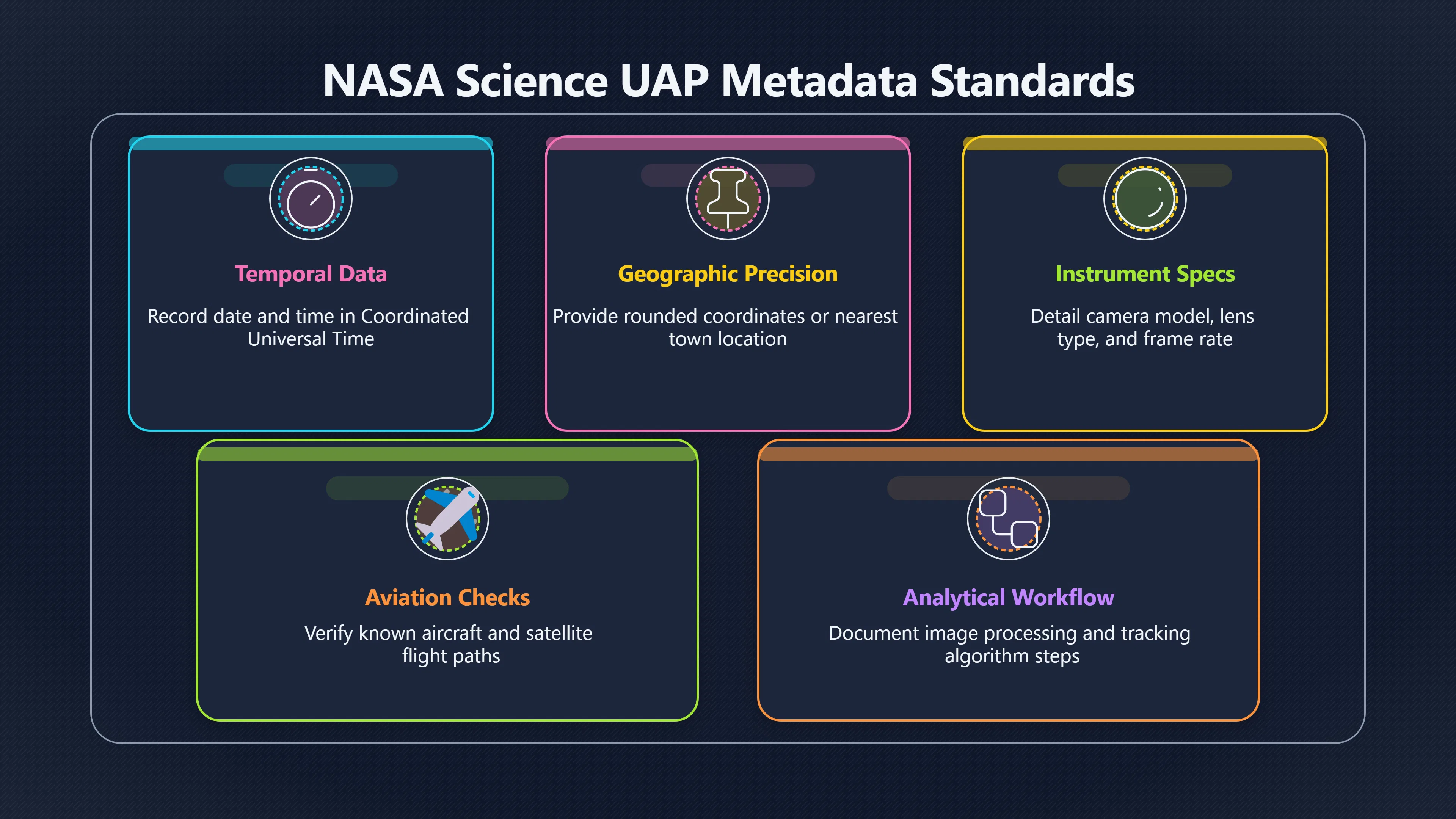
- The date and time of the observation, preferably in Coordinated Universal Time (UTC).
- Geographic information at an appropriate precision (for example, the nearest town or a rounded coordinate rather than an exact residential address where privacy is a concern).
- The observing geometry, including approximate viewing direction, elevation angle and field of view.
- The instruments used, including camera model, lens, spectral band, frame rate and calibration status.
- Weather conditions and astronomical context, such as cloud cover, Moon phase and visibility.
- Known aviation and satellite checks that were performed before classifying the event as unidentified.
- The analytical workflow, including any image processing, tracking algorithms or manual review.
- An explanation of remaining uncertainties and alternative explanations that could not be ruled out.
Publishing this metadata allows other researchers to reproduce calculations, compare observations from nearby stations and determine whether the event deserves further investigation without encouraging speculation unsupported by the data. NASA’s recommendations consistently stress metadata quality and calibration as prerequisites for meaningful scientific analysis.[NASA Science]science.nasa.govNASA ScienceUAPJune 16, 2022 — 9 Jun 2022 — The study will focus on identifying available data, how best to collect future data, and how…
Which details can create unnecessary harm?
Open data does not always mean unrestricted data.
Certain information may increase risks without improving scientific understanding. Responsible disclosure policies should therefore consider whether publication could expose individuals, infrastructure or future observing capability.
Examples include:
- Exact locations of privately owned stations where publication could reveal neighbouring homes or invite harassment.
- High-resolution imagery containing identifiable people, vehicle registration plates or residential property.
- Continuous live feeds that unintentionally monitor surrounding public areas.
- Internal network layouts, camera passwords or remote-access methods.
- Precise blind spots, sensor limitations or maintenance schedules that could be exploited.
- Information identifying private witnesses without explicit consent.
Privacy regulators increasingly evaluate surveillance according to necessity and proportionality rather than the operator’s intentions. A station built for sky observation can still collect personal data if its cameras regularly capture public spaces or neighbouring property. Limiting publication to material that serves a genuine scientific purpose helps demonstrate that the monitoring system is operating responsibly.[NASA Science]science.nasa.govNASA ScienceUAPJune 16, 2022 — 9 Jun 2022 — The study will focus on identifying available data, how best to collect future data, and how…

Why selective redaction often improves credibility
Some observers assume that any editing weakens evidence. In practice, documented redaction can strengthen trust because it separates privacy protection from evidential integrity.
A good disclosure policy records exactly what has been removed and why. Examples include:
- Blurring buildings or faces while preserving the sky region.
- Cropping the horizon if it contains unnecessary personal information.
- Replacing exact coordinates with a defined uncertainty radius.
- Removing audio that contains private conversations.
- Publishing image hashes or digital signatures so others can verify that scientific portions of the recording have not been altered.
Keeping an unmodified archival copy under controlled access preserves the evidential record while allowing a privacy-protected version to circulate publicly. This approach resembles established practice in many scientific and legal contexts where sensitive material exists alongside a redacted public version.
Public case summaries are often more valuable than raw video
Many observations ultimately prove to be aircraft, satellites, atmospheric phenomena or sensor artefacts. Publishing concise case summaries helps the wider community learn from these investigations without requiring access to complete datasets.
A useful public summary typically explains:
ElementPurposeObservation descriptionStates what was recorded without speculation.Instruments usedShows how the observation was obtained.Verification stepsDocuments aviation, astronomical and meteorological checks.Remaining uncertaintiesDistinguishes unknown from unexplained.Final assessmentExplains whether the event was identified, probably identified or remains unresolved.
Publishing negative findings is especially valuable. Demonstrating that unusual-looking events were traced to ordinary causes helps calibrate public expectations and shows that the network applies consistent standards rather than searching only for anomalies.
Handling requests for additional data
Researchers, journalists and government agencies may ask for more detailed records than are suitable for public release. A written disclosure policy should explain how these requests are handled before any significant event occurs.
Good practice is to distinguish between several levels of access:
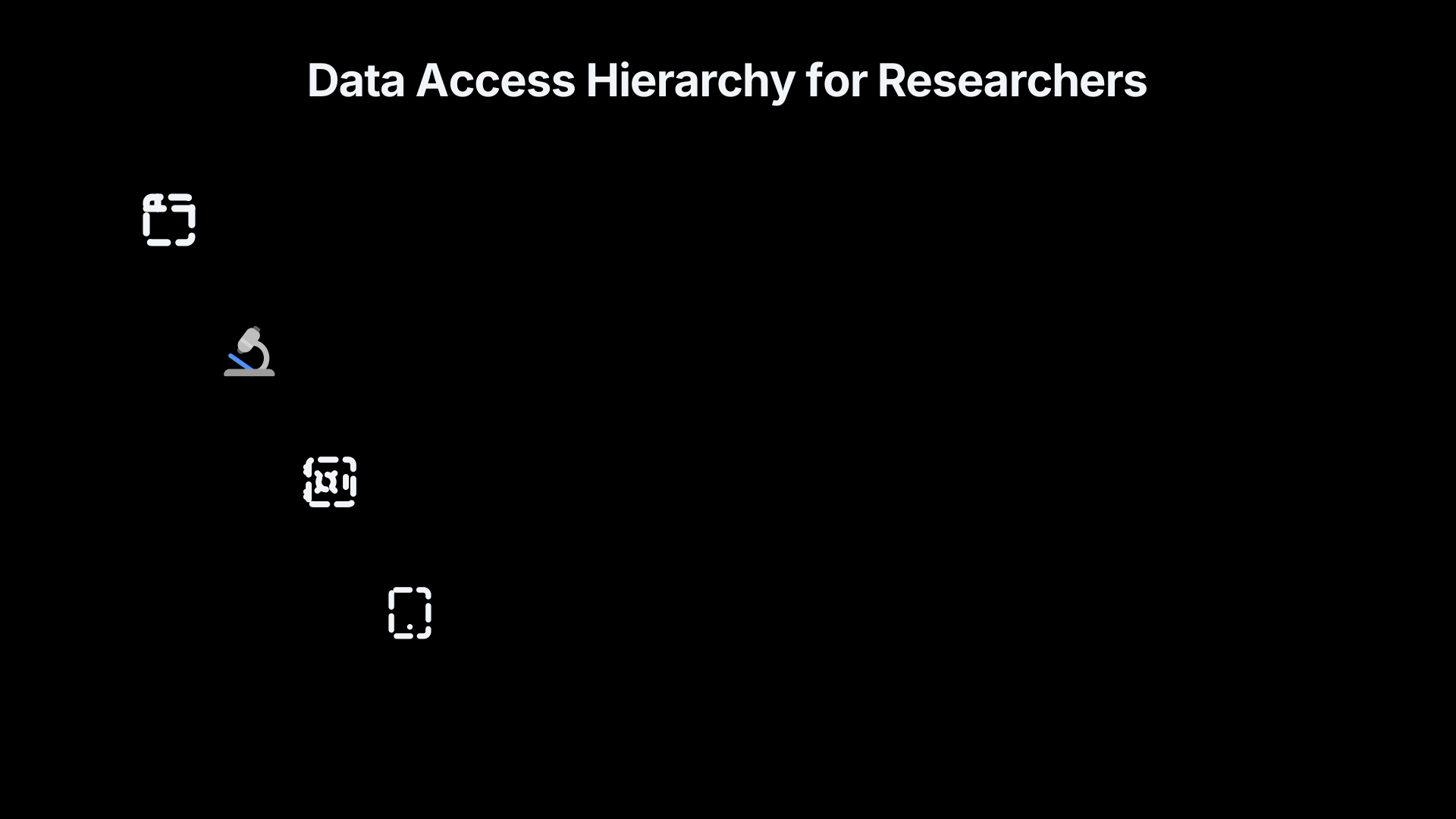
- Public release: redacted imagery, metadata and case summary.
- Qualified research access: higher-resolution material under agreed conditions that protect privacy and preserve chain of custody.
- Restricted archive: complete original recordings retained securely for evidential purposes or legal obligations.
Separating these access levels reduces pressure to choose between publishing everything and publishing nothing.
Building trust through consistent disclosure
Scientific credibility depends as much on predictable governance as on sophisticated instruments. A station that consistently publishes its methodology, calibration information, event metadata and carefully redacted evidence is generally easier for independent observers to evaluate than one that releases dramatic footage without context.
The broader scientific discussion around automated UAP observation increasingly points towards standardised data collection, documented analytical methods and curated archives rather than indiscriminate publication of every recording. High-quality records become more useful when readers understand both what has been shared and what has deliberately been withheld, together with the reasons for those decisions.[arXiv+2arXiv]arxiv.orgOpen source on arxiv.org.
Amazon book picks
Further Reading
Books and field guides related to What Should a UAP Station Publish?. Use these as the next step if you want deeper reading beyond the article.
The UFO Experience
Emphasizes systematic observation and documentation of unusual aerial reports.

Data protection
First published 2004. Subjects: Data protection, Law and legislation, Records, Right of Privacy, Law, great britain.
eBay marketplace picks
Marketplace Samples
Live-tested eBay searches with available results related to this page.




Endnotes
1.
Source: science.nasa.gov
Link:https://science.nasa.gov/uap/
Source snippet
NASA ScienceUAPJune 16, 2022 — 9 Jun 2022 — The study will focus on identifying available data, how best to collect future data, and how...
Published: June 16, 2022
2.
Source: arxiv.org
Link:https://arxiv.org/abs/2305.18566
3.
Source: arxiv.org
Title: arXiv The New Science of Unidentified Aerospace-Undersea Phenomena (UAP)
Link:https://arxiv.org/abs/2502.06794
4.
Source: arxiv.org
Link:https://arxiv.org/abs/2403.15368
5.
Source: archives.gov
Title: uap guidance
Link:https://www.archives.gov/records-mgmt/uap-guidance
Source snippet
Guidance to Federal Agencies on Unidentified Anomalous...8 May 2024 — The law requires that by October 20, 2024, each federal agency rev...
Published: October 20, 2024
Additional References
6.
Source: avi-loeb.medium.com
Link:https://avi-loeb.medium.com/resolving-the-nature-of-unidentified-anomalous-phenomena-uap-by-scientific-evidence-217cb8ac5f72
Source snippet
the Nature of Unidentified Anomalous Phenomena...Resolving the Nature of Unidentified Anomalous Phenomena (UAP) by Scientific Evidence F...
7.
Source: natlawreview.com
Link:https://natlawreview.com/press-releases/disclosure-foundation-[review
Source snippet
ion that is relevant to unlocking the mystery of UAP by, wherever...Read more...
8.
Source: dni.gov
Link:https://www.dni.gov/files/ODNI/documents/assessments/Prelimary-Assessment-UAP-20210625.pdf
Source snippet
Preliminary Assessment: Unidentified Aerial Phenomena...25 Jun 2021 — The FAA captures data related to UAP during the normal course of m...
9.
Source: k-dense.ai
Title: pursue uap declassified files analysis
Link:https://k-dense.ai/blog/pursue-uap-declassified-files-analysis
Source snippet
What 116 Declassified UAP Files Actually Say8 May 2026 — K-Dense Web analyzed 116 declassified UAP files in one prompt, producing a 60-pa...
Published: May 2026
10.
Source: youtube.com
Title: NASA releases UFO report, says agency will be transparent
Link:https://www.youtube.com/watch?v=yuqAeOUNHdg
Source snippet
NASA UAP independent study team report data transparency NASA releases UFO report, says agency will be transparent AP Archive...
11.
Source: europarl.europa.eu
Link:https://www.europarl.europa.eu/doceo/document/E-9-2024-000318_EN.html
Source snippet
monitoring and reporting in the EU Space Law31 Jan 2024 — This important initiative 'envisages common EU [rules]({{ 'rules/' | relative_url }}) addressing the safety, res...
12.
Source: youtube.com
Title: How Science is Revolutionising UAP Research: Data Triumphs Over Stigma
Link:https://www.youtube.com/watch?v=t75k2dAHwaU
Source snippet
NASA releases UFO report, says agency will be transparent...
13.
Source: youtube.com
Title: Nasa UFO report: What we learned from UAP study
Link:https://www.youtube.com/watch?v=eTaltOQLVLU
Source snippet
How Science is Revolutionising UAP Research: Data Triumphs Over Stigma...
14.
Source: facebook.com
Title: A new U.S
Link:https://www.facebook.com/NewsNationNow/posts/a-new-us-government-data-release-on-uaps-sheds-light-on-reported-encounters-worl/1025681053172245/
Source snippet
government data release on UAPs sheds light...In this video, host Kristin Fisher reviews the first release of 162 UAP (Unidentified Anom...
15.
Source: youtube.com
Title: Unidentified Anomalous Phenomena Independent Study Report
Link:https://www.youtube.com/watch?v=TQcqOW39ksk
Source snippet
NASA discusses findings from UFO study | full video...
Topic Tree