Within Starlink
The Starlink Case Pilots Could Not Check
A reported Pacific UAP encounter shows how Starlink launch data, orbital elements, and flight tracks can turn a mystery into a testable event.
On this page
- What the pilots reported
- How researchers reconstructed the view
- What the case teaches detectors
Page outline Jump by section
Introduction
On 10 August 2022, five pilots aboard two commercial airliners crossing the Pacific reported an unusual cluster of bright lights that appeared to move in ways they could not readily explain. The incident attracted attention because it involved multiple experienced observers, independent reports, cockpit photographs and video, and an environment where ordinary visual references are scarce. Rather than dismissing the reports or treating them as proof of something extraordinary, researchers reconstructed the event using satellite orbital data, aircraft position records and astronomical geometry. Their conclusion—that a recently launched Starlink satellite train seen under exceptional lighting conditions could account for the observations—has made the case one of the clearest demonstrations of how instrumented investigation can transform an apparent mystery into a testable hypothesis.[arXiv]arxiv.orgEnhancing Space Situational Awareness to Mitigate Risk: A Single-Case Study in the Misidentification of a Recently-Launched Starlink…
What the pilots reported
The sightings occurred during overnight flights across the Pacific Ocean shortly after a SpaceX Starlink launch on the same day. According to the published reconstruction, five pilots on two separate commercial aircraft independently reported seeing multiple bright lights. The lights were described as unusual enough to prompt discussion between crews and air traffic control, and one crew obtained two mobile-phone photographs and a short video from the cockpit.[arXiv]arxiv.orgEnhancing Space Situational Awareness to Mitigate Risk: A Single-Case Study in the Misidentification of a Recently-Launched Starlink…
Several features made the event difficult to interpret in real time:
- The lights appeared grouped rather than isolated.
- Their brightness changed dramatically over short intervals.
- The apparent motion did not resemble the single steady track that pilots normally associate with satellites.
- The crews had no practical way to check recently launched spacecraft while airborne.[arXiv]arxiv.orgEnhancing Space Situational Awareness to Mitigate Risk: A Single-Case Study in the Misidentification of a Recently-Launched Starlink…
These characteristics explain why the event became noteworthy. The reports were sincere observations made by trained professionals, yet they lacked the contextual information needed for immediate identification.
How researchers reconstructed the view
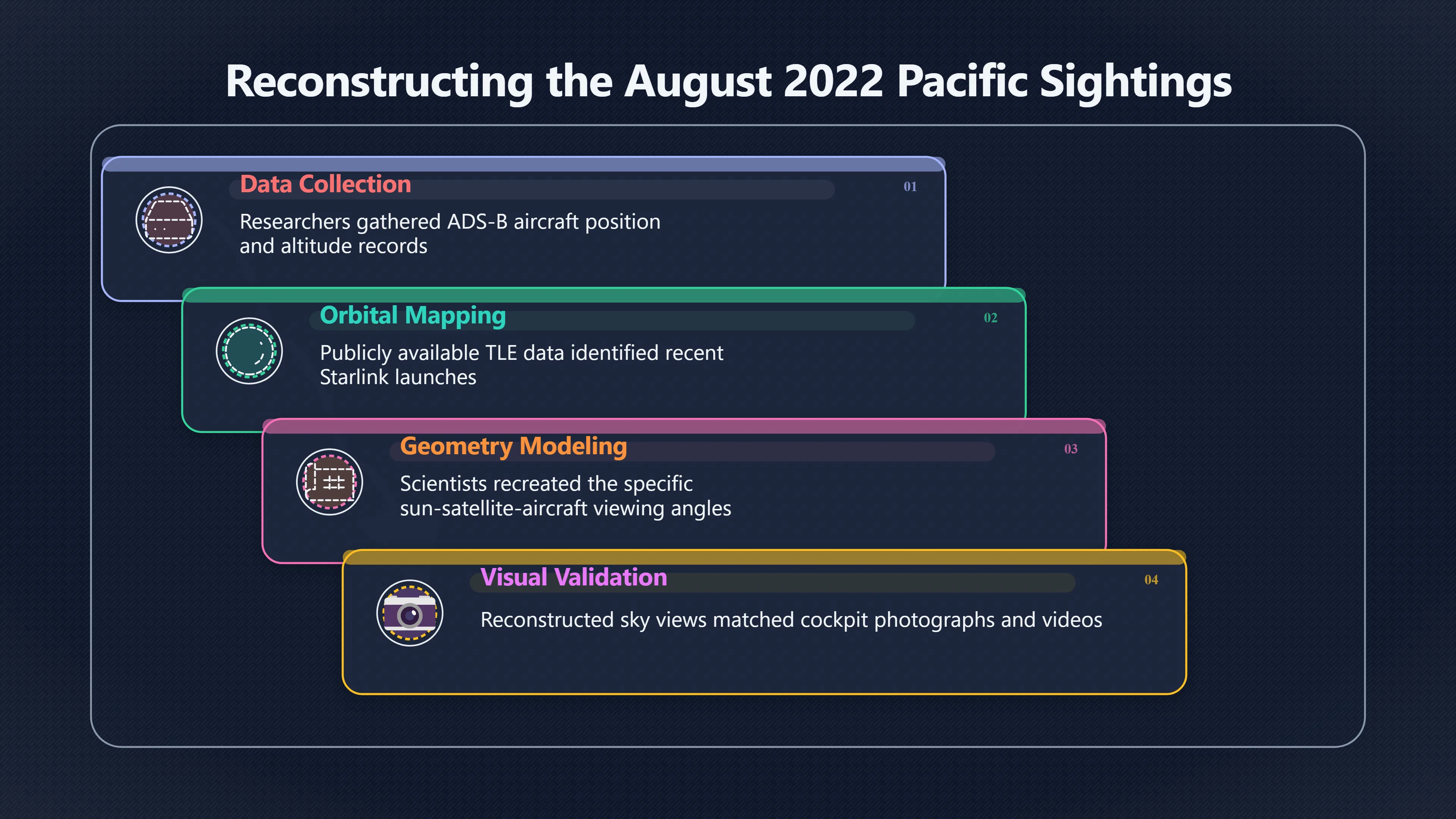
The value of this case lies less in the original sighting than in the reconstruction that followed. Rather than relying on witness testimony alone, researchers combined several independent datasets.
First, they obtained Automatic Dependent Surveillance–Broadcast (ADS-B) records, which precisely recorded the aircraft’s position, altitude and heading during the encounter. Second, they used publicly available two-line element (TLE) orbital data describing the recently launched Starlink satellites. Third, they recreated the geometry between the aircraft, the satellites and the Sun at the reported time.[arXiv]arxiv.orgEnhancing Space Situational Awareness to Mitigate Risk: A Single-Case Study in the Misidentification of a Recently-Launched Starlink…
This reconstruction showed that the aircraft were viewing a tightly grouped Starlink train that had been launched only hours earlier. Because the satellites were still close together, multiple spacecraft occupied nearly the same region of sky. At the same time, the Sun sat just below the horizon from the pilots’ perspective, creating ideal conditions for strong reflections from satellite surfaces.[arXiv]arxiv.orgEnhancing Space Situational Awareness to Mitigate Risk: A Single-Case Study in the Misidentification of a Recently-Launched Starlink…
Instead of assuming a vague similarity, the researchers compared the reconstructed sky view with the cockpit photographs and found that the predicted positions and timing closely matched the reported phenomenon. Their central argument was not merely that Starlink satellites were present, but that the known geometry reproduced the observed appearance well enough to provide a conventional explanation.[arXiv]arxiv.orgEnhancing Space Situational Awareness to Mitigate Risk: A Single-Case Study in the Misidentification of a Recently-Launched Starlink…
Why the lights looked so unusual
The case also highlighted an effect that many observers had not previously appreciated: exceptionally bright Starlink flares.
Most satellites appear as faint moving points. However, research into Starlink reflectance found that sunlight can strike the flat underside of the spacecraft at shallow angles, producing intense specular reflections. Under favourable geometry, these reflections can briefly become comparable in brightness to the brightest natural objects in the night sky.[arXiv]arxiv.orgarXiv Extreme Flaring of Starlink SatellitesarXiv Extreme Flaring of Starlink Satellites
Because dozens of newly launched satellites may occupy similar orbital paths, observers can see repeated brightening from different spacecraft in succession. Instead of one steadily moving light, the result can resemble lights repeatedly appearing, fading and reappearing in roughly the same area of sky—a visual pattern sometimes described by pilots as resembling a circular or “racetrack” sequence.[arXiv]arxiv.orgarXiv Extreme Flaring of Starlink SatellitesarXiv Extreme Flaring of Starlink Satellites
Importantly, this behaviour is an optical effect rather than evidence that the satellites are manoeuvring in unusual ways. The apparent motion arises from changing reflection geometry as multiple satellites successively satisfy the conditions for specular reflection.
Why pilots could not easily verify the explanation
The incident exposed a practical limitation rather than a failure of observation.
Commercial flight crews have access to weather information, terrain awareness and air traffic displays, but they generally do not have real-time tools showing recently launched satellite trains and predicted flare locations. Even if orbital elements are publicly available, converting them into a cockpit prediction requires specialised software, accurate timing and knowledge of satellite illumination geometry.[arXiv]arxiv.orgEnhancing Space Situational Awareness to Mitigate Risk: A Single-Case Study in the Misidentification of a Recently-Launched Starlink…
In August 2022, this information was effectively unavailable to the crews while the event unfolded. From their viewpoint, the lights genuinely appeared anomalous because the ordinary explanation was inaccessible in real time.
The researchers therefore argued that better space situational awareness tools could reduce unnecessary uncertainty for aviation. They suggested that satellite operators and governments could improve access to information about visible satellite configurations and unusual reflection events.[arXiv]arxiv.orgEnhancing Space Situational Awareness to Mitigate Risk: A Single-Case Study in the Misidentification of a Recently-Launched Starlink…
What the case teaches automated detectors
For developers of automated instrumented UFO or UAP detection systems, this incident is valuable precisely because the final explanation appears to be ordinary.
The reconstruction illustrates several design lessons:
- Orbital catalogues are essential. Detection systems should automatically compare observations with current satellite ephemerides rather than treating every unexplained light as independent evidence.
- Brightness alone is not a reliable anomaly indicator. Specular reflections can make distant satellites unexpectedly brilliant.
- Formation geometry matters. Recently launched satellite trains differ significantly from mature constellations and require separate modelling.
- Aircraft perspective changes the problem. Detectors intended for aviation must account for observer altitude and viewing geometry rather than relying solely on ground-based assumptions.
- Independent datasets increase confidence. Combining orbital elements, aircraft tracks and imaging data provides a much stronger explanation than witness testimony or image analysis alone.[arXiv+2arXiv]arxiv.orgEnhancing Space Situational Awareness to Mitigate Risk: A Single-Case Study in the Misidentification of a Recently-Launched Starlink…
The broader lesson is methodological. A credible automated anomaly detector should not simply classify unusual lights; it should actively attempt to eliminate known causes using continuously updated astronomical and aerospace data before labelling an event as genuinely unexplained.
Why this case remains important
The August 2022 Pacific incident remains influential because it demonstrates both the strengths and limits of eyewitness reports. Multiple experienced pilots honestly described something they could not identify, and their observations were sufficiently detailed to justify investigation. Yet the subsequent reconstruction showed that a combination of recently launched Starlink satellites, precise orbital mechanics and unusual illumination could reproduce the reported phenomenon without invoking unknown technology.[arXiv]arxiv.orgEnhancing Space Situational Awareness to Mitigate Risk: A Single-Case Study in the Misidentification of a Recently-Launched Starlink…
Rather than diminishing the value of the pilots’ reports, the case strengthens the argument for evidence-driven investigation. It shows that modern satellite constellations have created new classes of visual phenomena that neither human observers nor automated systems should evaluate in isolation from accurate space-object tracking.
Amazon book picks
Further Reading
Books and field guides related to The Starlink Case Pilots Could Not Check. Use these as the next step if you want deeper reading beyond the article.

UFOs : Generals, Pilots, and Government Officials Go on the R...
Provides context for pilot reports and investigations.
eBay marketplace picks
Marketplace Samples
Example marketplace items related to this page. Use the search link to explore similar finds on eBay.
Endnotes
1.
Source: arxiv.org
Link:https://arxiv.org/abs/2403.08155
Source snippet
Enhancing Space Situational Awareness to Mitigate Risk: A Single-Case Study in the Misidentification of a Recently-Launched Starlink...
2.
Source: arxiv.org
Title: arXiv Extreme Flaring of Starlink Satellites
Link:https://arxiv.org/abs/2405.13091
3.
Source: arxiv.org
Link:https://arxiv.org/pdf/2405.13091
Source snippet
Extreme Flaring of Starlink Satellitesby A Mallama · 2024 · Cited by 2 — This paper reports on extreme flares of many magnitudes that occ...
Additional References
4.
Source: reddit.com
Link:https://www.reddit.com/r/UFOs/comments/1i9iqy3/aaro_paper_on_uap_starlink_flares/
Source snippet
AARO paper on UAP & Starlink Flares: r/UFOsAARO has published a paper detailing the phenomenon of Starlink flares that have been reporte...
5.
Source: facebook.com
Link:https://www.facebook.com/groups/2365809903441367/posts/6866734786682167/
Source snippet
Starlink flares study by pilot and air crash investigatorStarlink [satellite flares]({{ 'satellite-flares/' | relative_url }}) over Factory Butte, UT... Another report of pilots se...
6.
Source: thedebrief.org
Link:https://thedebrief.org/spacex-starlink-extreme-flaring-increases-reported-uap-sightings-and-poses-aviation-risks-new-research-finds/
Source snippet
SpaceX Starlink "Extreme Flaring" Increases Reported...28 May 2024 — New research shows SpaceX's Starlink satellites can cause extreme f...
Published: May 2024
7.
Source: planet4589.org
Title: Jonathan Mc Dowell | Chandra X-ray Center Starlink had updated its plans
Link:https://planet4589.org/astro/starsim/index.html
Source snippet
Jonathan McDowell | Chandra X-ray CenterStarlink had updated its plans - partly in response to the concerns of astronomers. On this web p...
8.
Source: mtc-m12e.sid.inpe.br
Title: A total of 32 of the satellites were never tracked by NORAD
Link:https://mtc-m12e.sid.inpe.br/col/sid.inpe.br/mtc-m12e/2025/03.31.19.53/doc/npg-32-75-2025.pdf
Source snippet
tracking of the 2022 February Starlink satellites and...by FL Guarnieri · 2025 · Cited by 4 — Of the 49 Starlink satellites released int...
9.
Source: universetoday.com
Title: starlinks can produce surprisingly bright flares to pilots
Link:https://www.universetoday.com/articles/starlinks-can-produce-surprisingly-bright-flares-to-pilots
Source snippet
27 May 2024 — That paper discussed how the incident occurred on August 10, 2022, and was observed by five pilots aboard two separate comm...
Published: August 10, 2022
10.
Source: semanticscholar.org
Link:https://www.semanticscholar.org/paper/The-Brightness-of-Starlink-Mini-Satellites-During-Mallama-Cole/7e851b9f24100ac16fe7d049bc0b5a4144baa95c
Source snippet
Mallama, Richard E. Cole, authors. A. Worley · Published 20 May 2024...Read more...
Published: May 2024
11.
Source: skyandtelescope.org
Title: starlink flares can fool anyone even airline pilots
Link:https://skyandtelescope.org/astronomy-news/starlink-flares-can-fool-anyone-even-airline-pilots/
Source snippet
Starlink Flares Can Fool Anyone — Even Airline Pilots10 Jun 2024 — The flare from numerous Starlink satellites, launched by SpaceX to pro...
12.
Source: researchgate.net
Title: 380821064 Extreme Flaring of Starlink Satellites
Link:https://www.researchgate.net/publication/380821064_Extreme_Flaring_of_Starlink_Satellites
Source snippet
(PDF) Extreme Flaring of Starlink Satellites20 May 2024 — Brightness of the Qianfan Satellites. September 2024. Anthony Mallama · Richard...
Published: May 2024
13.
Source: icaiit.org
Title: We will evaluate using the link budget
Link:https://icaiit.org/paper.php?paper=11th_ICAIIT_1%2F1_9
Source snippet
Estimation of the Starlink Global Satellite System Capacityby D Shulakova · 2023 · Cited by 29 — In this paper, the capacity of the Starl...
Topic Tree