Within Hessdalen
What Years of Hessdalen Records Revealed
Years of AMS records suggested winter and late-night clustering, while also revealing how much filtering ordinary sky activity requires.
On this page
- Winter and late night event patterns
- Moon records and removed artificial lights
- Why relative patterns mattered more than single images
Page outline Jump by section
Introduction
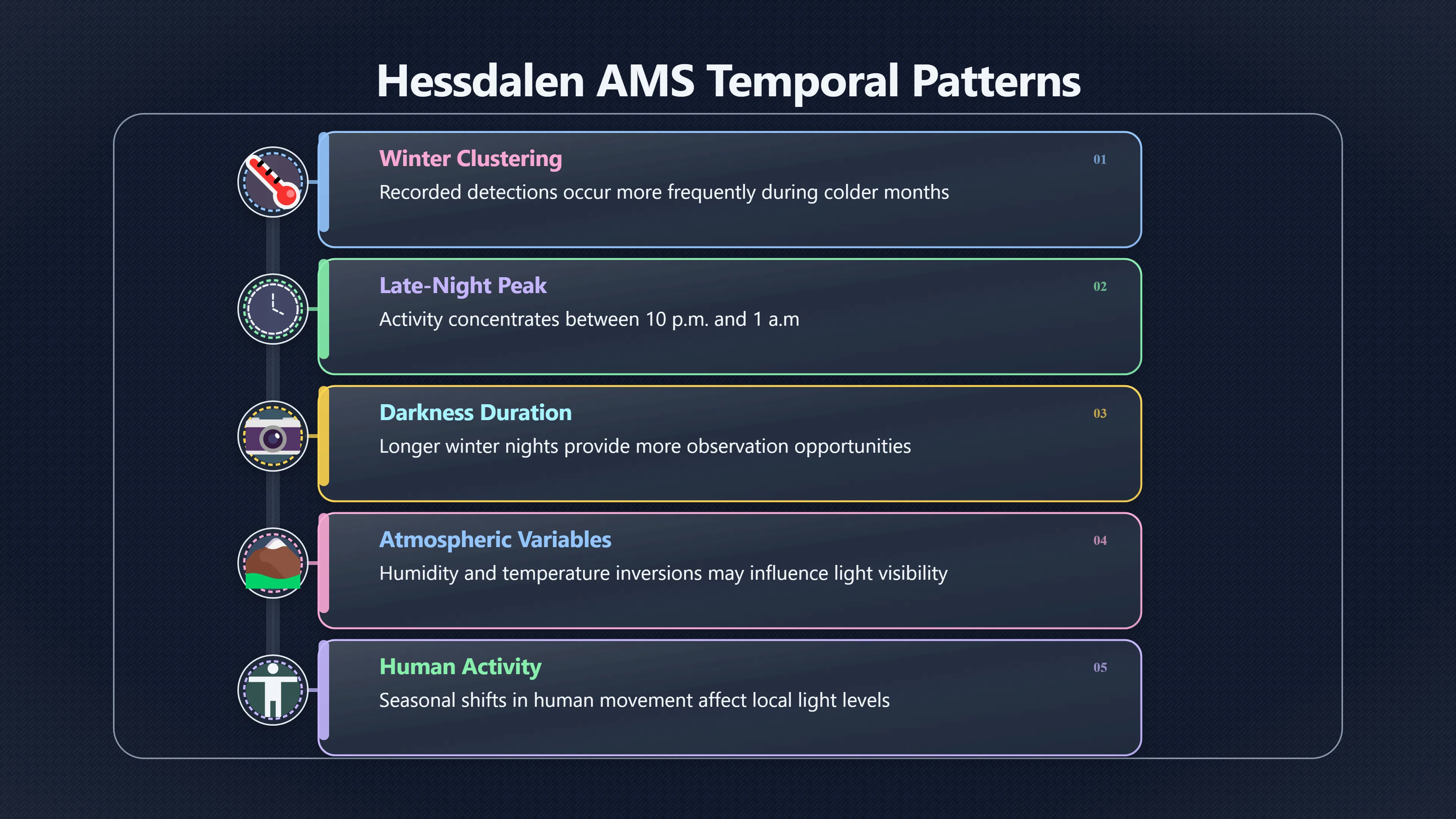
The most important result from the Hessdalen Automatic Measurement Station (AMS) was not a dramatic photograph or a single unexplained event. It was the creation of a long-term database that allowed researchers to compare thousands of hours of ordinary sky conditions with a much smaller number of unusual light detections. Over several years of operation, the AMS records suggested that reported light events were not randomly distributed in time. Instead, they appeared to cluster more often during winter months and during late-night hours, especially between roughly 10 p.m. and 1 a.m. At the same time, the database demonstrated how difficult it is to separate potentially unusual phenomena from mundane sources such as the Moon, aircraft, vehicles, weather effects, and other forms of night-time illumination.[Project Hessdalen]hessdalen.orgProject HessdalenA Long-Term Scientific Survey of the…June 29, 2004 — by M TEODORANI · 2004 · Cited by 97 — Abstract—The balls of ligh…
 For the history of automated UFO and UAP detection, this was a significant step. The Hessdalen database shifted attention away from isolated witness stories and toward statistical patterns that could only emerge through continuous monitoring.
Winter and Late-Night Event Patterns
One of the most frequently cited findings from analyses of AMS data was a temporal pattern. Researchers examining several years of recordings reported that light detections occurred more often during winter and were concentrated in late-night hours. A commonly cited analysis covering AMS observations from 1998 through 2001 found a noticeable peak between approximately 22:00 and 01:00. Winter also appeared to produce more recorded events than other seasons.[Project Hessdalen]hessdalen.orgProject HessdalenA Long-Term Scientific Survey of the…June 29, 2004 — by M TEODORANI · 2004 · Cited by 97 — Abstract—The balls of ligh…
These patterns mattered because they were derived from continuous monitoring rather than human memory. Witness reports can be affected by availability, expectations, weather, and population activity. A fixed camera system records whenever it is operating, making seasonal and hourly comparisons more meaningful.
Researchers proposed several possible reasons for the clustering without claiming that any had been proven:
- Winter provides longer periods of darkness, increasing observation opportunities.
- Atmospheric conditions such as humidity and temperature inversions may differ seasonally.
- Human activity patterns change across the year.
- Some natural luminous processes could depend on environmental conditions that are more common during colder months.[Project Hessdalen]hessdalen.orgProject HessdalenA Long-Term Scientific Survey of the…June 29, 2004 — by M TEODORANI · 2004 · Cited by 97 — Abstract—The balls of ligh…
Importantly, the database revealed a pattern, not a cause. The recurring timing suggested that further investigation should focus on environmental conditions present during those periods rather than treating every sighting as an isolated mystery.
Moon Records and Removed Artificial Lights
A less sensational but scientifically crucial aspect of the database was the effort devoted to eliminating false positives.
Published analyses of AMS records included maps of detected light events in which researchers explicitly identified and removed known artificial lights. They also noted that some of the brightest recurring detections were attributable to the Moon appearing in different positions and phases throughout the year. In one well-known event-distribution figure, several large clusters were identified as lunar observations rather than unexplained phenomena. Artificial light sources were similarly excluded after identification.[Project Hessdalen]hessdalen.orgProject HessdalenA Long-Term Scientific Survey of the…June 29, 2004 — by M TEODORANI · 2004 · Cited by 97 — Abstract—The balls of ligh…
This filtering process is easy to overlook, but it was one of the database’s most valuable contributions. Continuous automated monitoring inevitably captures:
- Moonlight.
- Planetary and stellar objects near the horizon.
- Aircraft.
- Vehicle headlights.
- Reflections and atmospheric optical effects.
- Local human-made illumination.[Project Hessdalen+2ResearchGate]hessdalen.orgProject HessdalenA Long-Term Scientific Survey of the…June 29, 2004 — by M TEODORANI · 2004 · Cited by 97 — Abstract—The balls of ligh…
The Hessdalen experience showed that a large fraction of apparent anomalies disappear once they are compared against known astronomical and terrestrial sources. Modern automated UAP observatories use a similar philosophy, increasingly incorporating aircraft databases, weather measurements, and astronomical catalogues precisely because long-term monitoring produces enormous numbers of ordinary detections.
The lesson from Hessdalen was therefore not simply that unexplained lights existed. It was that rigorous filtering was essential before any event could be considered worthy of further analysis.
Why Relative Patterns Mattered More Than Single Images
Many discussions of Hessdalen focus on striking photographs, but the database’s greater value came from aggregate behaviour.
A single image can be difficult to interpret. Even a clear photograph may not reveal distance, size, velocity, or physical origin. By contrast, a database allows investigators to ask broader questions:
- Do events occur more often at certain times?
- Are they associated with particular weather conditions?
- Do they appear in preferred regions of the valley?
- Are detections becoming more or less common over time?
- Can known sources explain recurring patterns?[Project Hessdalen]hessdalen.orgProject HessdalenA Long-Term Scientific Survey of the…June 29, 2004 — by M TEODORANI · 2004 · Cited by 97 — Abstract—The balls of ligh…
The AMS data suggested that unusual light reports did not follow a simple fixed trajectory across the valley. Instead, recorded events appeared in different locations, generally low in the sky and near the horizon. Researchers found no straightforward path or route that would indicate a conventional moving source repeatedly following the same track.[Project Hessdalen]hessdalen.orgProject HessdalenA Long-Term Scientific Survey of the…June 29, 2004 — by M TEODORANI · 2004 · Cited by 97 — Abstract—The balls of ligh…
This type of statistical evidence is inherently less dramatic than a famous photograph, but it is often more useful scientifically. It allows investigators to compare competing explanations against a long record rather than against a single memorable event.
What the Database Did Not Show
The Hessdalen database is sometimes portrayed as proof of a specific explanation, but the published analyses support a more cautious conclusion.
The AMS records demonstrated that unusual light detections were recurring, measurable, and suitable for statistical study. They revealed temporal clustering and provided a framework for eliminating many ordinary sources. Yet researchers repeatedly acknowledged that the patterns themselves did not identify the underlying mechanism. Even studies that highlighted winter and late-night concentrations stressed that the statistics did not explain the origin or nature of the lights.[Project Hessdalen]hessdalen.orgProject HessdalenA Long-Term Scientific Survey of the…June 29, 2004 — by M TEODORANI · 2004 · Cited by 97 — Abstract—The balls of ligh…
In that sense, the database achieved something both modest and important. It transformed a collection of local reports into a long-term observational record. The strongest result was not the confirmation of a particular theory but the demonstration that continuous automated monitoring can reveal trends that are invisible in anecdotal accounts while simultaneously exposing how much routine filtering is required before any anomaly can be taken seriously.[Project Hessdalen+2ResearchGate]hessdalen.orgProject HessdalenA Long-Term Scientific Survey of the…June 29, 2004 — by M TEODORANI · 2004 · Cited by 97 — Abstract—The balls of ligh…
Amazon book picks
Further Reading
Books and field guides related to What Years of Hessdalen Records Revealed. Use these as the next step if you want deeper reading beyond the article.
The UFO Experience
Emphasizes systematic classification and analysis of reports, paralleling the Hessdalen focus on long-term data collection.

UFOs : Generals, Pilots, and Government Officials Go on the R...
Covers evidence-based investigation of unexplained aerial phenomena and the value of documented observations over anecdotes.
The Demon-Haunted World
Provides the skeptical and statistical thinking needed to evaluate unusual observations, false positives, and pattern claims.
Identified Flying Objects
Explores scientific approaches to unexplained aerial observations and encourages data-oriented discussion.
eBay marketplace picks
Marketplace Samples
Example marketplace items related to this page. Use the search link to explore similar finds on eBay.
Endnotes
1.
Source: hessdalen.org
Link:https://hessdalen.org/reports/scex1802217251.pdf
Source snippet
Project HessdalenA Long-Term Scientific Survey of the...June 29, 2004 — by M TEODORANI · 2004 · Cited by 97 — Abstract—The balls of ligh...
Published: June 29, 2004
2.
Source: researchgate.net
Link:https://www.researchgate.net/publication/228609015_A_long-term_scientific_survey_of_the_Hessdalen_phenomenon
Source snippet
A long-term scientific survey of the Hessdalen phenomenonAll the reported light phenomena occurred at night. The magnetic eve...
3.
Source: old.hessdalen.org
Link:https://old.hessdalen.org/station/
Source snippet
Hessdalen ProjectProject Hessdalen - AMS21 Jan 2019 — Every hour are the [weather data]({{ 'weather-data/' | relative_url }}) transfered to www.hessdalen.org. The transfered dat...
Additional References
4.
Source: youtube.com
Title: Inside Norway’s UFO Valley: The Hessdalen Lights Phenomenon | Paskvan Podcasts
Link:http://www.youtube.com/watch?v=x_r4apzQlOY
Source snippet
Hessdalen lights phenomenon science automated detector The Hessdalen Lights — The Valley Where Scientists Built a UFO Research Station Ch...
5.
Source: facebook.com
Link:https://www.facebook.com/groups/625436697499583/posts/7266561173387069/
Source snippet
essdalen valley and for which there is no agreed upon explanation?...
6.
Source: melioratestlab.com
Title: testlab hessdalen lights release
Link:https://www.melioratestlab.com/2024/08/24/testlab-hessdalen-lights-release/
Source snippet
Testlab – Hessdalen Lights release24 Aug 2024 — The Hessdalen Lights are unexplained luminous phenomena observed in the Hessdalen Valley...
7.
Source: youtube.com
Title: The Hessdalen Lights — The Valley Where Scientists Built a UFO Research Station
Link:http://www.youtube.com/watch?v=1njXL_v3k48
Source snippet
Scientists Filmed These Lights in Norway — But Still Don’t Know What They Are...
8.
Source: youtube.com
Link:https://www.youtube.com/watch?v=D3NSbpG1G9k
Source snippet
Norway. Scientists have studied them with cameras, [radar]({{ 'radar/' | relative_url }})...
10.
Source: youtube.com
Title: MYSTERIOUS LIGHTS over Norway | The Proof is Out There (Season 2) | History
Link:http://www.youtube.com/watch?v=7hBUk13yE8s
Source snippet
The Hessdalen Lights Have Stumped Scientists for 40 Years...
11.
Source: youtube.com
Title: The Hessdalen Lights Have Stumped Scientists for 40 Years
Link:http://www.youtube.com/watch?v=YihXXHJ8VKc
Source snippet
Inside Norway’s UFO Valley: The Hessdalen Lights Phenomenon | Paskvan Podcasts...
12.
Source: facebook.com
Link:https://www.facebook.com/61583174895936/videos/the-hessdalen-lights-have-stumped-scientists-for-40-yearsin-a-remote-valley-in-n/1607905727171889/
Source snippet
r 600,000 times by university equipment...
13.
Source: Wikipedia
Title: Hessdalen lights
Link:https://en.wikipedia.org/wiki/Hessdalen_lights
Source snippet
Hessdalen lightsThe Hessdalen lights are unidentified lights which have been observed in a 12-kilometre-long (7.5 mi) stretch of the H...
Topic Tree