Within Hotspots
Why Ordinary Skies Matter to UAP Detectors
Distributed stations make anomalies more meaningful by measuring the normal background of aircraft, satellites, weather and wildlife.
On this page
- What a baseline sky record contains
- Why ordinary detections define unusual ones
- How comparable stations reduce local story bias
Page outline Jump by section
Introduction
Broad sky networks are valuable to automated UFO or UAP detectors because they establish what an ordinary sky looks like before attempting to identify anything genuinely unusual. Rather than concentrating on locations with a history of reports, distributed stations continuously record the routine passage of aircraft, satellites, meteors, birds, insects, weather phenomena and sensor artefacts across many environments. Over time, this creates a statistical baseline against which rare events can be judged. Without that reference, an apparently unusual detection may simply reflect local air traffic, seasonal wildlife, changing weather or the quirks of a single camera rather than an exceptional aerial event. NASA’s Independent Study Team identified high-quality baseline data, calibrated sensors and comprehensive metadata as essential foundations for any credible scientific investigation of UAP.[NASA Science]science.nasa.govScience Independent Study Team ReportNASA ScienceIndependent Study Team ReportSeptember 13, 2023 — The study of Unidentified Anomalous Phenomena (UAP) presents a unique scien…

What a baseline sky record contains
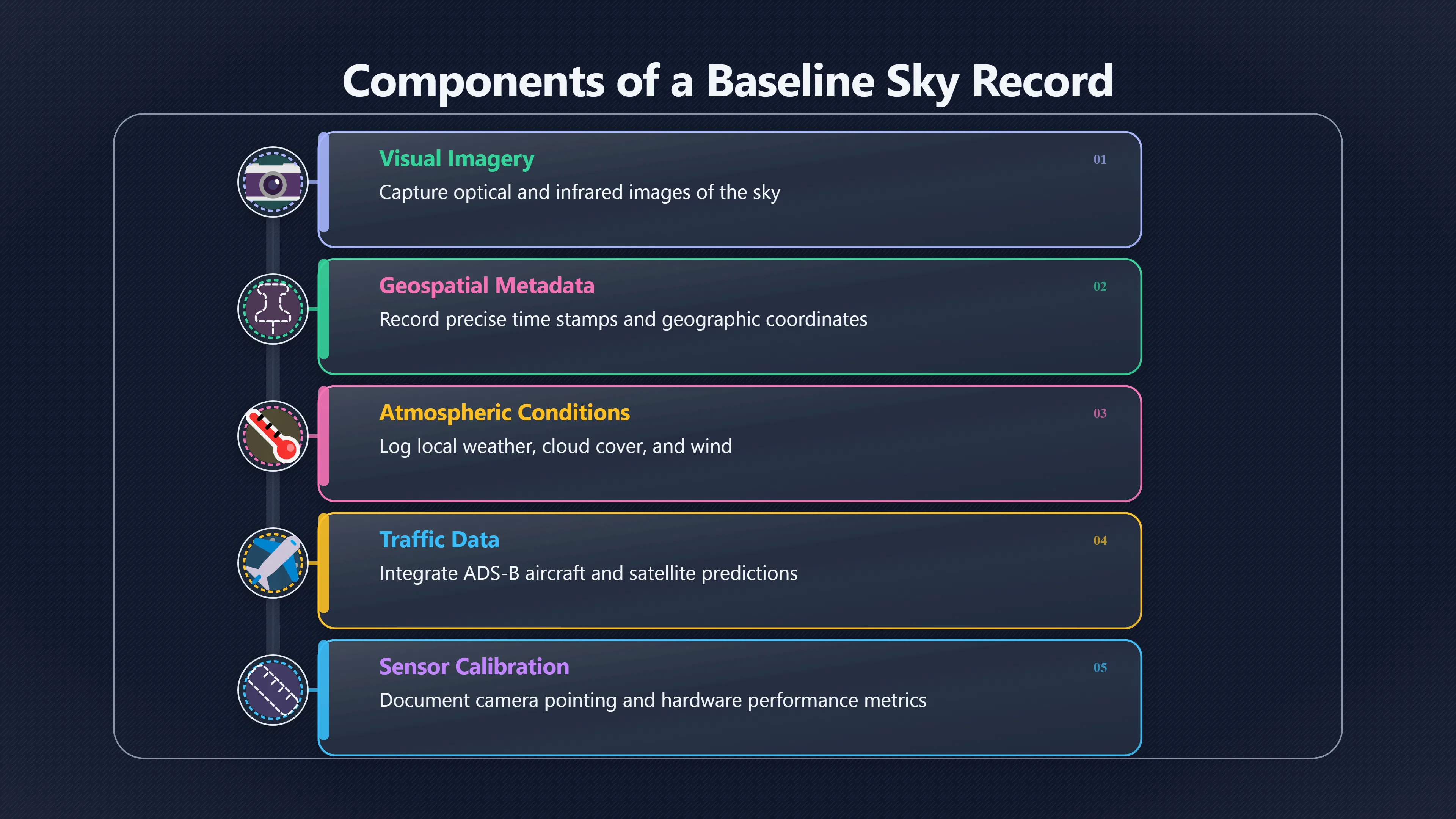
A useful baseline is much more than a collection of images. It is a structured record describing what normally occupies the sky at a particular place and time, together with the conditions under which those observations were made.
A mature network typically records:
- Optical and, where available, infrared imagery.
- Precise timestamps and geographic location.
- Camera calibration and pointing information.
- Local weather, cloud cover and atmospheric conditions.
- Aircraft identified through Automatic Dependent Surveillance–Broadcast (ADS-B).
- Satellite predictions and known astronomical objects.
- Environmental measurements such as wind, temperature or magnetic conditions where relevant.
- Detection confidence, tracking quality and classification results.
This combination allows investigators to determine not only whether an object was detected but also how often comparable events occur under similar conditions. For example, if a station repeatedly observes fast-moving infrared targets on humid summer evenings near commercial flight corridors, those detections become part of the expected background rather than unexplained anomalies.[MDPI+2Galileo Project]mdpi.comCommissioning an All-Sky Infrared Camera Array for…by L Domine · 2025 · Cited by 11 — One of the key instruments is an all-sky inf…
Recent work from the Galileo Project illustrates this approach. During commissioning of its all-sky infrared array, the team synchronised camera observations with ADS-B aircraft broadcasts, producing an extensive census of ordinary airborne traffic. Those known aircraft were used to calibrate the system, measure detection performance under different weather conditions and quantify the uncertainty associated with later anomaly searches. Approximately half a million aircraft trajectories contributed to characterising the observatory’s normal operating environment.[MDPI]mdpi.comCommissioning an All-Sky Infrared Camera Array for…by L Domine · 2025 · Cited by 11 — One of the key instruments is an all-sky inf…
Why ordinary detections define unusual ones
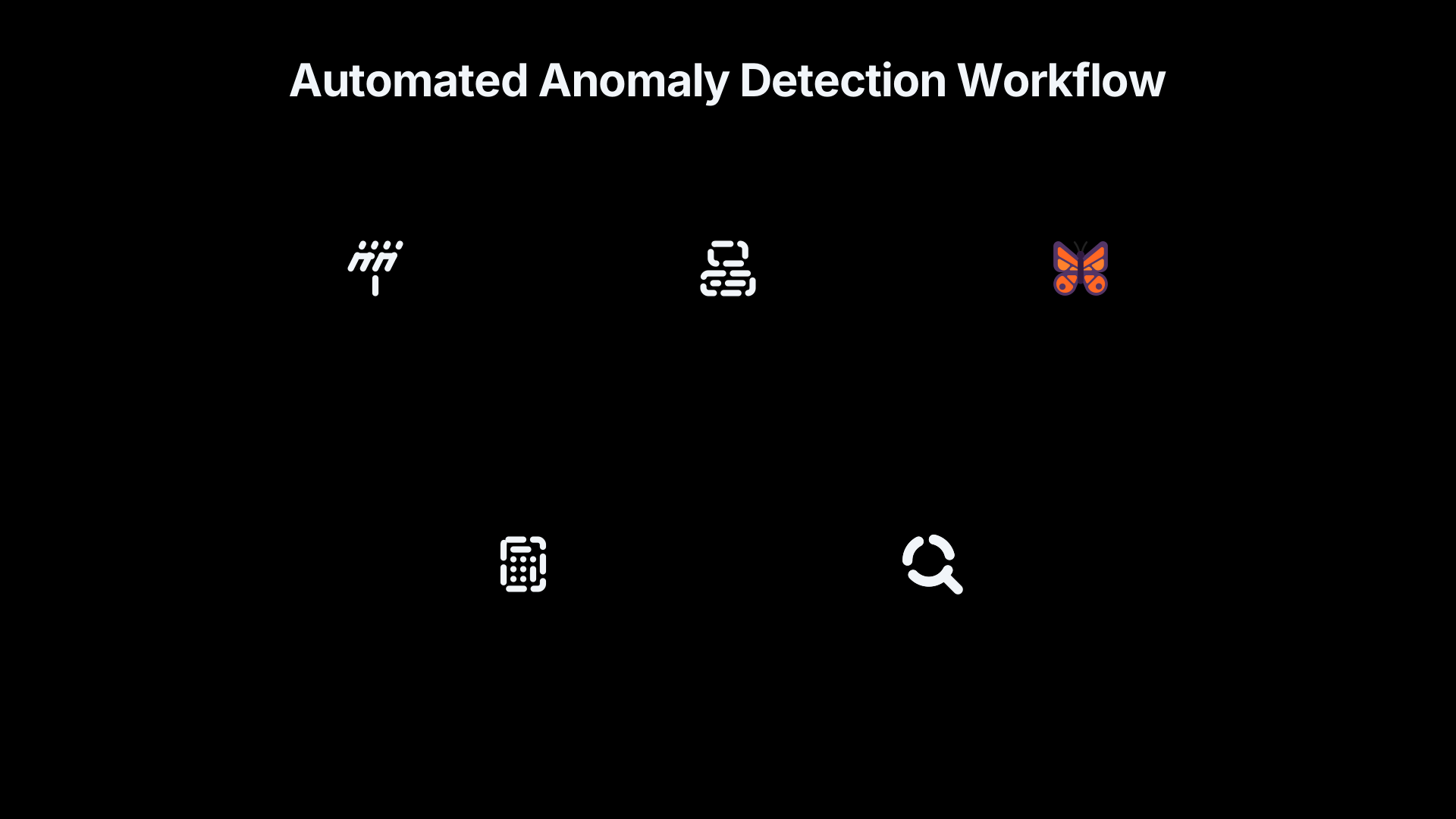
Automated anomaly detection works by comparing new observations against an established distribution of normal behaviour rather than against human expectations.
Several mechanisms depend directly on a broad baseline.
Known object removal. Aircraft transponders, satellite catalogues and astronomical databases eliminate many routine detections before an event is considered unusual. This reduces false positives without assuming that every unidentified object is extraordinary.[MDPI+2icts-yebes.oan.es]mdpi.comCommissioning an All-Sky Infrared Camera Array for…by L Domine · 2025 · Cited by 11 — One of the key instruments is an all-sky inf…
Statistical rarity. An event becomes interesting when it falls outside the normal distribution recorded by comparable instruments. A fast-moving object may be entirely typical near an airport but extremely uncommon above a remote observatory at the same elevation and speed.
Environmental context. Clouds, atmospheric turbulence, insects illuminated close to the lens and seasonal bird migrations all affect detection rates. A baseline captures these recurring influences, preventing them from being mistaken for novel phenomena. Machine-learning systems developed for astronomical all-sky cameras increasingly classify clouds and image quality automatically because environmental conditions strongly influence what cameras record.[arXiv]arxiv.orgarXiv Cloud Identification from All-sky Camera Data with Machine LearningCloud Identification from All-sky Camera Data with Machine LearningMarch 24, 2020…
Instrument behaviour. Every sensor generates noise, hot pixels, compression artefacts and occasional tracking errors. Long-term operation reveals these recurring patterns so they are not confused with external objects. NASA’s report similarly stresses calibration, metadata and uncertainty estimation as prerequisites for reliable UAP science.[NASA Science]science.nasa.govScience Independent Study Team ReportNASA ScienceIndependent Study Team ReportSeptember 13, 2023 — The study of Unidentified Anomalous Phenomena (UAP) presents a unique scien…
The practical consequence is that an anomaly is not simply “something unidentified.” It is something that remains inconsistent with the measured behaviour of both the environment and the instrument after routine explanations have been tested.
How comparable stations reduce local-story bias
A single observatory cannot easily distinguish between a genuinely unusual event and something unique to its surroundings. Networks overcome this by using comparable instruments deployed across different locations.
Standardised stations allow researchers to ask questions such as:
- Does the same class of detection appear at multiple sites?
- Does it correlate with geography or simply with air traffic density?
- Are apparent anomalies concentrated near particular weather regimes?
- Do identical sensors produce similar background detection rates?
If every station is calibrated differently, differences between locations may simply reflect different equipment. Comparable hardware, software and processing pipelines reduce this source of uncertainty.
This mirrors established practice in meteor observation and astronomical survey networks. Projects that monitor meteors or satellites rely on multiple calibrated all-sky cameras so that ordinary objects can be triangulated, classified and distinguished from camera artefacts. The same logic applies to automated UAP detection: confidence increases when independent stations observe compatible events under known performance characteristics.[Wikipedia+2conference.sdo.esoc.esa.int]WikipediaCameras for All-Sky Meteor SurveillanceCameras for All-Sky Meteor Surveillance
A distributed network also guards against cultural effects. Locations famous for unusual sightings naturally attract more attention, more observers and greater reporting rates. Broad coverage helps separate genuine geographic differences from differences caused by publicity, observer expectations or local folklore. Rather than assuming that reported hotspots represent unique physical environments, comparable stations provide an empirical way to test whether their skies actually differ from those elsewhere.
Why baseline networks improve anomaly confidence
Broad monitoring changes the scientific question from “Did something strange happen?” to “How improbable is this event given everything we know about ordinary skies?”
That shift has several advantages:
- Confidence can be expressed quantitatively rather than through subjective impressions.
- Detection algorithms can be trained using large numbers of verified ordinary events instead of only rare reports.
- False-positive rates become measurable and can be improved over time.
- Multi-site observations provide independent confirmation when unusual events occur.
- Long-term records reveal seasonal and annual patterns that short campaigns would miss.
The Galileo Project describes its objective as conducting a long-term multimodal census of aerial phenomena rather than searching only for unexplained cases. That emphasis reflects a broader scientific principle: reliable discovery depends first on measuring the ordinary population accurately. Only after the background has been characterised can statistically meaningful outliers be recognised and investigated.[arXiv+2Galileo Project]arxiv.orgThe Scientific Investigation of Unidentified Aerial Phenomena (UAP) Using Multimodal Ground-Based ObservatoriesMay 29, 2023…
Amazon book picks
Further Reading
Books and field guides related to Why Ordinary Skies Matter to UAP Detectors. Use these as the next step if you want deeper reading beyond the article.

UFOs : Generals, Pilots, and Government Officials Go on the R...
Explains why better data matter.


Digital Image Processing, Global Edition
First published 2018. Subjects: Image processing, digital techniques.
eBay marketplace picks
Marketplace Samples
Example marketplace items related to this page. Use the search link to explore similar finds on eBay.


Endnotes
1.
Source: science.nasa.gov
Title: Science Independent Study Team Report
Link:https://science.nasa.gov/wp-content/uploads/2023/09/uap-independent-study-team-final-report.pdf
Source snippet
NASA ScienceIndependent Study Team ReportSeptember 13, 2023 — The study of Unidentified Anomalous Phenomena (UAP) presents a unique scien...
Published: September 13, 2023
2.
Source: mdpi.com
Link:https://www.mdpi.com/1424-8220/25/3/783
Source snippet
Commissioning an All-Sky Infrared Camera Array for...by L Domine · 2025 · Cited by 11 — One of the key instruments is an all-sky inf...
3.
Source: icts-yebes.oan.es
Link:https://icts-yebes.oan.es/reports/doc/IT-CDT-2023-8.pdf
Source snippet
Detection of aircraft traces in nighttime all-sky camera images...by CH Fernández · 2023 — The method proposed in this study aims to str...
4.
Source: conference.sdo.esoc.esa.int
Link:https://conference.sdo.esoc.esa.int/proceedings/neosst1/paper/438/NEOSST1-paper438.pdf
Source snippet
USING ALL-SKY OPTICAL OBSERVATIONS FOR...by TPG Wijnen · Cited by 15 — Here we present a data reduction pipeline that can auto- maticall...
5.
Source: arxiv.org
Title: arXiv Cloud Identification from All-sky Camera Data with Machine Learning
Link:https://arxiv.org/abs/2003.11109
Source snippet
Cloud Identification from All-sky Camera Data with Machine LearningMarch 24, 2020...
Published: March 24, 2020
6.
Source: arxiv.org
Link:https://arxiv.org/abs/2507.21711
Source snippet
Nighttime Cloud Detection, Tracking and Prediction with All...by S Buntin · 2025 · Cited by 2 — This paper presents a novel method for r...
7.
Source: arxiv.org
Link:https://arxiv.org/html/2506.00125v1
Source snippet
1 Introduction30 May 2025 — A system designed for the comprehensive scientific study of aerial phenomena which integrates multiple sensor...
Published: May 2025
8.
Source: Wikipedia
Title: Cameras for All-Sky Meteor Surveillance
Link:https://en.wikipedia.org/wiki/Cameras_for_All-Sky_Meteor_Surveillance
9.
Source: arxiv.org
Link:https://arxiv.org/abs/2305.18566
Source snippet
The Scientific Investigation of Unidentified Aerial Phenomena (UAP) Using Multimodal Ground-Based ObservatoriesMay 29, 2023...
Published: May 29, 2023
10.
Source: arxiv.org
Link:https://arxiv.org/html/2411.02401v1
Source snippet
A Civilian Astronomer's Guide to UAP Research5 Nov 2024 — This model aids in predicting probe signatures and behaviour, improving detecti...
11.
Source: news.sky.com
Link:https://news.sky.com/story/nasa-ufo-report-live-scientists-to-release-unidentified-anomalous-phenomena-findings-12960933
Source snippet
UFO report - live: Scientists release Unidentified...14 Sept 2023 — NASA has released a report on Unidentified Anomalous Phenomena - com...
12.
Source: Wikipedia
Title: Hessdalen lights
Link:https://en.wikipedia.org/wiki/Hessdalen_lights
Source snippet
Hessdalen lightsThe Hessdalen lights are unidentified lights which have been observed in a 12-kilometre-long (7.5 mi) stretch of the H...
13.
Source: galileo.hsites.harvard.edu
Link:https://galileo.hsites.harvard.edu/publications/integrated-computing-platform-detection-and-tracking-unidentified-aerial
Source snippet
Computing Platform for Detection and Tracking of...The Galileo Project aims to shed light on the nature and characteristics of Unidentif...
Additional References
14.
Source: researchgate.net
Link:https://www.researchgate.net/publication/278390344Instrumented_Monitoring_of_Aerial_Anomalies-_A_Scientific_Approach_to_the_Investigation_On_Anomalous_Atmospheric_Light_Phenomena
Source snippet
(PDF) Instrumented Monitoring of Aerial AnomaliesMuch previous research work has been already done in the course of instrumented missions...
15.
Source: avi-loeb.medium.com
Title: a new calculation on the fly to the nasa uap study 2dacaf860cac
Link:https://avi-loeb.medium.com/a-new-calculation-on-the-fly-to-the-nasa-uap-study-2dacaf860cac
Source snippet
New Calculation on the Fly to the NASA UAP Study - Avi LoebThe NASA Study will examine unclassified data on UAP in an attempt to separate...
16.
Source: ralphbuncheinstitute.org
Title: nasa unidentified anomalous phenomena independent study team report
Link:https://ralphbuncheinstitute.org/nasa-unidentified-anomalous-phenomena-independent-study-team-report/
Source snippet
Figuring out the truth behind Unidentified Anomalous Phenomena (UAPs) takes more than speculation, it requires hard science.Read more...
17.
Source: elib.dlr.de
Title: ALDASORO Iker 2024 AllSky Cam DLR BT DLR REPORT 20240908 small
Link:https://elib.dlr.de/206572/1/ALDASORO-Iker-2024-AllSky_Cam-DLR-BT-DLR_REPORT_20240908_small.pdf
Source snippet
dlr.deAllSky-Camera system for Monitoring of Optical Satellite...by I Aldasoro Marculeta · 2024 · Cited by 2 — misalignment, incorrect s...
18.
Source: leonarddavid.com
Title: nasa report released unidentified anomalous phenomena uap
Link:https://www.leonarddavid.com/nasa-report-released-unidentified-anomalous-phenomena-uap/
Source snippet
Unidentified Anomalous Phenomena (UAP) – UPDATED14 Sept 2023 — NASA has released its Unidentified Anomalous Phenomena (UAP) report comple...
19.
Source: researchgate.net
Link:https://www.researchgate.net/publication/380882646_Detection_of_aircraft_traces_in_nighttime_all-sky_camera_images_using_deep_learning_A_new_way_to_improve_aerial_safety_in_Satellite_Laser_Ranging_operations
Source snippet
during operations to gather information about the observing conditions...
20.
Source: pubmed.ncbi.nlm.nih.gov
Link:https://pubmed.ncbi.nlm.nih.gov/39943425
Source snippet
an All-Sky Infrared Camera Array for...28 Jan 2025 — The detection efficiency is heavily dependent on weather conditions, range, and air...
21.
Source: research-collection.ethz.ch
Title: ch To Investigate or Not to Investigate?
Link:https://www.research-collection.ethz.ch/server/api/core/bitstreams/67dcdf4d-15f9-4538-95c7-201fad80ca03/content
Source snippet
Researchers' Views on...by E Caron · Cited by 1 — Here, we present the results of a survey indicating a significant support from a subse...
22.
Source: youtube.com
Title: The Galileo Project’s First Data on Half a Million Objects with Avi Loeb
Link:https://www.youtube.com/watch?v=uJtER5ahdPY
Source snippet
Scientist explains how he hunts for alien life in space | Hot Take with Jesse Weber...
23.
Source: youtube.com
Title: Replay! NASA’s Release of the Unidentified Anomalous Phenomena Report
Link:https://www.youtube.com/watch?v=nuBMnluJfs0
Source snippet
Replay! NASA's Release of the Unidentified Anomalous Phenomena Report - YouTube...
Topic Tree