Within Calibration
How bad weather tests sky cameras
Routine planes let a detector measure how fog, rain, haze, twilight and humidity change what its cameras can actually see.
On this page
- Why aircraft provide repeatable weather test objects
- Visibility conditions that change detection rates
- Building weather aware baselines for anomaly review
Page outline Jump by section
Introduction
For an automated instrumented UFO detector, bad weather is not a side issue. It directly changes what the system can and cannot see. A commercial airliner that is obvious on a clear afternoon may become a faint, intermittent target in haze, twilight, fog or rain even though the aircraft itself has not changed. That makes ordinary air traffic one of the most useful tools for measuring weather performance. Because many aircraft broadcast their positions through Automatic Dependent Surveillance–Broadcast (ADS-B), their location is independently known. A detector can therefore compare what its cameras recorded against where a real aircraft was expected to appear and how bright or detectable it should have been.[Federal Aviation Administration+2EUROCONTROL]faa.govFederal Aviation Administration Automatic Dependent SurveillanceFederal Aviation AdministrationAutomatic Dependent Surveillance - Broadcast (ADS-B)29 Sept 2025 — ADS-B In provides operators of properly…
 Within a UFO-monitoring network, these routine flights become repeatable test objects. Instead of asking whether a strange target is anomalous, operators can first ask a more fundamental question: how well was the system seeing ordinary aircraft under the same atmospheric conditions?
Why aircraft provide repeatable weather test objects
Weather testing requires targets that are real, frequent and independently verifiable. Aircraft satisfy all three requirements.
Commercial flights cross many observing stations every day at different altitudes, ranges and viewing angles. Because ADS-B broadcasts position, altitude and other flight information, a monitoring system can reconstruct where an aircraft should have appeared in the camera field of view at a specific moment.[Federal Aviation Administration+2EUROCONTROL]faa.govFederal Aviation Administration Automatic Dependent SurveillanceFederal Aviation AdministrationAutomatic Dependent Surveillance - Broadcast (ADS-B)29 Sept 2025 — ADS-B In provides operators of properly…
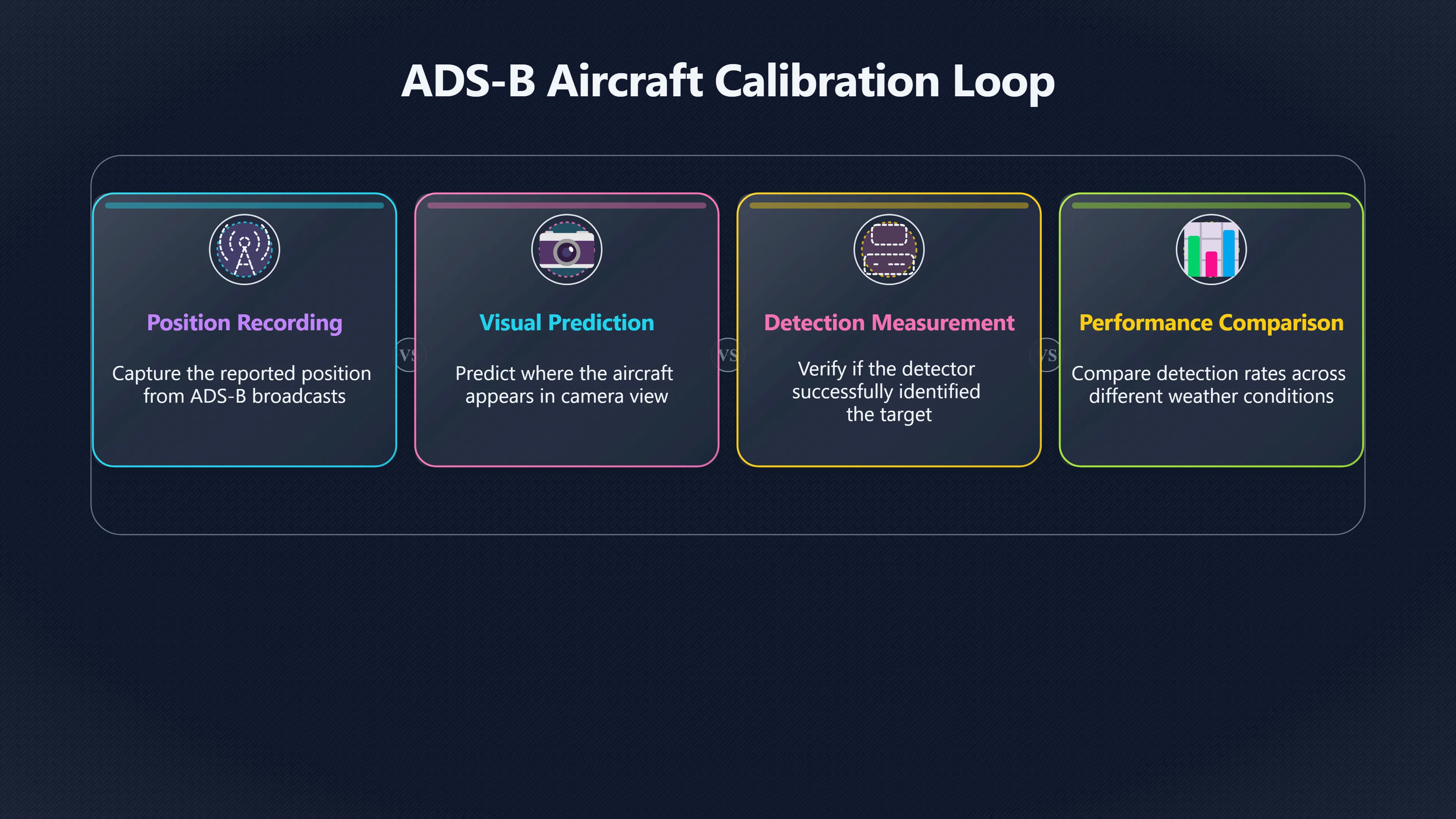
This creates a practical calibration loop:
- Record the aircraft’s reported position.
- Predict where it should appear in the image.
- Measure whether the detector found it.
- Compare detection performance across different weather conditions.
Unlike rare or disputed aerial events, thousands of ordinary flights can be accumulated into a statistical baseline. A detector may discover, for example, that it successfully identifies 95% of aircraft within a given angular range on clear days but only 60% during humid haze. Such measurements are far more useful than anecdotal impressions about whether conditions seemed “good” or “bad”.
The value is not limited to visible-light cameras. Infrared systems, all-sky cameras and automated tracking software can all be evaluated against the same stream of known aircraft targets. If one sensor continues to detect aircraft during haze while another fails, the weather sensitivity of each sensor becomes quantifiable rather than speculative.
Which conditions reduce detection rates most?
Atmospheric visibility is fundamentally controlled by how particles and droplets scatter and absorb light between the observer and the target. Aviation weather systems measure visibility because these effects directly influence what pilots and sensors can see. Fog, haze, rain, smoke, dust and high humidity all reduce contrast and apparent brightness.[Federal Aviation Administration+2Airport Lights Inspection]faa.govFederal Aviation Administration Chapter 7Safety of Flight… visibility restricted by haze and smoke…. Any obscuring matter such as rain, snow, dust, fog, haze or smoke reduce…
For sky-monitoring cameras, several conditions are especially important.
Fog and low cloud
Fog is among the most severe tests because it dramatically shortens visibility range. In aviation, fog is generally associated with visibility below one kilometre. Water droplets scatter incoming light and can make distant aircraft effectively disappear from optical systems.[Met Office]metoffice.gov.ukwhats the difference between mist fog and hazeMet OfficeMist, fog, and haze: What's the difference?10 Sept 2025 — For aviation purposes, fog is the name given when visibility drops be…
An aircraft that remains visible at 15 kilometres on a clear evening may vanish entirely when fog develops. By comparing detections against ADS-B tracks, operators can estimate the actual operational range of their cameras under low-visibility conditions.
Haze, smoke and humidity
Haze often creates a more subtle failure mode. Aircraft remain technically visible but lose contrast against the background sky. Small changes in humidity or aerosol concentration can significantly reduce the distance at which an object can be recognised. Aviation guidance repeatedly identifies haze, smoke and suspended particles as major causes of visibility degradation.[AOPA+3Airport Lights Inspection+3cfinotebook.net]tarmacview.comAirport Lights InspectionHaze | Airport Lights InspectionHaze refers to atmospheric obscuration caused by the suspension of extremely sma…
For UFO detector calibration, haze is particularly important because it can produce apparent “fade in” and “fade out” behaviour. A distant aircraft may intermittently emerge from the background, creating the illusion of unusual motion or appearance when the effect is actually atmospheric.
Rain and precipitation
Rain affects cameras in several ways simultaneously. Water in the atmosphere reduces contrast, droplets on optical surfaces distort images, and moving precipitation can generate false detections. Aviation visibility systems treat rain as a significant obscuration mechanism because it changes how much light reaches a sensor.[Federal Aviation Administration]faa.govFederal Aviation Administration Chapter 7Safety of Flight… visibility restricted by haze and smoke…. Any obscuring matter such as rain, snow, dust, fog, haze or smoke reduce…
Tracking ordinary aircraft during rainfall helps determine whether declining detection rates are caused by atmospheric attenuation, lens contamination or weaknesses in the detection software itself.
Twilight and low-light periods
The transition between day and night often produces more calibration challenges than either full daylight or darkness.
Aircraft navigation lights become more prominent while the aircraft body becomes less visible. Background sky brightness changes rapidly. Automatic exposure systems may adjust continuously. A target that is easy to classify during the day can become ambiguous during civil twilight even under otherwise clear weather conditions.
Routine aircraft traffic allows these effects to be measured repeatedly across many evenings and mornings rather than inferred from isolated observations.
Weather can mimic anomalies
One reason weather testing matters for anomaly review is that changing visibility can alter the apparent behaviour of ordinary aircraft.
Several well-known perceptual effects become more common when visibility degrades:
- Aircraft lights appear brighter than expected because surrounding reference points disappear.
- Objects emerge suddenly from haze layers.
- Navigation lights dominate the visual signature while the aircraft structure remains invisible.
- Partial cloud layers can hide and reveal targets, creating apparent accelerations or abrupt direction changes.
- Atmospheric scattering can distort perceived size and brightness.[ResearchGate+2Wikipedia]researchgate.netPresence of dust, fog, haze…Read more…
Without weather-aware calibration, a detector may treat these ordinary effects as evidence of unusual behaviour. With calibration data, operators can instead compare the event against thousands of similar aircraft observations recorded under comparable conditions.
Building weather-aware baselines for anomaly review
A mature UFO-monitoring system should not maintain a single detection threshold for all conditions. Instead, it should develop weather-specific performance baselines.
One practical approach is to group aircraft observations by environmental variables:
- Visibility range from meteorological reports.
- Relative humidity.
- Presence of rain or fog.
- Solar elevation angle.
- Cloud cover.
- Aerosol or smoke conditions.
- Time of day.[Pilot Institute+2Aviation Weather Center]pilotinstitute.commetar and taf reportsPilot InstituteHow to Read METAR and TAF Reports1 Jan 2025 — METAR and TAF provide vital weather info for pilots. METAR shows current con…
The detector can then calculate metrics such as:
- Probability of detection.
- Average tracking duration.
- Classification accuracy.
- False-positive rate.
- Maximum reliable detection distance.
Over time, a large catalogue of aircraft observations becomes a weather-performance map. Operators may learn that a camera reliably detects airliners at 25 kilometres on clear winter nights but only 8 kilometres during humid summer haze. Such information provides essential context when evaluating any unusual target.
Research in camera-based visibility estimation and automated fog detection illustrates the same principle from the opposite direction: image data can be used to infer atmospheric visibility because weather leaves measurable signatures in camera performance. Modern machine-learning systems increasingly use camera imagery to estimate visibility and identify low-visibility conditions automatically.[AMS Confex+2ADS]ams.confex.com410 Automatic Fog Detection and Visibility Estimation From…30 Jan 2024 — A method for determining the existence of fog and a…
What a weather-tested detector can claim
The strongest anomaly investigations are not those that record the most unusual objects. They are the ones that understand their own limitations.
If an automated sky-monitoring station can demonstrate that it routinely detects ordinary aircraft under specific weather conditions, and can quantify how performance changes in fog, haze, rain and twilight, then any remaining unexplained observations can be evaluated against a known baseline. Conversely, if the system’s ability to see ordinary aircraft under those same conditions has never been measured, then unusual detections may simply reflect unmeasured weather effects rather than genuinely anomalous phenomena.
Ordinary air traffic therefore serves a dual role. It is not merely background clutter to be filtered out. It is a continuously available test population that reveals how the atmosphere changes the detector itself, helping distinguish true anomalies from the shifting visibility of the sky.
Amazon book picks
Further Reading
Books and field guides related to How bad weather tests sky cameras. Use these as the next step if you want deeper reading beyond the article.
Weather Flying
Shows how weather affects aircraft operations and observation conditions, aligning with aircraft-based calibration and visibility testing.

Computer Vision
Provides foundations for object detection, tracking, image quality assessment, and performance benchmarking of camera systems.

Meteorology today
Explains fog, haze, clouds, precipitation, visibility, and other weather factors that affect camera detection performance.

Stimson's Introduction to Airborne Radar
First published 2014. Subjects: Radar in aeronautics.
eBay marketplace picks
Marketplace Samples
Example marketplace items related to this page. Use the search link to explore similar finds on eBay.
Endnotes
1.
Source: eurocontrol.int
Link:https://www.eurocontrol.int/service/automatic-dependent-surveillance-broadcast
Source snippet
sting their identity, position and other information derived from on board...Read more...
2.
Source: researchgate.net
Link:https://www.researchgate.net/publication/307977967_Measurement_of_the_atmospheric_visibility_distance_by_imaging_a_linear_grating_with_sinusoidal_amplitude_and_having_variable_spatial_period_through_the_atmosphere
Source snippet
Presence of dust, fog, haze...Read more...
3.
Source: cfinotebook.net
Link:https://www.cfinotebook.net/notebook/weather-and-atmosphere/obstructions-to-visibility
Source snippet
Obstructions To VisibilityHaze and smoke can obscure terrain and horizon references while still allowing some forward visibility. Precipi...
4.
Source: ams.confex.com
Title: 10 statute miles [SM]) to less than 3SM. Aircraft.Read more
Link:https://ams.confex.com/ams/92Annual/webprogram/Handout/Paper201227/2011%20AMS%20Haze%20Paper%20v2.pdf
Source snippet
EVALUATING THE IMPACTS OF HAZE ON AIR TRAFFIC...by RS Lee · Cited by 2 — Visibility through a haze layer – especially at shall...
5.
Source: aopa.org
Title: weather smoke gets in your eyes
Link:https://www.aopa.org/news-and-media/all-news/2023/august/flight-training-magazine/weather-smoke-gets-in-your-eyes
Source snippet
Smoke gets in your eyes10 Jul 2023 — VFR weather minimums require visibility of 3 statute miles below 10,000 feet msl in Class C,D,E, or...
6.
Source: Wikipedia
Link:https://en.wikipedia.org/wiki/Visibility
Source snippet
VisibilityIn meteorology, visibility is the measure of the distance at which an object or light can be clearly discerned.Read more...
7.
Source: ams.confex.com
Link:https://ams.confex.com/ams/104ANNUAL/webprogram/Paper431686.html
Source snippet
410 Automatic Fog Detection and Visibility Estimation From...30 Jan 2024 — A method for determining the existence of fog and a...
8.
Source: ui.adsabs.harvard.edu
Link:https://ui.adsabs.harvard.edu/abs/2022AGUFM.A15G1313M/abstract
Source snippet
Digital cameras are used as sensors for identifying areas...Read more...
9.
Source: Wikipedia
Title: Automatic Dependent Surveillance–Broadcast
Link:https://en.wikipedia.org/wiki/Automatic_Dependent_Surveillance%E2%80%93Broadcast
Source snippet
Automatic Dependent Surveillance–BroadcastADS-B is an aviation surveillance technology and form of electronic conspicuity in which an...
10.
Source: Wikipedia
Title: Automated airport weather station
Link:https://en.wikipedia.org/wiki/Automated_airport_weather_station
Source snippet
Automated airport weather stationAirport weather stations are automated sensor suites which are designed to serve aviation and meteoro...
11.
Source: faa.gov
Title: Federal Aviation Administration Automatic Dependent Surveillance
Link:https://www.faa.gov/about/office_org/headquarters_offices/avs/offices/afx/afs/afs400/afs410/ads-b
Source snippet
Federal Aviation AdministrationAutomatic Dependent Surveillance - Broadcast (ADS-B)29 Sept 2025 — ADS-B In provides operators of properly...
12.
Source: skybrary.aero
Title: Automatic Dependent Surveillance
Link:https://skybrary.aero/articles/automatic-dependent-surveillance-broadcast-ads-b
Source snippet
Broadcast (ADS-B)ADS-B is a Surveillance technique that relies on aircraft or airport vehicles broadcasting their identity, position and...
13.
Source: faa.gov
Title: Federal Aviation Administration Chapter 7
Link:https://www.faa.gov/air_traffic/publications/atpubs/aim_html/chap7_section_1.html
Source snippet
Safety of Flight... visibility restricted by haze and smoke.... Any obscuring matter such as rain, snow, dust, fog, haze or smoke reduce...
14.
Source: tarmacview.com
Title: Airport Lights Inspection Meteorological Visibility
Link:https://www.tarmacview.com/glossary/meteorological-visibility/
Source snippet
Airport Lights InspectionMeteorological Visibility - Airport Lights Inspection18 Nov 2025 — Meteorological visibility refers to the great...
15.
Source: metoffice.gov.uk
Title: whats the difference between mist fog and haze
Link:https://www.metoffice.gov.uk/blog/2025/whats-the-difference-between-mist-fog-and-haze
Source snippet
Met OfficeMist, fog, and haze: What's the difference?10 Sept 2025 — For aviation purposes, fog is the name given when visibility drops be...
16.
Source: tarmacview.com
Link:https://www.tarmacview.com/glossary/haze/
Source snippet
Airport Lights InspectionHaze | Airport Lights InspectionHaze refers to atmospheric obscuration caused by the suspension of extremely sma...
17.
Source: pilotinstitute.com
Title: metar and taf reports
Link:https://pilotinstitute.com/metar-and-taf-reports/
Source snippet
Pilot InstituteHow to Read METAR and TAF Reports1 Jan 2025 — METAR and TAF provide vital weather info for pilots. METAR shows current con...
18.
Source: aviationweather.gov
Link:https://aviationweather.gov/gfa/
19.
Source: facebook.com
Title: Automatic Dependent Surveillance
Link:https://www.facebook.com/groups/Aviationstudys/posts/2033716507065686/
Source snippet
Broadcast (ADS-B)...Automatic Dependent Surveillance-Broadcast (ADSB) is a technology that is used in aircraft to increase their visibil...
Additional References
20.
Source: medium.com
Link:https://medium.com/faa/a-fresh-forecast-ec83e1b565a9
Source snippet
A Fresh Forecast. Aviation Weather Under the MicroscopeWhen a METAR is labeled as a SPECI, pilots should take note that the winds, visibi...
21.
Source: etlaviation.com
Link:https://www.etlaviation.com/wp-content/uploads/_resources/FAA_Aviation_Weather_for_Pilots_and_Flight_Operations_Personnel_AC_00_6A_1975.pdf
Source snippet
FAA_Aviation_Weather_for_Pilot...AVIATION WEATHER is published jointly by the FAA Flight Standards Service... fog, haze, and smoke are n...
22.
Source: sesarju.eu
Link:https://www.sesarju.eu/sesar-solutions/ads-b-surveillance-aircraft-flight-and-surface
Source snippet
SESAR Joint UndertakingADS-B surveillance of aircraft in flight and on the surfaceAutomatic dependent surveillance-broadcast (ADS-B) is a...
23.
Source: gleim.com
Link:https://www.gleim.com/aviation/faraim/?fullTextNum=aim7&srsltid=AfmBOoob5MmRO_QCEVVMRTrym6zmip_f3mPSIpknF4_xDTf96YBdCiLT&terms%5B%5D=91.175
24.
Source: haisenglobal.com
Title: transmissometer visibility meter key role in airport weather safety
Link:https://www.haisenglobal.com/blog/transmissometer-visibility-meter-key-role-in-airport-weather-safety
Source snippet
Transmissometer (Visibility Meter): Key Role in Airport...27 Aug 2025 — The Transmissometer, also known as a Visibility Meter, is an indi...
25.
Source: sassofia.com
Title: what is ads b c automatic dependent surveillance broadcast
Link:https://sassofia.com/blog/what-is-ads-b-c-automatic-dependent-surveillance-broadcast/
Source snippet
What is ADS – B/C Automatic Dependent Surveillance6 Jul 2021 — Automatic Dependent Surveillance-Broadcast enables an aircraft to determin...
26.
Source: ctsys.com
Title: does your aviation weather briefing include smoke and ash
Link:https://www.ctsys.com/does-your-aviation-weather-briefing-include-smoke-and-ash/
Source snippet
Does your Aviation Weather Briefing Include Smoke and...17 Mar 2020 — Aviation weather briefings that include smoke and ash in wildfire...
27.
Source: caa.co.uk
Title: Detectors are mandatory at aerodromes providing automated observations.Read more
Link:https://www.caa.co.uk/publication/download/12602
Source snippet
Requirements for meteorological observations at aerodromes6 Aug 2023 — Cloud Base Recorders, Visibility Measuring Systems and Present Wea...
28.
Source: facebook.com
Title: ️ smoke can obscure the sky and change what you see in flightlearn what vertical
Link:https://www.facebook.com/CivilAviationSafetyAuthority/posts/%EF%B8%8F-smoke-can-obscure-the-sky-and-change-what-you-see-in-flightlearn-what-vertical/1238365101732148/
Source snippet
Learn what vertical visibility means, when it is reported and how smoke can...
29.
Source: universalweather.com
Title: aviation weather tips visibility
Link:https://www.universalweather.com/blog/aviation-weather-tips-visibility/
Source snippet
Aviation Weather Tips -- Visibility1 Aug 2025 — When operating to destinations with visibility under 1000/3 you should have at least two...
Topic Tree