Within Calibration
What missed planes reveal about UAP detectors
Failure to detect ordinary aircraft is useful evidence because it exposes weather, range, size and software limits before rare events are judged.
On this page
- Why false negatives matter for UAP claims
- Weather, range and aircraft size effects
- Using missed detections to set honest confidence limits
Page outline Jump by section
Introduction
One of the most useful tests of an automated UAP (Unidentified Anomalous Phenomena) detector is not whether it records something unusual, but whether it reliably records ordinary aircraft. Every missed airliner, helicopter or light aircraft provides evidence about the system’s blind spots. If a detector fails to see known targets whose existence can be independently verified through radar, ADS-B broadcasts or visual observation, then any claim about rarer and more unusual objects must be treated cautiously.
 This is a central lesson of modern UAP research. NASA’s independent UAP study emphasised that analysis is often limited by poor sensor calibration, incomplete metadata and a lack of baseline measurements of ordinary aerial traffic. Before a system can identify anomalies, it must first demonstrate what it can and cannot detect under normal conditions.[Wikisource+2NASA Science]en.wikisource.orgPage:UAP Independent Study Team - Final Report.pdf/512 Nov 2023 — At present, analysis of UAP data is hampered by poor sensor c…
Why false negatives matter for UAP claims
Most discussions of automated detection focus on false positives: birds identified as aircraft, reflections mistaken for objects, or sensor artefacts treated as real targets. However, false negatives—the failure to detect something that is actually present—are equally important.
A detector that misses known aircraft cannot accurately define its own detection envelope. The absence of a recorded target does not necessarily mean the target was absent. It may simply have been beyond the system’s effective range, hidden by weather, too dim in infrared, too small in angular size, or filtered out by tracking software.
For UAP investigations, this distinction is critical. Suppose an automated observatory reports that no conventional aircraft were present when an unusual object appeared. That statement only carries weight if the system has already demonstrated a high probability of detecting ordinary aircraft under similar conditions. Without that evidence, an apparent anomaly may simply occupy the same region of parameter space where the detector routinely fails.
This is why aviation surveillance systems are routinely evaluated not only by what they detect but also by what they miss. Aircraft-tracking technologies such as ADS-B and radar are assessed for coverage gaps, communication losses and performance limitations because missed tracks directly affect confidence in operational conclusions.[MDPI+2Federal Aviation Administration]mdpi.comAnalysis of Radar and ADS-B Influences on Aircraft Detect…by W Semke · 2017 · Cited by 38 — We examined the occurrence and duratio…
Weather, range and aircraft size effects
Distance shrinks targets faster than intuition suggests
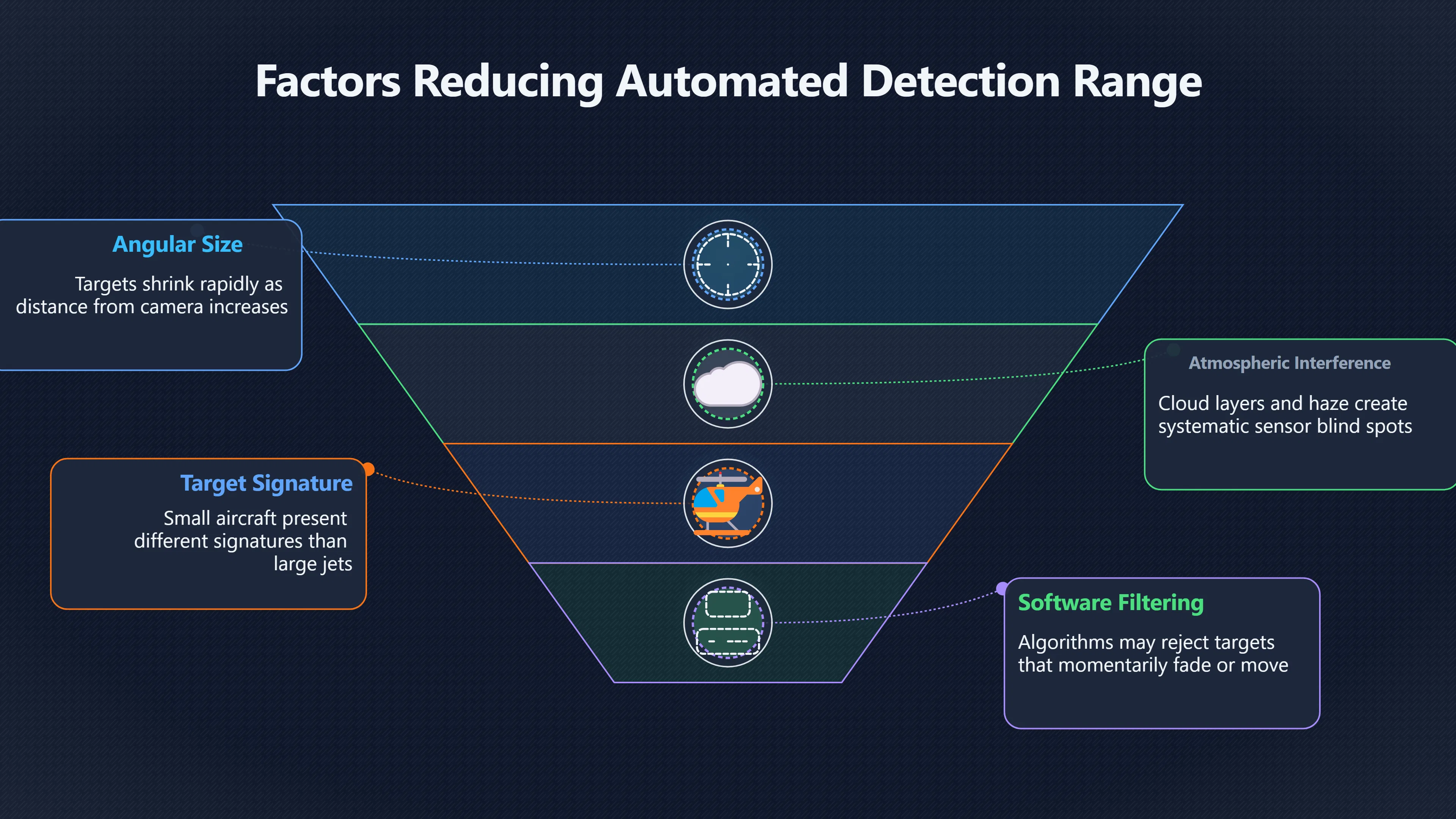
An aircraft visible to the human eye may occupy only a handful of pixels in a camera system several kilometres away. As range increases, the angular size of the target decreases rapidly. Detection algorithms that perform well on nearby aircraft may begin losing tracks as objects become smaller and dimmer.
A useful calibration exercise is therefore to compare aircraft detections against independently known aircraft positions from ADS-B. If the system consistently misses aircraft beyond a particular range or altitude, that defines a practical detection boundary. Such missed detections are not failures to be hidden; they are measurements of system capability.
Weather creates systematic blind spots
Cloud layers, haze, precipitation and atmospheric turbulence all affect optical and infrared sensors. Radar systems face their own weather-related challenges, including clutter, attenuation and anomalous propagation effects. Aviation surveillance standards explicitly recognise that weather and environmental conditions can generate detection problems and reduce reliability.[skyradar.com+2EUROCONTROL]skyradar.comatsep use cases impact of false targets on air traffic controlATSEP Use Cases: Impact of False Targets on Air Traffic Control21 Sept 2023 — For instance, weather conditions such as heavy precipitatio…
For automated UAP detectors, a night with thin haze may appear operationally normal while still reducing detection range substantially. If ordinary aircraft disappear from the dataset during such conditions, that loss provides a direct measure of degraded performance.
Aircraft type matters
Not all aircraft are equally detectable. A large jetliner, a piston aircraft, a helicopter and a distant business jet present different optical, infrared and radio-frequency signatures.
A detector that reliably acquires commercial airliners may still struggle with smaller aircraft. Consequently, calibration datasets should include a range of target types rather than a single category. A missed light aircraft may reveal limitations that thousands of successful airliner detections never expose.
What ADS-B comparisons reveal
ADS-B is particularly valuable because it provides an external reference. Equipped aircraft broadcast position, altitude and velocity information at regular intervals, allowing observers to compare what the detector should have seen against what it actually recorded.[Federal Aviation Administration]faa.govins outsFederal Aviation AdministrationIns and Outs7 Feb 2023 — ADS-B Out works by broadcasting information about an aircraft's GPS location, alt…
This comparison can uncover several important limitations:
- Coverage limits: aircraft appear in ADS-B records but never enter the detector’s track list.
- Range limits: detections begin only after aircraft reach a certain distance.
- Directional biases: aircraft are detected in some portions of the sky but not others.
- Weather sensitivity: detection rates drop under specific atmospheric conditions.
- Software filtering effects: tracking algorithms reject targets that momentarily fade, change brightness or move in unexpected ways.
Importantly, missed ADS-B aircraft do not always indicate camera failure. The comparison may instead reveal software thresholds that are too conservative. An algorithm designed to suppress noise may inadvertently suppress legitimate aircraft as well.
A mature observatory therefore treats discrepancies between sensor data and ADS-B records as diagnostic information rather than as mere errors.
Missed detections can expose hidden software assumptions
Many modern detection systems rely on automated classification and tracking pipelines. These pipelines contain assumptions about how real objects behave.
For example, a tracker may expect smooth motion across consecutive frames. If atmospheric distortion causes an aircraft to intermittently disappear, the software may terminate the track. Another algorithm may reject targets below a minimum brightness threshold, inadvertently excluding distant aircraft.
Such failures are valuable because they reveal assumptions that might otherwise remain invisible. A detector may appear highly accurate when evaluated only on successful tracks. Missed aircraft reveal where the software’s model of reality diverges from actual sky conditions.
This issue has parallels in aviation surveillance research, where communication dropouts, message losses and tracking interruptions are analysed specifically because they expose operational limitations that average performance statistics can conceal.[MDPI]mdpi.comAnalysis of Radar and ADS-B Influences on Aircraft Detect…by W Semke · 2017 · Cited by 38 — We examined the occurrence and duratio…
Using missed detections to set honest confidence limits
The most scientifically useful outcome of a missed-aircraft analysis is not a higher detection rate but a more honest estimate of uncertainty.
A well-characterised observatory might eventually be able to state:
- It detects 95% of ADS-B aircraft above a given angular size.
- Performance drops significantly in haze or low cloud.
- Detection probability decreases beyond a specified range.
- Small aircraft are detected less reliably than commercial jets.
- Certain regions of the sky have reduced sensitivity because of obstructions or optical distortion.
Those limits transform a detector from a camera system into a measurement instrument. They allow investigators to interpret unusual observations within a known framework of capability and uncertainty.
NASA’s UAP study repeatedly stressed the importance of calibration, metadata and baseline measurements because unexplained observations cannot be evaluated properly without understanding the behaviour of the instruments that produced them. Several apparent anomalies have been resolved only after closer examination of sensor characteristics and calibration details.[Wikisource+2Wikisource]en.wikisource.orgResponses to Statement of TaskNASA Unidentified Anomalous Phenomena: Independent…Oct 14, 2023 — Indeed, several apparent UAP have been demonstrated to be…
For automated UAP detectors, missed planes are therefore not embarrassing exceptions. They are among the most informative data points available. Every verified aircraft that should have been seen but was not helps define the true limits of the system. Until those limits are measured and understood, claims about rare or extraordinary aerial objects remain weaker than they may initially appear.
Amazon book picks
Further Reading
Books and field guides related to What missed planes reveal about UAP detectors. Use these as the next step if you want deeper reading beyond the article.

UFOs : Generals, Pilots, and Government Officials Go on the R...
Focuses on evaluating evidence quality, sensor observations, and limits of aerial anomaly reporting.
The UFO Experience
Emphasizes classification, observation quality, and the importance of understanding detection limitations.
Skunk Works
Provides practical aerospace context on aircraft capabilities, sensors, testing, and observational uncertainty.
The Demon-Haunted World
Explains skeptical evaluation of evidence, false conclusions, and the need for reliable baseline measurements.
eBay marketplace picks
Marketplace Samples
Example marketplace items related to this page. Use the search link to explore similar finds on eBay.


Endnotes
1.
Source: en.wikisource.org
Link:https://en.wikisource.org/wiki/Page%3AUAP_Independent_Study_Team_-_Final_Report.pdf/5
Source snippet
Page:UAP Independent Study Team - Final Report.pdf/512 Nov 2023 — At present, analysis of UAP data is hampered by poor sensor c...
2.
Source: science.nasa.gov
Link:https://science.nasa.gov/uap/
Source snippet
NASA ScienceUAP9 Jun 2022 — Low Water at San Carlos Reservoir. 4 min read. Low Water at San Carlos... Download the UAP Independent Study...
3.
Source: space.com
Title: nasa ufo uap study team first results revealed
Link:https://www.space.com/nasa-ufo-uap-study-team-first-results-revealed
Source snippet
NASA UFO report finds no evidence of 'extraterrestrial...14 Sept 2023 — "At present, analysis of UAP data is hampered by poor sensor cal...
4.
Source: mdpi.com
Link:https://www.mdpi.com/2226-4310/4/3/49
Source snippet
Analysis of Radar and ADS-B Influences on Aircraft Detect...by W Semke · 2017 · Cited by 38 — We examined the occurrence and duratio...
5.
Source: skyradar.com
Title: atsep use cases impact of [false targets]({{ ‘false-targets/’ | relative_url }}) on air traffic control
Link:https://www.skyradar.com/blog/atsep-use-cases-impact-of-false-targets-on-air-traffic-control
Source snippet
ATSEP Use Cases: Impact of False Targets on Air Traffic Control21 Sept 2023 — For instance, weather conditions such as heavy precipitatio...
6.
Source: eurocontrol.int
Link:https://www.eurocontrol.int/sites/default/files/publication/files/surveillance-standard-document-for-radar-surveillance-in-en-route-airspace-and-major-terminal-areas199703.pdf
Source snippet
RADAR SURVEILLANCE IN EN-ROUTE AIRSPACE AND...NOTE -. False PSR target reports may also be generated by weather, terrain, noise, clutter...
7.
Source: en.wikisource.org
Title: Responses to Statement of Task
Link:https://en.wikisource.org/wiki/NASA_Unidentified_Anomalous_Phenomena%3A_Independent_Study_Team_Report/Responses_to_Statement_of_Task
Source snippet
NASA Unidentified Anomalous Phenomena: Independent...Oct 14, 2023 — Indeed, several apparent UAP have been demonstrated to be...
8.
Source: nasa.gov
Title: to release discuss unidentified anomalous phenomena report
Link:https://www.nasa.gov/news-release/nasa-to-release-discuss-unidentified-anomalous-phenomena-report/
Source snippet
NASA to Release, Discuss Unidentified Anomalous...12 Sept 2023 — NASA commissioned the study to examine UAP from a scientific perspectiv...
9.
Source: faa.gov
Title: Federal Aviation Administration4-5-2
Link:https://www.faa.gov/air_traffic/publications/atpubs/aim/aim0405.html
Source snippet
4-5-2. Air Traffic Control Radar Beacon System (ATCRBS)8 Jan 2015 — (d) Coverage Limitations. Since TIS is provided by ground-based, seco...
10.
Source: faa.gov
Title: ins outs
Link:https://www.faa.gov/air_traffic/technology/equipadsb/capabilities/ins_outs
Source snippet
Federal Aviation AdministrationIns and Outs7 Feb 2023 — ADS-B Out works by broadcasting information about an aircraft's GPS location, alt...
11.
Source: faa.gov
Title: Federal Aviation Administration Automatic Dependent Surveillance
Link:https://www.faa.gov/about/office_org/headquarters_offices/avs/offices/afx/afs/afs400/afs410/ads-b
Source snippet
Federal Aviation AdministrationAutomatic Dependent Surveillance - Broadcast (ADS-B)Sep 29, 2025 — ADS-B is an advanced surveillance techn...
12.
Source: faa.gov
Link:https://www.faa.gov/air_traffic/publications/atpubs/aim_html/chap4_section_5.html
Source snippet
Section 5. Surveillance SystemsAdditionally, transponder or ADS-B equipped aircraft cannot be provided with radar advisories concerning p...
13.
Source: faa.gov
Link:https://www.faa.gov/
14.
Source: faa.gov
Link:https://www.faa.gov/air_traffic/technology/equipadsb/resources/faq
Source snippet
Frequently Asked Questions | Federal Aviation Administration1 Aug 2025 — Please see below for questions and answers about equipping. If y...
15.
Source: Wikipedia
Title: Federal Aviation Administration
Link:https://en.wikipedia.org/wiki/Federal_Aviation_Administration
Source snippet
Federal Aviation AdministrationThe Federal Aviation Administration (FAA) is a US federal government agency within the US Department of...
Additional References
16.
Source: researchgate.net
Link:https://www.researchgate.net/publication/332254869_Surveillance_Radar_System_Limitations_and_the_Advent_of_the_Automatic_Dependent_Surveillance_Broadcast_system_for_Aircraft_Monitoring
Source snippet
Surveillance Radar System Limitations and the Advent of...7 Apr 2019 — In this paper, the limitations of the surveillance radar system t...
17.
Source: nbaa.org
Link:https://nbaa.org/aircraft-operations/communications-navigation-surveillance-cns/global-positioning-system-gps/gps-interference/faa-publishes-updated-gps-gnss-interferences-jamming-and-spoofing-resource/
Source snippet
FAA Publishes Updated GPS/GNSS Interferences...The guide explains that unintentional interference can be caused by faulty commercial equ...
18.
Source: airservicesaustralia.com
Link:https://www.airservicesaustralia.com/wp-content/uploads/FAQ_ADS-B_DEC16.pdf
19.
Source: ll.mit.edu
Link:https://www.ll.mit.edu/sites/default/files/publication/doc/advances-primary-radar-technology-stone-ja-6398.pdf
Source snippet
Lincoln LaboratoryAdvances in primary-radar technologyThis article first delineates the primary-radar requirements for aircraft and weath...
20.
Source: cfinotebook.net
Link:https://www.cfinotebook.net/notebook/air-traffic-control/radar
Source snippet
RadarRadar coverage limitations can occur due to terrain, altitude, distance, and equipment performance factors. Transponders and ADS-B e...
21.
Source: youtube.com
Link:https://www.youtube.com/watch?v=cKrW0aoB_6w
Source snippet
ADS-B: The Future of Aircraft Surveillance! Explained by...ADSB is an advanced surveillance technology that allows aircraft to broadcast...
22.
Source: youtube.com
Link:https://www.youtube.com/watch?v=nuBMnluJfs0
Source snippet
Replay! NASA's Release of the Unidentified Anomalous...NASA commissioned an independent study team to examine unidentified anomalous phe...
23.
Source: skyandtelescope.org
Title: nasa finds no evidence ufos are extraterrestrial promises further study
Link:https://skyandtelescope.org/astronomy-news/nasa-finds-no-evidence-ufos-are-extraterrestrial-promises-further-study/
Source snippet
NASA Finds No Evidence UFOs Are Extraterrestrial...15 Sept 2023 — An independent study shows how NASA can help understand unidentified a...
24.
Source: avi-loeb.medium.com
Title: a new calculation on the fly to the nasa uap study 2dacaf860cac
Link:https://avi-loeb.medium.com/a-new-calculation-on-the-fly-to-the-nasa-uap-study-2dacaf860cac
Source snippet
New Calculation on the Fly to the NASA UAP Study - Avi LoebThe NASA Study will examine unclassified data on UAP in an attempt to separate...
25.
Source: meritalk.com
Title: nasa urged to take more permanent role in uap research effort
Link:https://www.meritalk.com/articles/nasa-urged-to-take-more-permanent-role-in-uap-research-effort/
Source snippet
NASA Urged to Take More Permanent Role in UAP...15 Sept 2023 — The study team found that most UAP data is “hampered by poor sensor calib...
Topic Tree