Within Sky 360
First Rule Out the Ordinary Sky
Sky360-style observations become stronger when station data is compared against ordinary aerial sources before calling anything anomalous.
On this page
- Matching aircraft and satellite records
- Checking weather, meteors and local drone activity
- Why exclusions make remaining cases stronger
Page outline Jump by section
Introduction
For networks such as Sky360, the first question is usually not “What is this object?” but “Can it be explained by known traffic in the sky?” The strength of an automated instrumented UAP system depends as much on excluding ordinary objects as on detecting unusual ones. A station that records a bright moving light but fails to compare it against aircraft, satellites, weather events or local drone activity produces little scientific value. A station that performs those checks systematically can narrow a large pool of sightings into a much smaller set of genuinely unresolved cases. This emphasis on exclusion aligns with broader scientific recommendations that UAP investigations need better baseline data, calibrated sensors and multiple sources of contextual information before anomalies can be assessed confidently.[NASA Science+2Sky & Telescope]science.nasa.govNASA ScienceIndependent Study Team ReportUnidentified Anomalous Phenomena (UAP) are one of our planet's greatest mysteries. Observations…

Matching Aircraft and Satellite Records
The most common source of apparent anomalies is ordinary aviation traffic. Modern citizen stations therefore incorporate aircraft-identification workflows as a routine part of event analysis.
Most commercial aircraft continuously broadcast position, altitude, speed and identification information through Automatic Dependent Surveillance–Broadcast (ADS-B). These broadcasts can be received by ground stations and aggregated into public tracking networks. Services such as OpenSky Network and ADS-B Exchange make it possible to compare a detected object’s time, direction and trajectory against known aircraft movements.[OpenSky Network+3Skybrary+3Federal Aviation Administration]skybrary.aeroAutomatic Dependent SurveillanceAutomatic Dependent Surveillance - Broadcast (ADS-B)ADS-B is a Surveillance technique that relies on aircraft or airport vehicles…
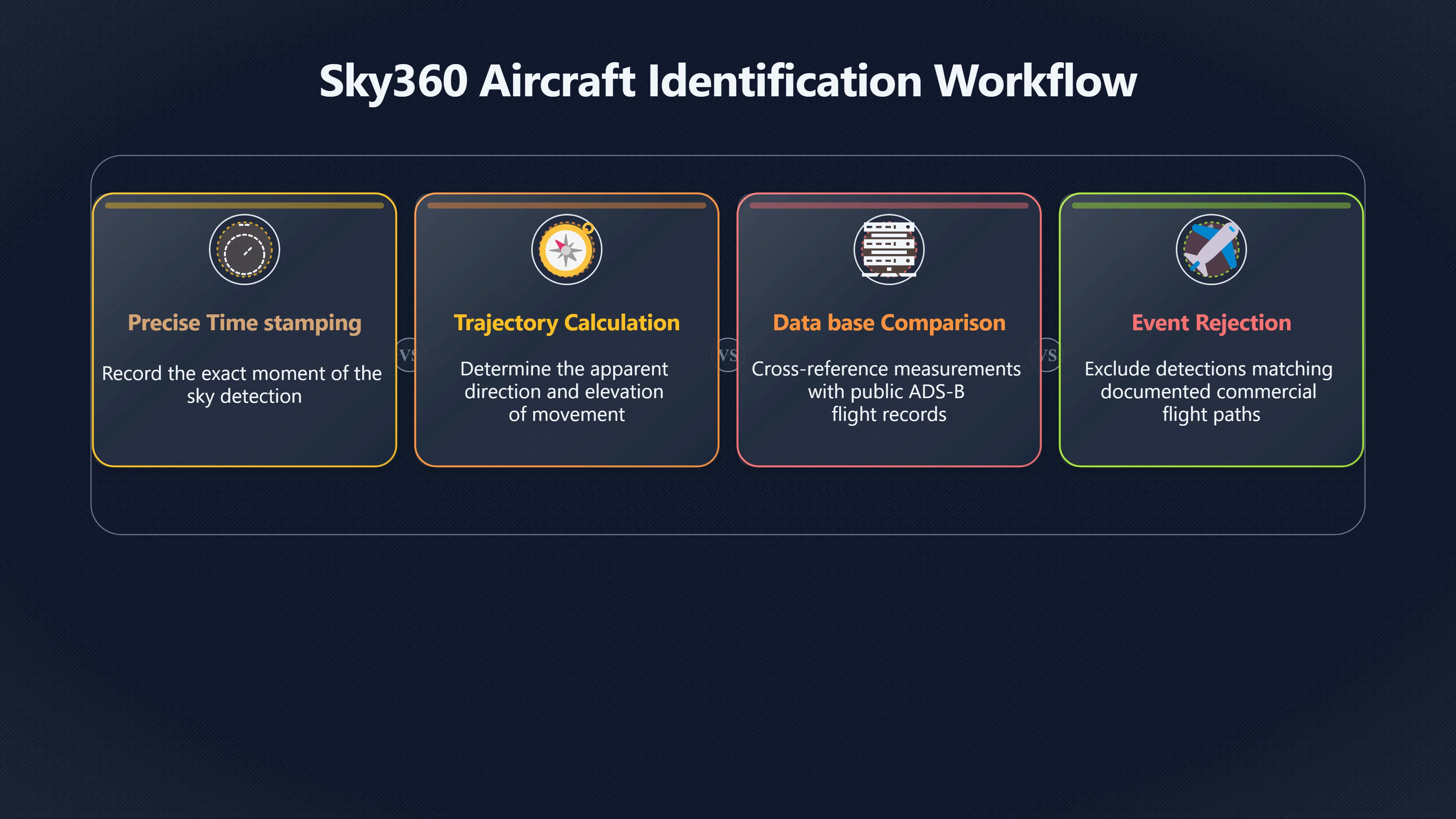
In practical terms, a Sky360-style station can:
- Timestamp a detection precisely.
- Calculate the object’s apparent direction and elevation.
- Compare those measurements with ADS-B records from the same moment.
- Determine whether a known aircraft occupied the same part of the sky.
- Reject events whose movement, brightness and position match a documented flight path.
This process is particularly important because aircraft can appear highly unusual under certain viewing conditions. Head-on approaches, landing lights, atmospheric haze and perspective effects can make conventional aircraft appear stationary, suddenly accelerating or exceptionally bright.
Networked aircraft databases provide another benefit: they help distinguish genuine unknowns from simple gaps in human perception. OpenSky itself was built around crowdsourced receivers using inexpensive equipment, demonstrating how distributed citizen sensors can collectively create a highly useful aviation reference layer.[Oxford Computer Science]cs.ox.ac.ukcovers 720,000 km2 and is able to capture more than 30 % of the total commercialford Computer ScienceA Large-scale ADS-B Sensor Network for ResearchSeptember 4, 2014 — by M Schäfer · Cited by 761 — OpenSky collects…
Satellite exclusion follows a similar logic. Many bright satellites, including Starlink trains and other low-Earth-orbit spacecraft, can produce unexpected visual appearances. Citizen-observation projects commonly compare detections against orbital catalogues and prediction services that calculate when satellites should be visible from a specific location. If a recorded track aligns with a known orbital pass, the event can often be classified immediately rather than remaining in an unidentified category.
The governance value of these databases is significant. Instead of relying on an observer’s judgement, stations can document exactly which aircraft and satellite records were checked and why an object was excluded. That creates an auditable trail that other investigators can review.
Checking Weather, Meteors and Local Drone Activity
Aircraft and satellites explain many reports, but they are not the only ordinary sources that must be eliminated.
Weather data provides another essential reference layer. Clouds, temperature inversions, ice crystals, lightning and atmospheric reflections can create unusual visual effects. Citizen stations increasingly combine sky imagery with meteorological records so that an apparent anomaly can be evaluated against local atmospheric conditions. NASA’s UAP study highlighted the importance of contextual environmental information and noted that Earth-observing datasets can help establish the conditions present when an event occurred.[Wikisource+2NASA Science]en.wikisource.orgResponses to Statement of TaskNASA Unidentified Anomalous Phenomena: Independent…14 Oct 2023 — NASA's fleet of earth-observing satellites should play a po…
Meteor activity is another routine check. Fast-moving luminous events may initially appear unusual, but meteor shower calendars, all-sky camera networks and astronomical observations often provide a straightforward explanation. Because meteors follow predictable seasonal patterns, cross-referencing astronomical data can rapidly remove many transient events from further investigation.
Drones present a more complicated challenge. Unlike commercial aircraft, many drones are small, operate at low altitude and may not appear in public flight-tracking databases. Consumer drones can also hover, manoeuvre abruptly and display bright navigation lights, behaviours that frequently resemble popular descriptions of anomalous objects.
To address this problem, citizen stations typically look for several indicators:
- Low-altitude operation close to the observer.
- Repeated movement patterns consistent with recreational flying.
- Intermittent navigation lights.
- Proximity to parks, industrial areas or known launch locations.
- Reports from local drone communities or regulatory databases where available.
Some advanced systems also use image analysis to estimate size, distance and motion, helping distinguish a nearby drone from a more distant object.
The key point is not that every drone can be identified. Rather, the station seeks enough contextual evidence to determine whether a conventional explanation remains more likely than an anomalous one.
Why Exclusions Make Remaining Cases Stronger
A common misunderstanding is that ruling out ordinary explanations somehow weakens a UAP investigation. In practice, the opposite is true.
Scientific studies of aerial anomalies repeatedly identify poor data quality, missing metadata and lack of baseline information as major obstacles. Many reported sightings remain unresolved simply because investigators cannot reconstruct what else was in the sky at the time.[WIRED+3NASA Science+3Sky & Telescope]science.nasa.govNASA ScienceIndependent Study Team ReportUnidentified Anomalous Phenomena (UAP) are one of our planet's greatest mysteries. Observations…
Citizen stations attempt to improve this situation by treating exclusion as a formal stage of analysis. A recorded event becomes more informative when investigators can demonstrate:
- No matching aircraft track was present.
- No known satellite pass fits the observation.
- Weather conditions do not account for the appearance.
- Meteor databases provide no corresponding event.
- A nearby drone explanation appears unlikely.
Even then, the result is not proof of something extraordinary. It is simply a stronger unresolved case.
This distinction matters for governance within open observation networks. If every unusual light is labelled anomalous immediately, the database fills with false positives. If every detection undergoes documented cross-checks first, the remaining cases become rarer, better characterised and more suitable for detailed review.
For projects such as Sky360, this filtering process is therefore not a secondary administrative step. It is the central mechanism that transforms continuous sky monitoring into a credible search for genuine anomalies. The more effectively a network can identify ordinary aircraft, satellites, weather effects and drones, the more meaningful its unresolved observations become.

Amazon book picks
Further Reading
Books and field guides related to First Rule Out the Ordinary Sky. Use these as the next step if you want deeper reading beyond the article.
The UFO Experience
Introduces classification and investigative methods useful for excluding ordinary phenomena.
Identified Flying Objects
Encourages systematic analysis of sightings and consideration of competing explanations.

UFOs : Generals, Pilots, and Government Officials Go on the R...
Emphasizes evidence, witness evaluation, and separating credible cases from ordinary explanations.
The UFO Enigma
Focuses on evaluating evidence and unresolved cases after conventional explanations are considered.
eBay marketplace picks
Marketplace Samples
Example marketplace items related to this page. Use the search link to explore similar finds on eBay.




Endnotes
1.
Source: science.nasa.gov
Link:https://science.nasa.gov/wp-content/uploads/2023/09/uap-independent-study-team-final-report.pdf
Source snippet
NASA ScienceIndependent Study Team ReportUnidentified Anomalous Phenomena (UAP) are one of our planet's greatest mysteries. Observations...
2.
Source: nasa.gov
Link:https://www.nasa.gov/news-release/nasa-to-release-discuss-unidentified-anomalous-phenomena-report/
Source snippet
t impossible to draw firm scientific conclusions about their nature...
3.
Source: skybrary.aero
Title: Automatic Dependent Surveillance
Link:https://skybrary.aero/articles/automatic-dependent-surveillance-broadcast-ads-b
Source snippet
Automatic Dependent Surveillance - Broadcast (ADS-B)ADS-B is a Surveillance technique that relies on aircraft or airport vehicles...
4.
Source: opensky-network.org
Link:https://opensky-network.org/
Source snippet
OpenSkyADS-B / Aircraft Database Alerts. View our live flight map. contributing your data to enhance global air traffic monitoring. Explo...
5.
Source: opensky-network.org
Link:https://opensky-network.org/about/publications
Source snippet
Publications with OpenSky Network DataA Large-scale ADS-B Sensor Network for Research". contains 868 publications created from research u...
6.
Source: en.wikisource.org
Title: Responses to Statement of Task
Link:https://en.wikisource.org/wiki/NASA_Unidentified_Anomalous_Phenomena%3A_Independent_Study_Team_Report/Responses_to_Statement_of_Task
Source snippet
NASA Unidentified Anomalous Phenomena: Independent...14 Oct 2023 — NASA's fleet of earth-observing satellites should play a po...
7.
Source: wired.com
Link:https://www.wired.com/story/nasa-ufos-aliens-report-2023
Source snippet
The agency stressed the need to shift the conversation from sensationalism to science and eliminate the stigma associated with reporting...
8.
Source: opensky-network.org
Link:https://opensky-network.org/data/scientific
Source snippet
Scientific DatasetsOpenSky Network ADS-C is an advanced surveillance system that utilizes an aircraft's onboard systems to automatically...
9.
Source: science.nasa.gov
Link:https://science.nasa.gov/uap/
Source snippet
nasa.govUAP9 Jun 2022 — A study team to examine unidentified anomalous phenomena (UAPs) – that is, observations of events in the sky that...
10.
Source: nasa.gov
Title: update nasa shares uap independent study report names director
Link:https://www.nasa.gov/news-release/update-nasa-shares-uap-independent-study-report-names-director/
Source snippet
UPDATE: NASA Shares UAP Independent Study Report14 Sept 2023 — NASA's new Director of UAP Research will develop and oversee the implement...
11.
Source: skyandtelescope.org
Title: nasa finds no evidence ufos are extraterrestrial promises further study
Link:https://skyandtelescope.org/astronomy-news/nasa-finds-no-evidence-ufos-are-extraterrestrial-promises-further-study/
Source snippet
UAP reports are typically single sightings and lack multiple measurements. Those individual reports also often lack sensor metadata, such...
12.
Source: faa.gov
Title: ins outs
Link:https://www.faa.gov/air_traffic/technology/equipadsb/capabilities/ins_outs
Source snippet
Federal Aviation AdministrationIns and Outs | Federal Aviation Administration7 Feb 2023 — ADS-B Out works by broadcasting information abo...
13.
Source: cs.ox.ac.uk
Title: covers 720,000 km2 and is able to capture more than 30 % of the total commercial
Link:https://www.cs.ox.ac.uk/files/7238/ipsn2014.pdf
Source snippet
ford Computer ScienceA Large-scale ADS-B Sensor Network for ResearchSeptember 4, 2014 — by M Schäfer · Cited by 761 — OpenSky collects...
Published: September 4, 2014
14.
Source: Wikipedia
Title: Automatic Dependent Surveillance–Broadcast
Link:https://en.wikipedia.org/wiki/Automatic_Dependent_Surveillance%E2%80%93Broadcast
Source snippet
Automatic Dependent Surveillance–BroadcastADS-B is an aviation surveillance technology and form of electronic conspicuity in which an...
15.
Source: cs.ox.ac.uk
Title: dasc 2021 adsb mandate fleet deployment
Link:https://www.cs.ox.ac.uk/files/12934/dasc_2021_adsb_mandate_fleet_deployment.pdf
Source snippet
Report 2021: Insights on ADS-B Mandate and...by J Sun · 2021 · Cited by 20 — In this paper, we analyze years of data collected by the Op...
Additional References
16.
Source: researchgate.net
Link:https://www.researchgate.net/publication/395858774_Toward_a_Reliability_Scale_for_Assessing_Reports_of_Unidentified_Anomalous_Phenomena_UAP
Source snippet
(PDF) Toward a Reliability Scale for Assessing Reports of...18 Sept 2025 — Unidentified Anomalous Phenomena (UAP) observations have been...
17.
Source: adsbexchange.com
Link:https://www.adsbexchange.com/
Source snippet
ADS-B ExchangeADS-B Exchange connects the world's largest independent ADS-B receiver network, displaying all aircraft broadcasts as recei...
18.
Source: aireon.com
Link:https://aireon.com/
Source snippet
Air Traffic Surveillance Data for the Aviation CommunityPowered by Iridium's networked constellation of 66 satellites, Aireon ADS-B provi...
19.
Source: medium.com
Link:https://medium.com/%40mcraddock/the-planes-that-map-the-world-e6f703f46038
Source snippet
How the World Learned to Measure Economic Shocks from...ADS-B (Automatic Dependent Surveillance-Broadcast), a system in which aircraft c...
20.
Source: reddit.com
Link:https://www.reddit.com/r/Futurology/comments/16ijwyl/nasa_shares_unidentified_anomalous_phenomena/
Source snippet
NASA Shares Unidentified Anomalous Phenomena...NASA commissioned the independent study to better understand how the agency can contribut...
21.
Source: reddit.com
Link:https://www.reddit.com/r/space/comments/16ij6ui/nasa_shares_unidentified_anomalous_phenomena/
Source snippet
NASA Shares Unidentified Anomalous Phenomena...NASA has released the Unidentified Anomalous Phenomena independent study team's report wi...
22.
Source: axios.com
Link:https://www.axios.com/2023/09/14/nasa-uap-report-release
Source snippet
government efforts in understanding UAPs. Unlike the Department of Defense's often classified data, NASA emphasizes transparency and publ...
23.
Source: reddit.com
Link:https://www.reddit.com/r/ADSB/comments/1bnsgzf/sample_flight_track_data_from_opensky_network_for/
Source snippet
Sample Flight Track Data from OpenSky network for IADsites ADSB Exchange, I made a Python script that shows an ATC-style display of aircr...
24.
Source: youtube.com
Link:https://www.youtube.com/watch?v=TQcqOW39ksk
25.
Source: avi-loeb.medium.com
Title: a new calculation on the fly to the nasa uap study 2dacaf860cac
Link:https://avi-loeb.medium.com/a-new-calculation-on-the-fly-to-the-nasa-uap-study-2dacaf860cac
Source snippet
New Calculation on the Fly to the NASA UAP Study - Avi LoebThe key in identifying an unusual signal lies in the data quality that makes i...
Topic Tree