Within Sky Detectors
What Would Make UAP Detector Data Credible?
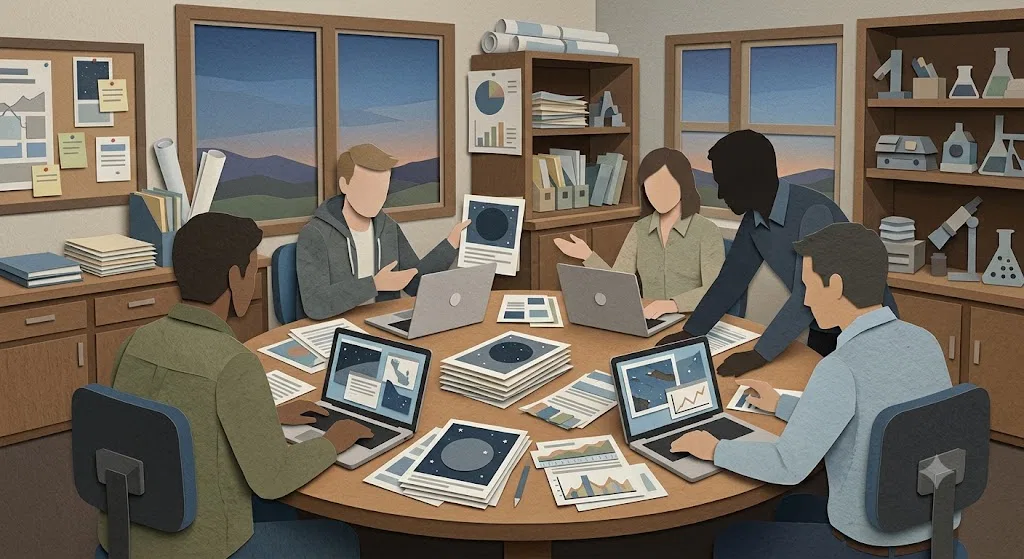
Detector evidence becomes more credible when outside analysts can inspect data, methods, calibration, and repeated results.
On this page
- Why raw and near raw data matter
- Independent replication across sites
- Privacy, security, and disclosure limits
Page outline Jump by section
Introduction
Automated instrumented UFO detectors will not become scientifically persuasive merely by recording unusual lights or tracks. Their evidence becomes credible when other people can inspect the data trail: raw or near-raw sensor records, calibration files, timestamps, pointing geometry, software versions, environmental context, and enough repeated observations to test whether a claimed anomaly survives independent analysis. NASA’s 2023 UAP study put the problem plainly: UAP analysis is held back by poor sensor calibration, missing metadata, lack of multiple measurements and lack of baseline data.[NASA Science]science.nasa.govScience Independent Study Team ReportNASA ScienceIndependent Study Team ReportSeptember 13, 2023 — At present, analysis of UAP data is hampered by poor sensor calibration, th…
That makes open data a governance problem as much as a technical one. The question is not whether every camera feed, radar trace or military sensor file should be dumped online. Some data can expose private locations, aircraft movements, security-sensitive capabilities or bystanders. The credible middle ground is a structured disclosure model: preserve full forensic data, release enough for independent testing, document what has been withheld, and make replication across sites the standard for strong claims.
Why raw and near-raw data matter
A UAP detector does not produce “evidence” in the scientific sense simply by saving a dramatic clip. A compressed video can show motion, brightness and shape, but it may hide the details needed to judge whether the object was a bird, aircraft, satellite, balloon, meteor, insect near the lens, autofocus artefact, rolling-shutter distortion or software-triggered false positive. For automated detector evidence, the valuable record is the whole event package: the original frames or sensor stream, clock synchronisation, lens and exposure settings, detector thresholds, site coordinates, weather, aircraft and satellite context, and any processing steps used to mark the event as anomalous.
NASA’s report is important because it moves the debate away from “better cameras” alone. It argues for a robust data acquisition strategy built around calibrated sensors, multiple measurements and baseline data, not just more sightings. Baseline data matters because a detector must know what ordinary skies look like at that site: air traffic patterns, insects, birds, clouds, stars, satellites, weather, local light pollution and recurring sensor quirks. Without that comparison set, “unusual” may only mean “unfamiliar to the analyst” or “rare in a small sample”.[NASA Science]science.nasa.govScience Independent Study Team ReportNASA ScienceIndependent Study Team ReportSeptember 13, 2023 — At present, analysis of UAP data is hampered by poor sensor calibration, th…
The same logic appears in newer instrumented UAP projects. The Galileo Project’s ground-observatory design is explicitly multimodal: wide-field cameras, narrow-field optical instruments, passive radar-style receivers, radio spectrum instruments, microphones, environmental sensors and magnetic-field measurements are intended to help distinguish physical objects from artefacts and to make true detections corroborable.[arXiv]arxiv.orgThe Scientific Investigation of Unidentified Aerial Phenomena (UAP) Using Multimodal Ground-Based ObservatoriesMay 29, 2023… Its later observatory computing architecture emphasises data provenance management, calibration and scientifically sound data collection, because the scientific bottleneck is not only detecting something but proving how the data were made.[arXiv]arxiv.orgarXiv Galileo Project Observatory Class System ArchitectureGalileo Project Observatory Class System ArchitectureMay 30, 2025…
This is why “near-raw” data can sometimes be as important as fully raw data. A public release may not need every continuous hour of uninteresting sky footage, but it should include enough unprocessed event material and enough surrounding context to let outsiders reproduce the conclusion. A credible event file would normally include:
- Original or minimally processed sensor records, not only edited highlights.
- Calibration information, including lens geometry, pointing direction, clock accuracy, sensor sensitivity and known limitations.
- Processing history, including detection thresholds, code versions, filters, compression and manual annotations.
- Negative context, meaning what other sensors did not see and what ordinary background activity looked like before and after the event.
- External cross-checks, such as aircraft transponder data, satellite predictions, weather records and astronomical ephemerides where relevant.
AARO’s public UAP imagery pages illustrate the cost of missing corroboration. In at least some posted cases, AARO says the available imagery cannot support a conclusive analytic evaluation because there is no corroborating telemetry or multimodal sensor data to decide whether a signature is a physical source or a sensor artefact.[AARO]aaro.milOpen source on aaro.mil. That is not a trivial technical footnote. It is the difference between a case that can be studied and a case that can only be debated.

The replication problem: one station is rarely enough
A single detector station can document that something crossed its field of view. It usually cannot, by itself, establish distance, size, speed or trajectory with high confidence. This is a central replication problem in UAP detector evidence: many spectacular interpretations depend on estimates that collapse if the object was much nearer, smaller, slower or more ordinary than assumed.
Replication has two meanings here. First, the same event should ideally be observed by more than one independent sensor or site. Two separated optical stations can triangulate position; radar-like or radio systems can add range or velocity constraints; environmental sensors can test whether local conditions explain the trigger. Second, the detection method itself should work repeatedly across time and locations. A detector that flags many “anomalies” at one site but not under comparable conditions elsewhere may be measuring local clutter, weather, software bias or equipment behaviour rather than a new phenomenon.
Hessdalen in Norway is a useful older example because it shows both the promise and the limits of long-running instrumented observation. The Hessdalen Automatic Measurement Station has used cameras and environmental sensors to monitor recurring light phenomena; its own station documentation describes weather sensors, regular data transfer and upgrades over time.[Hessdalen]old.hessdalen.orgAutomatic Measurement Station (AMSAutomatic Measurement Station (AMS That continuity is valuable, but it also shows why replication is hard: localised phenomena, changing hardware and partial public data make it difficult for independent teams to reproduce every claim or compare results cleanly across sites.
Citizen-science networks try to solve this by making detector stations more numerous and standardised. Sky360 describes itself as an open-source global sky-observation network using AI-powered tracking stations to detect, track, identify and analyse aerial phenomena.[Sky360]sky360.orgOpen source on sky360.org. Its public repository frames the project as observational citizen science and makes software development visible through GitHub.[GitHub]github.comOpen source on github.com. That open-source model can improve trust, but it only becomes scientifically powerful if hardware builds, calibration routines, clock discipline, metadata formats and data retention rules are consistent enough for results from one station to be compared with another.
UAPx provides a cautionary case from the field-expedition model. Its Catalina Island expedition used visible and infrared cameras and other sensors, and the published paper describes both successes and failures rather than presenting every ambiguity as a breakthrough. The study reports about an hour of triggered visible or night-vision video, more than 600 hours of untriggered far-infrared video and 55 hours of radiation measurements, while noting that several initially ambiguous observations were resolved through ordinary explanations.[arXiv]arxiv.orgOpen source on arxiv.org. That is exactly the sort of result replication culture needs: not just “interesting events”, but a record of false starts, mundane resolutions and thresholds for when an ambiguity deserves more attention.
The harder governance question is timing. UAPx states that raw data and analytical results are to be released only after analyses are completed, defined as peer-reviewed publication.[arXiv]arxiv.orgOpen source on arxiv.org. That is understandable in a research setting, where teams want to avoid premature claims and protect the integrity of analysis. But delayed release also limits independent scrutiny in the period when public attention is highest. A stronger norm would separate priority of analysis from verification: researchers may reserve first publication rights, but event packages, calibration files and analysis code should have a clear release schedule, with embargoes justified and time-limited.
What open data should include without becoming reckless
“Open data” in UAP detection should not mean indiscriminate publication of everything a station records. A sky detector may capture private property, people, vehicle movements, sensitive infrastructure, aircraft operations, or data from restricted military or intelligence systems. A governance framework has to protect those interests while still preventing “trust us” evidence from becoming the default.
The strongest approach is tiered access. Public users could receive redacted event packages: near-raw imagery, time windows, sensor settings, calibration summaries, local weather, known aircraft and satellite exclusions, and the analysis code used to classify the event. Qualified reviewers could receive fuller records under controlled terms where privacy, security or proprietary sensor details are involved. A permanent archive should preserve the full forensic chain even if some layers cannot be released immediately.
AARO’s own materials show why this matters. Its declassification information paper says the office routinely accesses classified information, including data collected by US government systems, while also placing emphasis on transparency and release where possible.[AARO]aaro.miland the Declassification Processand the Declassification Process A separate AARO workshop paper identifies classification as a major barrier because substantial UAP data may be captured on classified sensors, making it inaccessible until review.[AARO]aaro.mil2025 UAP Workshop Paper2025 UAP Workshop Paper This creates a structural problem for public replication: some of the most capable sensors may produce the least reproducible public evidence.
NASA occupies a different trust position because much of its scientific culture is built around open methods, public datasets and reproducible analysis. NASA’s public UAP materials say its Earth-observing data are not collected to identify UAP, but are publicly available and can be used by anyone.[NASA Science]science.nasa.govScience UAP FAQsScience UAP FAQs That does not make NASA satellites UAP detectors, and NASA itself notes that its Earth-observing satellites are not usually designed for small, fast aerial targets. But it does show a useful model: public data systems can help provide environmental context, baseline atmospheric information and independent checks around reported events.[NASA Science]science.nasa.govScience Independent Study Team ReportNASA ScienceIndependent Study Team ReportSeptember 13, 2023 — At present, analysis of UAP data is hampered by poor sensor calibration, th…
For civilian detector networks, the privacy problem is more local. A camera pointed at the sky may still include rooftops, windows, roads, gardens or identifiable patterns of life. A responsible open-data policy should therefore include automatic masking near the horizon, geofencing for sensitive sites, redaction of private ground imagery, clear consent rules for hosted stations, and a public statement of what is stored continuously versus what is retained only around triggered events. These choices do not weaken the evidence; they make long-term data collection more socially sustainable.
The credibility test for UAP detector claims
The most useful way to judge automated UAP detector evidence is not to ask whether a clip looks strange. It is to ask whether the claim could survive hostile-but-fair reanalysis by people outside the project. That means a credible case should allow independent reviewers to reconstruct what the detector knew, what it ignored, how it made the detection, and what ordinary explanations were tested.
A practical credibility ladder would look like this:
- Weak evidence: an edited clip, unclear metadata, unknown camera settings, no calibration, no independent sensor record.
- Better evidence: original event footage, timestamp, site location, sensor specifications, local weather and aircraft or satellite checks.
- Strong evidence: calibrated multi-sensor data, documented processing code, baseline comparisons, explicit false-positive testing and independent analyst access.
- Exceptional evidence: repeated detections across separated sites or independent networks, triangulated position and motion, public or auditable raw data, and successful replication under comparable conditions.
The official US reporting history reinforces this standard. The 2021 ODNI preliminary assessment said limited data and inconsistent reporting were key challenges, and noted that no standardised reporting mechanism existed for much of the dataset.[Director of National Intelligence]dni.govOpen source on dni.gov. The same report identified sociocultural stigma and sensor limitations as obstacles to UAP collection, including longstanding technical problems such as filtering radar clutter.[Director of National Intelligence]dni.govOpen source on dni.gov. These are not merely bureaucratic complaints. They explain why a large archive of reports can still yield few scientifically decisive cases.
Automated detectors can improve that situation only if they are designed as instruments first and storytelling devices second. A detector network that releases only selected clips may reproduce the old UFO problem with better cameras. A network that releases calibrated, time-synchronised, well-documented event packages can give sceptics, supporters and neutral analysts the same evidence to test.
Policy interventions that would make detector evidence more useful
The open-data problem is solvable if detector projects adopt publication rules before a major event occurs. The rules should be boring, written down and applied consistently, because ad hoc disclosure after a sensational detection will always look selective.
The most important intervention is a minimum event-data standard. Any serious UAP detector project should define the required contents of a publishable event package: sensor files, calibration records, timestamps, site geometry, detection settings, processing code, environmental data, known-aircraft checks and a list of missing data. NASA’s diagnosis of missing calibration, metadata, multiple measurements and baseline data provides a clear starting point for such a standard.[NASA Science]science.nasa.govScience Independent Study Team ReportNASA ScienceIndependent Study Team ReportSeptember 13, 2023 — At present, analysis of UAP data is hampered by poor sensor calibration, th…
A second intervention is pre-registered analysis. Projects can publish in advance how they will classify birds, aircraft, satellites, balloons, meteors, drones, lens artefacts and ambiguous cases. This does not remove judgement, but it reduces the temptation to change criteria after an exciting event. UAPx’s use of quantitative suggestions such as sigma thresholds for serious UAP research points towards this kind of discipline, because it frames anomaly claims in terms of statistical confidence rather than surprise alone.[arXiv]arxiv.orgOpen source on arxiv.org.
A third intervention is independent replication across sites. Public or semi-public detector networks should reward multi-station corroboration more heavily than single-station events. A dramatic single-camera clip may be worth investigating, but a modest-looking event seen by two calibrated stations can be more scientifically valuable because it allows geometry, distance and speed to be tested.
A fourth intervention is auditable withholding. When data cannot be released because of privacy, security, proprietary restrictions or classified sources, the project should say what category of information is withheld and why. AARO’s declassification materials show that such limits can be real, especially for government systems.[AARO]aaro.miland the Declassification Processand the Declassification Process But unexplained withholding damages credibility. A public evidence file should distinguish between “not collected”, “collected but corrupted”, “collected but withheld”, and “collected and available to reviewers”.

Privacy, security and disclosure limits
The tension in UAP detector evidence is that the most credible data are often the most sensitive. A full raw package might reveal exact sensor locations, fields of view, detection thresholds, aircraft activity, local infrastructure, or the performance of military and commercial systems. For public-facing science, the answer is not maximal secrecy or maximal exposure, but layered disclosure.
Civilian projects can usually release more than government programmes because they are not tied to classified sensors. Sky360’s open-source approach and public codebase are therefore valuable governance signals, provided the network also maintains clear standards for calibration, data retention and privacy.[GitHub]github.comOpen source on github.com. Commercial systems such as UFODAP raise a different issue: they may help collect structured data from many users, and UFODAP documentation describes tools to annotate, reduce and upload data to a common database, but the credibility of such evidence depends on how much of the underlying data model, review process and calibration history can be inspected.[Handprint]handprint.comOpen source on handprint.com.
Government programmes face the opposite problem. AARO’s GREMLIN prototype is intended to collect real-time UAP data, and its 2024 annual report says the system has begun collections for detecting, tracking and characterising UAP.[U.S. Department of War]media.defense.govFY24 CONSOLIDATED ANNUAL REPORT ON UAP 508FY24 CONSOLIDATED ANNUAL REPORT ON UAP 508 That is a major step for instrumented collection, but public credibility will depend on what can be released without exposing sensitive capabilities. A government statement that a sensor detected something is not equivalent to a reproducible scientific record unless outside reviewers can inspect enough of the data chain to test the conclusion.
The disclosure limit should therefore be framed around verification rather than curiosity. The public does not need every classified technical detail to assess a case, but independent reviewers do need enough information to rule out sensor artefacts, ordinary traffic, software errors and environmental effects. Where that cannot be provided, the claim should be labelled accordingly: unresolved for operational reasons, not scientifically demonstrated.
What would make UAP detector data credible?
Credible UAP detector evidence would look less like a viral video and more like a reproducible research dataset. It would include raw or near-raw sensor records, documented calibration, complete metadata, external context, code or processing descriptions, and a release pathway that lets independent analysts test the result. It would also show negative findings: ordinary planes, satellites, birds and artefacts correctly identified by the same system, because false positives are part of proving that a detector works.
The strongest future evidence would come from networks rather than isolated devices. A single station can raise a question; multiple calibrated stations can begin to answer it. A single unusual trigger can be intriguing; repeated cross-site detections under documented conditions can become evidence. Open data is the bridge between those two worlds. It does not guarantee that UAP detector networks will find anything extraordinary, but without it, even extraordinary-looking detections will remain difficult to trust.
Amazon book picks
Further Reading
Books and field guides related to What Would Make UAP Detector Data Credible?. Use these as the next step if you want deeper reading beyond the article.

UFOs : Generals, Pilots, and Government Officials Go on the R...
Discusses standards of evidence in UAP reporting.

Data Reduction and Error Analysis for the Physical Sciences
Supports credible, reproducible scientific data.

eBay marketplace picks
Marketplace Samples
Live-tested eBay searches with available results related to this page.


Endnotes
1.
Source: science.nasa.gov
Title: Science Independent Study Team Report
Link:https://science.nasa.gov/wp-content/uploads/2023/09/uap-independent-study-team-final-report.pdf
Source snippet
NASA ScienceIndependent Study Team ReportSeptember 13, 2023 — At present, analysis of UAP data is hampered by poor sensor calibration, th...
Published: September 13, 2023
2.
Source: arxiv.org
Link:https://arxiv.org/abs/2305.18566
Source snippet
The Scientific Investigation of Unidentified Aerial Phenomena (UAP) Using Multimodal Ground-Based ObservatoriesMay 29, 2023...
Published: May 29, 2023
3.
Source: arxiv.org
Title: arXiv Galileo Project Observatory Class System Architecture
Link:https://arxiv.org/abs/2506.00125
Source snippet
Galileo Project Observatory Class System ArchitectureMay 30, 2025...
Published: May 30, 2025
4.
Source: arxiv.org
Link:https://arxiv.org/html/2506.00125v1
Source snippet
1 Introduction30 May 2025 — A system designed for the comprehensive scientific study of aerial phenomena which integrates multiple s...
Published: May 2025
5.
Source: aaro.mil
Link:https://www.aaro.mil/UAP-Cases/Official-UAP-Imagery/
6.
Source: old.hessdalen.org
Title: Automatic Measurement Station (AMS)
Link:https://old.hessdalen.org/station/second.shtml
7.
Source: old.hessdalen.org
Title: Project Hessdalen
Link:https://old.hessdalen.org/station/
8.
Source: sky360.org
Link:https://www.sky360.org/
9.
Source: github.com
Link:https://github.com/Sky360-Repository/sky360
10.
Source: arxiv.org
Link:https://arxiv.org/abs/2312.00558
11.
Source: arxiv.org
Link:https://arxiv.org/html/2312.00558v3
12.
Source: aaro.mil
Title: and the Declassification Process
Link:https://www.aaro.mil/Portals/136/PDFs/Information%20Papers/AARO_Declassification_Info_Paper_2025.pdf
13.
Source: aaro.mil
Title: 2025 UAP Workshop Paper
Link:https://www.aaro.mil/Portals/136/PDFs/Information%20Papers/2025_UAP_Workshop_Paper.pdf
14.
Source: science.nasa.gov
Title: Science UAP FAQs
Link:https://science.nasa.gov/uap/faqs/
15.
Source: handprint.com
Link:https://www.handprint.com/UFO/UFODAP_User_Guide.pdf
16.
Source: ufodap.com
Link:https://ufodap.com/faq
17.
Source: arxiv.org
Link:https://arxiv.org/html/2411.02401v1
18.
Source: science.nasa.gov
Link:https://science.nasa.gov/uap/
19.
Source: nasa.gov
Title: update nasa shares uap independent study report names director
Link:https://www.nasa.gov/news-release/update-nasa-shares-uap-independent-study-report-names-director/
20.
Source: nasa.gov
Title: to release discuss unidentified anomalous phenomena report
Link:https://www.nasa.gov/news-release/nasa-to-release-discuss-unidentified-anomalous-phenomena-report/
21.
Source: github.com
Link:https://github.com/jamsoft/uap-data-vis-tool
22.
Source: github.com
Link:https://github.com/clariusdev/raw
23.
Source: github.com
Title: READM E.rst
Link:https://github.com/google/skywater-pdk-sky130-raw-data/blob/main/README.rst
24.
Source: aaro.mil
Link:https://www.aaro.mil/
25.
Source: aaro.mil
Title: UAP Records
Link:https://www.aaro.mil/UAP-Records/
26.
Source: war.gov
Title: Presidential Unsealing and Reporting System for UAP
Link:https://www.war.gov/UFO/
27.
Source: war.gov
Title: DOW UAP D077 Unresolved Case Analysis Update Western United States Event
Link:https://www.war.gov/medialink/ufo/061226/release_03/documents/DOW-UAP-D077_Unresolved-Case-Analysis-Update_Western-United-States-Event.pdf
28.
Source: dni.gov
Link:https://www.dni.gov/files/ODNI/documents/assessments/Prelimary-Assessment-UAP-20210625.pdf
29.
Source: media.defense.gov
Title: FY24 CONSOLIDATED ANNUAL REPORT ON UAP 508
Link:https://media.defense.gov/2024/Nov/14/2003583603/-1/-1/0/FY24-CONSOLIDATED-ANNUAL-REPORT-ON-UAP-508.PDF
30.
Source: dni.gov
Title: DF 2021 00275 Preliminary Assessment Unidentified Aerial Phenomena
Link:https://www.dni.gov/files/documents/FOIA/DF-2021-00275-Preliminary-Assessment-Unidentified-Aerial-Phenomena.pdf
31.
Source: dni.gov
Link:https://www.dni.gov/index.php/newsroom/reports-publications/reports-publications-2021/3550-preliminary-assessment-unidentified-aerial-phenomena
32.
Source: dni.gov
Title: reports publications 2021
Link:https://www.dni.gov/index.php/newsroom/reports-publications/reports-publications-2021
33.
Source: dni.gov
Title: Unclassified 2022 Annual Report UAP
Link:https://www.dni.gov/files/ODNI/documents/assessments/Unclassified-2022-Annual-Report-UAP.pdf
34.
Source: Wikipedia
Title: The Galileo Project
Link:https://en.wikipedia.org/wiki/The_Galileo_Project
35.
Source: Wikipedia
Title: Hessdalen AMS
Link:https://en.wikipedia.org/wiki/Hessdalen_AMS
36.
Source: aph.gov.au
Title: Preliminary Assessment UAP 20210625
Link:https://www.aph.gov.au/-/media/Estimates/fadt/supp2122/add_info/Preliminary-Assessment-UAP-20210625.pdf
37.
Source: media.defense.gov
Title: DOPSR 2024 0263 AARO HISTORICAL RECORD REPORT VOLUME 1 2024
Link:https://media.defense.gov/2024/Mar/08/2003409233/-1/-1/0/DOPSR-2024-0263-AARO-HISTORICAL-RECORD-REPORT-VOLUME-1-2024.PDF
38.
Source: jedem.org
Link:https://jedem.org/index.php/jedem/article/view/759/556
Additional References
39.
Source: youtube.com
Title: Public Meeting on Unidentified Anomalous Phenomena (Official NASA Broadcast)
Link:https://www.youtube.com/watch?v=bQo08JRY0iM
Source snippet
The Galileo Project's First Data on Half a Million Objects with Avi Loeb...
40.
Source: youtube.com
Title: Unidentified Anomalous Phenomena Independent Study Report
Link:https://www.youtube.com/watch?v=TQcqOW39ksk
Source snippet
Public Meeting on Unidentified Anomalous Phenomena (Official NASA Broadcast)...
41.
Source: youtube.com
Title: The Galileo Project’s First Data on Half a Million Objects with Avi Loeb
Link:https://www.youtube.com/watch?v=uJtER5ahdPY
Source snippet
Inside the AI Alien Hunting Project at Harvard...
42.
Source: researchgate.net
Link:https://www.researchgate.net/publication/371163445_The_Scientific_Investigation_of_Unidentified_Aerial_Phenomena_UAP_Using_Multimodal_Ground-Based_Observatories
43.
Source: researchgate.net
Link:https://www.researchgate.net/publication/391817538_Initial_results_from_the_first_field_expedition_of_UAPx_to_study_unidentified_anomalous_phenomena
44.
Source: facebook.com
Link:https://www.facebook.com/itvnews/posts/a-nasa-report-into-unidentified-flying-objects-ufos-has-found-no-evidence-that-t/686500760179269/
45.
Source: researchgate.net
Link:https://www.researchgate.net/publication/353539589_Analysis_of_ODNI_Preliminary_Assessment_Unidentified_Aerial_Phenomena
46.
Source: medium.com
Link:https://medium.com/skyhub10/building-a-sky-hub-uap-tracker-95e1750f2c63
47.
Source: facebook.com
Link:https://www.facebook.com/wxyzdetroit/posts/experts-have-urged-caution-around-the-release-of-the-new-files-warning-that-uap-/1471793191642975/
48.
Source: researchgate.net
Link:https://www.researchgate.net/figure/Flow-chart-of-the-Automatic-Measurement-Station-in-Hessdalen-System-2_fig1_241556861
Topic Tree