Within Baselines
Weather Can Change the Detector Before the Sky
Rain, humidity, clouds, Moon glare, and dirty lenses can change what a detector sees before any object in the sky becomes unusual.
On this page
- How clouds, humidity, and rain alter detections
- Why glare and lens contamination create repeatable artefacts
- Weather metadata that makes a sighting testable
Page outline Jump by section
Introduction
Weather is not an external nuisance that can be considered after an unusual sky event has been recorded. For an automated, instrumented UFO or unidentified anomalous phenomena (UAP) detector, weather is part of the detector itself because it changes what the sensors can see, how they measure it, and how software interprets the results. A camera looking through thin cloud, a lens covered in dew, or an infrared sensor viewing humid air is no longer observing the same sky under the same conditions. That means every anomaly baseline must include weather if it is to distinguish genuinely unusual observations from ordinary environmental effects. This principle is consistent with NASA’s recommendation that future UAP investigations rely on well-calibrated sensors, complete metadata and robust baseline datasets rather than isolated imagery.[NASA Science]science.nasa.govScience Independent Study Team ReportNASA ScienceIndependent Study Team ReportSeptember 13, 2023 — At present, analysis of UAP data is hampered by poor sensor calibration, th…
How clouds, humidity and rain alter detections
A detector records light that has already travelled through the atmosphere. The atmosphere is therefore part of the optical system, not merely its surroundings.
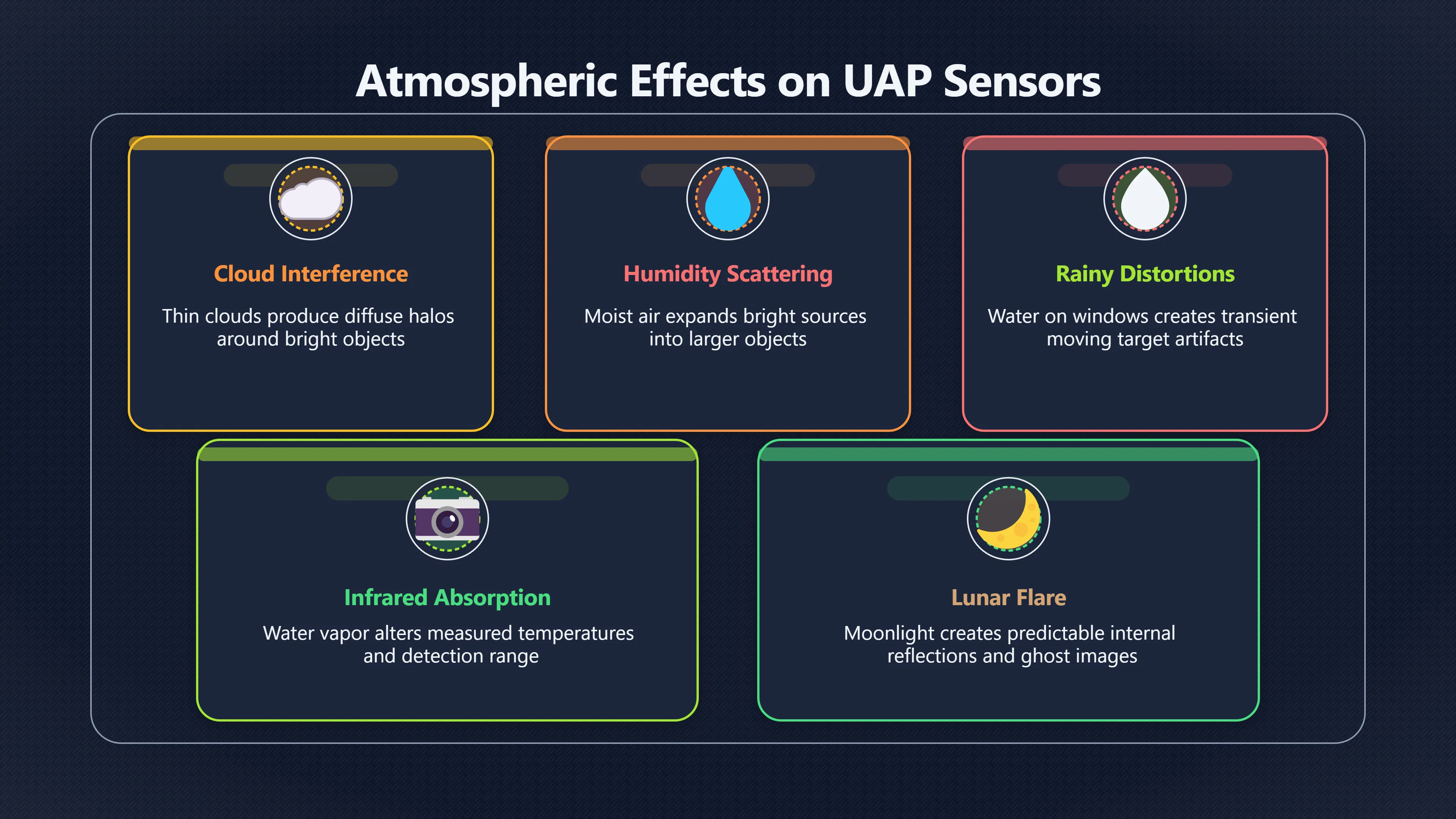
Clouds are the most obvious example. They block stars, scatter city lights, reflect moonlight and alter the contrast between objects and the background sky. Thin high cloud may leave stars visible while simultaneously producing diffuse halos around bright objects. Low cloud can brighten dramatically over urban areas, making aircraft lights appear larger, slower or more diffuse than they would in clear conditions. These effects vary continuously through the night, meaning that an object recorded under one cloud regime cannot be directly compared with another unless cloud conditions are known. Similar challenges are well recognised in astronomy and atmospheric imaging, where cloud detection is treated as a prerequisite for reliable image interpretation rather than an optional refinement.[PMC+2ResearchGate]pmc.ncbi.nlm.nih.govThe core of the algorithm is the “normalized polarization degree difference…Read more…
Humidity also changes observations in several ways. Moist air increases scattering of artificial light, reducing contrast and expanding bright sources into larger apparent objects. Near saturation, microscopic water droplets can produce haze long before obvious fog develops. Infrared systems are affected differently because water vapour absorbs and emits infrared radiation, altering measured temperatures and reducing effective detection range. Atmospheric scientists routinely account for these effects because they materially change remote-sensing measurements.[ECMWF Events (Indico)]events.ecmwf.intECMWF Events (Indico)The detection and assimilation of cloud-affected infrared…May 15, 2023 — 15 May 2023 — Clouds have a very strong…
Rain introduces both optical and mechanical effects. Falling drops reduce visibility, but water accumulating on protective windows or camera housings creates transient distortions that software may incorrectly interpret as moving targets. Heavy rain also changes autofocus performance, increases image noise and can interfere with tracking algorithms designed for clear skies.
For baseline construction, the important question is not simply whether rain occurred but how detector performance changed during and after rainfall. A useful system therefore learns separate “normal” behaviour for clear, humid, misty and rainy conditions instead of treating every night’s data as equivalent.

Why glare and lens contamination create repeatable artefacts
Many apparent anomalies originate on the detector rather than in the sky.
Condensation is one of the most common causes. As ambient temperature approaches the dew point, moisture forms on exposed optics. Unlike obvious raindrops, dew may appear gradually over tens of minutes, softening images and producing glowing discs around stars or aircraft lights. Because condensation often develops overnight, image quality may degrade without any change in the sky itself.
Dust, pollen, insects and dried water spots create another class of repeatable artefacts. During daylight they may be almost invisible, but at night they scatter incoming light and generate persistent bright patches or ghost images. Wide-angle all-sky cameras are especially susceptible because every contaminant remains fixed relative to the sensor while celestial objects move across the field.
Moonlight amplifies many of these problems. A bright Moon raises the background sky brightness, lowers contrast and increases internal reflections inside lenses. Depending on camera geometry, it may also generate flare, ghosts and streaks that move predictably as the Moon changes position. Without lunar phase and position in the baseline, these artefacts can appear unusual despite being entirely repeatable.
The practical lesson is that environmental artefacts have signatures. Lens contamination remains fixed in image coordinates while stars move behind it. Internal reflections often maintain predictable geometric relationships with the brightest light source. Recognising these patterns requires long-term collections under many weather and illumination conditions rather than analysis of individual frames.
Weather metadata that makes a sighting testable
Recording environmental conditions is valuable because it allows investigators to reproduce the observational circumstances instead of relying solely on the recorded image.
Useful metadata typically includes:[skyandtelescope.org]skyandtelescope.orgnasa finds no evidence ufos are extraterrestrial promises further studyUAP reports are typically single sightings and lack multiple measurements. Those individual reports also often lack sensor metadata, such…
- Cloud cover and cloud height where available.
- Temperature, humidity and calculated dew point.
- Rainfall and precipitation intensity.
- Wind speed and direction.
- Atmospheric pressure.
- Visibility or aerosol estimates where available.
- Moon phase, elevation and azimuth.
- Solar elevation during twilight.
- Lens or enclosure temperature.
- Heater, fan or dehumidifier operating status.
- Camera exposure, gain and focus settings.
These measurements provide context for interpreting sensor output. If a candidate anomaly coincides with rapidly increasing humidity, falling lens temperature and declining image sharpness, investigators have objective evidence that optical degradation may have contributed. Conversely, if environmental conditions remain stable while multiple independent sensors detect the same event, confidence in the observation increases.
NASA’s independent UAP study emphasised that sensor metadata is essential because observations cannot be evaluated properly without understanding the circumstances under which they were collected. Weather information is a core part of that contextual record rather than supplementary documentation.[NASA Science+2Wikisource]science.nasa.govScience Independent Study Team ReportNASA ScienceIndependent Study Team ReportSeptember 13, 2023 — At present, analysis of UAP data is hampered by poor sensor calibration, th…

Building weather into the baseline instead of filtering it away
A common design mistake is to discard data collected during poor weather. That approach reduces obvious false detections but also prevents the system from learning what poor weather normally looks like.
A stronger implementation is to classify observations by environmental regime. Instead of maintaining one baseline, the detector effectively maintains many:
- Clear, dry nights.
- Humid nights with increasing haze.
- Thin high cloud.
- Broken cloud.
- Overcast conditions.
- Light rain.
- Heavy rain.
- Bright Moon versus moonless nights.
Machine-learning systems benefit from this separation because they are no longer forced to treat radically different viewing conditions as examples of the same class. Statistical anomaly detection similarly becomes more reliable because each observation is compared against the appropriate environmental population rather than against all previous observations indiscriminately.
This mirrors established practice in astronomy, meteorology and Earth observation, where observations are routinely quality-controlled against atmospheric state before scientific interpretation.[PMC+2MDPI]pmc.ncbi.nlm.nih.govThe core of the algorithm is the “normalized polarization degree difference…Read more…
Why weather strengthens anomaly claims rather than weakening them
Some assume that documenting weather merely provides alternative explanations for unusual observations. In practice, comprehensive weather records strengthen credible anomaly investigations.
If an event remains unusual after accounting for cloud cover, atmospheric transmission, Moon position, humidity, lens condition and instrument state, investigators can eliminate many of the most common environmental explanations. That makes the remaining observation substantially more valuable than an isolated video lacking environmental context.
This emphasis on contextual measurement aligns with the direction of recent instrumented UAP programmes. NASA has argued that progress depends on calibrated sensors, multiple measurements, metadata and baseline datasets, while the U.S. All-domain Anomaly Resolution Office’s planned pattern-of-life collections with its GREMLIN sensor system reflect the same philosophy of understanding ordinary conditions before evaluating extraordinary ones.[NASA Science+2Breaking Defense]science.nasa.govScience Independent Study Team ReportNASA ScienceIndependent Study Team ReportSeptember 13, 2023 — At present, analysis of UAP data is hampered by poor sensor calibration, th…
In an automated sky-monitoring system, weather is therefore not background information. It is an active variable that changes both the atmosphere and the instrument. Any anomaly baseline that ignores it risks confusing changing observing conditions with changing objects in the sky.
Amazon book picks
Further Reading
Books and field guides related to Weather Can Change the Detector Before the Sky. Use these as the next step if you want deeper reading beyond the article.
The Demon-Haunted World
Supports cautious interpretation when ordinary weather effects create strange observations.
NightWatch
Explains how seeing conditions, haze, clouds, and sky brightness affect observation.
The Backyard Astronomer's Guide
Relevant to lens care, viewing conditions, weather limitations, and practical observing setups.
Meteorology today
Provides atmospheric science context for how weather changes what sensors record.
eBay marketplace picks
Marketplace Samples
Example marketplace items related to this page. Use the search link to explore similar finds on eBay.


Endnotes
1.
Source: science.nasa.gov
Title: Science Independent Study Team Report
Link:https://science.nasa.gov/wp-content/uploads/2023/09/uap-independent-study-team-final-report.pdf
Source snippet
NASA ScienceIndependent Study Team ReportSeptember 13, 2023 — At present, analysis of UAP data is hampered by poor sensor calibration, th...
Published: September 13, 2023
2.
Source: nasa.gov
Title: update nasa shares uap independent study report names director
Link:https://www.nasa.gov/news-release/update-nasa-shares-uap-independent-study-report-names-director/
Source snippet
UPDATE: NASA Shares UAP Independent Study Report14 Sept 2023 — We found that NASA can help the whole-of-government UAP effort through sys...
3.
Source: pmc.ncbi.nlm.nih.gov
Link:https://pmc.ncbi.nlm.nih.gov/articles/PMC9415724/
Source snippet
The core of the algorithm is the “normalized polarization degree difference...Read more...
4.
Source: researchgate.net
Link:https://www.researchgate.net/publication/317022372_Cloud_Detection_and_Prediction_with_All_Sky_Cameras
Source snippet
Cloud Detection and Prediction with All Sky CamerasThis article gives a short overview about a method that uses an all sky camera with a...
5.
Source: mdpi.com
Link:https://www.mdpi.com/2072-4292/9/8/806
Source snippet
Automatic Cloud and Shadow Detection in Optical Satellite...by E Parmes · 2017 · Cited by 29 — This paper presents a method to detect cl...
6.
Source: events.ecmwf.int
Link:https://events.ecmwf.int/event/334/contributions/3907/attachments/2234/3948/02_SAT_TC_IR_clouds_2023_burrows.pdf
Source snippet
ECMWF Events (Indico)The detection and assimilation of cloud-affected infrared...May 15, 2023 — 15 May 2023 — Clouds have a very strong...
Published: May 15, 2023
7.
Source: en.wikisource.org
Link:https://en.wikisource.org/wiki/NASA_Unidentified_Anomalous_Phenomena%3A_Independent_Study_Team_Report/Responses_to_Statement_of_Task
Source snippet
NASA Unidentified Anomalous Phenomena: Independent...14 Oct 2023 — The panel notes that, at present, gathering data on UAP is...
8.
Source: science.nasa.gov
Link:https://science.nasa.gov/uap/
Source snippet
nasa.govUAP9 Jun 2022 — The study will focus on identifying available data, how best to collect future data, and how NASA can use that da...
9.
Source: en.wikisource.org
Title: Page:UAP Independent Study Team Final Report
Link:https://en.wikisource.org/wiki/Page%3AUAP_Independent_Study_Team_-_Final_Report.pdf/5
Source snippet
wikisource.orgPage:UAP Independent Study Team - Final Report.pdf/512 Nov 2023 — At present, analysis of UAP data is hampered by poor sens...
10.
Source: astronomy.com
Title: nasa wants to take ufos seriously and scientifically
Link:https://www.astronomy.com/science/nasa-wants-to-take-ufos-seriously-and-scientifically/
Source snippet
NASA wants to take UFOs seriously — and scientifically19 Sept 2023 — “We found that NASA can help the whole-of-government UAP effort thro...
11.
Source: breakingdefense.com
Link:https://breakingdefense.com/2024/11/gremlin-but-no-aliens-pentagon-uap-office-plans-first-deployment-of-new-sensor-suite/
Source snippet
GREMLIN, but no aliens: Pentagon UAP office plans first...14 Nov 2024 — GREMLIN sensor suite for detecting, deployed to undertake a 90-d...
Additional References
12.
Source: aaro.mil
Link:https://www.aaro.mil/UAP-Cases/Official-UAP-Imagery/
Source snippet
UAP ImageryAARO assesses, with high confidence, that the objects depicted in the video are almost certainly (>95% likelihood) conservatio...
13.
Source: earth.esa.int
Link:https://earth.esa.int/eogateway/documents/20142/37627/7_Preusker_cloud_detection.pdf/798b9178-a801-379f-3396-93f643f7b49b
Source snippet
DetectionThe test detects opaque clouds during day above dark surfaces (sun glint free ocean or green vegetation). •The basic physics of...
14.
Source: rev.com
Title: unidentified anomalous phenomena independent study report from nasa transcript
Link:https://www.rev.com/transcripts/unidentified-anomalous-phenomena-independent-study-report-from-nasa-transcript
Source snippet
UAP Independent Study Report from NASA18 Sept 2023 — The Unidentified Anomalous Phenomena from NASA released a report to the public. Read...
15.
Source: youtube.com
Link:https://www.youtube.com/watch?v=TQcqOW39ksk
16.
Source: skyandtelescope.org
Title: nasa finds no evidence ufos are extraterrestrial promises further study
Link:https://skyandtelescope.org/astronomy-news/nasa-finds-no-evidence-ufos-are-extraterrestrial-promises-further-study/
Source snippet
UAP reports are typically single sightings and lack multiple measurements. Those individual reports also often lack sensor metadata, such...
17.
Source: war.gov
Title: dod examining unidentified anomalous phenomena
Link:https://www.war.gov/News/News-Stories/Article/Article/3965403/dod-examining-unidentified-anomalous-phenomena/
Source snippet
14 Nov 2024 — AARO received 757 UAP reports during this period, 485 of these reports featured UAP incidents that occurred during the repo...
18.
Source: meritalk.com
Title: nasa urged to take more permanent role in uap research effort
Link:https://www.meritalk.com/articles/nasa-urged-to-take-more-permanent-role-in-uap-research-effort/
Source snippet
NASA Urged to Take More Permanent Role in UAP...15 Sept 2023 — The study team found that most UAP data is “hampered by poor sensor calib...
19.
Source: nevadacurrent.com
Title: nasa report finds no evidence that ufos are extraterrestrial
Link:https://nevadacurrent.com/2023/09/18/nasa-report-finds-no-evidence-that-ufos-are-extraterrestrial/
Source snippet
18 Sept 2023 — Analysis of this data is “hampered by poor sensor calibration, the lack of multiple measurements, the lack of sensor metad...
20.
Source: nextgov.com
Title: nasa report finds no evidence ufos are extraterrestrial
Link:https://www.nextgov.com/ideas/2023/09/nasa-report-finds-no-evidence-ufos-are-extraterrestrial/390350/
Source snippet
NASA report finds no evidence that UFOs are extraterrestrial15 Sept 2023 — Analysis of this data is “hampered by poor sensor calibration...
21.
Source: spaceanddefense.io
Title: nasa new director of unidentified anomalous phenomena
Link:https://spaceanddefense.io/nasa-new-director-of-unidentified-anomalous-phenomena/
Source snippet
15 Sept 2023 — The report contains the external study team's findings and recommendations which aim to inform NASA on what possible data...
Topic Tree