Within Starlink
Why Starlink Trains Look Like Formations
Newly deployed Starlink satellites can look like coordinated formations before they separate and dim into ordinary sky traffic.
On this page
- What a post launch train looks like
- Why the first few days are hardest to classify
- How detectors can use launch timing
Page outline Jump by section
Introduction
Freshly launched Starlink satellites are one of the clearest modern examples of an ordinary space event being mistaken for an unidentified anomalous phenomenon (UAP). During the first few days after launch, dozens of satellites travel in a closely spaced line before gradually separating into their operational orbits. To an observer unfamiliar with the deployment process, this can resemble a coordinated formation of bright objects moving silently across the sky rather than a collection of individual satellites. This brief post-launch phase is especially important for automated, instrumented UAP detectors because it combines unusual geometry, high brightness and uncommon appearance into a single event that differs markedly from normal satellite traffic.[AARO]aaro.milCorrelations of Starlink Satellite Flaring with UAPCorrelations of Starlink Satellite Flaring with UAP…January 24, 2025 — by A An · 2024 — The design, launch, and operation of Space…
What a post-launch train looks like
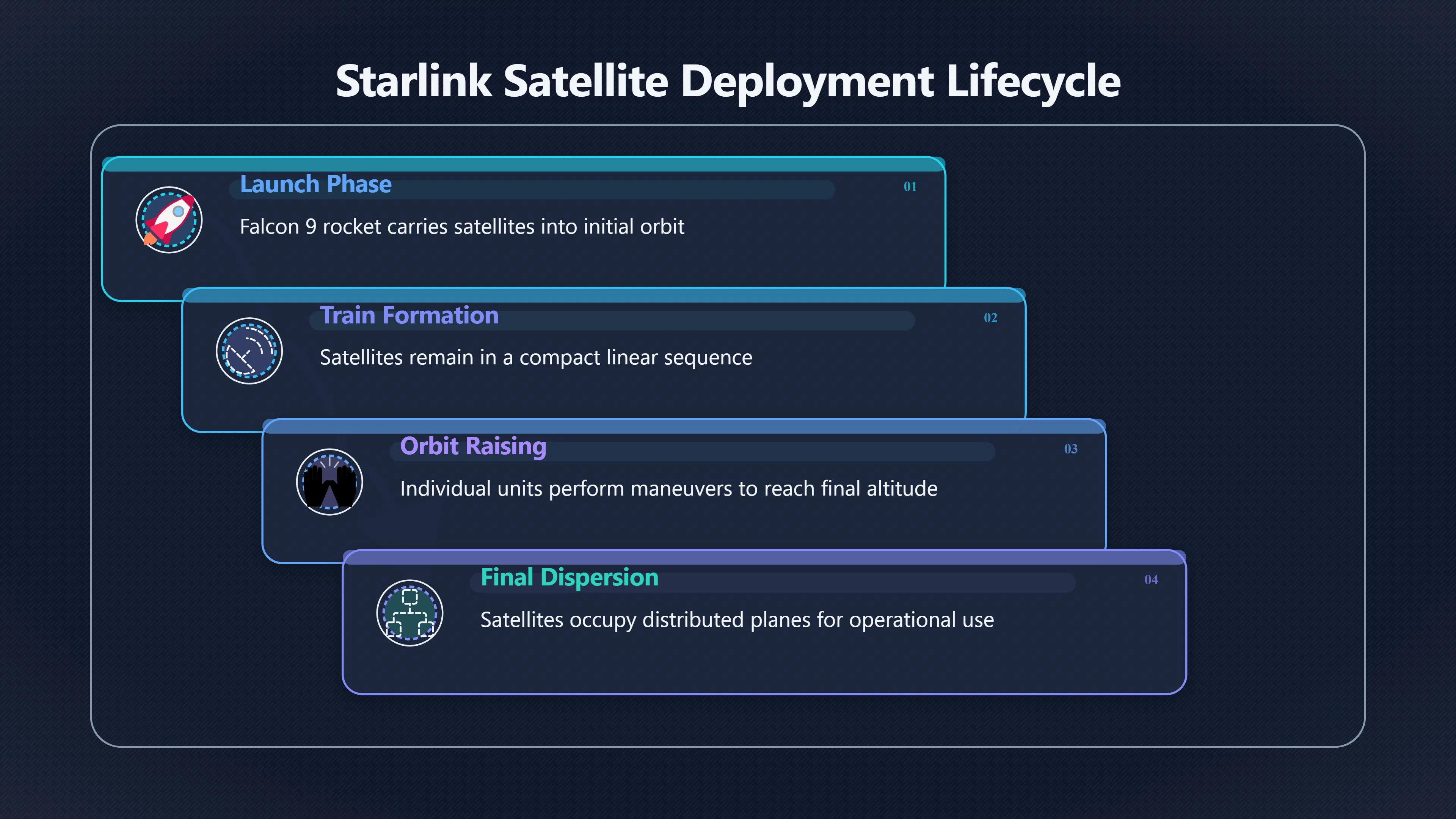
Unlike mature Starlink satellites, which are spread around Earth in well-defined orbital shells, newly deployed satellites leave the launch vehicle in a compact sequence. After release they remain close together while beginning a gradual orbit-raising process. From the ground, this appears as a chain of evenly spaced lights travelling along the same path at nearly identical speed.
Several characteristics make the pattern visually striking:
- The satellites are arranged with unusually regular spacing.
- The entire formation follows a common trajectory with little apparent change in relative position.
- Individual satellites often have similar brightness because they are still in comparable orientations after deployment.
- The train can stretch across a large portion of the sky while maintaining its orderly appearance.
The effect is temporary. As satellites raise their orbits and adjust their positions, the train disperses over several days until the spacecraft resemble ordinary individual satellites crossing the sky independently.[AARO]aaro.milCorrelations of Starlink Satellite Flaring with UAPCorrelations of Starlink Satellite Flaring with UAP…January 24, 2025 — by A An · 2024 — The design, launch, and operation of Space…
For human observers, the unusual regularity is often more surprising than the brightness itself. Most familiar satellite passes involve isolated points of light. A procession of dozens of objects moving in perfect sequence naturally invites explanations involving coordinated vehicles or formation flight, particularly when seen unexpectedly.
Why the first few days are hardest to classify
The deployment phase creates a combination of features that many anomaly-detection systems are designed to notice.
A detector looking for unusual aerial activity may identify:
- numerous objects appearing simultaneously;
- consistent spacing suggestive of deliberate formation;
- highly correlated motion;
- brightness patterns that differ from established satellite catalogues if orbital data have not yet been updated.
This is a short-lived classification problem. Once orbital manoeuvres begin, spacing between satellites increases and the distinctive “train” rapidly disappears.
The challenge is increased because freshly launched satellites may not yet be represented accurately in every publicly available orbital catalogue. Initial tracking information can be incomplete or evolve rapidly as observations improve. A detector relying on stale ephemerides—the predicted positions of satellites—may therefore find no matching object even though the lights are entirely expected.[arXiv]arxiv.orgEnhancing Space Situational Awareness to Mitigate Risk: A Single-Case Study in the Misidentification of a Recently-Launched Starlink…
The geometry also differs from mature constellations. During routine operations, Starlink satellites occupy distributed orbital planes that rarely produce long, tightly ordered formations. The launch phase is therefore statistically unusual even though it is operationally routine.
Why formation alone is weak evidence for an anomaly
The visual impression of coordination does not imply unusual propulsion or intelligent manoeuvring.
In a fresh Starlink train:
- every satellite follows essentially the same orbital path established by the launch vehicle;
- similar velocities arise naturally because the satellites begin from nearly identical orbital conditions;
- apparent formation results from orbital mechanics rather than active close-formation flying.
This distinction matters for automated systems. A detector that treats persistent linear spacing as evidence of coordinated flight risks producing false positives whenever a recent Starlink launch becomes visible.
The deployment geometry also produces predictable evolution. Night after night, observers can watch the spacing slowly increase as satellites perform orbit-raising manoeuvres, exactly matching expected mission operations rather than unexplained behaviour.[AARO]aaro.milCorrelations of Starlink Satellite Flaring with UAPCorrelations of Starlink Satellite Flaring with UAP…January 24, 2025 — by A An · 2024 — The design, launch, and operation of Space…
How detectors can use launch timing
Launch timing provides one of the strongest contextual filters available to automated UAP systems.
Instead of analysing each observation in isolation, a detector can compare an event against recent launch schedules. If a large linear formation appears within days of a Falcon 9 Starlink mission, the prior probability that the observation is a fresh satellite train increases dramatically.
Useful features include:
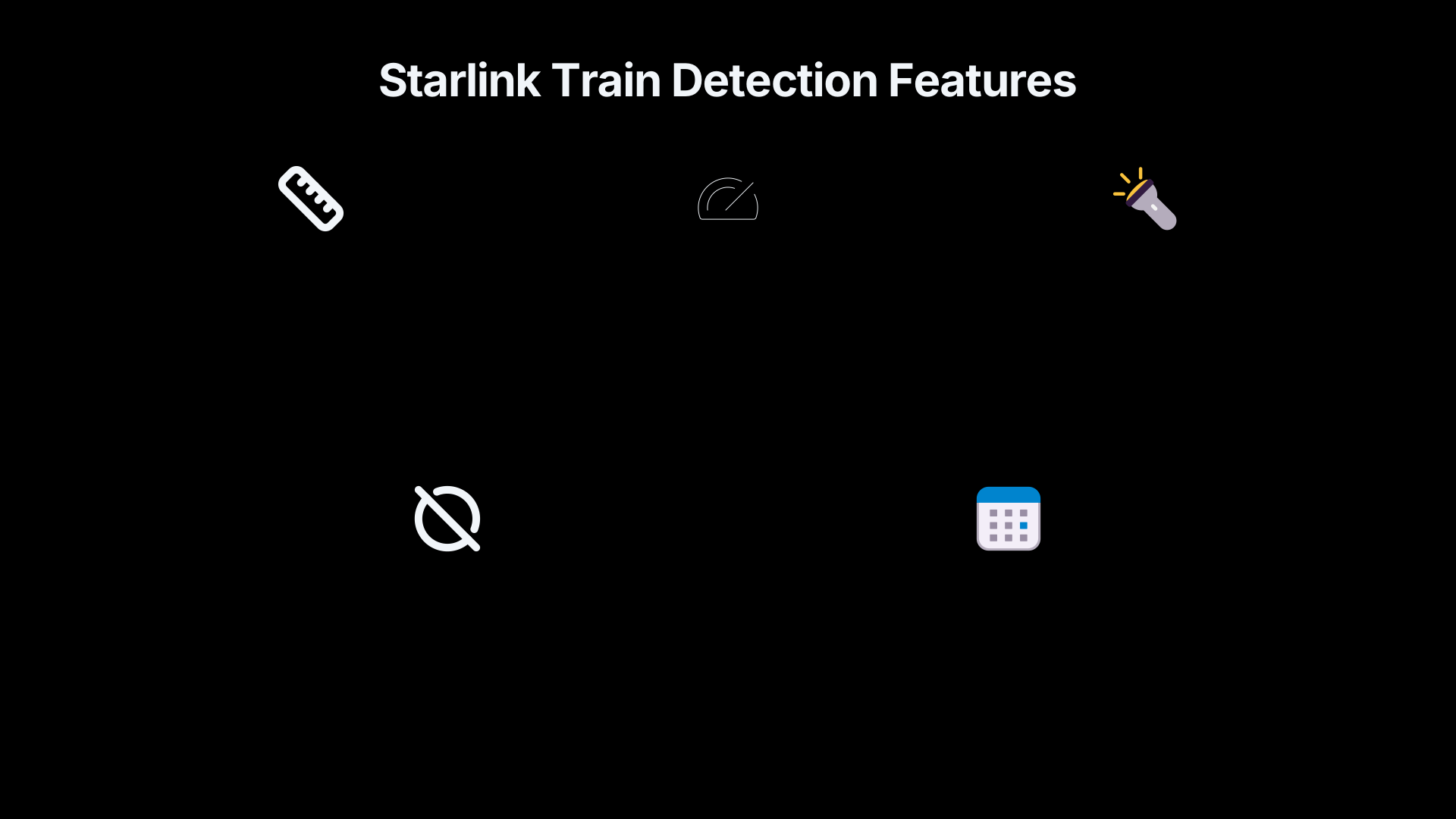
- Time since launch. The highest confusion risk occurs during the first several days after deployment.
- Predicted orbital plane. Newly released satellites occupy known launch trajectories before dispersing.
- Expected train length. Multiple closely spaced detections are consistent with a recent deployment.
- Solar illumination. Visibility is greatest shortly after sunset and before sunrise, when satellites remain sunlit while the ground is dark.
- Catalogue freshness. Recently issued orbital elements or supplemental launch data are more reliable than older catalogues for newly deployed spacecraft.[AARO]aaro.milCorrelations of Starlink Satellite Flaring with UAPCorrelations of Starlink Satellite Flaring with UAP…January 24, 2025 — by A An · 2024 — The design, launch, and operation of Space…
Rather than rejecting an event outright, an evidence-based detector can reduce its anomaly score whenever these independent indicators agree.

A concrete aviation example
A well-documented example illustrates why launch awareness matters.
Researchers reconstructed an August 2022 incident in which five commercial pilots aboard two aircraft over the Pacific reported an apparent UAP. Using Starlink launch records, orbital data and aircraft position information, they recreated the geometry seen from the cockpits. Their analysis found that a recently launched Starlink train matched the reported observations in position, timing and appearance.
The authors argued that improved space situational awareness—including automated prediction of visible satellite trains—could reduce confusion for pilots and investigators while improving aviation safety. The work also demonstrates an approach directly applicable to automated UAP monitoring systems: combine launch information, orbital predictions and viewing geometry before classifying an event as anomalous.[arXiv]arxiv.orgEnhancing Space Situational Awareness to Mitigate Risk: A Single-Case Study in the Misidentification of a Recently-Launched Starlink…
Implications for automated UAP detection
Fresh Starlink trains represent a distinct event window rather than a permanent source of confusion. Their importance lies in demonstrating that a visually extraordinary formation can arise from completely understood orbital operations.
For instrumented detection systems, this leads to several practical design principles:
- treat recent launches as a high-priority contextual input rather than relying solely on image analysis;
- update satellite ephemerides frequently enough to capture newly deployed spacecraft;
- recognise that correlated motion immediately after launch is expected behaviour;
- combine optical observations with launch schedules and orbital prediction instead of interpreting formation geometry alone.
Within the broader problem of satellite-related false positives, the post-launch train phase is unusual because it compresses many visually impressive features—multiple objects, orderly spacing and coordinated motion—into a brief, predictable period. Systems that explicitly model this deployment window can eliminate a significant class of false UAP reports without reducing sensitivity to genuinely unexplained events.[AARO]aaro.milCorrelations of Starlink Satellite Flaring with UAPCorrelations of Starlink Satellite Flaring with UAP…January 24, 2025 — by A An · 2024 — The design, launch, and operation of Space…
Amazon book picks
Further Reading
Books and field guides related to Why Starlink Trains Look Like Formations. Use these as the next step if you want deeper reading beyond the article.

UFOs : Generals, Pilots, and Government Officials Go on the R...
Places Starlink misidentifications in wider context.
eBay marketplace picks
Marketplace Samples
Example marketplace items related to this page. Use the search link to explore similar finds on eBay.
Endnotes
1.
Source: aaro.mil
Title: Correlations of Starlink Satellite Flaring with UAP
Link:https://www.aaro.mil/Portals/136/PDFs/Information%20Papers/AARO_Satellite_Flaring_Paper.pdf
Source snippet
Correlations of Starlink Satellite Flaring with UAP...January 24, 2025 — by A An · 2024 — The design, launch, and operation of Space...
Published: January 24, 2025
2.
Source: arxiv.org
Link:https://arxiv.org/abs/2403.08155
Source snippet
Enhancing Space Situational Awareness to Mitigate Risk: A Single-Case Study in the Misidentification of a Recently-Launched Starlink...
3.
Source: space.com
Title: x starlink satellites
Link:https://www.space.com/spacex-starlink-satellites.html
Source snippet
Starlink satellites: Facts, tracking and impact on astronomy1 Jun 2026 — Starlink is the name of a satellite network developed by the pri...
Additional References
4.
Source: spaceflightnow.com
Link:https://spaceflightnow.com/2026/02/01/live-coverage-spacex-to-launch-25-starlink-satellites-on-falcon-9-rocket-from-vandenberg-sfb/
Source snippet
SpaceX experiences Falcon 9 upper stage anomaly...1 Feb 2026 — “During today's Falcon 9 launch of Starlink satellites, the second stage...
5.
Source: youtube.com
Link:https://www.youtube.com/watch?v=8rdXkjH3AMw
Source snippet
SpaceX Falcon 9 rocket grounded after Starlink satellites lost...SpaceX's Falcon 9 will remain grounded for some period of time and duri...
6.
Source: metabunk.org
Title: starlink flares tle sources for trains vs stellarium.14542
Link:https://www.metabunk.org/threads/starlink-flares-tle-sources-for-trains-vs-stellarium.14542/
Source snippet
Starlink Flares TLE Sources for Trains (vs. Stellarium)3 Nov 2025 — Should I expect to see at the time newly deployed Starlink trains in...
7.
Source: pbs.org
Title: malfunction on spacex rocket leaves companys starlink satellites in wrong orbit
Link:https://www.pbs.org/newshour/science/malfunction-on-spacex-rocket-leaves-companys-starlink-satellites-in-wrong-orbit
Source snippet
The company said flight controllers managed to make contact with half of the satellites and...Read more...
8.
Source: reddit.com
Link:https://www.reddit.com/r/SpaceXMasterrace/comments/1ep2p71/how_long_after_launch_does_a_single_payload_of/
Source snippet
OP a particular picture of what appeared to be a Starlink train was taken...
9.
Source: facebook.com
Link:https://www.facebook.com/groups/2365809903441367/posts/27187048340890846/
Source snippet
or deception, part of the fictional concept of “space”...
10.
Source: youtube.com
Title: If you see these lights in the sky, don’t be afraid! STARLINK Satellite Train
Link:https://www.youtube.com/watch?v=wBpVQln4MIU
Source snippet
StarLink Satellite seen in Rocky Mountain National Park. Train of lights It's a UFO...
11.
Source: youtube.com
Title: How Space X is continuing to reduce brightness of UFO like satellites
Link:https://www.youtube.com/watch?v=vHW3clIokqk
Source snippet
If you see these lights in the sky, don't be afraid! STARLINK Satellite Train...
12.
Source: youtube.com
Link:https://www.youtube.com/watch?v=-n4cErrDr6M
Source snippet
Starlink Satellite Train - Elon Musk SpaceX 2026...
13.
Source: youtube.com
Title: Starlink Satellite Train
Link:https://www.youtube.com/watch?v=FtV6KkIznKY
Source snippet
Still not aliens - Starlink satellites pass over Ohio Thursday night...
Topic Tree