Within Sky Detectors
Do Magnetic Sensors Help UAP Detection?
Magnetic sensors are sometimes included, but their value depends on careful baselines and sceptical interpretation.
On this page
- Why magnetometers appear in designs
- What a magnetic anomaly would need to show
- False signals and local interference
Page outline Jump by section
Introduction
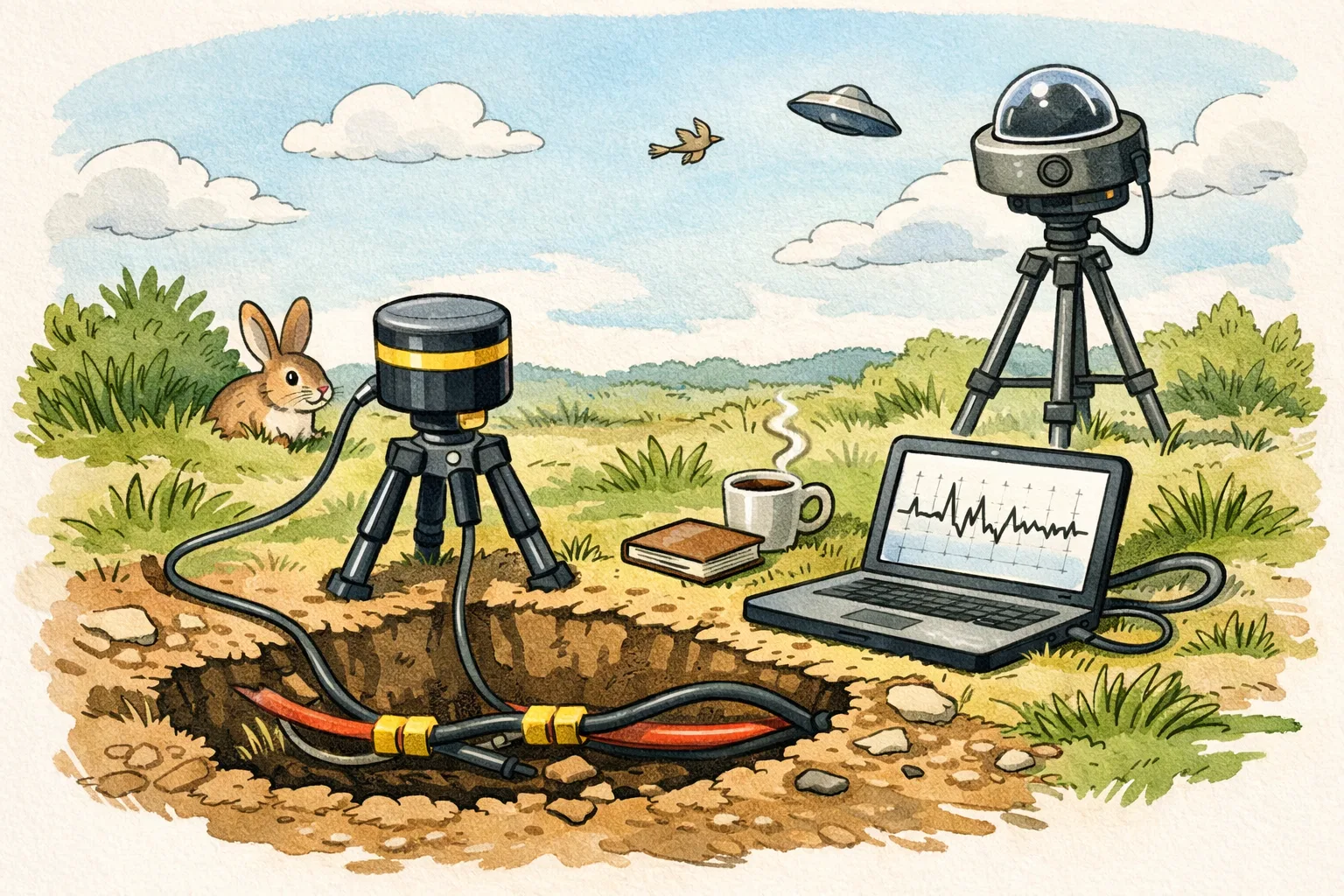
Magnetometers appear in some automated UFO or UAP detector designs because many historical reports describe “electromagnetic effects”: compass swings, stalled engines, radio interference, odd instrument behaviour or claims of magnetic-field disturbance near a sighting. In a serious detector network, however, a magnetometer is not a magic UFO sensor. It is an auxiliary instrument that can only become useful when its readings are time-synchronised, calibrated, compared with local and regional baselines, and interpreted alongside cameras, weather data, acoustic sensors, radio-frequency monitoring and aircraft or satellite context.
The best current use case is modest but valuable: a magnetic sensor can help test whether a visually detected event coincided with a local magnetic anomaly that is not explained by space weather, nearby machinery, power systems, vehicles, sensor drift or site contamination. NASA’s UAP study stressed that progress depends on calibrated sensors, metadata, multiple measurements and baseline data; magnetometers fit that logic only when they are treated as measurement instruments rather than anomaly generators.[NASA Science]science.nasa.govNASA Science…
Why magnetometers appear in detector designs
The immediate reason is historical. UFO literature has long included claims that nearby unidentified objects caused electromagnetic or magnetic effects. The Condon Report’s chapter on indirect physical evidence noted that reported effects included stalled automobile engines, headlight failure, radio and television interference, electric-clock disruption, power failures, magnetic disturbances and temporary radiation-count increases; it also stressed that such claims were not consistent across cases and could appear even in reports later attributed to mundane objects such as birds or balloons.[files.ncas.org]files.ncas.orgCondon Report Section III, Chapter 4: Indirect Physical EvidenceCondon Report Section III, Chapter 4: Indirect Physical Evidence
Aviation-related reports are one reason the idea persists. A 2001 NARCAP technical report by Richard Haines and Dominique Weinstein examined 57 pilot sighting reports that alleged electromagnetic effects. In the 27 stronger “Category 1” cases, the authors counted 52 different reported effects; radio systems and magnetic compass systems were among the most frequently reported affected systems. The report’s conclusion that compass deviation appeared correlated with UAP position is suggestive, but it remains based on historical reports, not controlled instrument-network detections.[Aviation Anomalies Center]earthworm-owl-l76t.squarespace.comAviation Anomalies CenterA Preliminary Study of Fifty Seven Pilot Sighting Reports Involving Alleged Electro-Magnetic Effects on Aircraft…
Modern detector projects have translated that history into cautious instrumentation. The Galileo Project’s multimodal observatory concept includes environmental sensors for temperature, pressure, humidity, wind, quasistatic electric and magnetic fields, and energetic particles, alongside optical, infrared, radio, acoustic and radar-related measurements. Its rationale is not that a magnetometer alone can identify a UAP, but that multiple independent data channels make artefacts and false interpretations easier to recognise.[arXiv]arxiv.orgOpen source on arxiv.org.
Commercial and citizen-facing detector systems have also included magnetic sensors. UFODAP’s technology page lists a three-dimensional magnetometer with selectable ranges of ±4, ±8, ±12 and ±16 gauss inside its multi-sensor data acquisition unit, alongside inertial sensors, barometer, temperature and humidity sensors, GPS and optional software-defined radio. That kind of inclusion shows how magnetic sensing has become part of the “instrumented” UAP toolkit, even though the sensor’s evidential value depends heavily on how the data are logged and checked.[UFODAP]ufodap.comOpen source on ufodap.com.
What a magnetic anomaly would need to show
A persuasive magnetic claim would need to pass a higher bar than “the magnetometer spiked when something was seen”. At minimum, the event would need precise timing, known sensor orientation, raw or minimally processed data, local environmental records, equipment status logs, and comparison with other magnetometers. It would also need a clear visual or independent detection of the aerial target, otherwise the magnetic reading is merely an unexplained local disturbance.
The Galileo Project’s 2025 geomagnetic variometer paper is useful because it shows what a more careful version looks like. The authors state that their goal is to identify magnetic anomalies that cannot readily be explained by natural or human-made origins and to analyse them jointly with visible and infrared cameras, acoustic equipment and weather monitoring. Their first variometer station used a vector magnetometer and data acquisition system at a Colorado observatory, and the project evaluated six months of recordings, including the May 2024 G5 geomagnetic storm.[Gi Copernicus]gi.copernicus.orgGi Copernicus GIGi Copernicus GI
That paper is also important because it treats baseline comparison as central, not optional. The authors emphasised that the nearby USGS magnetic observatory in Boulder was key to evaluating their data, because comparison with a certified observatory helped establish whether their instrument was behaving properly. In other words, the exciting part is not a claimed UAP magnetic signature; it is the more prosaic but essential work of proving that the station can tell ordinary geomagnetic variation from local anomaly.[Gi Copernicus]gi.copernicus.orgGi Copernicus GIGi Copernicus GI
A credible magnetic anomaly in an automated detector should therefore meet several conditions:
- It should be localised. If the same disturbance appears across a wide region, space weather or regional geomagnetic variation becomes more likely than a nearby aerial object.
- It should be time-locked to another detection. A magnetic deviation that coincides with a tracked object in calibrated optical or infrared imagery is more useful than an isolated spike.
- It should survive equipment checks. Power cycling, temperature sensitivity, loose cabling, nearby ferrous objects and sensor saturation must be excluded.
- It should have a plausible spatial pattern. Multiple nearby magnetometers should show a pattern consistent with distance and direction, not random site-specific noise.
- It should be archived with metadata. Without sensor range, sampling rate, orientation, calibration history and processing steps, later analysis becomes guesswork.
False signals and local interference
The biggest risk is that magnetometers are excellent at detecting things that are not UAP. They can respond to electric currents, ferrous metal, vehicles, buried infrastructure, building materials, rail systems, power supplies, cables, motors, weather-related grounding issues, and space-weather disturbances. For an automated UFO detector, that means a magnetic channel can easily become a false-positive machine unless the installation is treated like a small geophysical observatory.
Professional geomagnetic practice gives a useful standard. INTERMAGNET’s technical guidance says observatories should use routine data inspection, inter-comparison, data cleaning and baseline estimation; daily quality tasks include inspecting magnetograms, comparing instruments, comparing with nearby observatories, checking timing consistency, identifying spikes or steps, and recording changes in an observatory diary. These are not bureaucratic niceties. They are exactly the controls that prevent an “anomaly” from being a loose cable, clock error or local equipment change.[INTERMAGNET]tech-man.intermagnet.orgOpen source on intermagnet.org.
Site choice matters just as much as sensor choice. In the Galileo Project’s variometer deployment, the team selected a site without human-made magnetic interference, protected equipment from water and intense sunlight, ensured orientation with a custom mount, and avoided magnetic deployment items such as ordinary ferrous screws. That kind of detail is a useful corrective to the casual assumption that a magnetometer can simply be bolted to a sky camera mast and treated as scientific evidence.[arXiv]arxiv.orgOpen source on arxiv.org.
Space weather is another major confounder. USGS material on geomagnetism notes that magnetic storms can generate electric fields in the Earth and interfere with grounded power transmission systems; its programme exists partly because Earth’s magnetic field varies naturally and sometimes dramatically. A detector that flags every magnetic disturbance without checking geomagnetic indices or nearby observatory data will confuse global or regional geophysical activity with local mystery.[USGS]usgs.govGeomagnetism Program | U.S. Geological SurveyGeomagnetism Program | U.S. Geological Survey
Even older UAP field stations illustrate both the appeal and the limitation. The Hessdalen Automatic Measurement Station, operating from August 1998, combined cameras with a magnetometer that measured three magnetic components once per minute and transmitted hourly summaries. Its own technical description notes that the readings were in nanotesla but were not absolute values. That is useful auxiliary monitoring, but not enough by itself to establish a physical mechanism behind the Hessdalen lights.[Hessdalen]old.hessdalen.orgProject HessdalenProject Hessdalen
How exotic-signal claims should be handled
The phrase “exotic signal” is where detector design can drift from science into storytelling. A magnetic anomaly does not automatically imply unknown propulsion, non-human technology, plasma physics, gravitational effects or an object manipulating electromagnetism. It first implies that the local magnetic environment changed, or that the instrument thought it did. The order of explanation matters.
The Condon Report remains relevant here because it separated claims from residual evidence. It noted that physical effects might, in principle, leave detectable changes or instrumented records, but that many claimed effects were difficult to verify after the fact. For automated detector design, the lesson is not to dismiss every electromagnetic report; it is to design systems that capture the relevant data at the time of the event, under known conditions, before interpretation hardens into folklore.[files.ncas.org]files.ncas.orgCondon Report Section III, Chapter 4: Indirect Physical EvidenceCondon Report Section III, Chapter 4: Indirect Physical Evidence
A sceptical detector design should therefore treat magnetometer output as a decision-support layer. It can help rank events for review, test whether a local disturbance accompanied a visual track, and identify correlations worth follow-up. It should not be used as a standalone trigger for extraordinary claims unless the system has already characterised its own ordinary disturbances across seasons, storms, traffic patterns, maintenance cycles and nearby electrical activity.
The best evidence would look less dramatic than many enthusiasts expect. It would be a repeatable, well-documented cluster: calibrated optical or infrared tracking of an object; no matching ADS-B aircraft, satellite, drone or weather explanation; simultaneous magnetic disturbance on more than one local instrument; absence of a matching regional geomagnetic disturbance; clean equipment logs; and public release of enough raw data for independent reanalysis. That would not prove an exotic craft, but it would create a real scientific anomaly rather than an anecdote with a sensor attached.
What magnetic sensors can realistically add
Magnetometers can help UAP detector networks in three narrow ways. First, they add environmental context: if a camera event occurs during a geomagnetic storm or near a local electrical disturbance, that matters for interpretation. Second, they can test historical electromagnetic-effect claims by collecting continuous, timestamped data rather than relying on witness memory. Third, they can reveal site-specific interference that might otherwise contaminate other sensors or produce misleading triggers.
Their limits are just as important. A magnetic sensor cannot estimate distance to an aerial object without geometry and multiple measurement points. It cannot distinguish a drone from a plasma-like atmospheric event by itself. It cannot turn an uncalibrated video into a physical measurement. And it cannot rescue a detector design that lacks clock synchronisation, provenance, baselines and mundane-object filtering.
The practical conclusion is that magnetic sensors do help UAP detection, but mainly by making claims harder to inflate. In a weak design, a magnetometer adds a new stream of ambiguous anomalies. In a strong design, it adds a falsifiable channel: one more way to ask whether an event left a measurable, local, time-locked physical signature, and one more way to rule out the ordinary before reaching for the exotic.
Amazon book picks
Further Reading
Books and field guides related to Do Magnetic Sensors Help UAP Detection?. Use these as the next step if you want deeper reading beyond the article.

UFOs : Generals, Pilots, and Government Officials Go on the R...
Provides context for sensor-based UAP investigations.

Introduction to Geomagnetic Fields
Explains magnetic field measurements and interpretation.
eBay marketplace picks
Marketplace Samples
Live-tested eBay searches with available results related to this page.

Endnotes
1.
Source: science.nasa.gov
Link:https://science.nasa.gov/wp-content/uploads/2023/09/uap-independent-study-team-final-report.pdf
Source snippet
NASA Science...
2.
Source: files.ncas.org
Title: Condon Report Section III, Chapter 4: Indirect Physical Evidence
Link:https://files.ncas.org/condon/text/s3chap04.htm
3.
Source: arxiv.org
Link:https://arxiv.org/abs/2305.18566
4.
Source: ufodap.com
Link:https://ufodap.com/technology
5.
Source: gi.copernicus.org
Title: Gi Copernicus GI
Link:https://gi.copernicus.org/articles/14/335/2025/
6.
Source: tech-man.intermagnet.org
Link:https://tech-man.intermagnet.org/latest/chapters/processdata/dataqualitycontrol.html
7.
Source: arxiv.org
Link:https://arxiv.org/html/2507.11355v1
8.
Source: usgs.gov
Title: Geomagnetism Program | U.S. Geological Survey
Link:https://www.usgs.gov/programs/geomagnetism
9.
Source: old.hessdalen.org
Title: Project Hessdalen
Link:https://old.hessdalen.org/station/first.shtml
10.
Source: egusphere.copernicus.org
Title: egusphere 2025 2396
Link:https://egusphere.copernicus.org/preprints/2025/egusphere-2025-2396/egusphere-2025-2396.pdf
11.
Source: gi.copernicus.org
Link:https://gi.copernicus.org/articles/14/335/2025/gi-14-335-2025.pdf
12.
Source: egusphere.copernicus.org
Title: egusphere 2025 3431
Link:https://egusphere.copernicus.org/preprints/2025/egusphere-2025-3431/
13.
Source: usgs.gov
Title: space weather and magnetic storms invaders outer spacesort
Link:https://www.usgs.gov/news/featured-story/space-weather-and-magnetic-storms-invaders-outer-spacesort
14.
Source: usgs.gov
Link:https://www.usgs.gov/programs/geomagnetism/introduction-geomagnetism
15.
Source: usgs.gov
Link:https://www.usgs.gov/media/videos/5-geomagnetic-storms-reshaped-society
16.
Source: pubs.usgs.gov
Link:https://pubs.usgs.gov/publication/70274314
17.
Source: old.hessdalen.org
Title: Hessdal article2000.shtml
Link:https://old.hessdalen.org/reports/Hessdal-article2000.shtml
18.
Source: tech-man.intermagnet.org
Link:https://tech-man.intermagnet.org/stable/chapters/absmeasurements/dataqualitycontrol.html
19.
Source: tech-man.intermagnet.org
Link:https://tech-man.intermagnet.org/stable/chapters/oneminuteimos/qualcontrol.html
20.
Source: colorado.edu
Title: condon report cu boulders historic ufo study
Link:https://www.colorado.edu/coloradan/2021/11/05/condon-report-cu-boulders-historic-ufo-study
21.
Source: arxiv.org
Link:https://arxiv.org/html/2506.00125v1
22.
Source: arxiv.org
Link:https://arxiv.org/html/2511.21884
23.
Source: arxiv.org
Link:https://arxiv.org/abs/2507.11355
24.
Source: ufodap.com
Title: UFODA P
Link:https://ufodap.com/
25.
Source: ufodap.com
Link:https://ufodap.com/faq
26.
Source: earthworm-owl-l76t.squarespace.com
Link:https://earthworm-owl-l76t.squarespace.com/s/narcap_TR-3_2001.pdf
Source snippet
Aviation Anomalies CenterA Preliminary Study of Fifty Seven Pilot Sighting Reports Involving Alleged Electro-Magnetic Effects on Aircraft...
27.
Source: Wikipedia
Title: The Galileo Project
Link:https://en.wikipedia.org/wiki/The_Galileo_Project
28.
Source: Wikipedia
Title: Hessdalen AMS
Link:https://en.wikipedia.org/wiki/Hessdalen_AMS
29.
Source: ufodap.myshopify.com
Link:https://ufodap.myshopify.com/
30.
Source: ufodap.myshopify.com
Title: Multi-Sensor Data Acquisition Unit (MSDAU)
Link:https://ufodap.myshopify.com/collections/multi-sensor-data-acquisition-unit-msdau
31.
Source: gfzpublic.gfz-potsdam.de
Link:https://gfzpublic.gfz-potsdam.de/rest/items/item_5029649_1/component/file_5029650/content
32.
Source: gfzpublic.gfz.de
Link:https://gfzpublic.gfz.de/rest/items/item_5029649_3/component/file_5029650/content
33.
Source: thecrimson.com
Title: galileo project
Link:https://www.thecrimson.com/article/2021/8/11/galileo-project/
Additional References
34.
Source: youtube.com
Link:http://www.youtube.com/watch?v=sf9lbbjV_xA
Source snippet
"UAP" magnetometer sensor tracking station More incredible footage of a UFO rising from our oceans! What are these advanced crafts?...
35.
Source: youtube.com
Link:http://www.youtube.com/watch?v=vJIt0vZyEKQ
Source snippet
Tracking UFOs and Anomalous Objects with Ronald Olch (UFO Data Acquisition Project) | 2021 Interview...
36.
Source: youtube.com
Link:http://www.youtube.com/watch?v=lx128Ln6HsI
Source snippet
Skywatcher: Function, Purpose, and Scientific Framework | Garry Nolan...
37.
Source: youtube.com
Title: Skywatcher: Function, Purpose, and Scientific Framework | Garry Nolan
Link:http://www.youtube.com/watch?v=kPodKWDFrp4
Source snippet
UFOs Detected LIVE on Multiple Sensors | Radar, IR & 3GHz Signals | UAP Files Podcast | Tedesco Bros...
38.
Source: youtube.com
Title: Sky360: A Global UAP Tracking Network for Science | Richard Hopf
Link:http://www.youtube.com/watch?v=M528GR8DgYU
Source snippet
UFO/UAP Protocols and Analysis with Ronald Olch (UFO Data Acquisition Project) | 2021 Interview...
39.
Source: war.gov
Link:https://www.war.gov/medialink/ufo/release_1/255_413270_ufo%27s_and_defense_what_should_we_prepare_for.pdf
40.
Source: nsa.gov
Link:https://www.nsa.gov/portals/75/documents/news-features/declassified-documents/ufo/usaf_fact_sheet_95_03.pdf
41.
Source: researchgate.net
Link:https://www.researchgate.net/publication/227070831_Magnetic_Observatory_Data_and_Metadata_Types_and_Availability
42.
Source: researchgate.net
Link:https://www.researchgate.net/publication/371163445_The_Scientific_Investigation_of_Unidentified_Aerial_Phenomena_UAP_Using_Multimodal_Ground-Based_Observatories
43.
Source: researchgate.net
Link:https://www.researchgate.net/publication/367076053_The_Scientific_Investigation_of_Unidentified_Aerial_Phenomena_UAP_Using_Multimodal_Ground-based_Observatories
Topic Tree
Follow this branch
Parent topic
Sky DetectorsRelated pages 29
- Baselines Why one magnetometer is not enough
- Compass Claims Do old compass stories justify magnetometers?
- Credible Spike When is a magnetic spike worth attention?
- Galileo Test What Galileo learned from magnetic monitoring
- Quiet Site Why magnetometer placement can make or break data
- +1 more in sidebar