Within Radar
The passive radar network built for real tracks
The Galileo-linked SkyWatch concept shows how separated receivers could estimate position and velocity instead of relying on video alone.
On this page
- What Sky Watch is trying to measure
- Why multiple receivers matter
- Design envelope versus backyard reality
Page outline Jump by section
Introduction
SkyWatch is one of the more technically ambitious ideas to emerge from the broader effort to build automated, instrumented systems for investigating unidentified aerial phenomena (UAP). Rather than relying on a single camera or eyewitness report, the concept combines passive multistatic radar with other calibrated sensors to estimate an object’s three-dimensional position and velocity. The goal is not to prove that unusual objects exist, but to replace ambiguous two-dimensional imagery with measurable trajectories that can be independently analysed. That distinction is important because many apparent anomalies disappear once reliable range and motion data become available.[galileo.hsites.harvard.edu]galileo.hsites.harvard.eduSkyWatch: A Passive Multistatic Radar Network for the…passive radar will assist the Galileo Project in the detection and classificatio…
 SkyWatch was developed as part of the Galileo Project’s broader observatory concept. Its proposed role is to provide quantitative measurements of distance, altitude and speed that complement optical, infrared and other sensor data, allowing ordinary aircraft, birds, drones and balloons to be identified more confidently while highlighting the comparatively rare events that genuinely warrant further investigation.[galileo.hsites.harvard.edu]galileo.hsites.harvard.eduSkyWatch: A Passive Multistatic Radar Network for the…passive radar will assist the Galileo Project in the detection and classificatio…
What SkyWatch is trying to measure
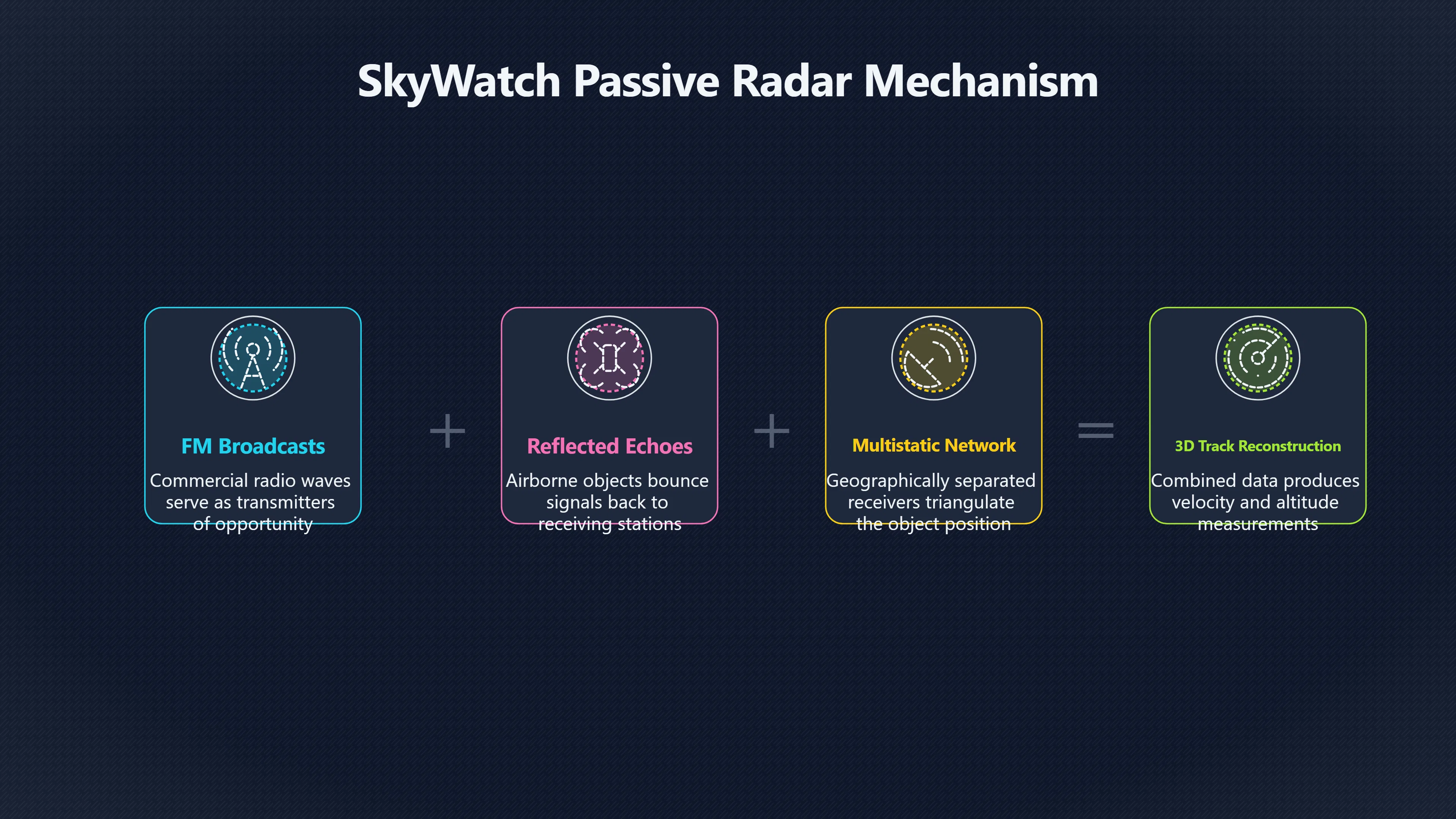
Unlike conventional surveillance radar, SkyWatch does not transmit its own radio pulses. Instead, it exploits existing commercial FM radio broadcasts as “transmitters of opportunity”. Multiple receiving stations monitor both the direct broadcast signal and the much weaker reflections from airborne objects. By comparing the timing and frequency shifts of these signals, the system attempts to estimate where an object is in three-dimensional space and how it is moving.[World Scientific+2galileo.hsites.harvard.edu]worldscientific.comWorld ScientificSkyWatch: A Passive Multistatic Radar Network for the…by M Randall · 2023 · Cited by 10 — The SkyWatch radar complemen…
The design described by the SkyWatch researchers aims for several specific outputs:
- Three-dimensional position rather than only angular direction.
- Velocity estimates derived from Doppler measurements.
- Continuous time-series tracks instead of isolated detections.
- Synchronised measurements that can be fused with optical and infrared observations.[World Scientific]worldscientific.comWorld ScientificSkyWatch: A Passive Multistatic Radar Network for the…by M Randall · 2023 · Cited by 10 — The SkyWatch radar complemen…
The published design discusses an intended operating envelope of roughly 150 km horizontal range, altitudes up to around 80 km and tracking updates of up to approximately 15 measurements per second, depending on geometry and signal quality. These figures describe engineering objectives rather than demonstrated performance across every environment.[World Scientific]worldscientific.comWorld ScientificSkyWatch: A Passive Multistatic Radar Network for the…by M Randall · 2023 · Cited by 10 — The SkyWatch radar detects F…
Why multiple receivers matter
The central innovation is not passive radar itself, which has been studied for decades, but the use of geographically separated receivers operating together as a multistatic network.
With only one receiver and one illuminating transmitter, the system can constrain an object’s location only imperfectly. The reflected signal indicates that the target lies somewhere along a bistatic range surface, while Doppler measurements reveal motion along particular directions. This leaves substantial ambiguity.
Adding additional receivers changes the problem. Each receiver contributes an independent delay and Doppler measurement. When these observations are combined on a central server, they can be triangulated into an estimated three-dimensional track that evolves through time. The Galileo Project paper describes exactly this architecture, with networked receivers forwarding processed measurements for track reconstruction rather than each station attempting to solve the geometry independently.[arXiv]arxiv.orgOpen source on arxiv.org.
This approach addresses one of the biggest weaknesses of video-only UAP reports. A bright point crossing a camera image may appear to accelerate dramatically, yet without distance information it is impossible to distinguish between:
- a nearby bird,
- a distant aircraft,
- a drone,
- atmospheric effects,
- or something genuinely unusual.
Recovering position as well as direction makes speed and acceleration estimates physically meaningful instead of being inferred from image motion alone.[galileo.hsites.harvard.edu]galileo.hsites.harvard.eduSkyWatch: A Passive Multistatic Radar Network for the…passive radar will assist the Galileo Project in the detection and classificatio…
How SkyWatch fits into a multi-sensor observatory
SkyWatch is not intended to replace cameras. Instead, it forms one measurement layer within a broader observing system.
The Galileo Project’s proposed observatories combine passive radar with optical imaging, infrared cameras and additional environmental sensors. A candidate event would ideally be observed simultaneously by several instruments, allowing independent measurements to be compared.
For example:
- cameras provide angular position and visual appearance;
- infrared sensors estimate thermal characteristics;[Passive radar]WikipediaPassive radar ar estimates range, velocity and altitude;
- combining all three makes object classification substantially more robust than relying on any single sensor.[World Scientific]worldscientific.comWorld ScientificSkyWatch: A Passive Multistatic Radar Network for the…by M Randall · 2023 · Cited by 10 — The SkyWatch radar complemen…
This philosophy mirrors standard practice in aerospace sensing, where independent measurements are generally considered stronger evidence than any single sensor operating in isolation.
Design envelope versus backyard reality
The published SkyWatch papers describe a research prototype rather than an off-the-shelf citizen instrument.
Several practical constraints limit what a small installation can achieve.
First, passive radar depends heavily on geometry. The locations of FM transmitters, receiving stations and the target all influence detection quality. A configuration that works well in one region may perform much less effectively elsewhere.[arXiv]arxiv.orgOpen source on arxiv.org.
Secondly, reflections from commercial broadcasts are extremely weak compared with the direct broadcast itself. Considerable signal processing is required to suppress the direct signal and recover echoes that may lie below the apparent noise floor. This is a well-known challenge throughout passive radar research and is one reason high-dynamic-range receivers and sophisticated digital processing are essential.[Wikipedia]WikipediaPassive radarPassive radar
Thirdly, reliable three-dimensional reconstruction requires precise timing, stable receiver calibration and communication between network nodes. The SkyWatch design therefore sends processed delay and Doppler measurements over the internet to a central processing system, rather than expecting isolated receivers to produce complete tracks independently.[arXiv]arxiv.orgOpen source on arxiv.org.
These requirements mean that a lone hobbyist receiver is unlikely to deliver the same capability as a coordinated multistatic network.

What the evidence currently supports
The strongest evidence available today concerns the engineering concept rather than operational discoveries.
The peer-reviewed SkyWatch paper and associated preprint describe the architecture, expected performance envelope and initial prototype testing around the Harvard–Smithsonian Center for Astrophysics. They argue that passive multistatic radar can provide quantitative position and velocity estimates suitable for integration with other observatory sensors.[World Scientific]worldscientific.comWorld ScientificSkyWatch: A Passive Multistatic Radar Network for the…by M Randall · 2023 · Cited by 10 — The SkyWatch radar complemen…
However, the published literature does not report confirmed detections of anomalous craft or demonstrate that SkyWatch has identified objects exhibiting unexplained physics. Instead, the work establishes an experimental framework for collecting better-quality measurements should unusual events occur.[World Scientific]worldscientific.comWorld ScientificSkyWatch: A Passive Multistatic Radar Network for the…by M Randall · 2023 · Cited by 10 — The SkyWatch radar complemen…
That distinction is important. SkyWatch’s scientific value lies in improving the quality of evidence available for aerial observations. If future events can be documented with synchronised three-dimensional tracks rather than isolated videos, investigators will be better positioned either to identify conventional explanations or to determine that an observation genuinely merits further study.
Amazon book picks
Further Reading
Books and field guides related to The passive radar network built for real tracks. Use these as the next step if you want deeper reading beyond the article.
The 1090 Megahertz Riddle
Useful companion for distinguishing cooperative aircraft tracks from other detections.
Fundamentals of Radar Signal Processing
Explains Doppler processing, detection, and estimation used in track generation.


Radar Handbook
Covers radar theory, signal processing, and target tracking relevant to passive systems.
eBay marketplace picks
Marketplace Samples
Example marketplace items related to this page. Use the search link to explore similar finds on eBay.

Endnotes
1.
Source: galileo.hsites.harvard.edu
Link:https://galileo.hsites.harvard.edu/publications/skywatch-passive-multistatic-radar-network-measurement-object-position-and
Source snippet
SkyWatch: A Passive Multistatic Radar Network for the...passive radar will assist the Galileo Project in the detection and classificatio...
2.
Source: arxiv.org
Link:https://arxiv.org/abs/2305.18562
3.
Source: Wikipedia
Title: Passive radar
Link:https://en.wikipedia.org/wiki/Passive_radar
4.
Source: galileo.hsites.harvard.edu
Link:https://galileo.hsites.harvard.edu/search
Source snippet
The Galileo ProjectSkyWatch: A Passive Multistatic Radar Network by passive radar will assist the Galileo Project in the detection and...
5.
Source: youtube.com
Title: Inside the AI Alien Hunting Project at Harvard
Link:https://www.youtube.com/watch?v=oDAY0_wRjxA
Source snippet
The Galileo Project...
6.
Source: youtube.com
Title: The Galileo Project
Link:https://www.youtube.com/watch?v=YSxF8SuTBtU
Source snippet
Is This the Future of UFO Research? | The Galileo Project...
7.
Source: youtube.com
Title: Is This the Future of UFO Research? | The Galileo Project
Link:https://www.youtube.com/watch?v=4H0M8TdrgOs
Source snippet
The Galileo Project - YouTube The Galileo Project - YouTube...
8.
Source: worldscientific.com
Link:https://www.worldscientific.com/doi/10.1142/S2251171723400044?srsltid=AfmBOorNDfIRhXXEHZGa02K10Hcdl1WNzNVKhJbExVaZWUh3ygRp1PXL
Source snippet
World ScientificSkyWatch: A Passive Multistatic Radar Network for the...by M Randall · 2023 · Cited by 10 — The SkyWatch radar complemen...
9.
Source: worldscientific.com
Link:https://www.worldscientific.com/doi/10.1142/S2251171723400044?srsltid=AfmBOopIVdzh6mwJZO0ivMQWHDAJBl7x7NhPLIfmYl5GZkUm2H55Tm_o
Source snippet
World ScientificSkyWatch: A Passive Multistatic Radar Network for the...by M Randall · 2023 · Cited by 10 — The SkyWatch radar detects F...
10.
Source: nuforc.org
Link:https://nuforc.org/skywatch/
Source snippet
Passive Radar Network for Citizen Disclosure22 Jun 2023 — Now, almost 20 years later, Mitch Randall, working with the Galileo Project at...
11.
Source: ascendantai.com
Link:https://ascendantai.com/skywatch
Source snippet
Passive Radar UFO Detector for Citizen Disclosure28 Sept 2023 — SkyWatch is a decentralized network of citizen-deployed radar receivers t...
Additional References
12.
Source: researchgate.net
Link:https://www.researchgate.net/figure/Color-online-The-SkyWatch-passive-multistatic-radar-network-consists-of-two-or-more_fig1_371163081
Source snippet
(Color online) The SkyWatch passive multistatic radar...The Galileo Project aims to improve the detection and classification of aerial o...
13.
Source: researchgate.net
Link:https://www.researchgate.net/publication/371163081_SkyWatch_A_Passive_Multistatic_Radar_Network_for_the_Measurement_of_Object_Position_and_Velocity
Source snippet
SkyWatch: A Passive Multistatic Radar Network for the...29 May 2023 — (Abridged) The Galileo Project aims to improve the detection and c...
Published: May 2023
14.
Source: researchgate.net
Link:https://www.researchgate.net/publication/366121932_SkyWatch_A_Passive_Multistatic_Radar_Network_for_the_Measurement_of_Object_Position_and_Velocity
Source snippet
A Passive Multistatic Radar Network for the Measurement...25 Apr 2026 — The Galileo Project is designing, building, and commissioning a...
15.
Source: reddit.com
Link:https://www.reddit.com/r/UAP/comments/137gl1y/skywatch_a_passive_multistatic_radar_network_for/
16.
Source: altpropulsion.com
Title: skywatch ufo radar
Link:https://www.altpropulsion.com/skywatch-ufo-radar/
Source snippet
10 Nov 2023 — Skywatch was developed through the Galileo Project and hopes to detect UAP using reflected signals as an alternative to tra...
17.
Source: youtube.com
Link:https://www.youtube.com/watch?v=mwsEatnZ358
Source snippet
ventions and advancements in passive radar technology...
18.
Source: reddit.com
Title: Mitch Randall
Link:https://www.reddit.com/r/UFOs/comments/17sl9u6/mitch_randall_skywatch_ufo_radar_network/
Source snippet
Skywatch UFO Radar Network: r/UFOsSkywatch was developed through the Galileo project and hopes to detect UAP using reflected signals fro...
19.
Source: amostech.com
Link:https://amostech.com/TechnicalPapers/2024/Poster/Finch.pdf
Source snippet
The surveillance... 4 illustrates un-cued detections across a 10-minute interval on August 24, 2024 exploiting a single FM radio.Read more...
Published: August 24, 2024
20.
Source: music.youtube.com
Link:https://music.youtube.com/podcast/vc5UzCi-DC8
Source snippet
UAP/UFO Radar Innovation & the Future with Mitch...22 Oct 2025 — SkyWatch is a decentralized network of citizen-deployed radar receivers...
21.
Source: youtube.com
Title: Mitch Randall on Skywatch Passive Radar UAP Tracking
Link:https://www.youtube.com/watch?v=ozYbZOyO5Eo
Topic Tree