Within Weather
Why infrared skies can fool detectors
Thermal targets can look unusually bright or dark when humidity, cloud temperature and background conditions shift the contrast.
On this page
- How humidity and cloud temperature change thermal contrast
- Why background choice matters in infrared review
- Weather notes that make thermal clips testable
Page outline Jump by section
Introduction
Infrared (IR) cameras do not measure an object’s identity; they measure differences in thermal radiation between a target and its background. That distinction is especially important when reviewing unusual aerial observations. In humid conditions, the apparent brightness or darkness of an object can change even when the object’s temperature remains the same because water vapour, clouds and the thermal background all influence the infrared signal reaching the sensor. For automated instrumented UAP detectors, this means that weather can alter apparent contrast without changing the underlying object. Recording humidity, cloud conditions and atmospheric temperature alongside thermal imagery therefore makes later analysis far more reliable and helps distinguish genuine anomalies from changing viewing conditions.[PMC+2NASA PACE]pmc.ncbi.nlm.nih.govThermal Imager Range: Predictions, Expectations, and Realityby D Perić · 2019 · Cited by 98 — Thermal imagers are designed to use targ…
How humidity and cloud temperature change thermal contrast
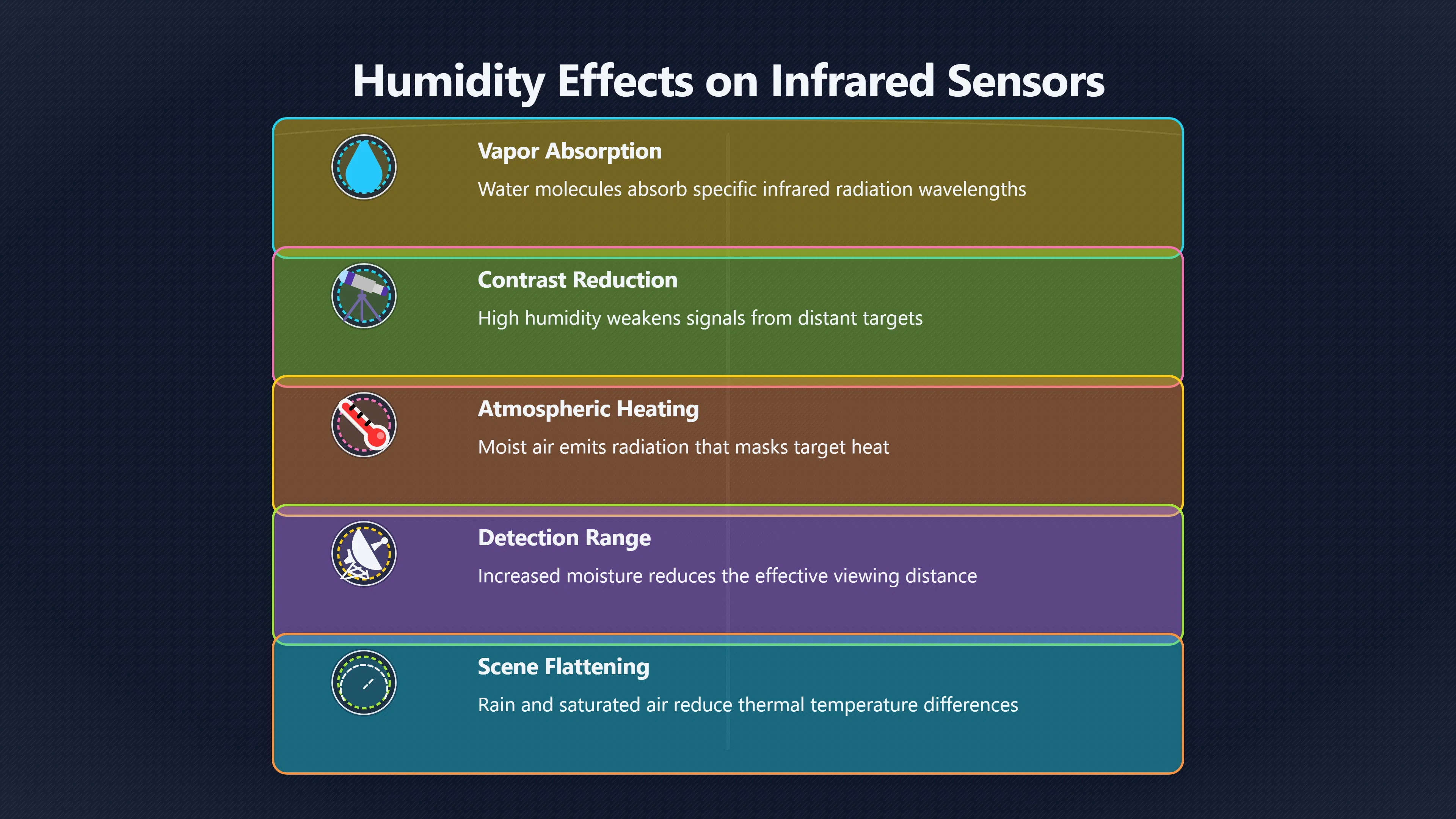
Thermal cameras operate within atmospheric “windows” where infrared radiation passes through the air relatively efficiently. These windows are not perfectly transparent. Water vapour absorbs portions of the infrared spectrum, reducing transmission between a distant object and the camera. The effect grows with increasing humidity and path length, meaning the same aircraft, bird or balloon may appear with weaker or altered thermal contrast on a humid evening than on a dry winter night.[PMC+2NASA PACE]pmc.ncbi.nlm.nih.govThermal Imager Range: Predictions, Expectations, and Realityby D Perić · 2019 · Cited by 98 — Thermal imagers are designed to use targ…
Humidity also changes the apparent temperature of the atmosphere itself. Instead of viewing a target against an effectively empty sky, the camera increasingly receives infrared radiation emitted by warm, moist air. This reduces the temperature difference between target and background, making some objects blend into the scene while causing others to stand out unexpectedly depending on their own temperature and emissivity.
Clouds introduce another layer of complexity. A cloud is not simply an obstruction; it is an infrared emitter with its own brightness temperature. High, cold cloud tops may provide a very cold background against which a moderately warm object appears exceptionally bright. Low cloud, however, often has a temperature much closer to objects near the ground, reducing apparent contrast. Satellite meteorology relies on precisely these thermal brightness differences to identify cloud properties, illustrating that cloud temperature itself is a measurable part of an infrared scene rather than merely an obstruction. American Meteorological Society Journals+2atmosphere-imager.gsfc.nasa.gov[journals.ametsoc.org]journals.ametsoc.orgAmerican Meteorological Society JournalsMeasuring Cloud Cover and Brightness Temperature with a…by S Smith · 2008 · Cited by 53 — In t…
The practical result is that a thermal target can appear to brighten or fade during a recording simply because the background temperature changed as clouds moved, not because the target itself changed.
Why background choice matters in infrared review
Visible-light observers often focus on the object alone. Infrared analysts must pay equal attention to what lies behind it.
A small warm object viewed against cold, clear upper atmosphere will exhibit high contrast. The same object crossing a warmer cloud deck may become difficult to distinguish despite maintaining the same physical temperature. Likewise, an apparently “cold” object may simply be silhouetted against an unusually warm infrared background.
For automated UAP detection, background selection influences several processing stages:
- Detection thresholds based on thermal contrast may trigger or fail depending on background temperature.
- Automatic tracking software can lose lock if cloud movement alters scene contrast more rapidly than object motion.
- False positives become more likely when cloud edges produce rapidly changing thermal gradients.
- Apparent fluctuations in object brightness may reflect environmental changes rather than changes in propulsion or energy output.
Modern thermal imaging literature therefore treats scene contrast as a property of both target and environment rather than of the target alone. Studies comparing infrared imaging performance consistently show that atmospheric transmission, scene temperature distribution and environmental conditions influence detection range and apparent target visibility alongside sensor performance.[PMC+2wp.optics.arizona.edu]pmc.ncbi.nlm.nih.govThermal Imager Range: Predictions, Expectations, and Realityby D Perić · 2019 · Cited by 98 — Thermal imagers are designed to use targ…

Why humid skies can create misleading thermal behaviour
Several mechanisms can combine during humid weather to produce recordings that appear unusual without requiring an unusual object.
Reduced atmospheric transmission. Water vapour absorbs infrared radiation, weakening signals from distant targets. This makes distant objects appear dimmer and can reduce measured temperature contrast.[Flir Media]flirmedia.comSummer month atmospheres usually have a higher attenuation compared to winter months due to increased…Read more…
Changing cloud background. Moving cloud layers replace one thermal background with another. An object crossing between clear sky and cloud can appear to brighten or darken abruptly even if it maintains constant temperature.[American Meteorological Society Journals]journals.ametsoc.orgAmerican Meteorological Society JournalsMeasuring Cloud Cover and Brightness Temperature with a…by S Smith · 2008 · Cited by 53 — In t…
Compressed temperature differences. Rain, moist ground and saturated air often reduce temperature differences between natural objects and their surroundings. Thermal scenes become flatter, making automatic detection more difficult and increasing uncertainty in object classification.[FLIR]flir.comCan Thermal Imaging See Through Fog and Rain?December 30, 2020 — 30 Dec 2020 — Thermal imaging cameras see in total darkness, produci…
Variable apparent range. Increasing humidity reduces useful detection distance. A target may appear to weaken or disappear with distance because atmospheric absorption increases, not because the object has changed course or ceased emitting heat.[PMC]pmc.ncbi.nlm.nih.govThermal Imager Range: Predictions, Expectations, and Realityby D Perić · 2019 · Cited by 98 — Thermal imagers are designed to use targ…
These mechanisms are well understood in military surveillance, industrial thermography and environmental remote sensing. They illustrate why apparent thermal behaviour alone is insufficient evidence for unusual object characteristics.
Weather notes that make thermal clips testable
The value of environmental measurements is that they allow analysts to test competing explanations instead of relying on visual impressions.
Useful metadata include:
- Relative humidity and dew point.
- Air temperature at the observing site.
- Cloud fraction, cloud base and cloud type.
- Cloud-top temperature where satellite data are available.
- Rain, fog or mist observations.
- Wind speed and direction at both surface and, where possible, higher altitudes.
- Camera spectral band (for example long-wave or mid-wave infrared).
- Viewing angle, estimated range and observation time.
These measurements make it possible to compare a thermal event with nearby weather observations, aviation reports and satellite cloud products. If an apparent brightness change coincides with a transition from clear sky to low cloud, or with rapidly increasing atmospheric moisture, the thermal behaviour has a conventional mechanism that can be evaluated quantitatively rather than assumed to represent unusual physics.[AIRS+2atmosphere-imager.gsfc.nasa.gov]airs.jpl.nasa.govAIRS, the Atmospheric Infrared Sounder on NASA's Aqua satellite, gathers infrared energy emitted from Earth's surface and atmosphere…

Implications for automated instrumented UAP detectors
For automated detector networks, humidity is not merely background weather information but part of the sensor calibration problem. Detection algorithms that rely on fixed contrast thresholds are vulnerable to changing atmospheric conditions because identical objects may produce different infrared signatures under different humidity and cloud conditions.
A more robust approach records environmental measurements alongside every thermal frame and incorporates them into later review. Instead of asking only whether an object appeared unusually bright or dark, investigators can ask whether the observed contrast matches what would be expected from the measured humidity, atmospheric transmission and cloud temperatures at that moment.
This shifts infrared evidence from subjective interpretation towards reproducible analysis. Apparent thermal anomalies remain worthy of investigation, but they are evaluated against the environmental conditions that determine how infrared cameras actually see the sky.
Amazon book picks
Further Reading
Books and field guides related to Why infrared skies can fool detectors. Use these as the next step if you want deeper reading beyond the article.

Introduction to infrared and electro-optical systems
Directly explains infrared imaging, atmospheric effects, detector performance, and thermal contrast.

The infrared handbook
Covers atmospheric transmission, humidity effects, backgrounds, and infrared detection fundamentals.

Remote Sensing of the Environment
Discusses atmospheric transmission, sensor interpretation, and environmental effects relevant to thermal imaging.

Meteorology today
Explains humidity, clouds, atmospheric temperature, and weather conditions that affect infrared observations.
eBay marketplace picks
Marketplace Samples
Example marketplace items related to this page. Use the search link to explore similar finds on eBay.
Endnotes
1.
Source: pmc.ncbi.nlm.nih.gov
Link:https://pmc.ncbi.nlm.nih.gov/articles/PMC6696215/
Source snippet
Thermal Imager Range: Predictions, Expectations, and Realityby D Perić · 2019 · Cited by 98 — Thermal imagers are designed to use targ...
2.
Source: pace.oceansciences.org
Title: NASA PACESection III: Light & the Atmosphere
Link:https://pace.oceansciences.org/atmos_light.cgi
Source snippet
NASA PACEApr 3, 2026 — Notice the greenhouse gases (i.e., carbon dioxide, water vapor) have high absorption in the infrared wavelengths...
3.
Source: airs.jpl.nasa.gov
Link:https://airs.jpl.nasa.gov/
Source snippet
AIRS, the Atmospheric Infrared Sounder on NASA's Aqua satellite, gathers infrared energy emitted from Earth's surface and atmosphere...
4.
Source: atmosphere-imager.gsfc.nasa.gov
Link:https://atmosphere-imager.gsfc.nasa.gov/products/cloud
Source snippet
Cloud (06_L2) | Atmosphere Discipline Team Imager ProductsThe MODIS Cloud Product combines infrared emission and solar reflectance techni...
5.
Source: isccp.giss.nasa.gov
Title: ISCC P C2/D2 Selected Variable Descriptions
Link:https://isccp.giss.nasa.gov/products/variables.html
Source snippet
ISCCP C2/D2 Selected Variable Descriptions - NASAThe temperature represents the amount of infrared radiation emitted by the cloud and the...
6.
Source: wp.optics.arizona.edu
Title: Comparison Of Scene Contrast Temperature In MWIRand LWIR
Link:https://wp.optics.arizona.edu/alumni/wp-content/uploads/sites/113/2024/06/ComparisonOfSceneContrastTemperatureInMWIRandLWIR.pdf
Source snippet
1 Comparison of Scene Contrast Temperature in MWIR and...by S Jordan · 2024 · Cited by 3 — effect on both LWIR and MWIR scene contrast d...
7.
Source: flir.com
Link:https://www.flir.com/discover/rd-science/can-thermal-imaging-see-through-fog-and-rain/
Source snippet
Can Thermal Imaging See Through Fog and Rain?December 30, 2020 — 30 Dec 2020 — Thermal imaging cameras see in total darkness, produci...
Published: December 30, 2020
8.
Source: modis-land.gsfc.nasa.gov
Title: MOD21 ATBD Hulley v2.4
Link:https://modis-land.gsfc.nasa.gov/pdf/MOD21_ATBD_Hulley_v2.4.pdf
Source snippet
mod21 land surface temperature and emissivity atbdby G Hulley · 2016 · Cited by 6 — The remainder of the document will discuss the MODIS...
9.
Source: viirsland.gsfc.nasa.gov
Link:https://viirsland.gsfc.nasa.gov/Products/NASA/LSTESDR.html
Source snippet
Remote Sensing of Environment...Read more...
10.
Source: viirsland.gsfc.nasa.gov
Title: VNP21 LSTE ATBD v2.1
Link:https://viirsland.gsfc.nasa.gov/PDF/VNP21_LSTE_ATBD_v2.1.pdf
Source snippet
Publication 09 - VIIRS Land Team - NASAby G Hulley · 2016 · Cited by 18 — Numerical simulations have shown that TES is able to recover te...
11.
Source: science.nasa.gov
Title: spacecraft maps earths global emissivity
Link:https://science.nasa.gov/photojournal/nasa-spacecraft-maps-earths-global-emissivity/
Source snippet
Spacecraft Maps Earth's Global EmissivityOct 20, 2014 — Our planet emits energy as thermal infrared radiation at wavelengths we cannot no...
12.
Source: science.nasa.gov
Title: 13 radiationbudget
Link:https://science.nasa.gov/ems/13_radiationbudget/
Source snippet
Earth's Radiation Budget4 Aug 2023 — Greenhouse gases in the atmosphere (such as water vapor and carbon dioxide) absorb most of the Earth...
13.
Source: airs.jpl.nasa.gov
Link:https://airs.jpl.nasa.gov/publications/315/
Source snippet
of atmospheric-temperature and water-vapor...by SP Ho · 2002 · Cited by 18 — During the past 30 years, considerable progress has been ma...
14.
Source: ntrs.nasa.gov
Link:https://ntrs.nasa.gov/citations/20010072848
Source snippet
Thermal Infrared Radiation Parameterization...by MD Chou · 2001 · Cited by 436 — This technical memorandum documents the longwave radiat...
15.
Source: modis.gsfc.nasa.gov
Title: atbd mod11
Link:https://modis.gsfc.nasa.gov/data/atbd/atbd_mod11.pdf
Source snippet
A., ''The water vapor continuum and its role in remote sensing,'' in Proc. of Conference on Optical Remote. Sensing of the Atmosphere, Sa...
16.
Source: hytes.jpl.nasa.gov
Title: Hy TES L2 ATBD
Link:https://hytes.jpl.nasa.gov/downloads/atbds/HyTES_L2_ATBD.pdf
Source snippet
Thermal Emission Spectrometer (HyTES) Level...by G Hulley · Cited by 8 — TES has been shown to accurately recover temperatures within 1...
17.
Source: ntrs.nasa.gov
Link:https://ntrs.nasa.gov/api/citations/19990100634/downloads/19990100634.pdf
Source snippet
Emissivity Maps for Use in Retrievals of Longwave...by AC Wilber · 1999 · Cited by 190 — An accurate accounting of the surface emissivit...
18.
Source: ecostress.jpl.nasa.gov
Title: govecostress level-2 atbd
Link:https://ecostress.jpl.nasa.gov/downloads/atbd/ECOSTRESS_L2_ATBD_LSTE_2018-03-08.pdf
Source snippet
level-2 atbd - NASA23 Feb 2016 — Generally the radiance in the thermal infrared region is insensitive to aerosols in the troposphere so...
19.
Source: ntrs.nasa.gov
Link:https://ntrs.nasa.gov/api/citations/20210026338/downloads/Wu_remotesensing-13-04578.pdf
Source snippet
Thermal Imager (CTI) for Atmospheric Remote...by DL Wu · 2021 · Cited by 7 — PBL cloud detection poses a greater challenge for passive I...
20.
Source: ntrs.nasa.gov
Link:https://ntrs.nasa.gov/api/citations/20080030345/downloads/20080030345.pdf
Source snippet
Empirical Relationship between the Mean, the Maximum and the Minimum of the. Thermal Infrared Emissivity...Read...
21.
Source: asapdata.arc.nasa.gov
Link:https://asapdata.arc.nasa.gov/emas/reference/mas.pdf
Source snippet
Scanning Spectrometer for Remote Sensing of Cloud...by MD KING · Cited by 310 — An airborne scanning spectrometer was developed for meas...
22.
Source: support.flir.com
Link:https://support.flir.com/DSDownload/Assets/T810442-en-US_A4.pdf
Source snippet
documentation Thermography13 Aug 2019 — Figure 3.4 Images from a FLIR T440 with temperature ranges of –20 to... Kern: Evaluation of infr...
23.
Source: flirmedia.com
Link:https://www.flirmedia.com/MMC/CVS/Tech_Notes/TN_0001_EN.pdf
Source snippet
Summer month atmospheres usually have a higher attenuation compared to winter months due to increased...Read more...
24.
Source: journals.ametsoc.org
Link:https://journals.ametsoc.org/view/journals/apme/47/2/2007jamc1615.1.xml
Source snippet
American Meteorological Society JournalsMeasuring Cloud Cover and Brightness Temperature with a...by S Smith · 2008 · Cited by 53 — In t...
25.
Source: journals.ametsoc.org
Link:https://journals.ametsoc.org/view/journals/atot/40/6/JTECH-D-22-0128.1.xml
Source snippet
The Polar Radiant Energy in the Far Infrared Experiment (PREFIRE) mission will measure Earth's emission at wavelengths ranging from 3 to...
26.
Source: pmc.ncbi.nlm.nih.gov
Link:https://pmc.ncbi.nlm.nih.gov/articles/PMC5579559/
Source snippet
of Ambient Temperature and Relative Humidity on...by QH Tran · 2017 · Cited by 152 — To address this problem, thermal imaging/infrared t...
Additional References
27.
Source: researchgate.net
Link:https://www.researchgate.net/publication/385323581_Integrating_Thermal_Infrared_Imaging_and_Weather_Data_for_Short-Term_Prediction_of_Building_Envelope_Thermal_Appearance
Source snippet
Integrating Thermal Infrared Imaging and [Weather Data]({{ 'weather-data/' | relative_url }}) for...1 Oct 2024 — This study presents a novel deep-learning framework for predict...
28.
Source: researchgate.net
Link:https://www.researchgate.net/publication/322110603_NASA%27s_MODIS_and_VIIRS_Land_Surface_Temperature_and_Emissivity_Products_A_Long-Term_and_Consistent_Earth_System_Data_Record
29.
Source: infraredadaptations.co.uk
Link:https://www.infraredadaptations.co.uk/atmosphere-ir-windows/
Source snippet
The dotted lines are the thermal emission spectra for bodies at 5700°C and 20°C.Read more...
30.
Source: researchgate.net
Link:https://www.researchgate.net/publication/237352823_THE_USE_OF_INFRARED_RADIATION_FOR_THERMAL_SIGNATURES_DETERMINATION_OF_GROUND_TARGETS
Source snippet
arget and its background or, in other words, adjusting the target's thermal...Read more...
31.
Source: pixfra.com
Title: how does weather affect thermal imaging
Link:https://www.pixfra.com/how-does-weather-affect-thermal-imaging
Source snippet
?18 Jul 2025 — Atmospheric attenuation increases with humidity as water vapor absorbs certain infrared wavelengths. This effect reduces s...
32.
Source: lightpath.com
Title: ir imaging comparison the basics
Link:https://www.lightpath.com/insights/ir-imaging-comparison-the-basics
Source snippet
IR Imaging Comparison: The Basics2 Mar 2026 — Explore an IR imaging comparison, covering LWIR vs MWIR, key metrics, environmental factors...
33.
Source: youtube.com
Title: [WAPORCV] Unit 1.1.2 Thermal Infrared Sensors
Link:https://www.youtube.com/watch?v=DtivZX11RUg
Source snippet
Atmospheric transmission infrared humidity absorption Astronomy - Ch. 9.1: Earth's Atmosphere (19 of 61) How H2O Absorption Spectrum Comp...
34.
Source: youtube.com
Link:https://www.youtube.com/watch?v=XIBsjBvRTew
Source snippet
Lecture 36: Thermal Infrared Remote Sensing – Part 2...
35.
Source: downloads.regulations.gov
Title: attachment 10
Link:https://downloads.regulations.gov/NOAA-NMFS-2016-0008-0019/attachment_10.pdf
Source snippet
OF MEDIUM AND LONG WAVE...Infrared thermal imagers convert the radiation received by a detector into a false colour visual image which r...
36.
Source: youtube.com
Title: Atmospheric Windows, Spectral Bands & Absorption | Remote Sensing & GIS
Link:https://www.youtube.com/watch?v=l-zkUPorETs
Source snippet
EGM703: Week 1, Part 1: Principles of Thermal Remote Sensing...
Topic Tree