Within Sky Detectors
Why Strange Clips Need More Context
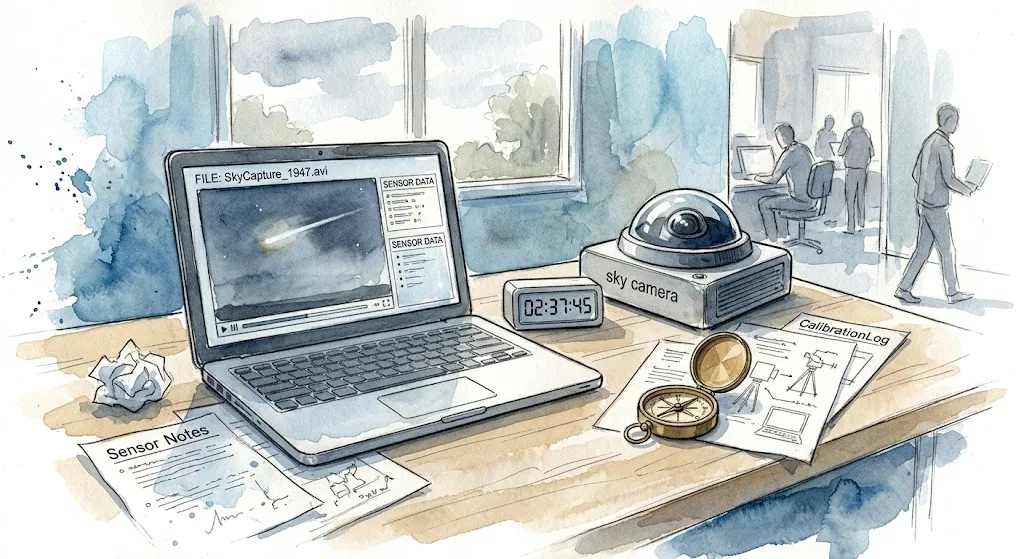
Without time, location, pointing, settings, and provenance, even dramatic sky footage can be nearly impossible to analyse.
On this page
- The missing facts in ordinary UFO videos
- What provenance means for sensor records
- How metadata changes later analysis
Page outline Jump by section
Introduction
Strange UFO clips are hard to trust not because every clip is fake, but because most clips arrive without the information needed to analyse them. A bright dot crossing a dark sky, an infrared blob over the sea, or a fast-looking object near clouds may be visually dramatic while still being scientifically weak. Without reliable time, location, camera pointing, focal length, exposure settings, sensor type, raw files, chain of custody and nearby aircraft or weather context, analysts often cannot tell whether they are looking at an unusual object, a familiar object in an unusual geometry, a sensor artefact, or a misleading edit.
This is one of the main reasons automated instrumented UFO detectors matter. NASA’s 2023 UAP independent study report said current UAP analysis is hampered by poor sensor calibration, lack of multiple measurements, lack of sensor metadata and lack of baseline data.[NASA Science]science.nasa.govNASA ScienceIndependent Study Team ReportAt present, analysis of UAP data is hampered by poor sensor calibration, the lack of multiple me… In plain terms: a clip is not the same as a measurement. A detector network is valuable only if it records enough context for a later analyst to reconstruct what the sensor saw and why.
The Missing Facts in Ordinary UFO Videos
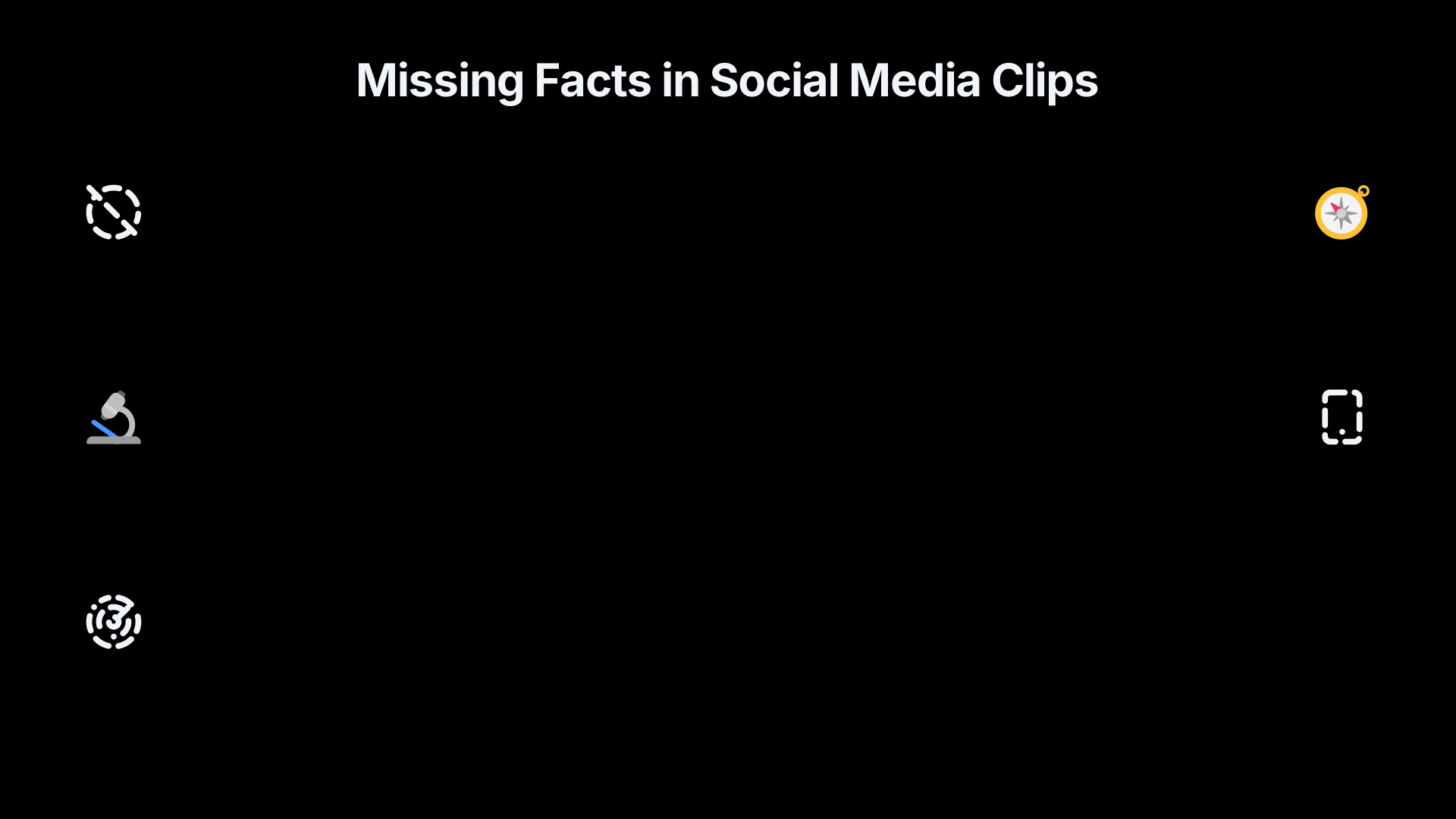
Most public UFO videos are detached from the facts that would make them testable. A typical social-media clip may show only a cropped object and a witness description: “fast”, “silent”, “hovering”, “shot over the city last night”. That is useful as a lead, but weak as evidence. A serious analysis needs to know where the camera was, where it was pointed, the exact time, the original file, the lens and zoom settings, the frame rate, whether digital stabilisation was active, whether the clip has been compressed or re-exported, and what else was in the sky.
Digital-image metadata can help, but only if it is preserved. EXIF metadata in still images can store camera model, lens information, exposure settings, time and sometimes location; video files can also contain useful technical metadata, though it is often stripped by messaging apps, editing software and social platforms.[Canon UK]canon.co.ukCanon UKUnderstanding EXIF and metadataApril 27, 2023 — Everything you need to know about EXIF data – how to view the shooting information in your photos, edit it, remove it or… A clip copied from a phone to a social network may therefore lose the very information that would help distinguish a satellite, aircraft, balloon, bird, drone, reflection or camera artefact from something genuinely unexplained.
The most damaging gaps are usually simple:
- Time: Without an accurate timestamp, it is harder to compare the sighting with aircraft transponder data, satellite passes, meteor showers, weather radar, military exercises, astronomical objects or other witnesses.
- Location: Without a camera position, analysts cannot reconstruct lines of sight, estimate angles, or check whether the object was near an airport, flight path, launch site, coast, mountain ridge or known landmark.
- Pointing direction: A clip facing north has different candidate explanations from one facing west at sunset. Compass direction and elevation angle often matter more than the object’s apparent shape.
- Camera settings: Zoom, focus, exposure, stabilisation and infrared mode can turn ordinary lights into blobs, discs, streaks or “pulsing” objects.
- Original file: A screen recording, crop, repost or edited montage may hide compression artefacts, missing frames, audio cuts and the true field of view.
- Environmental context: Clouds, wind direction, temperature, humidity, smoke, reflections, insects near the lens and atmospheric turbulence can all change what a sky object looks like.
This is why a video can be sincere and still be hard to trust. The witness may have seen something puzzling, but the record may not contain enough information to test the puzzle.

Why “Fast” and “Close” Are Often Inferences, Not Observations
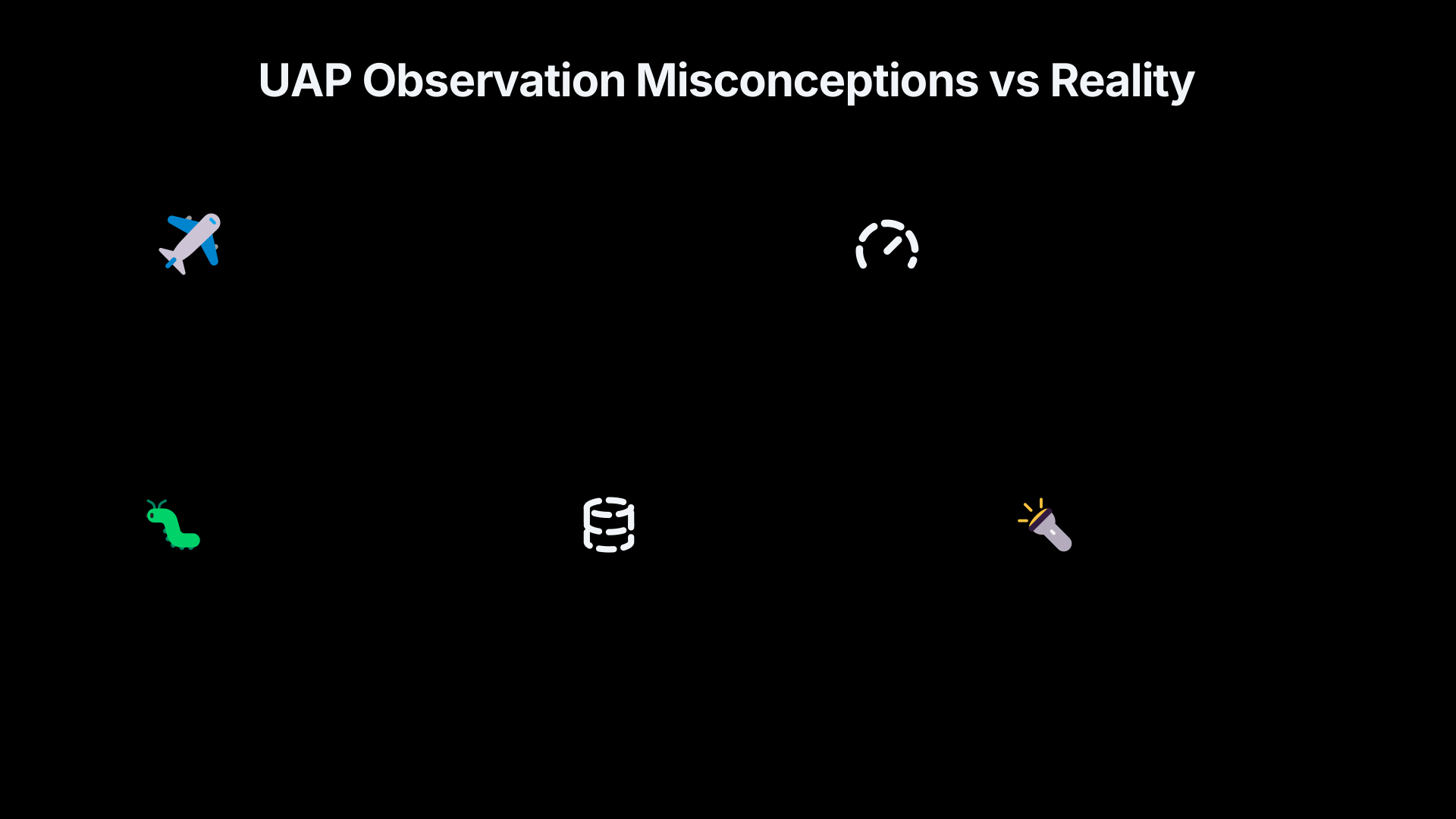
Many UFO clips feel compelling because the object appears to accelerate, cross the frame quickly, or move against the background in an unexpected way. The problem is that apparent speed in a two-dimensional image is not the same as real speed in three-dimensional space. Unless distance is known, speed is usually guessed.
The “GO FAST” U.S. Navy video is a useful example because it shows how a fast-looking infrared target can be affected by geometry. NASA’s public UAP work and independent analyses have highlighted parallax: when the observing aircraft is moving rapidly, a relatively ordinary object can appear to streak across the background even if the object itself is not moving at extraordinary speed.[Metabunk]metabunk.orgnasa panel analyzes go fast.13174NASA panel analyzes GO FAST19 Sept 2023 — The main point of the NASA analysis is that the GO FAST object looks fast because of pa… The key lesson is not that every such video has the same explanation. It is that apparent motion alone is weak evidence unless the analyst has aircraft position, sensor pointing, range data, field of view and timing.
The same problem appears in phone footage. A tiny object near the camera may look like a large object far away. A balloon drifting in the wind may look stationary if the camera is moving. A bird or insect out of focus may look like a structured craft. A satellite flare may appear to “turn on” or “vanish”. A camera’s autofocus, digital zoom or image stabilisation can create apparent jumps that belong to the device, not the sky.
Instrumented detectors are designed to reduce this ambiguity. A calibrated station can record the camera’s fixed position, lens geometry, time source, pointing model, local weather and ideally simultaneous data from other sensors. That does not make every event easy to solve, but it changes the question from “What does this clip look like?” to “What physical path is consistent with the measurements?”
What Provenance Means for Sensor Records
Provenance is the record of where data came from, how it was captured, what happened to it afterwards and whether it can be checked against the original. For UAP analysis, provenance is not paperwork for its own sake. It is the difference between a reusable observation and a rumour with pixels.
A strong sensor record should preserve the original file or raw data, the sensor identity, the software version, the location and clock source, the calibration history, the trigger condition, the processing steps and any edits made before publication. NASA’s report explicitly emphasised the importance of metadata such as sensor type, manufacturer details, noise characteristics and time of acquisition for characterising both a possible UAP and the sensor itself.[Wikisource]en.wikisource.orgPage:UAP Independent Study TeamPage:UAP Independent Study Team - Final Report.pdf/1512 Nov 2023 — Indeed, several apparent UAP have been demonstrated to be se… This matters because an “anomaly” may belong to the sensor: a hot pixel, rolling shutter distortion, autofocus failure, infrared glare, lens reflection, compression pattern or tracking-lock artefact.
AARO’s public releases show the practical consequence of limited provenance. Its official imagery page includes cases where the available video footage is not enough for AARO to determine what the subject was, including a Europe 2024 case made up of 30 seconds of footage from a commercially available mobile phone camera.[AARO]aaro.milOpen source on aaro.mil. In another AARO listing, several reports are described as short infrared clips from military platforms, sometimes with no oral or written description from the reporter.[AARO]aaro.milNext UAP Report DocumentsNext UAP Report Documents Even when the sensor is sophisticated, a thin record can leave analysts with too little to reconstruct the event.
Provenance also protects against another common problem: the clip that has travelled too far. Once a video has been downloaded, cropped, slowed down, sharpened, narrated, re-uploaded and detached from the original witness, later viewers may be analysing a derivative object rather than the observation itself. The claim may harden as the evidence weakens.
How Metadata Changes Later Analysis
Metadata does not merely add background detail. It changes what analysts can calculate.
With reliable time and location, an analyst can check aircraft tracks, satellite databases, astronomical positions, weather conditions and other reports. With camera pointing and field of view, the analyst can reconstruct a line of sight. With a known lens and sensor size, the angular size and angular motion can be estimated. With multiple stations observing the same event, triangulation may become possible. With infrared and visible-light data together, analysts can compare shape, heat signature and illumination. With radar, acoustic or radio-frequency data, the object may be tested across independent channels rather than judged from a single image.
This is the logic behind multimodal UAP observatories such as the Galileo Project. Its published concept is to conduct a census of aerial phenomena using integrated instruments rather than relying on isolated witness footage; later architecture work describes systems for real-time data acquisition, sensor optimisation and data provenance management.[The Galileo Project]galileo.hsites.harvard.eduOpen source on harvard.edu. The purpose is not to make every unknown exotic. It is to make ordinary explanations easier to confirm and genuinely unusual cases harder to dismiss as missing context.
AARO has made a similar point from the government-analysis side. Its FY2024 consolidated annual report said case resolution remained constrained by a lack of timely and actionable sensor data.[U.S. Department of War]media.defense.govFY24 CONSOLIDATED ANNUAL REPORT ON UAP 508FY24 CONSOLIDATED ANNUAL REPORT ON UAP 508 Its FY2023 report also noted that some gaps arise from insufficient radar, electro-optical or infrared data, sensor artefacts such as infrared flare, and optical effects such as parallax.[AARO]aaro.milUNCLASSIFIED FY23 Consolidated Annual Report on UAP OctFiscal Year 2023 Consolidated Annual Report on…The report covers unidentified anomalous phenomena (UAP) These gaps are the direct… These are not minor technicalities. They are the boundary between “unidentified because extraordinary” and “unidentified because under-recorded”.
Why Baseline Data Matters as Much as Anomaly Data
A single strange clip is easier to overread when there is no record of what normal looks like from the same sensor. Baseline data is the ordinary-sky archive: aircraft, birds, drones, satellites, meteors, balloons, insects, clouds, glare, atmospheric effects and camera faults captured under many conditions. NASA identified lack of baseline data as one of the obstacles to useful UAP analysis.[NASA Science]science.nasa.govNASA ScienceIndependent Study Team ReportAt present, analysis of UAP data is hampered by poor sensor calibration, the lack of multiple me…
Baseline data helps in two ways. First, it gives analysts a comparison library. If a detector records hundreds of aircraft in infrared, analysts can learn how aircraft look at different ranges, angles, temperatures and sensor settings. If it records birds, insects and balloons, it can show how often they mimic stranger shapes. Second, baseline data reveals the quirks of the instrument itself. A camera may produce repeated reflections at particular sun angles. A tracking algorithm may lose lock in predictable ways. A lens may create flares that look like moving lights when the camera pans.
This is where automated detectors differ from viral UFO clips. A viral clip is usually selected because it looks strange. A detector should record enough ordinary material to show how strangeness is being judged. The anomaly is meaningful only against a background of non-anomalies.
The Trust Problem Is Not Just Hoaxes
It is tempting to frame metadata gaps as a fraud problem: no metadata, therefore suspicious. That is too simple. Missing metadata can result from ordinary behaviour. People film quickly, crop for clarity, send files through apps, protect their location, or upload to platforms that strip technical data. Military and government releases may remove or withhold details for operational-security reasons. Historical cases may never have had standardised reporting in the first place.
The 2021 U.S. intelligence preliminary assessment said limited data and inconsistency in reporting were key challenges to evaluating UAP, noting that a standardised reporting mechanism had not existed until recently in parts of the U.S. military system.[Director of National Intelligence]dni.govOpen source on dni.gov. AARO’s 2025 workshop paper similarly described UAP reports as often lacking standardised metadata, formatting or nomenclature, making comparative analysis difficult across military, civilian, archival and social-media sources.[AARO]aaro.mil2025 UAP Workshop Paper2025 UAP Workshop Paper
So the right question is not “Is the witness lying?” It is “Can the record support the claim being made?” A clip may support a modest claim — that someone saw an unidentified light at a given time — while failing to support a stronger claim about speed, altitude, size, technology or origin.
What Better UFO Detector Records Should Include
For automated instrumented UFO detectors, the metadata problem becomes a design requirement. A sky station that only produces attractive clips repeats the weakness of ordinary UFO evidence. A useful station should produce an event package: the clip plus enough structured information to let someone else test it.
A strong event package would include:
- exact timestamp from a synchronised clock;
- fixed sensor location and altitude;
- pointing direction, elevation angle and field of view;
- camera model, lens, focal length, exposure, gain, focus and frame rate;
- raw or minimally processed frames where possible;
- calibration files and known sensor defects;
- local weather and visibility;
- aircraft, satellite and astronomical cross-checks;
- detection-trigger details and software version;
- a clear chain of custody from capture to publication;
- links to simultaneous observations from other stations or sensors.
This does not guarantee a solution. Some events may remain unresolved even with good metadata. But it narrows the uncertainty. It lets analysts say, with more confidence, whether the object was too high for a bird, too slow for a meteor, consistent with a balloon, aligned with a satellite flare, or visible from more than one site.
The Bottom Line for Strange Clips
A strange clip should be treated as a starting point, not a conclusion. The more dramatic the apparent behaviour, the more the surrounding metadata matters. Speed needs distance. Shape needs focus and resolution. Heat signatures need sensor settings. Direction changes need stabilisation and pointing data. Provenance needs the original file and a documented path from camera to viewer.
This is why metadata gaps sit at the centre of the case for automated instrumented UFO detectors. The goal is not to drain mystery from the sky by assumption, nor to inflate every unknown into a breakthrough. The goal is to make future sightings analysable. A clip without context can be intriguing; a calibrated, time-stamped, multi-sensor record can become evidence.
Amazon book picks
Further Reading
Books and field guides related to Why Strange Clips Need More Context. Use these as the next step if you want deeper reading beyond the article.
The UFO Experience
Explains why evidence quality, witness reports, and investigative standards matter when assessing unusual aerial sightings.
How to Lie with Statistics
Illustrates how incomplete information and missing context can produce misleading conclusions.
Calling Bullshit
Directly addresses evaluating claims when evidence, metadata, and provenance are incomplete or unreliable.
The Demon-Haunted World
Promotes critical thinking, evidential standards, and careful analysis of extraordinary claims.
eBay marketplace picks
Marketplace Samples
Live-tested eBay searches with available results related to this page.

Endnotes
1.
Source: science.nasa.gov
Link:https://science.nasa.gov/wp-content/uploads/2023/09/uap-independent-study-team-final-report.pdf
Source snippet
NASA ScienceIndependent Study Team ReportAt present, analysis of UAP data is hampered by poor sensor calibration, the lack of multiple me...
2.
Source: canon.co.uk
Title: Canon UKUnderstanding EXIF and metadata
Link:https://www.canon.co.uk/pro/infobank/all-about-exif/
Source snippet
April 27, 2023 — Everything you need to know about EXIF data – how to view the shooting information in your photos, edit it, remove it or...
Published: April 27, 2023
3.
Source: metabunk.org
Title: nasa panel analyzes go fast.13174
Link:https://www.metabunk.org/threads/nasa-panel-analyzes-go-fast.13174/
Source snippet
NASA panel analyzes GO FAST19 Sept 2023 — The main point of the NASA analysis is that the GO FAST object looks fast because of pa...
4.
Source: aaro.mil
Title: UNCLASSIFIED FY23 Consolidated Annual Report on UAP Oct 25 2023 1236
Link:https://www.aaro.mil/Portals/136/PDFs/UNCLASSIFIED-FY23_Consolidated_Annual_Report_on_UAP-Oct_25_2023_1236.pdf
Source snippet
Fiscal Year 2023 Consolidated Annual Report on...The report covers unidentified anomalous phenomena (UAP) These gaps are the direct...
5.
Source: en.wikisource.org
Title: Page:UAP Independent Study Team
Link:https://en.wikisource.org/wiki/Page%3AUAP_Independent_Study_Team_-_Final_Report.pdf/15
Source snippet
Page:UAP Independent Study Team - Final Report.pdf/1512 Nov 2023 — Indeed, several apparent UAP have been demonstrated to be se...
6.
Source: en.wikisource.org
Title: Responses to Statement of Task
Link:https://en.wikisource.org/wiki/NASA_Unidentified_Anomalous_Phenomena%3A_Independent_Study_Team_Report/Responses_to_Statement_of_Task
7.
Source: aaro.mil
Link:https://www.aaro.mil/UAP-Cases/Official-UAP-Imagery/
8.
Source: aaro.mil
Title: Next UAP Report Documents
Link:https://www.aaro.mil/Next-AARO-Home-redesign/Next-Parent/Next-UAP-Report-Documents/
9.
Source: aaro.mil
Title: 2025 UAP Workshop Paper
Link:https://www.aaro.mil/Portals/136/PDFs/Information%20Papers/2025_UAP_Workshop_Paper.pdf
10.
Source: aaro.mil
Link:https://www.aaro.mil/Portals/136/PDFs/AARO_Mission_Brief_2025.pdf
11.
Source: aaro.mil
Title: UAP Records
Link:https://www.aaro.mil/UAP-Records/
12.
Source: aaro.mil
Link:https://www.aaro.mil/
13.
Source: metabunk.org
Title: AAR O’s Historical UAP Report
Link:https://www.metabunk.org/threads/aaros-historical-uap-report-volume-1.13375/
14.
Source: metabunk.org
Title: page 8
Link:https://www.metabunk.org/threads/fravors-hypersonic-ufo-observation-parallax-illusion-comparing-accounts.10941/page-8
15.
Source: metabunk.org
Title: page 4
Link:https://www.metabunk.org/threads/f-16-pilot-chris-lehtos-interpretation-of-the-gofast-footage-focus-parallax-inaccurate-range.11789/page-4
16.
Source: metabunk.org
Title: ukrainian uap study observation of events.12607
Link:https://www.metabunk.org/threads/ukrainian-uap-study-observation-of-events.12607/
17.
Source: metabunk.org
Title: page 2
Link:https://www.metabunk.org/threads/skywatcher-part-ii-mapping-the-unknown.14128/page-2
18.
Source: metabunk.org
Title: page 3
Link:https://www.metabunk.org/threads/me23-aaro-release-%E2%80%94-unresolved-uap-report-middle-east-2023.14190/page-3
19.
Source: metabunk.org
Link:https://www.metabunk.org/home/?ref=webworm.co
20.
Source: metabunk.org
Title: Aguadilla Infrared Footage of ‘UFOs’
Link:https://www.metabunk.org/threads/aguadilla-infrared-footage-of-ufos-probably-hot-air-wedding-lanterns.8952/
21.
Source: metabunk.org
Title: The Tape
Link:https://www.metabunk.org/threads/the-tape-the-most-important-case-yet-a-uap-files-film.14043/
22.
Source: en.wikisource.org
Title: Page:UAP Independent Study Team Final Report
Link:https://en.wikisource.org/wiki/Page%3AUAP_Independent_Study_Team_-_Final_Report.pdf/5
23.
Source: en.wikisource.org
Title: Page:AARO Historical Record Report Volume 1 2024
Link:https://en.wikisource.org/wiki/Page%3AAARO_Historical_Record_Report_Volume_1_2024.pdf/7
24.
Source: en.wikisource.org
Title: Index:AARO Historical Record Report Volume 1 2024
Link:https://en.wikisource.org/wiki/Index%3AAARO_Historical_Record_Report_Volume_1_2024.pdf
25.
Source: en.wikisource.org
Title: 2022 Annual Report on Unidentified Aerial Phenomena
Link:https://en.wikisource.org/wiki/2022_Annual_Report_on_Unidentified_Aerial_Phenomena
26.
Source: war.gov
Title: department of defense releases the annual report on unidentified anomalous phen
Link:https://www.war.gov/News/Releases/Release/Article/3964824/department-of-defense-releases-the-annual-report-on-unidentified-anomalous-phen/
27.
Source: war.gov
Link:https://www.war.gov/ufo/
28.
Source: science.nasa.gov
Link:https://science.nasa.gov/uap/
29.
Source: nasa.gov
Title: update nasa shares uap independent study report names director
Link:https://www.nasa.gov/news-release/update-nasa-shares-uap-independent-study-report-names-director/
30.
Source: secnav.navy.mil
Title: mil Prelimary Assessment UAP
Link:https://www.secnav.navy.mil/foia/readingroom/CaseFiles/UAP%20INFO/Prelimary%20Assessment%20UAP.pdf
31.
Source: space.com
Title: nasa ufo uap study team first results revealed
Link:https://www.space.com/nasa-ufo-uap-study-team-first-results-revealed
32.
Source: galileo.hsites.harvard.edu
Link:https://galileo.hsites.harvard.edu/publications/scientific-investigation-unidentified-aerial-phenomena-uap-using-multimodal
33.
Source: media.defense.gov
Title: FY24 CONSOLIDATED ANNUAL REPORT ON UAP 508
Link:https://media.defense.gov/2024/Nov/14/2003583603/-1/-1/0/FY24-CONSOLIDATED-ANNUAL-REPORT-ON-UAP-508.PDF
34.
Source: dni.gov
Link:https://www.dni.gov/files/ODNI/documents/assessments/Prelimary-Assessment-UAP-20210625.pdf
35.
Source: Wikipedia
Title: The Galileo Project
Link:https://en.wikipedia.org/wiki/The_Galileo_Project
36.
Source: media.defense.gov
Title: DOPSR 2024 0263 AARO HISTORICAL RECORD REPORT VOLUME 1 2024
Link:https://media.defense.gov/2024/Mar/08/2003409233/-1/-1/0/DOPSR-2024-0263-AARO-HISTORICAL-RECORD-REPORT-VOLUME-1-2024.PDF
37.
Source: reddit.com
Link:https://www.reddit.com/r/UFOs/comments/1go9ej4/the_galileo_project_under_my_leadership_avi_loeb/
38.
Source: galileo.hsites.harvard.edu
Link:https://galileo.hsites.harvard.edu/FAQ
39.
Source: youtube.com
Link:https://www.youtube.com/watch?v=uJtER5ahdPY
40.
Source: dni.gov
Title: 4020 uap 2024
Link:https://www.dni.gov/index.php/newsroom/reports-publications/reports-publications-2024/4020-uap-2024
41.
Source: zenodo.org
Link:https://zenodo.org/records/20137882
Additional References
42.
Source: eyewitness.global
Link:https://www.eyewitness.global/Using-metadata.html
Source snippet
For example, the footage's time and location, and the device it was taken with. Metadata is important...Read more...
43.
Source: youtube.com
Title: Tracking Down a Tic-Tac UFO
Link:https://www.youtube.com/watch?v=nPGmUF6R3CY
Source snippet
Mick West analyze UFO video metadata calibration Explained: "Go Fast" UFO Video - Not Low and Not Fast - Like a Balloon...
44.
Source: youtube.com
Title: OSINT At Home #2
Link:https://www.youtube.com/watch?v=d3NsT8lJRlE
Source snippet
Replay! NASA's Release of the Unidentified Anomalous Phenomena Report...
45.
Source: researchgate.net
Link:https://www.researchgate.net/publication/371163445_The_Scientific_Investigation_of_Unidentified_Aerial_Phenomena_UAP_Using_Multimodal_Ground-Based_Observatories
46.
Source: reddit.com
Link:https://www.reddit.com/r/UFOB/comments/1i6y9o8/aaro_internal_report_analysis_major/
47.
Source: aui.edu
Link:https://aui.edu/aaro-releases-report-on-unidentified-anomalous-phenomena-uap/
48.
Source: dvidshub.net
Link:https://www.dvidshub.net/unit/AARO
49.
Source: researchgate.net
Link:https://www.researchgate.net/publication/353539589_Analysis_of_ODNI_Preliminary_Assessment_Unidentified_Aerial_Phenomena
50.
Source: facebook.com
Link:https://www.facebook.com/deepuniversee/posts/videos-and-images-shared-online-in-this-style-usually-fall-into-the-broader-cate/970619415735947/
51.
Source: forensicosint.com
Link:https://www.forensicosint.com/free-tools/image-metadata-analyzer
Topic Tree